Paperis Articles
High-Rise Living — Same Height, Different Homes
The worry that high-rise apartments isolate people and harm their mental health has run for more than half a century since a 1967 finding. A 2007 review read high-rises as less satisfactory for most people and not optimal for children, moderators aside, but first noted that most conclusions are tempered by income, neighbourhood, gender, life stage and the ability to choose a housing form. How later mental-health studies split by what they compared, and why the evidence gathered here cannot tell whether height itself plays a part.
Your field's papers, as audio
Pick your fields and journals — Paperis summarizes the key papers and turns them into audio. Listen on your commute.
Start Paperis free →High-Rise Living — Same Height, Different Homes
An Old Worry
442 residents of public housing complexes in two mid-sized Canadian cities were interviewed, and the results were published in 1977 (DOI: 10.2307/2955349). This survey noted that it supported a finding reported in 1967 by a researcher named Fanning, specifically the relationship that the higher the floor one lived on, the greater the psychological strain felt by residents. However, that relationship held true only for women. For men, conversely, the higher the floor, the smaller the strain. The researchers tried to explain this relationship by sequentially adding twelve control variables along with items asking about household composition, watching children, the degree of being confined to the home, and social isolation, but adding any of these did not reduce the relationship.
The worry this article deals with continues from around that time. High-rise housing is the practice of living in a home inside a building stacked many floors high. High-rise apartments have long been discussed alongside the poor mental health of the people living in them (DOI: 10.3390/challe10020034), and early studies concluded that high-rise apartments create difficulties for quality of life, separating people from their neighbors, making them a nuisance to one another, and turning them into nameless beings (DOI: 10.3390/ijerph17134619). Exactly which floor onward is considered "high" varies from study to study. There are studies that group 6 floors and above together (PMID 28053608), and studies that establish 13 floors and above as a separate standard (PMID 39601955).
More than half a century of research has accumulated since the finding of 1967. The question is singular. Does living on a high floor change the mind? And if it does change, is it because of the height? The finding of 1967 was about the relationship between height and strain, and the survey of 1977 added the condition "only in women" to it. Such conditions follow along until the end of this article.
The Picture Assembled by Research Reviews
The impact of high-rise buildings on residents was gathered into seven branches in a 2007 research review. They are the experience of buildings, satisfaction, preference, social behavior with neighbors, crime and the fear of crime, children, and mental health and suicide (DOI: 10.3763/asre.2007.5002).
What this review noted first is conditions. A moderating factor is a factor that changes for whom and under what conditions the relationship between a cause and an effect appears. This review states that most conclusions are softened depending on moderating factors, and lists seven of them. They are the socio-economic status of the residents, neighborhood quality, parenting, gender, life stage, how crowded the home is, and whether people could choose the housing type themselves (DOI: 10.3763/asre.2007.5002). The "in women only" of the Canadian survey fits into the gender slot of this list.
Next, the review recorded the conclusions. Putting moderating factors aside, the conclusion points toward the literature indicating that high-rises are less satisfying to most people than other housing types, are not best for children, involve drier human relationships and less helping behavior than other housing types, have greater crime and fear of crime, and that high-rises might separately account for some suicides (DOI: 10.3763/asre.2007.5002). The final sentence is written with the expression "might," and this piece carries that expression forward. The crime aspect is covered separately in "High-Rise Public Housing — Outside the Frame of a Falling Building" from the same series.
Another review from 2003 narrowed the group further. High-rise living is harmful to the psychological well-being of women raising young children (PMID 14709704). The same review also noted that while poor-quality housing appears to increase psychological distress, it is difficult to draw a clear conclusion due to methodological issues.
On the children's side, there is a survey from Tokyo. From 1987 to 1988 in a high-rise residential area in Tokyo, mothers and kindergarten teachers recorded the daily behavior of 1,045 toddlers through questionnaires (PMID 2637293). Children living in high-rises lagged behind those living in low-rises in independently performing basic living habits. The researchers saw the reason as possibly stemming from outings decreasing, causing mothers to stick too closely to their children. This explanation is the researchers' interpretation, and the study compared things using questionnaires filled out by mothers and teachers.
The people singled out by the two reviews and the Tokyo survey overlap. Young children, and the mothers raising those children. Disadvantageous outcomes in high-rises have actually been reported, but attached to most of those outcomes is "for whom, under what conditions."
How This Question Was Measured
In 2018, a synthesis reappraising 117 systematic reviews and comparable reports on the relationship between human-made environments, such as buildings and neighborhoods, and health was published (PMID 30055594). That synthesis noted that the quality of evidence is uneven, and that much of the evidence relies on cross-sectional studies, making it difficult to draw a clear causal chain between the environment and health. The evidence for high-rise living is in a similar situation. Not a single study among the evidence this article relies on assigned people to live on specific floors by a lottery.
A cross-sectional study is research that surveys people once at a single point in time, measuring the conditions and states at that moment together. If this method yields the result that high-rise residents are more depressed than low-rise residents, it has simply looked at two things present together right now. This single snapshot cannot tell us whether the move came first or the depression came first, or whether something else drove them both.
A cohort study is research that designates a group of people and follows them over time, seeing what happens to them later according to their initial conditions. The sequence is visible, but who entered those conditions in the first place is still not determined by the researchers. A 2003 review also noted that more studies following people forward, and randomized experiments where possible, are needed (PMID 14709704).
Applying future studies in advance to these two frameworks looks like this. The Oslo survey asked people to self-report their past medical history, and in that it did not follow people over time, it is close to cross-sectional (PMID 28053608). The studies in Tokyo, Hong Kong, Guangzhou, and Tehran are also surveys that did not follow people over time. The Denmark and Rotterdam studies are cohorts that designated people and followed them for several years (PMID 40217191) (PMID 39601955). The Hanoi study mixed journals, surveys, and interviews across four neighborhoods in one city, and the Melbourne and Chicago studies are records of in-depth interviews with a small number of people.
The comparison pairs also vary from study to study. The 2007 review and the Tokyo survey compared people living in high-rise buildings with those living in other types of homes, while the 2003 review treated high-rise housing itself as the exposure. The 1977 Canadian survey and the Oslo and Rotterdam studies compared which floor people lived on, and Rotterdam compared floors among people who had all been living in high-rise buildings from the start. Even with the same result that "high-rise residents fared worse," it carries a different weight depending on which pair was compared and whether it was a one-time survey or a cohort followed for ten years.
Same Height, Different Conditions
12,525 residents in Oslo, Norway, reported which floor their bedroom is on and whether they had ever suffered from a stroke, a condition where blood clots in veins, or leg pain while walking that forces them to rest (PMID 28053608). This survey looked at cardiovascular medical history, not mental health. Even after adjusting for demographic characteristics, socioeconomic status, and health behaviors, all three medical histories were more common the higher the floor. However, when looking separately at 5,374 residents of block-type apartments, that trend disappeared. Only one remained: people living on the 6th floor or higher had about 1.5 times the odds of having suffered from a condition where blood clots in veins compared to basement and 1st-floor residents (odds ratio 1.504, 95% confidence interval 1.007–2.247). The first sentence of the researchers' conclusion stated that the floor lived on in Oslo showed a positive association with cardiovascular disease, and in the next sentence they wrote that the best-supported explanation might be confounding that remained even after adjusting for building height and socioeconomic status.
A confounding variable is a third factor that intertwines with both the cause and effect being compared, making a nonexistent relationship appear real or masking a real one. According to the Oslo researchers' interpretation, floor level may have moved together with what kind of building one lives in and what one's financial situation is, and if so, other things may have been bundled together into the single number of the floor level. The researchers wrote this using "may be," and also put forward another related explanation involving electricity in the air.
A cohort in Denmark looked at housing type rather than floor level. 14,387 people were followed from 2000 to 2018 using national patient and prescription registry data to compare the rate of new-onset depression (PMID 40217191). People living in rented apartments had a rate 1.32 times that of people living in owner-occupied detached houses, after adjustment (95% confidence interval 1.14–1.53). 11% of this relationship was explained by annoyance felt inside the home, and 8% by self-reported loneliness. In this comparison, housing type and whether the home was rented or owned were bundled into a single category, and people living in owner-occupied townhouses and rented townhouses also showed higher rates than detached-home owners. The researchers wrote that after confirming these results, more research is needed to address other pathways and the possibility of causality.
A preliminary survey from Singapore published in 1976 interviewed 438 households living in high-rise apartments across three public housing estates (PMID 938126). Worry and anxiety moved together with the respondents' socioeconomic status, and for most, their self-rated health remained unchanged even after moving to their current home. The same survey also noted that the living conditions of high-rise apartments tended to affect patterns of meeting relatives and close acquaintances.
How a person came to live in that house is also a condition. Self-selection is when people do not happen to fall into certain conditions but instead choose and enter them themselves, making the people in those conditions different from the start. A 2007 synthesis highlighted "whether housing type could be chosen" as a condition that moderates outcomes (DOI: 10.3763/asre.2007.5002). If the people who could choose and those who could not were different from the beginning, that same problem could enter into the comparison itself, but among the evidence gathered in this article, no study separately measured that in comparisons between high-rises and other homes. Assignment happens on the side that could not choose. A review that retraced public high-rise estates in the London borough of Brent through historical documents and site visits notes that many British public high-rise estates built in the 1960s and 1970s were sometimes rushed and poorly built, bringing design and construction problems to light early (PMID 12722580). This review suggests that such estates were soon stigmatized and struggled to find tenants, along with which households with fewer alternative destinations were assigned in increasing numbers, creating a downward loop that was difficult to reverse with existing management methods.
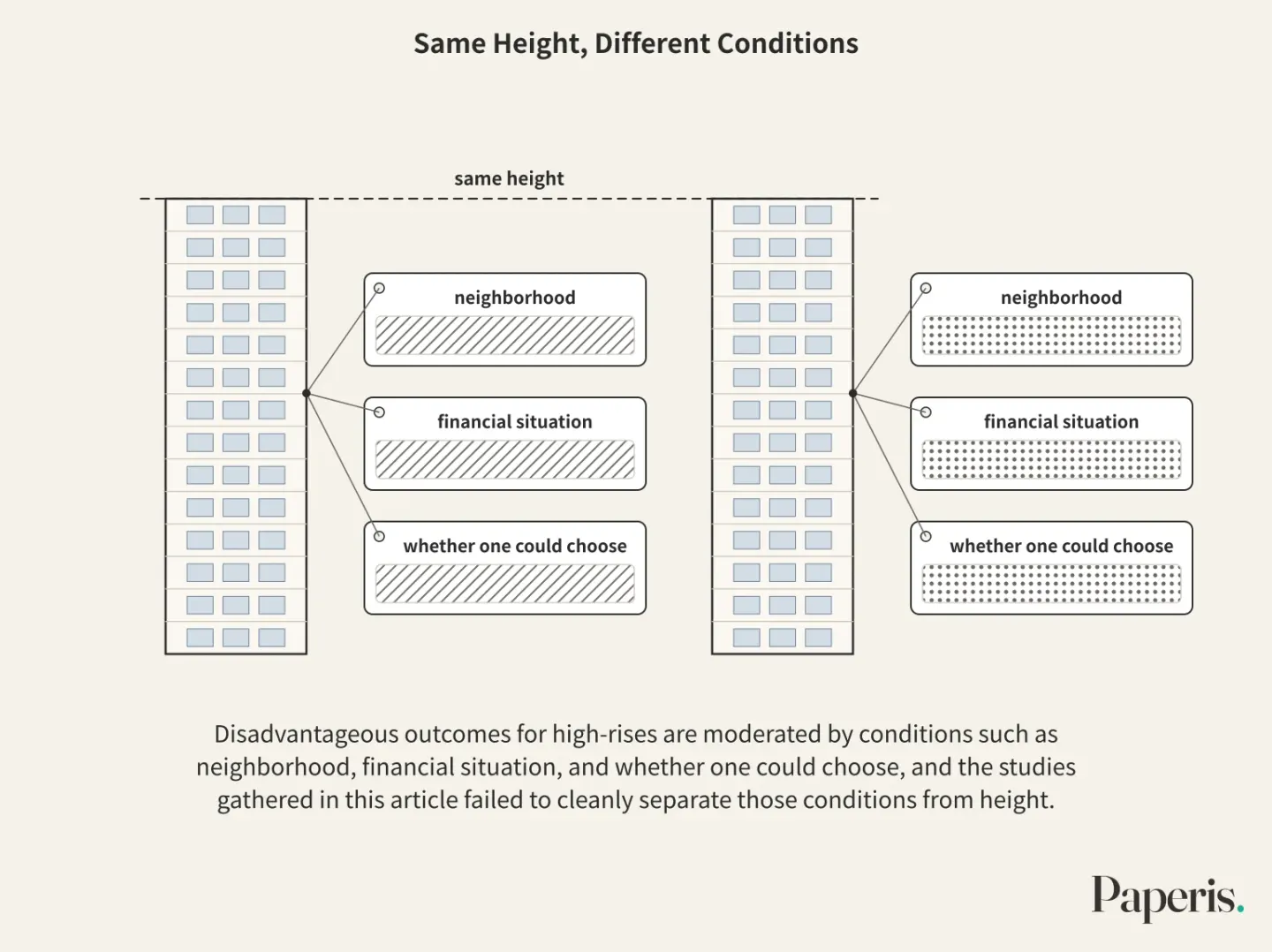
Let us place two houses of the same height side by side. One house is in a high-rise estate in a poor neighborhood. A review that selected, gathered, and examined literature in 2019 notes that psychological distress and poor mental health among high-rise apartment residents actually manifest, particularly in apartments in poor neighborhoods (DOI: 10.3390/challe10020034). The other house is at the same height but in a wealthy neighborhood, with green views or water visible out the window. The same review notes that many apartments in developed-country cities are in such wealthy neighborhoods, where higher floors command higher prices. The review's authors separated these two cases and proposed two models, viewing the relationship between high-rise living and mental health in either case as an issue of social justice. This review's observation is that even at the same height, outcomes varied depending on which neighborhood it was in, and bundling the two houses together by floor number alone hides that difference.
There are also studies that expressed doubt from a different angle. A study published in 1981 that sociologically investigated high-rise buildings in Graz, Austria, and surveyed general practitioners who primarily saw those residents, found no tendency for objectively confirmed illnesses to increase among upper-floor residents, true for both adults and children (PMID 7223139). These researchers viewed general flaws in urban planning, housing planning, and construction as driving a search for scapegoats, making high-rise buildings an easy target. The most noticeable flaws in the Graz high-rises were poor site selection and clumsy construction, and they concluded that good location and good construction are far more important than housing type. The same paper also noted that accurate and sufficiently broad empirical research had not yet been conducted.
Disadvantageous outcomes for high-rises are moderated by conditions such as neighborhood, financial situation, and whether one could choose, and the studies gathered in this article failed to cleanly separate those conditions from height.
Are Neighbors Truly Growing More Distant?
Social isolation is a state where encounters and connections with family, friends, and neighbors have diminished. An earlier 2007 review read that human relationships are drier and helping behaviors are fewer at higher elevations (DOI: 10.3763/asre.2007.5002). In a 1977 Canadian survey, even when items asking about social isolation were included, the relationship between floor level and tension did not diminish (DOI: 10.2307/2955349). In a Danish cohort comparing rented apartments and self-owned detached houses rather than floor levels, 8% of the difference in depression was explained by self-perceived loneliness (PMID 40217191).
Where, then, do people meet in high-rise buildings? In four low-income high-rise apartment blocks in Hanoi, Vietnam, 274 residents logged and surveyed whom and where they met, 45 participated in in-depth interviews, and the researchers directly measured the physical environment of the buildings (DOI: 10.3390/ijerph17134619). The frequency and locations of encounters varied depending on individual and neighborhood characteristics. Most encounters took place in transitional circulation spaces within the building, where chatting and bringing children out to play while watching over them also occurred. However, using these spaces for multiple overlapping purposes had negative impacts on privacy, the feeling of safety, and the cleanliness of the common areas. The same hallway served as both a place of encounter and a source of burden.
In a new private high-rise complex in Melbourne, Australia, 10 parents raising children aged five or younger used self-taken photographs and stories to illustrate their connections with neighbors (PMID 31330493). The study notes that such complexes are often conceived and designed with single-person households and couples without children in mind. What blocked the parents' connections were the design of the complex and the homes, frequently changing neighbors, and the necessity of maintaining distance precisely because they lived in close physical proximity. What opened up connections were organized gatherings and activities, as well as the shared experience of raising children in the same neighborhood. The title of the paper is "Knowing People Just by Sight". The method of directly asking residents and reading buildings through their words was covered in "Paths and Use — A Newcomer's Steps, an Occupant's Word".
An interview study covering Cabrini Green, a high-density public housing development in Chicago, shows a different scene (PMID 29651759). This study notes that public housing residents in previous studies had stronger social ties than people receiving other forms of housing assistance, and it interviewed mothers who raised children there, as well as daughters who grew up there and are now raising children elsewhere. The interviews suggested that as the high-rise buildings were shut down, the support network that sustained the mothers—particularly the roles played by the neighborhood and institutions—shifted. There were connections supporting people even within the high-rise complex, and when the buildings closed, the fabric of those connections changed as well.
When we picture a household raising a young child, these records come together in one place. Melbourne's parents pointed to indoor spaces and frequently changing neighbors as barriers in a complex often built with childless people in mind (PMID 31330493). In Hanoi, the act of bringing a child out to play and watching over them took place in the building's circulation spaces (DOI: 10.3390/ijerph17134619). Tokyo researchers interpreted the delayed independence of high-rise toddlers as potentially resulting from mothers spending excessive time stuck indoors with their children due to decreased outings (PMID 2637293). And the group that a 2003 review noted as being harmed by high-rise living was women raising young children (PMID 14709704). Because these four records span different cities and eras, they cannot be linked into a single line of causality. However, the act of going outside with children appears together in the Tokyo and Hanoi records, and the Melbourne parents added the challenge of maintaining distance from neighbors to that mix.
The three studies from Hanoi, Melbourne, and Chicago are each records from a single city and cannot be directly generalized elsewhere, nor are they studies comparing floor levels, so they do not speak to the specific role of height. Even so, what the three records point to as barriers and pathways of connection points in the same direction: how circulation spaces are shared, how frequently neighbors change, and whether gatherings and support exist. The conclusion of the 2007 review—that human relationships are drier at higher elevations—remains unchanged, and the conditions where connections arise and break within those settings are precisely these.
Results That Do Not Converge on One Side
In a neighborhood in Rotterdam, Netherlands, 2,330 elderly people living in high-rise buildings at the time of the initial survey were tracked for 10 years, or until they lost contact or died (PMID 39601955). This study looked at death rather than the mind, and compared floors entirely among people living in high-rise buildings. During this time, 602 people died. Setting the risk of death for people living on the 13th floor or higher as 1 and adjusting for comparison, the results were 1.31 (95% confidence interval 0.89 to 1.95) for floors 1 to 2, 1.52 (1.04 to 2.22) for floors 3 to 4, 1.07 for floors 5 to 6, 1.12 for floors 7 to 8, 1.45 (0.96 to 2.18) for floors 9 to 10, and 1.04 for floors 11 to 12. The only bracket where the entire confidence interval was greater than 1, making it hard to view as a coincidence, was floors 3 to 4. In its first sentence, this paper notes that studies looking at living floors and health have yielded conflicting results.
The authors concluded that the relationship between floors and death is not a straight line, and that the association was stronger on the lower floors compared to the highest floor. However, because there was only one bracket that was hard to view as a coincidence, and because it was an observational cohort that followed people already living on those floors rather than assigning people to floors, this article considers the evidence too thin to read this as a risk of lower floors. Since the outcome is death and the subjects are elderly people living in high-rise buildings, this is also not evidence that directly overturns the concerns about minds and children seen earlier.
A systematic literature review examining the homes and mental health of the elderly gathered 21 studies published between 2002 and 2023 (PMID 39309881). The studies were found worldwide, but were noticeably concentrated in China. The authors summarized that high floors, multi-story homes, larger homes, better-quality homes, bathing facilities, and the use of clean fuels for heating and cooking had positive effects on the mental health of the elderly, and noted that the effects of building materials yielded mixed results. High floors are listed in the same category as large, good-quality homes and clean fuel. While this review looked at mental health—the same as the concerns earlier—the subjects were elderly and the studies were concentrated in a single country, so it cannot directly overturn the earlier concerns. Who lives in those high-rise buildings and under what circumstances also remains as the same question.
Surveys from other cities also do not converge on one side. A study of 221 people selected through stratified random sampling in two neighborhoods of Hong Kong, well-known for high-density and high-rise housing, noted that the association between neighborhood environmental quality and mental health was weak, that in neighborhoods with poor housing conditions, home characteristics led more directly to mental health, and that in neighborhoods with better conditions, they led indirectly (PMID 35564537). In a household survey in Guangzhou, China, neighborhoods where more floor area was built relative to land area, and neighborhoods where buildings were dense, showed correlations toward better resident mental health (DOI: 10.3390/ijerph16173206). This is a result measuring neighborhood density rather than building height. In an online survey answered by 421 residents of Tehran, Iran in April 2020 while staying home due to COVID-19, the mental health of people living in detached houses was better than those living in both low-rise and high-rise multi-family housing (PMID 40477479). The difference between low-rise and high-rise does not appear in the abstract.
There are also studies looking inside buildings. Eighty design requirements set by apartment design policies across three Australian state governments were measured in 172 apartment buildings, and after grouping buildings with similar requirements, the mental well-being scores of residents were compared (PMID 37415596). Demographic characteristics and self-selection factors were adjusted for. Residents of buildings that met 29 requirements spanning nine design elements scored 1.96 points higher than residents of buildings that met fewer requirements. The authors noted that this is the first study to empirically confirm that combinations of design requirements set by policies are associated with the positive mental health of apartment residents. This study is also an observational study comparing people who already live there. The fact that resident scores differed between buildings even within the same apartment form shows that there are differences missed by a question bundled simply as "high-rise or not."
Because the mental health results in this section each compare different things (high-rise versus other homes, neighborhood environmental quality and density, design requirements, and home forms during isolation) and involve different subjects, and all are observational studies comparing people who were already living in those places, they cannot be used to flip the conclusion to "high-rises are good for the mind."
What Is Still Debated — The Share of Height Alone
The remaining question is narrow. When income, choice, neighborhood, and building quality are all stripped away, does even a tiny share belong to height itself?
On one side stands the conclusion of a 2007 synthesis. Once adjusting factors are set aside, high rises are less satisfying for most people, are not best for children, and may help explain some suicides separately (DOI: 10.3763/asre.2007.5002). On the other side is the interpretation of Oslo researchers who looked at the same question through cardiovascular medical history, though with a different result. The tendency for a medical history to be more common on higher floors mostly vanished when looking only among apartment residents, and those researchers considered unadjusted confounding to be the best-supported explanation (PMID 28053608). On the mental side, a 1977 Canadian survey noted that the relationship between floor and strain did not shrink even after including various variables, but that sample consisted of public housing residents in two cities, and studies that assigned people to floors are absent from the evidence gathered in this article.
There are also physical conditions that change along with height. A study measuring indoor air for two weeks in the homes of 339 children aged 5 to 6 living in Northern Manhattan and the Bronx in New York recorded that indoor soot particles and some polycyclic aromatic hydrocarbons were lower on higher floors, and that living in low-rise buildings was linked to higher levels of these substances (PMID 21886868). This study did not measure children's health outcomes, and the authors stopped at stating that children can be exposed to different levels of pollution depending on floor, season, and building type. What is visible outside the window also changes by floor. In an exploratory experiment that showed healthy residents 29 window-view photographs taken from various floors of high-rise buildings with differing amounts of greenery and measured their brainwaves, an effect where floor and the amount of greenery acted together on brainwaves appeared, and that phenomenon seemed more distinct on higher floors (DOI: 10.3390/ijerph15112358). The authors noted that results at this stage cannot confirm a large effect among floor, greenery, and brainwaves, and stopped at saying there is a possibility that a window view with greenery benefits mental health. How window greenery was measured by research designs was covered in "Trees Outside the Window — What Came In With the View".
A 2003 synthesis noted one more circumstance that makes this question harder. Because exposure to bad environmental conditions is not randomly distributed and tends to cluster among poor people and ethnic minorities, we need to look further at the health impacts of facing multiple environmental hazards all at once (PMID 14709704). To isolate the share of height alone, those hazards that cluster together with height must be isolated alongside it. The authors of the Danish cohort also noted that more research is needed to address pathways and causal possibilities (PMID 40217191).
This question still has no answer. Records exist showing that air and window views change according to height, but within the studies reviewed in this article, evidence connecting those differences all the way to mental health is absent.
So What Did We Learn?
There was a basis for the concerns connecting high-rises and the mind. The 1977 studies of female public housing residents in Canada, women raising young children, toddlers in Tokyo, and the conclusion gathered by a 2007 review—setting aside moderating factors—that high-rises are "less satisfactory for most people, not the best for children, and involve drier interpersonal relationships" serve as that basis. The studies collected by the 2007 review up to that point generally leaned unfavorably toward high-rises, and those findings were softened depending on gender, life stage, residents' circumstances, neighborhood quality, how crowded the home was, and whether they chose the home themselves. A 2019 review noting that things were especially bad in poor neighborhoods is also one of those conditions.
Among subsequent mental health studies, direct comparisons of high-rises with other homes were rare, and their directions differed depending on what was compared and from whom. A 2019 review that selected and gathered literature noted that the poor mental health of high-rise residents was particularly pronounced in poor neighborhoods. In a Danish cohort comparing rented apartments and owned detached houses, there was more depression among renters in apartments, and during COVID-19 quarantine in Tehran, residents of detached houses fared better than residents of both low-rise and high-rise multi-family housing. A review of 21 studies on older adults from 2002 to 2023 placed high-rises—in studies concentrated in China, alongside spacious, good-quality homes and clean fuel—on the positive side of older adults' mental health. Some studies did not compare heights directly. In Hong Kong, the link between neighborhood environmental quality and mental health was weak while home characteristics were linked to mental health; in Guangzhou, denser neighborhoods leaned toward better mental health; and in Australia, residents of buildings with better design requirements—even within the same apartment type—faired better. Studies with differing results must be looked at separately. In Oslo, differences in floor levels mostly disappeared when cardiovascular history was compared among apartment residents, and regarding mortality among high-rise older adults in Rotterdam, the authors noted that the association was stronger for lower floors.
The studies gathered by the 2007 review generally leaned unfavorably toward high-rises and were softened by conditions. Subsequent mental health studies rarely compared heights directly, and their directions differed depending on what was compared (housing type and tenure, neighborhood quality and density, design) and the groups studied. The evidence gathered in this article does not contain designs capable of separating whether that is the share of height itself.
Even at the same height, there are different homes. Who lives in what kind of building in which neighborhood and under what circumstances cannot be seen through a single number like the floor level.
Source Papers
- "The Consequences of Living in High-Rise Buildings" (2007) — DOI: 10.3763/asre.2007.5002 — Summary of research on the effects of high-rise living. Most conclusions depend on moderating factors (socioeconomic status, neighborhood, parenting, gender, life stage, indoor density, choice), but independent of moderators, high-rises may be linked to lower satisfaction, suboptimal conditions for children, drier interpersonal relationships, increased crime and fear, and a possible independent explanation for some suicides.
- "High-Rise Housing and Psychological Strain" (1977) — DOI: 10.2307/2955349 — Interviews with 442 public housing residents in two Canadian cities. The relationship where higher floors mean greater strain appeared only in women, with the reverse true for men. Control and mediating variables failed to weaken the relationship.
- "High-Rise Apartments and Urban Mental Health—Historical and Contemporary Views" (2019) — DOI: 10.3390/challe10020034 — The link between high-rises and poor mental health is especially pronounced in poor neighborhoods, whereas high-rises with good views in affluent neighborhoods are expensive. Two models are proposed, raising social justice issues.
- "Where do People Interact in High-Rise Apartment Buildings? Exploring the Influence of Personal and Neighborhood Characteristics" (2020) — DOI: 10.3390/ijerph17134619 — Diaries, surveys of 274 residents, and interviews of 45 people across four low-income high-rise buildings in Hanoi. Most encounters occur in transitional spaces, and multipurpose use places a burden on privacy, a sense of safety, and cleanliness.
- "The built environment and mental health." (2003) — PMID 14709704 — High-rises are harmful to the psychological well-being of women raising young children. Methodological issues require prospective studies and randomized trials, and exposure to poor environments is concentrated among the poor and ethnic minorities.
- "Effects of high-rise living on physical and mental development of children." (1989) — PMID 2637293 — Survey of 1,045 toddlers in Tokyo. Delayed independence in basic living habits among children in high-rises, interpreted by the researchers as excessive attachment by mothers due to decreased outings.
- "Built and natural environment planning principles for promoting health: an umbrella review." (2018) — PMID 30055594 — Re-analysis of 117 reviews. Mixed quality of evidence and reliance on cross-sectional designs make causal links difficult.
- "The Association between Residence Floor Level and Cardiovascular Disease: The Health and Environment in Oslo Study." (2016) — PMID 28053608 — Self-reported cardiovascular history of 12,525 people in Oslo. Disease history increased with floor level, but among apartment residents only, the association disappeared except for venous thrombosis (OR 1.504 for floor 6 and above). Residual confounding is the most plausible explanation.
- "Housing type and risk of depression - the mediating effects of perceived indoor annoyances and loneliness: a Danish cohort study, 2000-2018." (2025) — PMID 40217191 — Cohort of 14,387 people. Rented apartments vs. owned detached houses showed a depression incidence IRR of 1.32, mediated 11% by indoor annoyances and 8% by loneliness. Studies to confirm causality are needed.
- "A preliminary study of the health of a populaltion staying in apartments of varying sizes in Singapore." (1976) — PMID 938126 — Interviews with 438 households in Singapore public housing high-rises. Worry and anxiety are linked to socioeconomic status, self-rated health mostly unchanged after moving, and living conditions influence contact patterns with relatives and close acquaintances.
- "A review of social housing regeneration in the London Borough of Brent." (2003) — PMID 12722580 — Design and construction problems in 1960s-70s high-rise public housing complexes, stigmatization, and a downward spiral caused by allocating units to households with fewer options.
- "[On the evaluation of health factors in high-rise buildings. 3. Sociological investigations and questioning of physicians about living in high-rise buildings (author's transl)]." (1981) — PMID 7223139 — Graz high-rise survey and questionnaire of general practitioners. No trend toward objective illness increase on upper floors; location and construction matter more than building form, and high-rises serve as scapegoats.
- ""Surface acquaintances": Parents' experiences of social connectedness and social capital in Australian high-rise developments." (2019) — PMID 31330493 — Photo-elicitation interviews with 10 parents in Melbourne high-rise developments. Design, frequent moving, and distancing act as barriers, while gatherings and parenting experiences build connection.
- "Investigating the Support Networks for Mothers of a High-density Public Housing Community and the Effects of Housing Closures on These Support Systems." (2018) — PMID 29651759 — Interviews with two generations in Chicago's Cabrini-Green. High-rise closures disrupted neighborhood and institutional support systems.
- "Vertical Living and Longevity: Examining Mortality by Floor of Residence in an Elderly Population." (2024) — PMID 39601955 — 10-year follow-up of 2,330 elderly residents in Rotterdam high-rises, with mortality as the outcome. Non-linear compared to floor 13 and above, with significance found only on floors 3–4 (HR 1.52); the association is stronger on lower floors.
- "Dwelling characteristics and mental well-being in older adults: A systematic review." (2024) — PMID 39309881 — 21 papers, heavily focused on China. High floors, large homes, quality, bathing facilities, and clean fuel have positive effects on older adults' mental health, while building materials show mixed results.
- "The Impacts of Housing Characteristics and Built-Environment Features on Mental Health." (2022) — PMID 35564537 — 221 people in two Hong Kong neighborhoods. The link between environmental quality and mental health is weak, and direct and indirect pathways vary depending on neighborhood circumstances.
- "Exploring the Linkage between the Neighborhood Environment and Mental Health in Guangzhou, China" (2019) — DOI: 10.3390/ijerph16173206 — Household survey in Guangzhou. Floor-area ratio, building density, and green space per capita showed positive correlations with mental health.
- "Housing and mental health during outbreak of COVID-19." (2021) — PMID 40477479 — Online survey of 421 people in Tehran during COVID-19 self-quarantine. Mental health was better among residents of detached houses than those in low-rise or high-rise apartment complexes.
- "The architecture of mental health: identifying the combination of apartment building design requirements for positive mental health outcomes." (2023) — PMID 37415596 — 172 buildings in Australia, 80 design requirements. Residents of buildings meeting more requirements scored +1.96 higher on mental well-being.
- "Effects of Floor Level and Building Type on Residential Levels of Outdoor and Indoor Polycyclic Aromatic Hydrocarbons, Black Carbon, and Particulate Matter in New York City." (2011) — PMID 21886868 — Homes of 339 children aged 5–6 in New York City. Indoor soot and some PAHs were lower on higher floors; health outcomes were not measured.
- "Window View and the Brain: Effects of Floor Level and Green Cover on the Alpha and Beta Rhythms in a Passive Exposure EEG Experiment" (2018) — DOI: 10.3390/ijerph15112358 — Exploratory EEG experiment with 29 people. Interaction between floor level and green cover, but no large effects could be confirmed.
Sources (22)
- The Consequences of Living in High-Rise BuildingsDOI 10.3763/asre.2007.5002
- High-Rise Housing and Psychological StrainDOI 10.2307/2955349
- High-Rise Apartments and Urban Mental Health—Historical and Contemporary ViewsDOI 10.3390/challe10020034
- Where do People Interact in High-Rise Apartment Buildings? Exploring the Influence of Personal and Neighborhood CharacteristicsDOI 10.3390/ijerph17134619
- The built environment and mental healthPMID 14709704
- Effects of high-rise living on physical and mental development of childrenPMID 2637293
- Built and natural environment planning principles for promoting health: an umbrella reviewPMID 30055594
- The Association between Residence Floor Level and Cardiovascular Disease: The Health and Environment in Oslo StudyPMID 28053608
- Housing type and risk of depression - the mediating effects of perceived indoor annoyances and loneliness: a Danish cohort study, 2000-2018PMID 40217191
- A preliminary study of the health of a populaltion staying in apartments of varying sizes in SingaporePMID 938126
- A review of social housing regeneration in the London Borough of BrentPMID 12722580
- [On the evaluation of health factors in high-rise buildings. 3. Sociological investigations and questioning of physicians about living in high-rise buildings (author's transl)]PMID 7223139
- Surface acquaintances\PMID 31330493
- Investigating the Support Networks for Mothers of a High-density Public Housing Community and the Effects of Housing Closures on These Support SystemsPMID 29651759
- Vertical Living and Longevity: Examining Mortality by Floor of Residence in an Elderly PopulationPMID 39601955
- Dwelling characteristics and mental well-being in older adults: A systematic reviewPMID 39309881
- The Impacts of Housing Characteristics and Built-Environment Features on Mental HealthPMID 35564537
- Exploring the Linkage between the Neighborhood Environment and Mental Health in Guangzhou, ChinaDOI 10.3390/ijerph16173206
- Housing and mental health during outbreak of COVID-19PMID 40477479
- The architecture of mental health: identifying the combination of apartment building design requirements for positive mental health outcomesPMID 37415596
- Effects of Floor Level and Building Type on Residential Levels of Outdoor and Indoor Polycyclic Aromatic Hydrocarbons, Black Carbon, and Particulate Matter in New York CityPMID 21886868
- Window View and the Brain: Effects of Floor Level and Green Cover on the Alpha and Beta Rhythms in a Passive Exposure EEG ExperimentDOI 10.3390/ijerph15112358