Paperis Articles
Curves — The Pull at First Glance, and the Conditions That Follow
Do people prefer rounded shapes? A preference for curvature observed for a century is reliable but not universal (a 2022 meta-analysis of 61 studies) — viewing time, the object, the viewer and the question asked all change its size and direction.
Your field's papers, as audio
Pick your fields and journals — Paperis summarizes the key papers and turns them into audio. Listen on your commute.
Start Paperis free →Curves — The Pull at First Glance, and the Conditions That Follow
A Quick Glance at a Single Photo
A photo of an object flashes on the screen for a brief moment and then disappears. Some objects have rounded, curved outlines, while others are sharply angled. The viewer chooses whether they like or dislike the object. This method summarizes in a single sentence a 2006 experiment comparing curved and angular shapes, as presented in a 2020 conference abstract. That abstract states that the experiment asked people to answer whether they liked or disliked photos of curved or angular objects shown briefly (DOI: 10.1167/jov.20.11.667). Because it is a one-sentence summary inside a conference abstract, details like presentation time or participant count are absent there.
The abstract of the paper published in 2006 titled "People prefer curved objects" does not disclose the design, but instead states the research question, hypothesis, and conclusion. The starting point was the observation that people make snap judgments about objects they encounter every day. Such rapid judgments have no choice but to rely on the outward appearance of the objects, yet it was not known which properties of that appearance drive the judgment. The research team formed a hypothesis: that outlines with sharp angles can convey a sense of threat, and therefore an initial judgment of such objects would lean toward the negative. The results matched that hypothesis. The authors concluded that whether an object's outline is sharply angled or roundly curved has a decisive influence on the attitude toward that object (DOI: 10.1111/j.1467-9280.2006.01759.x).
The word chosen by the original research is "matched." In that paper, threat was a hypothesis formulated by the research team. What was measured and how is not in that paper's abstract, and it cannot be confirmed from the abstracts alone whether the experiment summarized by the conference abstract is the same experiment as this paper.
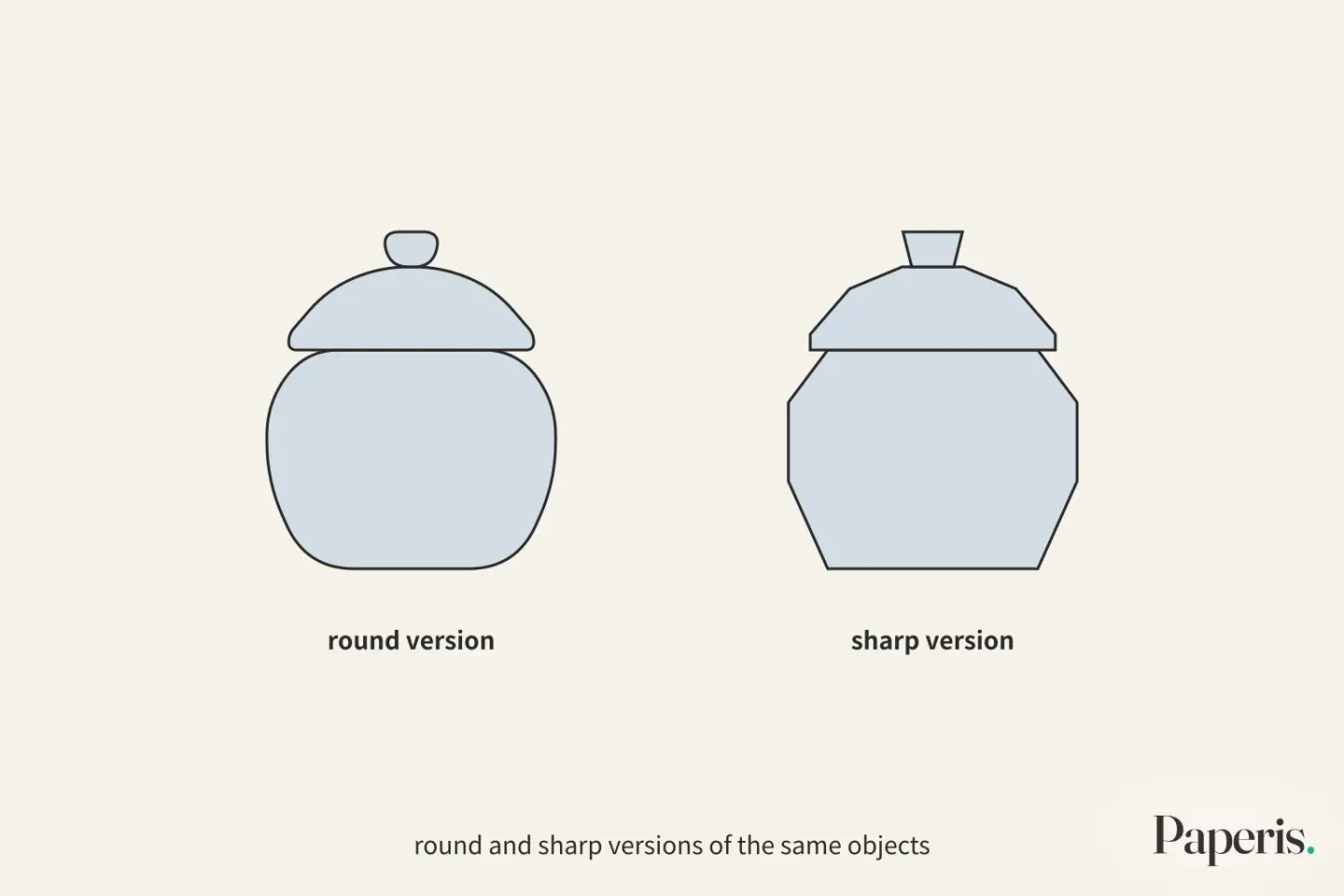
The phenomenon pointed to by these results has a name. Curve preference is the tendency to prefer the side where the outline is roundly curved over the side where it is sharply angled, even for the same type of object or space. Researchers also call it the curvature effect. The observation that rounded contours and lines are more pleasurable than straight ones appears repeatedly in the aesthetic literature, was tested intermittently throughout the history of scientific psychology, and only became the subject of systematic research in the decade leading up to 2015 (PMID 26793092). Evidence that humans are sensitive to visual curves and prefer them goes back a century, and this effect has been observed across multiple age groups, cultures, and non-human primates. Thanks to this, expectations arose that curve preference might be universal. Meanwhile, several studies reported that this preference varies depending on the context and the individual, casting doubt on that expectation (DOI: 10.1111/nyas.14919). Even so, the idea that humans have a universal visual preference for curved shapes has been a widely accepted belief (PMID 37429830).
The observation that "people like curves" has existed for a century, and the 2006 experiment, if we follow the conference abstract's summary, was one of several experiments that measured that observation through judgments made the moment a photo was briefly seen. The explanation attached to that judgment—threat—was a hypothesis from the start.
The Experiment Moves to Room Photographs
Rooms with curved interiors and rooms with straight interiors—photographs of rooms where only the outlines were systematically changed—appear one after another in front of people lying inside a brain imaging machine. This is a scene from an experiment published in 2013. The people answered two questions. One was whether the space was beautiful, and the other was an approach-avoidance judgment. An approach-avoidance judgment is a decision choosing whether to step closer to a target or back away; in the room photograph experiment, it asks whether one would enter or leave the room. The researchers explain that both questions are outcomes of interest to both architects and the people who use spaces.
The beauty side went as predicted. People were more consistent in judging curved interiors as beautiful rather than straight interiors. A feeling of "how pleasant it is" explained close to 60% of the spread in beauty scores. On the other hand, whether one would enter or leave did not change depending on the outline. Even while that judgment remained unchanged, curved interiors made the visual cortex more active. The researchers concluded that the well-established effect of outlines on objects can be extended to architecture (DOI: 10.1073/pnas.1301227110). This experiment measured judgments made looking at photographs, and also reported that the judgment of beauty and the judgment of entering moved separately.
There are also attempts that moved outside of buildings. A poster presentation released online in 2015 made four variations of the same building facade. They are a heavily curved board, a moderately curved board, a straight board, and a sharply angled board. Twenty-four people chose the better side between pairs of pictures, rated goodness, familiarity, complexity, stability, and desire to approach on a five-point scale, and arranged four in order. In the pairwise choice, the heavily curved facade was preferred the most, followed by the moderately curved board, the angled board, and the straight board in that order. In the goodness score, the angled board came after the heavily curved board. Concluding that curvature affects preference even in architectural stimuli, the authors added that the least liked was always the straight board, rather than the expected angled board (DOI: 10.7490/f1000research.1110733.1). This material is a poster rather than a peer-reviewed paper, and the participants number 24.
There are also results showing that when curves become excessive, preference drops. In a 2017 conference paper where 32 people evaluated 18 spaces in virtual reality as good or bad, spaces with rounded outline elements received judgments of being better. However, when the curves became large across the entire surface of the space beyond the corner seams, preference dropped distinctly. The authors summarized that the curve preference fits better at moderate curvature than at extreme curvature (DOI: 10.52842/conf.caadria.2017.581). This is also the result of a single conference proceeding paper.
When moved to architecture, the judgment leaning toward curves repeated. At the same time, the judgment to enter did not follow, the most heavily curved did not always win, and in the facade study, the last-place spot differed from expectations.
Are Sharp Things a Threat?
The 2006 explanation that sharply bent corners remind us of danger was given a name in a later study. The threat cue hypothesis is the explanation that sharply bent outlines remind people of danger, so that the moment we look at an angular object, our judgment tilts toward the negative. If this hypothesis is correct, it creates predictions we can test. The effect should be larger when the angular shape is within arm's reach, and people should move to avoid angular shapes.
A study published in 2016 tested these predictions across four experiments. The first experiment used abstract shapes that varied in outline and complexity, confirmed a preference for curves, and showed that this preference was not tied to how complex people felt the shapes were. The second experiment changed the distance. If angular shapes are linked to threat, the effect should be stronger when they are placed in the space close to the body, but this prediction was not supported. The third experiment pitted straight lines and curves against each other without corners. When colored lines were shown through round or square windows, curves were rated more favorably than angular lines and even than straight lines without bends. Corners were not strictly necessary for people to prefer curves.
The fourth experiment did not ask directly whether people liked the shapes, but used a task that measured whether they approached or retreated from targets on a screen. A response of approaching toward curves appeared, but a response of avoiding angular shapes was not confirmed. The authors concluded that the threat association hypothesis alone cannot fully explain the curve effect, noting that curved shapes themselves are visually pleasing (PMID 25871463). The phrasing "cannot fully explain" leaves room for the threat cue hypothesis to account for a part of it. What this study tested were abstract shapes and lines.
There were also boundaries to the range where curves win. Earlier experiments mostly used emotionally neutral objects. A 2011 study showed welcome objects like cake or chocolate and unwelcome objects like snakes or bombs on round and sharp versions. People preferred round versions only when the objects were neutral or welcome, and there was no difference in how much people liked round versus sharp versions for unwelcome objects like snakes or bombs. The authors read this as evidence that aesthetic responses are adaptive, interpreting that in this case, the liking or disliking of what the object was outweighed the outline (PMID 21936294).
The word "adaptive" is an interpretation that this response may have been shaped to be useful to humans. A 2015 review summarized that while there are recent studies supporting the idea that a preference for curves is biologically determined, claims have also emerged that this preference is a cultural phenomenon. The same review noted that the absence of a unifying framework and clearly defined concepts may be hindering efforts to understand the preference for curves (PMID 26793092). There may be an evolutionary narrative that a distant past of guarding against sharp things left us with this response, but the evidence gathered in this article includes no studies testing that narrative. What these experiments measured were choices in front of a screen.
The threat cue hypothesis started as the hypothesis of the original study, and a study that tested it with four experiments concluded that explanation alone is not enough. The results of studies tested with brain imaging vary depending on the type of photograph in the next section. As for why the preference for curves arises, multiple explanations still stand side by side today.
What Brain Scans Showed
What changes in the brain while we look at a curved interior and weigh its beauty? A 2013 experiment using room photographs measured this inside a brain-scanning machine, and this kind of research belongs to a field called neuroaesthetics. Neuroaesthetics is the research field that measures what happens in the brain when a person judges something to be beautiful.
In that experiment, while weighing beauty, the only area that was more active in response to curved outlines was the anterior cingulate cortex. This area strongly reacts to the reward value and emotional salience of an object. Beauty scores rose and fell together with the activity of a brain network known to be used when aesthetically evaluating various types of visual stimuli. Combining evidence from both behavior and the brain, the researchers wrote that the role played by emotion in favoring curves reveals itself even in the field of architecture (DOI: 10.1073/pnas.1301227110). A 2021 book chapter introducing the same study summarized that this result supports the idea that the preference for curved designs comes from emotion (DOI: 10.1093/oso/9780197513620.003.0043). "Comes from emotion" is the authors' interpretation, and what the scans directly showed was that the activity of those areas changed while making judgments.
There is a study that moved the same question to hospital photographs. The amygdala is a small area located deep inside the brain, one on each side, and is frequently studied alongside emotional responses like fear. Published in 2016, this study tried to test the threat signal hypothesis with the amygdala. Thirty-six healthy adults (across three age groups, men and women) had their brains scanned while looking at 312 real photographs—objects, interiors, building exteriors, and landscapes—in random order, and the data was collected in 2013. In landscape photographs and medical object photographs, the amygdala was more active with sharp outlines. However, in hospital interior and building exterior photographs, the amygdala was conversely more active with the curved side. The authors explain that this activity belongs to a pre-cognitive stage of perception, namely an early stage before consciously evaluating the photograph.
Concluding that the shape of a hospital systematically influences the early-stage fear response perceived by a person, the authors added that it remains unknown whether this first impression actually connects to the subsequent experience of a sick or injured patient (DOI: 10.1177/1937586715624210). The participants were not patients, and what was measured was brain activity while viewing photographs. What the authors called a "fear response" is the early amygdala activity when healthy adults view photographs, and the same curve was paired with opposite directions of activity depending on the type of photograph. The authors also noted that they do not know whether that activity translates to what actual patients experience in a hospital.
There is also a study that re-examined brain data. In a 2024 study that re-analyzed brain-scan data gathered while making beauty judgments and approach-avoidance judgments regarding architectural images, the early visual cortex (V2 to V3) responded to computer-calculated curvature in both tasks. On the other hand, areas including the fusiform gyrus responded to perceived curvature—and even then, only when judging beauty (PMID 39489733). This means that the early response accepting curvature was the same regardless of the task, while the response to perceived curvature varied depending on what was being judged.
What brain scans showed is limited to which areas were more active and when in front of curves. The explanation that those areas are places reacting to reward and emotion is knowledge that the researchers brought in and attached from other studies, and the connection that "because that area was active, curves are felt as beautiful" belongs to interpretation.
Re-examined Studies
If we gather 309 effect sizes from 61 studies and recalculate them together, how much of a curve preference remains? A 2022 meta-analysis did that calculation. A meta-analysis is a method that pools the results of multiple studies addressing the same question and recalculates them all at once. This meta-analysis included 106 independent samples. The value representing the size of the effect was 0.39, which the authors termed a medium size. And they found four conditions that change the magnitude of this preference: viewing time, type of object, expertise, and task. The authors' conclusion is this: The curve preference is a reliable but not a universal phenomenon, and it is influenced by factors other than the shape entering the eye (DOI: 10.1111/nyas.14919).
The first condition is viewing time. In a 2019 experiment where participants were shown round and sharp versions of the same objects side by side and asked to choose one, the preference for the round version was strongest when real object photographs were shown for only 0.084 seconds, and that preference faded when unlimited time was given. Meaningless patterns were different. The round version was chosen even at 0.084 seconds and 0.15 seconds, and when unlimited time was given, the preference actually increased markedly. For patterns viewed briefly, most participants chose the round version even though they could not clearly distinguish between the two versions. The authors concluded that viewing time, the type of stimulus, and the interplay between the two influence the curve preference (PMID 30536967). For real objects, the pull of first glance faded the longer they were viewed.
The second condition is the type of object. A 2025 study that conducted two experiments using photographs of tables and chairs recorded eye movements while participants rated their preference in the first experiment, and in the second experiment used a brief presentation—specifically, showing them for only 0.084 seconds—believed to boost the curve effect. Neither experiment confirmed a clear curve preference for tables or chairs. Yet in the first experiment, eyes lingered longer on round tables than on angular tables, and that difference did not translate into an overall preference. The research team discussed these results in the context that familiarity and the object's utility shape preference judgments, and also noted that the curve effect has been reported to be larger in abstract shapes than in interior spaces (DOI: 10.1177/20416695251341682).
The utility of objects also came up in a short commentary that re-examined the data from the meta-analysis. Affordance is the utility that an object extends to a person, the property that tells us a chair can be sat on and a handle can be grasped. This 2023 commentary reported finding a relationship within the meta-analysis data where the more affordances an object had, the weaker the curve preference became, and proposed explaining this from the perspective that bodily experience enters into judgment (PMID 37429830). It is a short piece in the format of a commentary, and its explanation is at the proposal stage.
Results measured in virtual reality were mixed. The 2017 conference paper seen earlier reported a judgment that round elements are better in a virtual reality space. In a 2021 experiment, 42 people freely explored four living rooms meticulously matched to each other inside a photorealistic virtual reality setup. Out of 33 measures concerning emotion, behavior, and thought, after applying corrections to filter out accidental discoveries, only two left a difference according to outline, and both favored the angular room. Re-analyzing with a different statistical method yielded the same direction. The authors noted that this result is evidence against the hypothesis that curves are preferred, and that psychological responses to outlines in near-real architectural environments can be more complex (PMID 34886236).
The same research team converted those living rooms into photographs in 2022 and showed them online to 198 people. There were 20 photographs of living rooms that varied only in outline (angular vs. curved) and style (modern vs. classical). This time, overall, the curved side scored higher in beauty, goodness, and relaxation ratings, and lower in stress scores. Among the spread of scores, the share explained by the difference in outline was 1% to 2% for beauty and 8% to 12% for stress. When dividing by style, the curve's advantage in beauty appeared only in the modern living room photographs; when dividing by gender, it appeared only in participants who identified as female. The difference in stress scores remained regardless of style, and showed no difference by gender. The authors summarized that this study primarily confirmed the positive effects of curves, while noting that those effects have multiple layers (PMID 36532994). These scores are self-evaluations made while looking at photographs, not measurements of bodily stress. Summarizing the earlier virtual reality experiment as "those rooms made no difference" (the abstract of that study reported a difference favoring the angular room in two out of 33 measures), the authors proposed that still photographs and immersive presentations can yield different results.
There are also results in the exact opposite direction. In 2026 experiments conducted online and in the laboratory using interior photographs that systematically varied ceiling height, openness, and curvature, participants consistently preferred rectilinear spaces. The primary question of this study was whether preference aids memory, and the preference results emerged out of that process (PMID 42218353).
The third condition is expertise. In a 2017 study showing interior spaces to people who self-identified as architects or designers and to those who did not, when judging beauty, experts rated rectilinear spaces as less beautiful than curved spaces, whereas outlines did not affect the beauty judgments of non-experts. When choosing whether to enter or leave, the roles swapped. Non-experts were more likely to choose to enter curved spaces, while the choices of experts were not affected by outline. The authors considered that the claim of outlines being an important and potentially adaptive feature in architecture and design gains strength, while emphasizing that their aesthetic and motivational meanings vary depending on expertise (DOI: 10.1037/aca0000150).
The fourth condition is the task, meaning what is being asked. In both the 2013 experiment and this expert study, "Is it beautiful?" and "Would you enter?" operated separately. The 2013 participants (the abstract does not state their expertise) favored curves only on the beauty side, and the 2017 experts did the same, whereas non-experts chose curves only on the entry side. A re-analysis of brain data for architectural images also showed that perceived curvature responses in regions including the fusiform gyrus appeared only when judging beauty (PMID 39489733).
There are also conditions reported outside the four picked by the meta-analysis. One is culture. In a 2022 study (the abstract does not state the sample size or stimuli) that re-tested earlier findings—that Western observers prefer curved outlines, high ceilings, and open spaces—using the architectural aesthetic judgments of Chinese observers, the tendency to prefer high ceilings and open spaces held up. However, the tendency to prefer curved outlines was entangled with ceiling height and openness, appearing only when ceilings were low and spaces were enclosed. The authors concluded that the curve preference is less reliable for Chinese observers (DOI: 10.1371/journal.pone.0265412). How ceiling height and openness change the feel of a room is covered in "Space and Scale — The Seat with Its Back to the Wall, Facing the Window".
The 2020 conference abstract summarizing the 2006 experiment reports an experiment with non-Western participants, where the response method changed the results. The curve effect appeared only when photographs of real objects were shown for 0.09 seconds and rated as good or bad, and did not appear for meaningless objects. When participants were asked to rate them on a scale from 1 to 100, a trend in the opposite direction of curves was observed instead. Noting that this preference has been verified primarily in Western populations, the research team wrote that the curve effect varies depending on the context, and that the reason may be differences in the judgment methods of Western and non-Western participants (DOI: 10.1167/jov.20.11.667). Being a single conference abstract, the design details cannot be verified.
Differences between individuals are also substantial. In a 2021 study that gender-matched 160 undergraduate students majoring in psychology, mathematics, engineering, and computer science, participants overall preferred rounded shapes over angular shapes, but that preference was strongest among female psychology majors (PMID 33732544). Another 2019 study reported that while people generally preferred curved objects and curved patterns, the differences between individuals were surprisingly wide, and people who were sensitive to curves in real objects were also sensitive to curves in abstract patterns (PMID 31146089).
What the re-examined studies have shaken is the universality of the curve preference. The meta-analysis judged the tendency to lean toward curves to be reliable, but that inclination does not appear with the same magnitude and direction everywhere.
First Glance and Beyond
We follow a single round shape as it passes through various conditions in the laboratory. Each step is a different experiment. When shown on a screen as a real object photo for 0.084 seconds, the round version received the greatest preference. When allowed to view the same photo as long as they wanted, that preference faded (PMID 30536967). If that object was something avoided like a snake or a bomb, no difference emerged in the goodness of the two versions (PMID 21936294). If that object was a table or chair, showing it for only 0.084 seconds did not produce a clear preference. In another experiment where participants were allowed to view them over time, eyes lingered longer on round tables, but it did not lead to preference (DOI: 10.1177/20416695251341682).
When that same round shape becomes the outline of a room, a 2013 experiment judged the curved room to be more beautiful, and the choice to enter remained the same (DOI: 10.1073/pnas.1301227110). In a 2017 study separating architects, designers, and non-experts, the curve effect appeared only toward beauty for experts and toward entering for non-experts, with the non-experts' results conflicting with the 2013 experiment (DOI: 10.1037/aca0000150). Chinese observers favored curves only when the room had a low, closed ceiling (DOI: 10.1371/journal.pone.0265412). In an experiment having participants look around a virtual reality living room, two of the 33 resulting differences favored the angular room (PMID 34886236), while another virtual reality space experiment favored curved elements (DOI: 10.52842/conf.caadria.2017.581). There is also an experiment using indoor photos with varied ceiling height, openness, and curvature where participants consistently preferred the straight-lined space more (PMID 42218353).
Along this path, the pull toward curves grows, disappears, or tilts backward toward straight lines. The inclination toward curves truly exists, and its magnitude and direction vary depending on viewing time, the object, the viewer, and the question asked. The sentence "Curves are beautiful" becomes correct only when these conditions are attached.
Curves in architecture have other origins. The curves covered in "Antoni Gaudí — Turning Hanging Strings Upside Down to Find Where Stone Can Stand" are structural answers found to see where stone can stand, and belong to different questions than the experiments in this article measuring preferences in front of photos.
The remaining questions lie inside actual buildings. A 2022 study noted that indoor curve research is scarce and has relied mainly on schematic drawings or mismatched stimuli (PMID 36532994), and the authors of a hospital photo study also noted that it is unknown whether the first impression in front of a photo connects to actual patient experiences (DOI: 10.1177/1937586715624210). The pull in front of a briefly viewed photo has been confirmed by multiple experiments (though some objects like tables and chairs remain unconfirmed), and studies measuring what that pull leaves behind for someone spending a day inside a room are absent from the evidence gathered in this article.
Source Papers
- "Humans Prefer Curved Visual Objects" (2006) — DOI: 10.1111/j.1467-9280.2006.01759.x — Hypothesis that sharp contours convey threat and produce a negativity bias, results match hypothesis, contours have a decisive influence on attitudes toward objects.
- "Preference for curved contours using various presentation times and response measures" (2020) — DOI: 10.1167/jov.20.11.667 — Conference abstract. Summary of 2006 experimental design, curve effect in non-Western participants only with real objects at 90ms and like/dislike tasks, no effect for meaningless objects, opposite tendency on score scales, possibility of cultural differences.
- "How universal is preference for visual curvature? A systematic review and meta-analysis" (2022) — DOI: 10.1111/nyas.14919 — 61 papers, 106 samples, 309 effect sizes, g=0.39 medium, moderated by viewing time, stimulus type, expertise, and task, reliable but not universal.
- "Affordances and curvature preference: The case of real objects and spaces." (2023) — PMID 37429830 — Commentary. Dominant belief in universal curvature preference, negative relationship between affordances and curvature preference in re-analyzing meta-analysis data, proposed embodied cognition explanation.
- "Impact of contour on aesthetic judgments and approach-avoidance decisions in architecture" (2013) — DOI: 10.1073/pnas.1301227110 — fMRI, curved interiors judged as more beautiful, feeling good accounts for about 60% of variance in beauty, approach-avoidance unaffected by contours, anterior cingulate cortex and visual cortex activation, role of emotion.
- "Varying curvature and angularity of architectural facades can influence aesthetic judgments" (2015) — DOI: 10.7490/f1000research.1110733.1 — Poster. Four panels of the same building facade, 24 people, most-curved panel most preferred, straight panel always ranked lowest (not the expected angular panel).
- "Cognition and Evaluation of Architecture Environments Based on Geometric Contour References and Aesthetic Judgements" (2017) — DOI: 10.52842/conf.caadria.2017.581 — Conference paper. 18 VR spaces, 32 people, rounded elements preferred, preference drops sharply when overall surface curvature is high, moderate curvature preferred.
- "Do observers like curvature or do they dislike angularity?" (2016) — PMID 25871463 — Four experiments. Distance hypothesis not supported, curves preferred even over straight lines, approach toward curves present but no avoidance of angular things, threat-association hypothesis alone cannot explain everything.
- "Emotional valence modulates the preference for curved objects." (2011) — PMID 21936294 — Curve preference only for neutral and positive objects, no difference for negative ones (snakes, bombs), aesthetic responses are adaptive.
- "Preference for Curvature: A Historical and Conceptual Framework." (2015) — PMID 26793092 — Review. Biological determinism versus cultural phenomenon, lack of a unified framework and concepts may hinder understanding.
- "The Neuroaesthetics of Architecture" (2021) — DOI: 10.1093/oso/9780197513620.003.0043 — Book chapter. Introduction of 2013 experiment, interpreted as supporting the idea that preference for curved design stems from emotion.
- "Can Hospital Form Trigger Fear Response?" (2016) — DOI: 10.1177/1937586715624210 — 36 healthy adults, 312 real photos, fMRI, amygdala activation increased for sharp landscapes and medical objects, and for curved hospital interiors and exteriors, relationship with actual patient experience unknown.
- "Neural dissociation between computational and perceived measures of curvature." (2024) — PMID 39489733 — Re-analysis of architectural fMRI data, V2–V3 respond to computational curvature task-independently, fusiform gyrus responds to perceived curvature only during beauty judgments.
- "The effects of presentation time on preference for curvature of real objects and meaningless novel patterns." (2019) — PMID 30536967 — Real objects show peak curve preference at 84ms, thinning out at unlimited time, meaningless patterns increase at unlimited time, time, stimulus type, and interaction have effects.
- "Reassessing the curvature effect in tables and chairs" (2025) — DOI: 10.1177/20416695251341682 — Two experiments (eye tracking, 84ms) failed to confirm a clear curvature preference in tables and chairs, longer gaze duration on curved tables, familiarity and usage context.
- "The Living Space: Psychological Well-Being and Mental Health in Response to Interiors Presented in Virtual Reality." (2021) — PMID 34886236 — 4 VR living rooms, 42 people, only 2 out of 33 results showed a difference after correction, favoring angular rooms, evidence contradicting the curvature preference hypothesis.
- "The contour effect: Differences in the aesthetic preference and stress response to photo-realistic living environments." (2022) — PMID 36532994 — 198 online participants, 20 living room photos, aesthetic effect 1–2%, stress effect 8–12%, aesthetic preference only in modern style and female respondents, stress effect independent of style and gender, mainly confirming positive effects of curves (multiple layers), potential difference between still photos and immersive presentation.
- "The impact of preference for interior space design on incidental recognition memory." (2026) — PMID 42218353 — Interior photos with varying ceiling height, openness, and curvature, participants consistently preferred straight spaces, preference predicted only long-term recognition memory.
- "Preference for curvilinear contour in interior architectural spaces: Evidence from experts and nonexperts." (2017) — DOI: 10.1037/aca0000150 — Experts show contour effect only in beauty, non-experts only in entering, contours are an important and potentially adaptive feature, but expertise modulates aesthetic and motivational meaning.
- "Aesthetic judgment of architecture for Chinese observers" (2022) — DOI: 10.1371/journal.pone.0265412 — Chinese observers also prefer high ceilings and open spaces, curvature preference only in low, enclosed spaces, less reliable.
- "The role of gender and academic degree on preference for smooth curvature of abstract shapes." (2021) — PMID 33732544 — 160 undergraduates, overall curvature preference, strongest in female psychology majors.
- "Aesthetic sensitivity to curvature in real objects and abstract designs." (2019) — PMID 31146089 — Overall curvature preference and wide individual differences, sensitivity to real objects and abstract patterns goes together.
Sources (22)
- Humans Prefer Curved Visual ObjectsDOI 10.1111/j.1467-9280.2006.01759.x
- Preference for curved contours using various presentation times and response measuresDOI 10.1167/jov.20.11.667
- How universal is preference for visual curvature? A systematic review and meta-analysisDOI 10.1111/nyas.14919
- Affordances and curvature preference: The case of real objects and spacesPMID 37429830
- Impact of contour on aesthetic judgments and approach-avoidance decisions in architectureDOI 10.1073/pnas.1301227110
- Varying curvature and angularity of architectural facades can influence aesthetic judgmentsDOI 10.7490/f1000research.1110733.1
- Cognition and Evaluation of Architecture Environments Based on Geometric Contour References and Aesthetic JudgementsDOI 10.52842/conf.caadria.2017.581
- Do observers like curvature or do they dislike angularity?PMID 25871463
- Emotional valence modulates the preference for curved objectsPMID 21936294
- Preference for Curvature: A Historical and Conceptual FrameworkPMID 26793092
- The Neuroaesthetics of ArchitectureDOI 10.1093/oso/9780197513620.003.0043
- Can Hospital Form Trigger Fear Response?DOI 10.1177/1937586715624210
- Neural dissociation between computational and perceived measures of curvaturePMID 39489733
- The effects of presentation time on preference for curvature of real objects and meaningless novel patternsPMID 30536967
- Reassessing the curvature effect in tables and chairsDOI 10.1177/20416695251341682
- The Living Space: Psychological Well-Being and Mental Health in Response to Interiors Presented in Virtual RealityPMID 34886236
- The contour effect: Differences in the aesthetic preference and stress response to photo-realistic living environmentsPMID 36532994
- The impact of preference for interior space design on incidental recognition memoryPMID 42218353
- Preference for curvilinear contour in interior architectural spaces: Evidence from experts and nonexpertsDOI 10.1037/aca0000150
- Aesthetic judgment of architecture for Chinese observersDOI 10.1371/journal.pone.0265412
- The role of gender and academic degree on preference for smooth curvature of abstract shapesPMID 33732544
- Aesthetic sensitivity to curvature in real objects and abstract designsPMID 31146089