Paperis Articles
The 2026 Nobel Prize in Chemistry — Chemistry That Makes One Hand on Its Own, and Did Life Take That Path?
Molecules come in right- and left-handed forms, and the body tells them apart. Kagan and Soai showed how, in reactions that make one hand, a tiny imbalance can grow enormously. From the nonlinear effect that breaks the expected proportion between catalyst and product purity, to autocatalysis in which a product copies its own hand, to the still-open question of why life uses only one hand.
Your field's papers, as audio
Pick your fields and journals — Paperis summarizes the key papers and turns them into audio. Listen on your commute.
Start Paperis free →The 2026 Nobel Prize in Chemistry — Chemistry That Makes One Hand on Its Own, and Did Life Take That Path?
Two Hands in the Mirror
On October 7, 2026, the Royal Swedish Academy of Sciences announced that the Nobel Prize in Chemistry would be awarded to two chemists. They are Henri B. Kagan of Paris-Sud University in France and Kenso Soai of Tokyo University of Science in Japan (Nobel Committee, press release). Their research can be explained with two palms. Your right hand and your left hand have the same number of fingers and the same order of joints. Yet if you put your left hand into a right-hand glove, it does not fit. The reflection of your right hand in a mirror looks like a left hand, but no matter how you turn them, the two cannot be superimposed.
Many molecules are also divided into these two hands in this way. When you simply make such molecules in a laboratory, usually right-handed and left-handed ones come out mixed in an exact fifty-fifty ratio. Chemists have long searched for a way to selectively make only one hand, and the research of the two laureates deals with a strange phenomenon revealed during that process. It is the phenomenon where a tiny initial tilt grows much larger through a reaction. Kagan is a chemist who has long studied reactions that selectively make single-handed molecules (DOI: 10.1021/acscatal.3c02965), and Soai is a chemist who, together with his colleagues, succeeded in experiments where molecules produced in a reaction cause the creation of more molecules identical to themselves (DOI: 10.1103/revmodphys.85.603). The reason for the award is "for the discovery of non-linear effects and autocatalysis in asymmetric organic synthesis." Put simply in Korean, this honors the discovery of the phenomenon where purity grows beyond direct proportion in asymmetric organic synthesis—making single-handed molecules selectively—along with reactions where products make more of themselves (Nobel Committee, press release).
The Nobel Committee explains the research of the two men as finding a solution to a century-old chemical puzzle: how one hand of living things could arise spontaneously (Nobel Committee, press release). The same committee's scientific background document adds that this solution is not an answer to where the single hand of life actually came from, but rather one among several possible explanations (Nobel Committee, scientific background). This article follows what that amplification is, how it was discovered, and why it connects to the question "Why does life use only one hand?". The chemical path by which a single hand can arise spontaneously has been confirmed in the laboratory, while whether Earth's life actually took that path remains open. The distance between these two sentences is the trunk of this entire article.
The Body Distinguishes Between the Two Hands
Hands, screws, and many molecules share the same property. Chirality is the property in which an object or molecule cannot be superimposed on its mirror image, no matter how it is rotated. And enantiomers are a pair of molecules that have the exact same types of atoms and connectivity, but are mirror images of each other and cannot be superimposed. Right-handed and left-handed molecules are a pair of enantiomers.
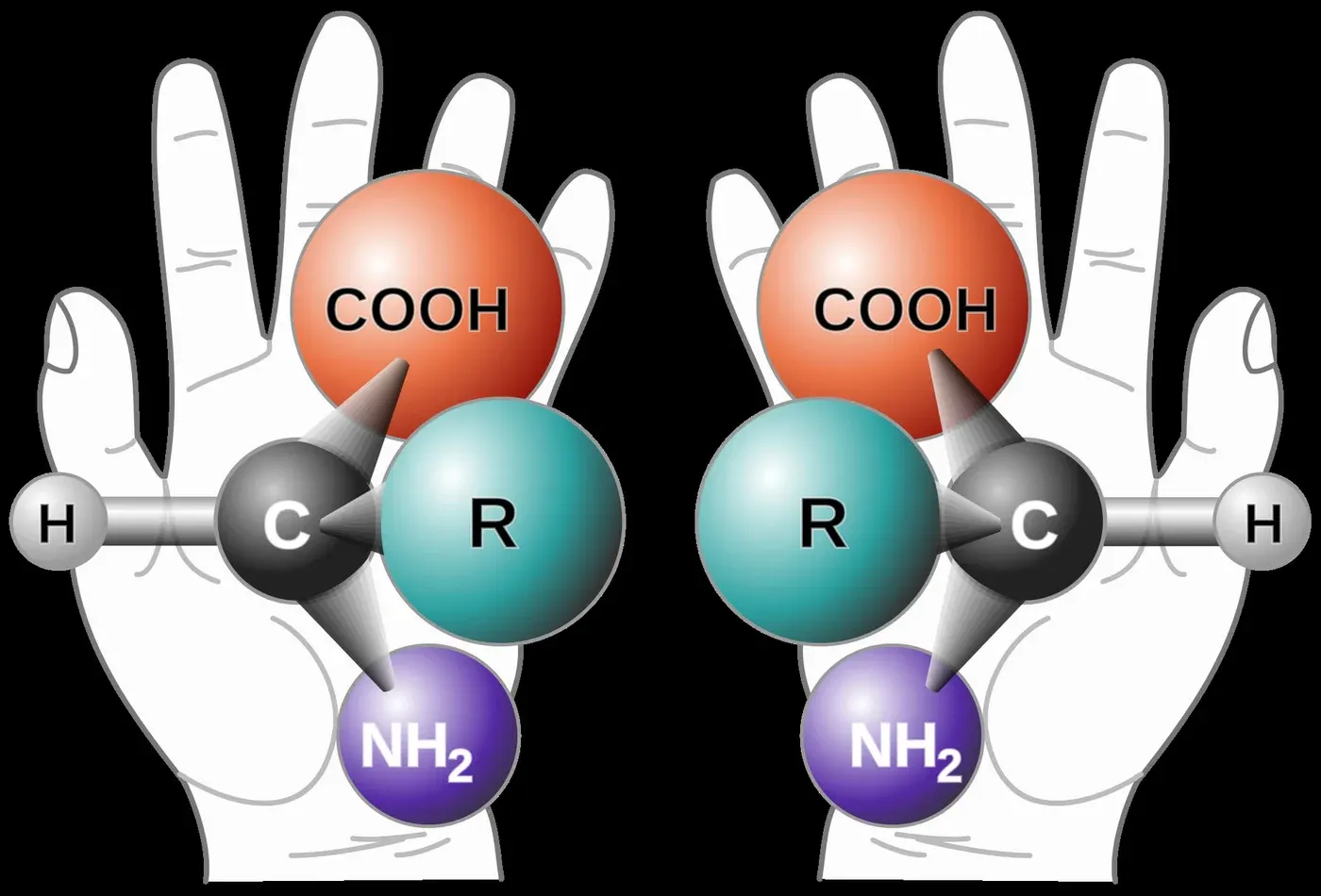
Figure: A pair of mirror-image amino acids drawn on left and right hands, with the same atoms in the same order but impossible to superimpose (2008) · Public domain, via Wikimedia Commons
The two hands share most of the same properties, such as melting point and boiling point. The difference emerges only when the counterpart is also a hand. Because the enzymes, receptors, transporters, and DNA that drugs interact with inside the body often demand a precise fit, a drug with a mixture of both hands and a drug containing only one hand can behave very differently inside the body (DOI: 10.1093/toxsci/kfp097). This is the same principle by which a right-handed glove accepts only a right hand. The same review notes that the two hands can also differ in carcinogenicity or harm to a fetus (DOI: 10.1093/toxsci/kfp097).
Therefore, the hands become an issue when making drugs. A 2006 review noted that over half of the drugs used at the time were chiral molecules, and that nearly 90 percent of those were sold as a 50-50 mixture of both hands (DOI: 10.59566/ijbs.2006.2085). The situation is different for newly released drugs. A 2012 study notes that the recognition of the importance of drug handedness spread widely due to the thalidomide tragedy, and that most new drugs coming onto the market around that time contained only a single hand (DOI: 10.1002/chem.201202651).
Thalidomide is the name most frequently called upon in the story of hands, but what the evidence tells us is not simple. This drug’s two hands convert into each other inside the body (DOI: 10.1211/0022357001774660). In a study where the two hands were administered intravenously separately to six healthy men, the only observed effect was drowsiness, and its degree was related to the blood concentration of the right-handed form (R-form) (DOI: 10.1211/0022357001774660). Many single-handed drugs, including thalidomide, convert into the other hand inside the body, which can erase the advantage of having only one hand or produce unexpected effects (DOI: 10.1002/chem.201202651). This means that while isolating a single hand is important, the risks of a drug cannot be managed by that factor alone.
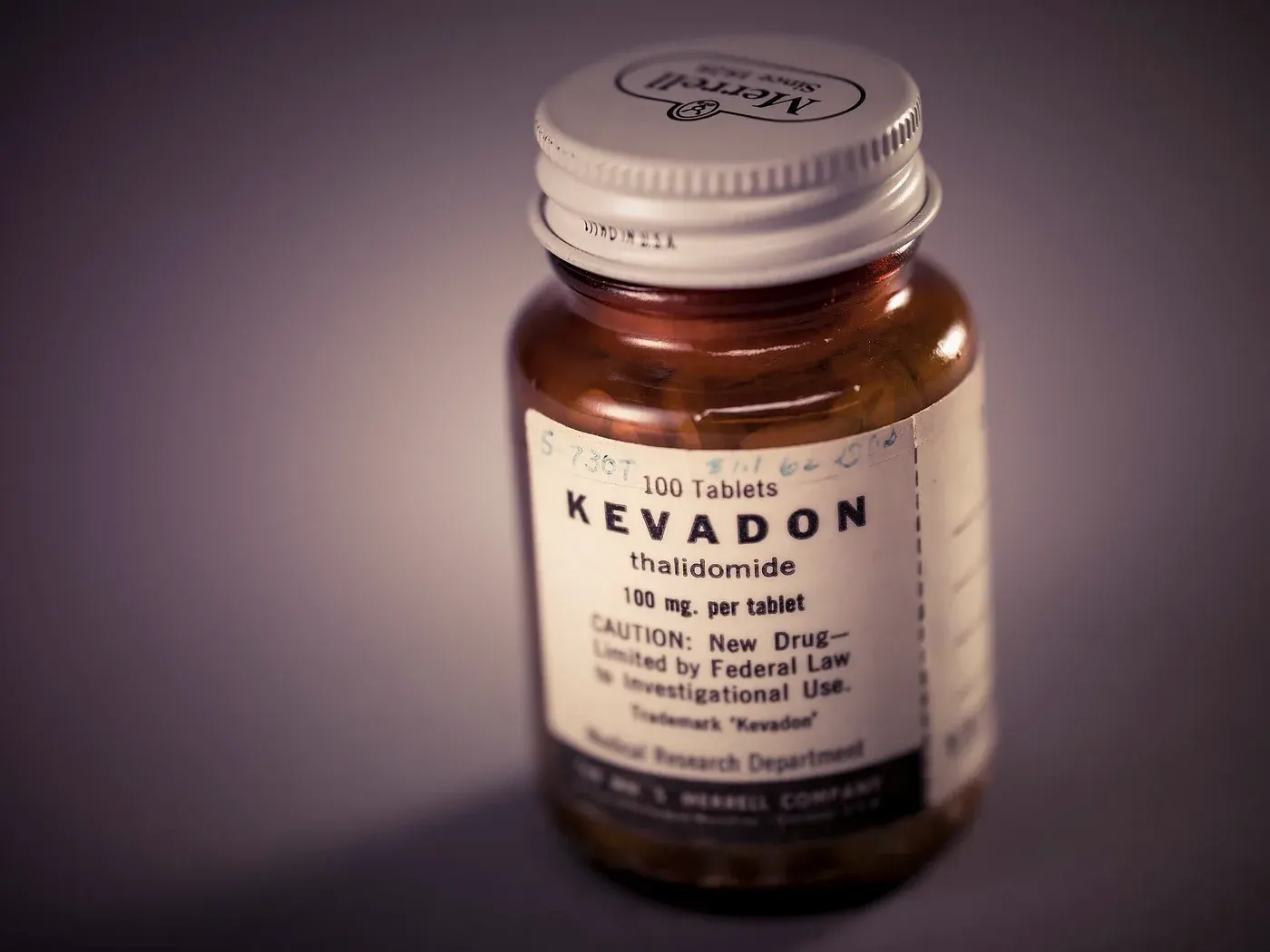
Figure: A bottle of Kevadon, thalidomide distributed for investigational use in the US in the early 1960s, from the FDA collection (photographed 2019) · Public domain, via Wikimedia Commons
There have also been attempts to solve the handedness-conversion problem in reverse. Drugs derived from thalidomide have been developed and sold as mixtures of both hands because their hands convert inside the body (DOI: 10.1073/pnas.1417832112). In 2015, a research team locked each hand in place by replacing the hydrogen at the inversion site with heavy hydrogen. As a result, the anti-inflammatory potency in a test tube differed by up to 20 times between the two hands, and in an animal model transplanted with human myeloma cells, only one hand suppressed tumor growth while the other showed almost no effect (DOI: 10.1073/pnas.1417832112). Although these are results from the in vitro and animal stages, they demonstrate just how differently two hands made of the same atoms can work inside the body.
There is one takeaway from this section. Because the body distinguishes between the two hands, technology that selectively synthesizes the desired hand has practical utility.
How to Make Just One Hand
Asymmetric synthesis is chemical synthesis designed to make more of one hand between the two hands. If you run a reaction without any special devices, the two hands come out half and half, so you have to put something with a single hand somewhere in the reaction to tilt the balance.
The reason the two hands come out half and half is simple. If neither the starting materials nor the reaction environment has a single hand, the path to make the right hand and the path to make the left hand become identical conditions, like reflections in a mirror. Neither path is any easier, so the two hands come out in equal amounts. When something with a single hand intervenes, one of those two paths becomes easier.
One efficient device is a catalyst (DOI: 10.1002/anie.200705241). A catalyst is a substance that makes a reaction happen faster while remaining unchanged after the reaction ends. If the catalyst itself has a single hand, the product coming through that catalyst will also tilt toward one hand. Such catalysts are usually made from single-handed substances obtained from nature, or by separating one hand from a fifty-fifty mixture of starting materials (DOI: 10.1002/anie.200705241).
A scale to measure how much it has tilted is needed. Enantiomeric excess is the value obtained by subtracting the proportion of the less abundant hand from the proportion of the more abundant hand, serving as a scale to measure how pure a single hand is. If there is 60% right hand and 40% left hand, the enantiomeric excess is 20%. If it is fifty-fifty, it is 0%; if there is only the right hand, it is 100%.
With this scale, we can write down common sense that chemists have long held. It is the common sense that if the enantiomeric excess of the catalyst is half, the enantiomeric excess of the product will also be roughly half. Therefore, catalysts with less purity seemed to have no reason to be used (DOI: 10.1002/anie.200705241). The discovery in the next section starts right from this common sense.
1986: The Breakdown of Proportionality
In 1986, Kagan's research group showed that in one oxidation reaction, the enantiomeric excess of the product came out higher than the enantiomeric excess of the catalyst, and they also put forward a framework to explain why (Nobel Committee, scientific background). A 1998 review and the Nobel Committee's scientific background both note that until then, it was usual to assume that the purity of the product was directly proportional to the purity of the catalyst (DOI: 10.1002/(sici)1521-3773(19981116)37:21<2922::aid-anie2922>3.0.co;2-1) (Nobel Committee, scientific background). The same review asks who would have thought beforehand that an impure catalyst could yield a product purer than the catalyst itself, and writes that in reality, it can deviate greatly from that straight line (DOI: 10.1002/(sici)1521-3773(19981116)37:21<2922::aid-anie2922>3.0.co;2-1).
To see what that straight line is in numbers, let us put it this way. Suppose there is a reaction where a pure catalyst yields a product with an enantiomeric excess of 90%. If the enantiomeric excess of the raw material used to make the catalyst drops to 50%, following the straight line should yield half that, 45% for the product. None of the three reactions that the 1986 study first examined in detail followed this straight line. Two came out lower than expected, and one came out higher (Nobel Committee, scientific background). This means this value can come out much higher than 45%, or much lower (DOI: 10.1021/ja973049m).
A non-linear effect is a phenomenon where the purity of the catalyst and the purity of the product are not directly proportional but curve to one side. There are two directions of curving. If the product becomes purer than expected, it is amplification, and if it becomes less pure, it is the opposite (DOI: 10.1021/ja973049m). A 2023 article by Kagan's students and colleagues summarizing his research career lists the problem of non-linear effects and the question of the origin of handedness on Earth as the topics he worked on (DOI: 10.1021/acscatal.3c02965).
There is a predecessor to this idea. A 2000 commentary notes that the non-linear effect in asymmetric synthesis was predicted 60 years earlier by chemist W. Langenbeck, and compares it to how, in cases where chiral raw materials are reacted directly without a catalyst, a similar amplification phenomenon has been known for a long time (DOI: 10.1002/(sici)1521-3773(20000204)39:3<495::aid-anie495>3.0.co;2-g). Kagan's research group's explanation is as follows. If a single catalyst has two handed parts attached, an impure raw material will produce catalysts mixed with both right- and left-handed parts, in addition to catalysts made of matching handed parts. If the mixed catalysts work better, the product becomes less pure than expected, and if the catalysts made of matching handed parts work better, it becomes purer (Nobel Committee, scientific background). Kagan and his coworkers built a mathematical model for this curving (DOI: 10.1021/ja973049m), and other research groups broadened the framework by even predicting reaction rates using that model (DOI: 10.1021/ja973049m, DOI: 10.1021/ja982448u). The concept of non-linear effects was subsequently expanded to non-catalytic reagents and other types of reactions (DOI: 10.1055/s-2001-14660).
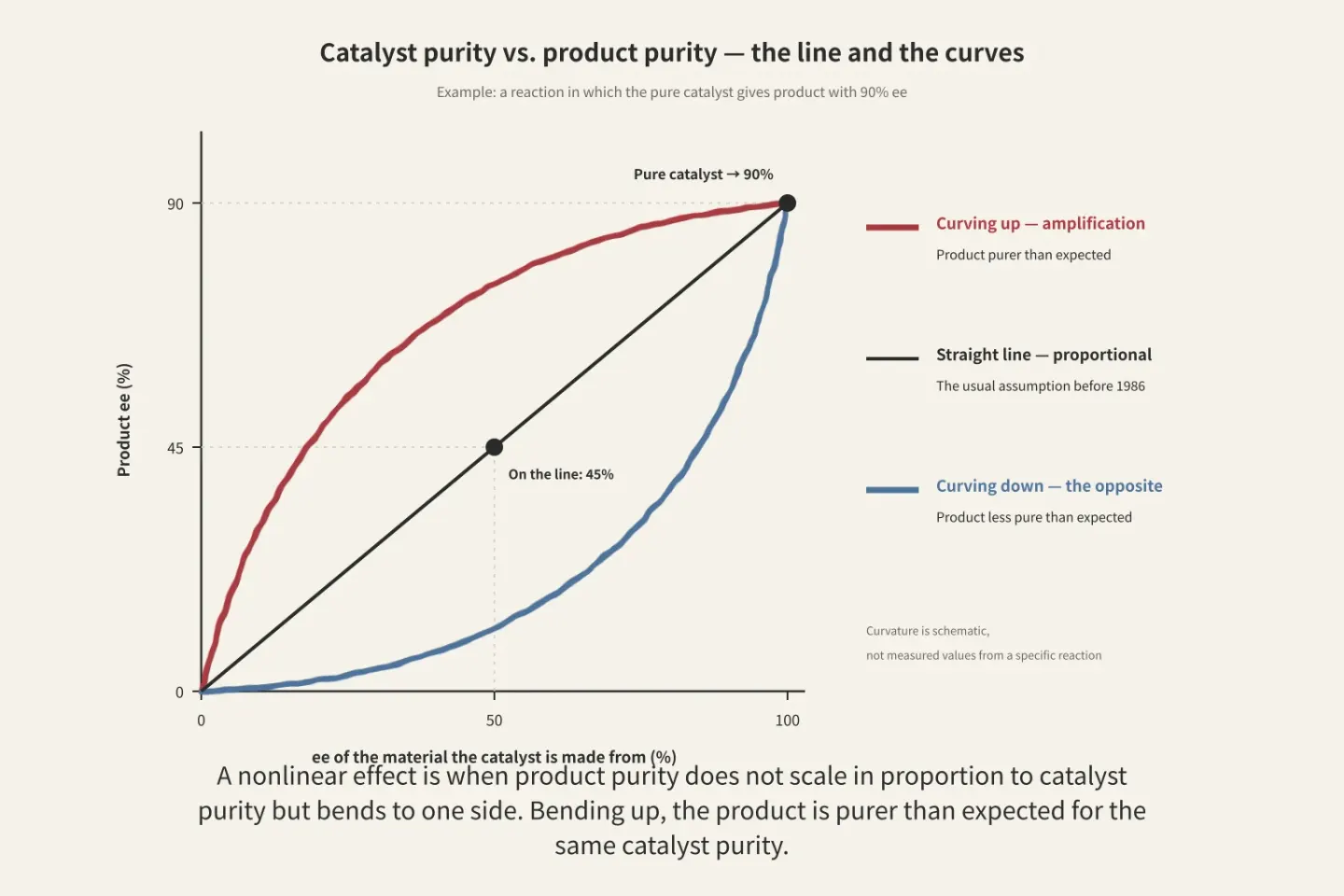
Figure: a diagram Paperis drew using only what the article says
Where the curving comes from can be seen by following one reaction. In a reaction linking two molecules using a zinc-containing catalyst, the purity of the product was much higher than the purity of the raw material that made the catalyst, and the lower the purity of the raw material, the more noticeably slow the reaction became (DOI: 10.1021/ja981740z). In this family of reactions led by a research group headed by chemist Ryoji Noyori, when the enantiomeric excess of the raw material was 15%, the product came out at 98% (Nobel Committee, scientific background). The cause lay in right-handed catalysts and left-handed catalysts pairing up with the same handedness and with the other handedness, joining and breaking apart (DOI: 10.1021/ja981740z). As summarized in the Nobel Committee's scientific background, pairs mixed with both right- and left-handed parts are more stable, so the hand in smaller quantity gets tied up in those pairs and cannot work as a catalyst (Nobel Committee, scientific background). Keeping this pairing at the core, amplification is explained by the difference in turnover numbers between the cycle driven by the right-handed catalyst and the cycle driven by the left-handed catalyst (DOI: 10.1002/tcr.1). This research group reproduced the experimental results with calculations that incorporated both pairing equilibrium and reaction rates (DOI: 10.1021/ja981740z).
There is a price attached to this. In reactions that sharply boost product purity, the rate at which the product is formed can drop significantly (DOI: 10.1021/ja973049m). An impure catalyst can yield a purer product, and at that price, the reaction can become slow.
Non-linear effects also have two uses. One is practical. It opens a way to obtain pure products even with impure catalysts (DOI: 10.1002/anie.200705241). A pharmaceutical company research group obtained a product with a 95% enantiomeric excess using reagents made from a 70% pure raw material during the process of making a drug candidate substance (Nobel Committee, scientific background). The other is diagnosis. Looking at how much it deviates from the straight line gives clues about what the catalyst actually looks like while it is working inside the reaction (DOI: 10.1002/anie.200705241, DOI: 10.1055/s-2001-14660).
Reactions Where the Product Becomes the Catalyst
In nonlinear effects, the catalyst remains in the exact initial amount throughout the reaction. The Soai reaction is different in precisely that point. Autocatalysis is a reaction where the product resulting from the reaction becomes the catalyst for that very same reaction to make more of its share. If the product is one hand and that product is a catalyst that makes more of the same hand, the catalyst multiplies by itself as the reaction proceeds.
Autocatalysis alone does not multiply one hand. If a pure catalyst yields a product with an enantiomeric excess of 90%, reusing that product as a catalyst yields 81%, and repeating it lowers it further (Nobel Committee, scientific background). For one hand to multiply, the nonlinear effect from the previous section must be present together. The autocatalysis that Soai first observed in 1990 was precisely a side that eroded in that manner. The product made more of the product of the same hand, but a catalyst with an enantiomeric excess of 86% yielded 35% product (Nobel Committee, scientific background). Five years later, in 1995, the Soai research team reported an autocatalytic reaction where purity rises. Using a product with an enantiomeric excess of 5% as a catalyst yielded 55%, and using the new product as a catalyst again to run it five consecutive times reached 90% (Nobel Committee, scientific background).
In the Soai reaction, a molecule called pyrimidyl alkanol does precisely this job. This molecule is both the product of a reaction where one aldehyde and one zinc compound meet, and a catalyst that guides the same reaction toward the same hand as itself (DOI: 10.1021/bk-2017-1258.ch003). A 1996 journal commentary introduced this reaction, asking "A Darwinian Property in Catalysis?", and noted that in such self-replicating systems, repeating the reaction multiple times can enormously amplify the enantiomeric excess (DOI: 10.1002/anie.199616571).
Even larger numbers emerged. According to an article summarizing their own research by the Soai research team, a product starting at an enantiomeric excess of roughly 0.00005% multiplied to over 99.5% through the reaction (DOI: 10.1021/ar5003208). Another summary article by the same research team and the Nobel Committee scientific background record that this exceeded 99.5% through three consecutive reactions (DOI: 10.1021/bk-2017-1258.ch003) (Nobel Committee, scientific background). 0.00005% means that out of 4 million molecules, one hand outnumbers the other by barely 2. 99.5% means that 997 to 998 out of 1,000 are one hand. According to the first article, in the meantime, the hand that was initially very slightly abundant multiplied by roughly 630,000 times, while the hand that was very slightly scarce multiplied by less than 1,000 times (DOI: 10.1021/ar5003208). When a product replicates its own hand, a nearly invisible tilt becomes almost the entirety.
Amplification occurring in a single reaction has also been recorded. In an experiment where another research team created new starting materials and ran the reaction side by side multiple times under the same conditions, a single reaction increased the enantiomeric excess from 7.2% to 94.1%, and from 3.1% to 92.1%. This is the largest value reported up to that time for single-reaction amplification in the Soai reaction (DOI: 10.1002/chem.200900634). A difference that was less than one in ten became a difference exceeding nine in ten in a single attempt.
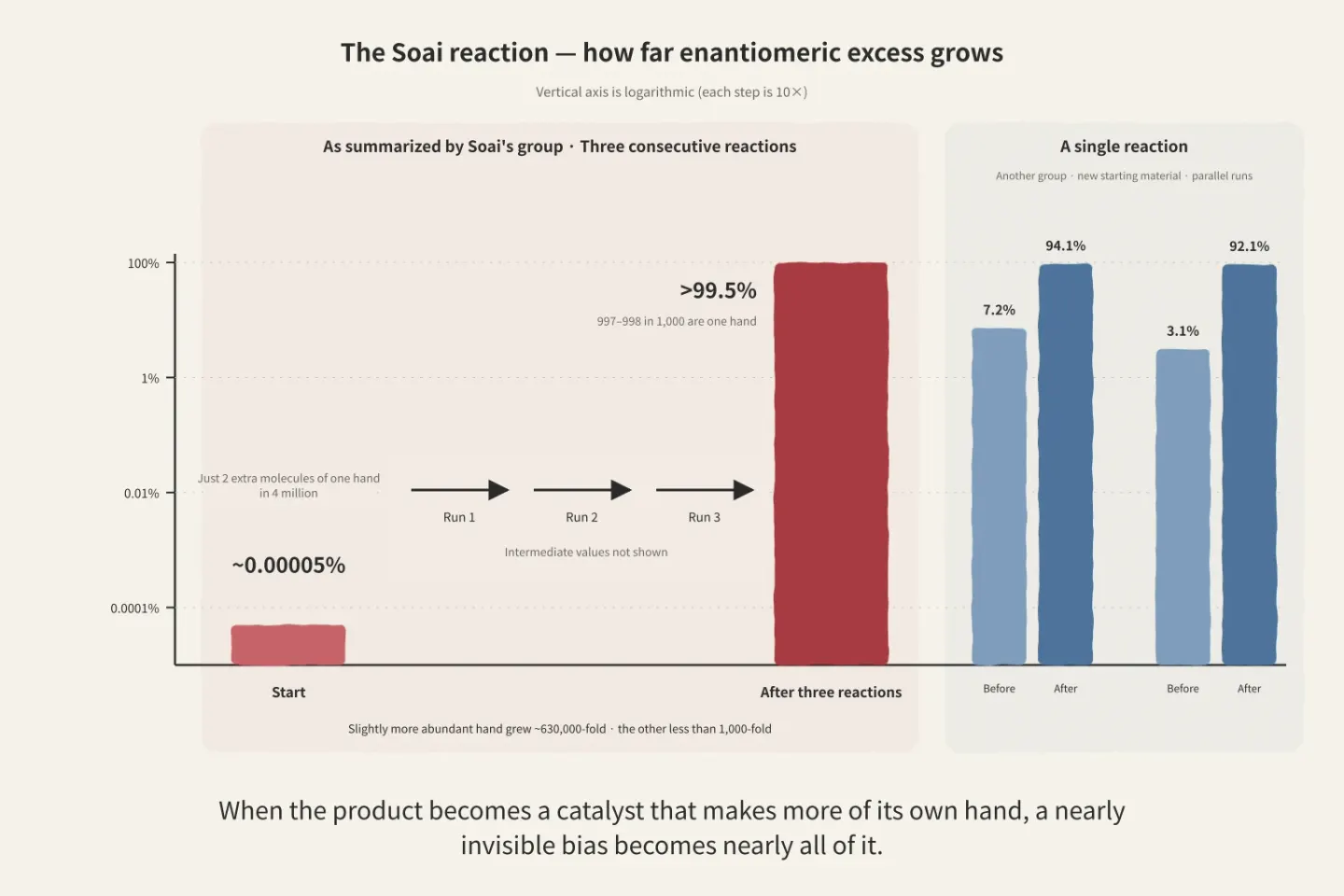
Figure: a diagram Paperis drew using only what the article says
One must also know how rare this reaction is. A 2010 summary article described the Soai reaction as the only chemical reaction at the time where large amplification of enantiomeric excess and asymmetric autocatalysis could be studied together (DOI: 10.1002/chir.20849), and a 2019 review states that the Soai reaction is the only experimental example of an amplifying autocatalyst (DOI: 10.1021/acs.chemrev.9b00557). Nonlinear effects, on the other hand, are relatively common in asymmetric synthesis (DOI: 10.1039/9781839163685-00104).
Theory came before experiments. Models in which one hand is generated via autocatalysis have attracted attention for over half a century, and a 2019 review summarizes that the history of those theoretical models led to the discovery of the Soai reaction (DOI: 10.1021/acs.chemrev.9b00557). The representative one is a mathematical model put forward in 1953 by theoretical physicist Frederick Charles Frank at the University of Bristol in the UK (Nobel Committee, scientific background). The Frank model weaves together an autocatalyst that makes more of the same hand and a process where the two hands block each other's work (DOI: 10.1073/pnas.0503171102). Frank wrote that demonstrating it in the laboratory would not be impossible, and the Nobel Committee explains the Soai reaction as the first case confirming that model in the laboratory (Nobel Committee, scientific background).
How this happens is still contested. A 2020 study notes that the exact mechanism remains under debate due to complex equilibria and elusive intermediates, and proposes a new mechanism in which another complex formed transiently during the reaction forms the autocatalytic loop (DOI: 10.1002/chem.202003260). A model where two catalyst molecules pair up predicted low-temperature experimental values too low by up to four orders of magnitude, and an analysis incorporating a tetrameric cluster matched the experiment (DOI: 10.1002/cphc.200900369). A 2017 quantitative model also views the site where amplification occurs as low-concentration tetrameric clusters, and considers that it does not happen in the easily noticeable dimeric clusters (DOI: 10.1002/cctc.201701554). In a 2005 reaction rate model as well, the process where the two hands inhibit each other is a core element, and that inhibition appears to stem from the equilibrium where molecules pair up. The same model notes that the exact process by which the step making more of the same hand occurs has not yet been elucidated, and concludes that looking solely at reaction rates, assuming a single unpaired molecule acts as the catalyst can explain all experimental results reported so far (DOI: 10.1073/pnas.0503171102). The Nobel Committee scientific background summarizes that two detailed mechanisms currently exist. One proposal is that a cluster of four same-hand molecules captures the starting material, and the other proposal is that a complex formed transiently during the reaction forms the autocatalytic loop. There is also the argument that since the two studies used different starting materials, both could hold true (Nobel Committee, scientific background). Whether what acts as the catalyst is a single molecule, a tetrameric cluster, or another transiently formed complex yields different answers across studies.
Even When We Tipped Nothing At All
There is an even stranger aspect to the Soai reaction. Even when you put in no single-handed material at all and react only an aldehyde and a zinc compound, the product comes out tipped toward the right hand or the left hand enough to be measured, and if you then repeat the reaction, it becomes almost entirely one-handed. Which side it tilts toward is split randomly every time (DOI: 10.1039/9781839166273-00065, DOI: 10.1063/1.2901849). This is interpreted as happening because a small imbalance that accidentally occurs at first acts directly as a catalyst and gets amplified (DOI: 10.1039/9781839166273-00065). In the Soai research team's 2003 experiment, out of 37 times, 18 times tilted toward the R-form and 19 times toward the S-form, and the enantiomeric excess spread from 15% to 91%. Chemist Daniel Singleton's research team also separately showed the same phenomenon (Nobel Committee, scientific background).
Strictly speaking, an exact fifty-fifty split is rather rare. Because the number of molecules is finite, you cannot avoid one side becoming slightly more numerous purely by probability, even with no factors at all (DOI: 10.1135/cccc20030849). One experimental report from 2003 notes that this tilt clearly appeared even in clean, new reaction vessels and did not depend on any single reaction condition. The research team explains the reason like this: in autocatalysis, the entire final product "reproduces" out of the first few reactions, so the accidental difference among those very first few molecules becomes a measurable tilt (DOI: 10.1039/b307382n). The first few events determine the hand of the whole.
Room for counterarguments remains here. A 2003 commentary notes that there is no easy way to distinguish between a reaction starting from a very small accidental bias and a reaction starting from an unconfirmed trace amount of a single-handed impurity. The same commentary nevertheless judges it nearly certain that the Soai reaction can produce a single hand even under impurity-free conditions (DOI: 10.1135/cccc20030849).
There are also reports of seeing similar spontaneous tilting in two other, more common reactions. The finding is that, under conditions without any single-handed factor, the enantiomeric excess of the product came out randomly between 0.3% and 50.8% (DOI: 10.1002/chir.20474). This is a report by a single research team and should be read alongside a 2019 review's summary that the experimental example of autocatalysis with massive amplification remains solely the Soai reaction.
Conversely, if you deliberately give a very small trigger, the reaction follows that trigger. Circularly polarized light, which is light twisted to one side, mineral crystals like quartz, and even molecules where only the weight of a single atom is changed, such as replacing hydrogen with heavy hydrogen, have served as triggers, producing products heavily tilted toward the hand designated by the trigger (DOI: 10.1021/ar5003208).
Just how small a trigger can be detected has also been measured through experiments. Even when single-handed material was added at concentrations lower than $10^{-14}$ moles per liter, the reaction followed that hand, and a 2005 reaction rate model reproduced experimental results where an enantiomeric excess of less than 0.000001% swelled to over 60%, matching this sensitivity (DOI: 10.1073/pnas.0503171102).
One research team proposed using this property in reverse, as a measurement method that amplifies an enantiomeric excess too small to measure and then back-calculates the original value (DOI: 10.1002/chem.200900634). This reaction acts as a magnifying glass that enlarges invisible differences in hand until they can be seen with the eye.
Why Life Uses Only One Hand
Biological amino acids are left-handed (L-form), and sugars are right-handed (D-form) (DOI: 10.1201/9781003294276-7). Homochirality is the state in which the amino acids and sugars used by living things are each provided in only one hand. The primitive Earth likely had both hands in roughly equal amounts, and the question is how only one hand remained (DOI: 10.1101/cshperspect.a032540).
The leading picture for this question has two stages. First, some reason creates a small tilt, and second, that tilt is amplified so that only one hand remains (DOI: 10.1103/revmodphys.85.603). Because candidates for the first stage, such as circularly polarized light or crystals like quartz, can only create a low or medium enantiomeric excess, Soai's team reasons that amplification in the second stage is necessary (DOI: 10.1201/9781003294276-7). For the first stage candidates, several proposals have been put forward, such as the hypothesis that strong infrared circularly polarized light was observed in regions where stars form, and circularly polarized light of a shorter wavelength created hand differences in cosmic molecules, explaining the bias of amino acids in meteorites (DOI: 10.1126/science.281.5377.672), and the hypothesis that electrons released when ultraviolet light hit magnetite may have helped a one-handed reaction (DOI: 10.1073/pnas.2204765119).
Putting these two stages to an actual experiment looks like this. Circularly polarized light by itself can only create a low or medium tilt (DOI: 10.1201/9781003294276-7). However, if the small imbalance created by shining circularly polarized light is put into the Soai reaction as a trigger, a product heavily tilted toward the hand designated by the trigger comes out (DOI: 10.1201/9781003294276-7, DOI: 10.1021/ar5003208). One candidate for the first stage and the second stage were connected inside a flask. Because this connection was achieved with laboratory materials, it is far from evidence that the same thing happened on the primitive Earth.
The Soai reaction showed that the second stage is actually possible in the laboratory. A 2013 review names the amplification by Soai's research team and the one-handed crystals obtained by researcher Viedma while growing sodium chlorate crystals as two experiments that established the second stage (DOI: 10.1103/revmodphys.85.603). However, the same review notes that we still do not know where the homochirality of life came from (DOI: 10.1103/revmodphys.85.603). The Soai reaction is a reaction that runs on laboratory materials not directly connected to the primitive Earth, and how life's one-handedness arose has not been solved yet. A 2012 review notes that experiments in the late 20th century confirmed the basic properties of theoretical models, but in chemical systems not directly related to the primitive Earth (DOI: 10.1021/ar200316n), and a 2019 review leaves finding a plausible amplifying autocatalyst on the primitive Earth as a task for the future (DOI: 10.1021/acs.chemrev.9b00557).
The Nobel Committee's scientific background draws the same line. The Frank model does not answer where life's one-handedness came from and is one of several possible explanations, and that event, which took place 3,500,000,000 to 4,000,000,000 years ago, will probably never have a definitive answer. It also notes that the Soai reaction is an important proof of concept, but is not directly related to the problem of how life's one-handedness arose in water (Nobel Committee, scientific background).
As paths for amplification, there are candidates other than autocatalysis. The process of crystals melting and growing back (DOI: 10.1021/ja303566g), and models dealing with the breaking and joining of long chains (DOI: 10.1021/acs.jpcb.6b10705) are also being studied as routes that can magnify a small bias into one hand. The Soai reaction is a chemical reaction showing that amplification actually happens among several candidates, and which path life took remains open.
Now, and Open Questions
Now, 40 years after 1986, the two discoveries are used in different ways. The sensitivity of the Soai reaction has been used to tell apart the hands of hydrocarbons whose hands can hardly be sorted out by any other method (DOI: 10.1021/ar5003208). Nonlinear effects became a tool to peer into what catalysts look like while working inside a reaction, and a 2008 review summarizes that over the preceding decade, their uses broadened to both metal-bearing catalysts and organic catalysts (DOI: 10.1002/anie.200705241).
The open questions are also clear. Exactly what form of molecule works as a catalyst in the Soai reaction is still debated (DOI: 10.1002/chem.202003260). Amplification reactions running on prebiotic Earth materials are still being searched for (DOI: 10.1021/acs.chemrev.9b00557). Whether the initial tilt came from light, from minerals, or from chance is also unsettled (DOI: 10.1103/revmodphys.85.603).
The one line to take with you is this: a small tilt can be blurred or greatly magnified depending on the setup of the reaction, and the two laureates' research showed the path by which it is magnified in the laboratory.
Where to Look Further
- The principle by which catalysts lower the hill of a reaction continues in "Chemical Reactions — The Hill to Climb, the Road Traveled Both Ways".
- How molecules are put together from atoms can be seen from the beginning in "Elements and Molecules — 118 Pieces of Type, Tens of Millions of Words".
- How atoms bind together to form the shape of a molecule is covered by "Chemical Bonds — A Rope Held Together, a Rope Pulled to One Side".
Awards in other categories that same year continue in The 2026 Nobel Prize in Physiology or Medicine — A Door Opened by Light, From Pond Algae to a Switch for the Brain, The 2026 Nobel Prize in Physics — Messengers from the Cosmos, Caught in a Cubic Kilometer of Ice, The 2026 Nobel Prize in Economics — From One Household's Arithmetic to a Nation's Business Cycle, The 2026 Nobel Prize in Literature — Anne Carson, New Forms from a Dialogue with Ancient Poetry, and The 2026 Nobel Peace Prize — Crimes Named in Court: Navi Pillay and the International Criminal Tribunal for Rwanda.
Award Materials
- "The 2026 Nobel Prize in Chemistry Press Release" (2026) — https://www.kva.se/en/news/the-nobel-prize-in-chemistry-2026/ — Laureates and affiliations, original motivation for the prize, research from 1986 and 1995, committee evaluation
- "Scientific Background on the 2026 Nobel Prize in Chemistry" (2026) — https://www.kva.se/en/news/the-nobel-prize-in-chemistry-2026/ — History of nonlinear effects and the Soai reaction, the Frank model, two proposed mechanisms, committee's caveat on the origin of life's single handedness
Source Papers
- "Chiral Toxicology: It's the Same Thing…Only Different" (2009) — DOI: 10.1093/toxsci/kfp097 — Because enzymes, receptors, and DNA have single-handed structures, the properties of two hands can differ greatly, hand-switching inside the body can eliminate benefits, and carcinogenicity and teratogenicity can also differ.
- "Chiral Drugs. An Overview" (2006) — DOI: 10.59566/ijbs.2006.2085 — More than half of the drugs in use are handed molecules, and nearly 90% of those are sold as 50-50 mixtures.
- "Enantiomerization Mechanism of Thalidomide and the Role of Water and Hydroxide Ions" (2012) — DOI: 10.1002/chem.201202651 — The thalidomide tragedy revealed the importance of handedness (as of 2012), and most new drugs are single-handed forms, but many drugs including thalidomide change hands inside the body (computational study).
- "Intravenous Formulations of the Enantiomers of Thalidomide: Pharmacokinetic and Initial Pharmacodynamic Characterization in Man" (2000) — DOI: 10.1211/0022357001774660 — In 6 healthy men, the two hands swapped into each other inside the body, and the observed drowsiness correlated with the concentration of the R-form.
- "Differentiation of antiinflammatory and antitumorigenic properties of stabilized enantiomers of thalidomide analogs" (2015) — DOI: 10.1073/pnas.1417832112 — Up to a 20-fold difference in in vitro anti-inflammatory effects between two hands held in place by heavy hydrogen, with only one hand suppressing tumors in an animal graft model.
- "Nonlinear Effects in Asymmetric Catalysis" (2008) — DOI: 10.1002/anie.200705241 — The origin of handed catalysts, the expectation of proportionality to purity and its departure, the diagnosis and practical value of nonlinear effects, and expansion over the past decade.
- "Nonlinear Effects in Asymmetric Synthesis and Stereoselective Reactions: Ten Years of Investigation" (1998) — DOI: 10.1002/(sici)1521-3773(19981116)37:21<2922::aid-anie2922>3.0.co;2-1 — Before 1986, product purity was thought to be directly proportional to catalyst purity, but it can deviate significantly.
- "Mathematical Models of Nonlinear Effects in Asymmetric Catalysis: New Insights Based on the Role of Reaction Rate" (1997) — DOI: 10.1021/ja973049m — Predicting reaction rates with the Kagan model, where strong amplification can come at the cost of lowered rates, and negative nonlinear effects also exist.
- "A Pioneering Career in Catalysis: Henri B. Kagan" (2023) — DOI: 10.1021/acscatal.3c02965 — Dedicatory writings by students and colleagues, including nonlinear effects and the problem of the origin of handedness on Earth in Kagan's research scope.
- "How Long Have Nonlinear Effects Been Known in the Field of Catalysis?" (2000) — DOI: 10.1002/(sici)1521-3773(20000204)39:3<495::aid-anie495>3.0.co;2-g — Nonlinear effects in asymmetric synthesis were predicted 60 years ago by Langenbeck, and stoichiometric reaction amplification using handed starting materials has been known for a long time.
- "Nonlinear Effects in Asymmetric Catalysis: A Personal Account" (2001) — DOI: 10.1055/s-2001-14660 — Retrospection on the discovery of nonlinear effects, the expansion of the concept, and its use as a mechanistic tool.
- "Quantitative Analysis of the Chiral Amplification in the Amino Alcohol-Promoted Asymmetric Alkylation of Aldehydes with Dialkylzincs" (1998) — DOI: 10.1021/ja981740z — In zinc-catalyzed reactions, product purity is much higher than that of the starting material while the rate drops, caused by same-hand and different-hand pairing, with calculations reproducing experiments.
- "Kinetic Implications of Nonlinear Effects in Asymmetric Synthesis" (1998) — DOI: 10.1021/ja982448u — Simulating reactions using initial selectivity data to extend the Kagan model into a mechanistic tool.
- "Self and nonself recognition of chiral catalysts: The origin of nonlinear effects in the amino‐alcohol catalyzed asymmetric addition of diorganozincs to aldehydes" (2001) — DOI: 10.1002/tcr.1 — Amplification reflects differences in turnover numbers between two enantiomeric catalyst rings, with reversible pairing being key.
- "Mechanisms of Amplification" (2022) — DOI: 10.1039/9781839163685-00104 — Experimental examples of autocatalytic amplification are uniquely found in the Soai reaction, and nonlinear effects are relatively common in asymmetric synthesis.
- "Asymmetric Autocatalysis and the Origin of Homochirality" (2017) — DOI: 10.1021/bk-2017-1258.ch003 — Pyrimidyl alkanol catalyzes its own production, amplifying an extremely low enantiomeric excess to over 99.5% through three consecutive reactions.
- "Asymmetric Autocatalysis with Amplification of Chirality" (1996) — DOI: 10.1002/anie.199616571 — Journal commentary: "A Darwinian Principle within Catalysts?", with enormous amplification of enantiomeric excess across multiple cycles.
- "Asymmetric Autocatalysis of Pyrimidyl Alkanol and Its Application to the Study on the Origin of Homochirality" (2014) — DOI: 10.1021/ar5003208 — From about 0.00005% to over 99.5%, with the abundant hand amplified roughly 630,000-fold and the scarce hand under 1,000-fold, triggered by circularly polarized light, crystals, and isotopes.
- "A concise summary of experimental facts about the Soai reaction" (2010) — DOI: 10.1002/chir.20849 — The sole reaction at the time capable of studying large amplification and asymmetric autocatalysis together.
- "Autocatalytic Models for the Origin of Biological Homochirality" (2019) — DOI: 10.1021/acs.chemrev.9b00557 — The only experimental example of amplifying autocatalysis, with finding a plausible setting on the primitive Earth remaining a challenge.
- "In Situ Mass Spectrometric and Kinetic Investigations of Soai's Asymmetric Autocatalysis" (2020) — DOI: 10.1002/chem.202003260 — The exact mechanism is still debated, proposing a mechanism where hemiacetal complexes form autocatalytic rings.
- "Amplification of Chirality and Enantioselectivity in the Asymmetric Autocatalytic Soai Reaction" (2009) — DOI: 10.1002/cphc.200900369 — A dimer model predicts 0°C experimental values up to four orders of magnitude too low, whereas incorporating tetrameric aggregates matches them.
- "A Quantification of the Soai Reaction" (2017) — DOI: 10.1002/cctc.201701554 — Amplification stems not from readily visible dimers, but from low-concentration tetrameric aggregates.
- "Mirror-symmetry breaking in the Soai reaction: A kinetic understanding" (2005) — DOI: 10.1073/pnas.0503171102 — Reproducing Soai reaction behavior via a model of same-hand autocatalysis and mutual inhibition between the two hands, matching all experimental effects even when placing a single unpaired molecule as a catalyst.
- "Reflections on spontaneous asymmetric synthesis by amplifying autocatalysis" (2003) — DOI: 10.1039/b307382n — Spontaneous tilting even in clean new vessels, explained by a probabilistic effect of "reproducing" from a small number of initial events.
- "Demonstration of spontaneous chiral symmetry breaking in asymmetric Mannich and Aldol reactions" (2007) — DOI: 10.1002/chir.20474 — Random enantiomeric excesses of 0.3 to 50.8% under conditions devoid of single-handed factors (single study).
- "Absolute Asymmetric Synthesis in the Soai Reaction" (2022) — DOI: 10.1039/9781839166273-00065 — Products tilt randomly toward R or S even without single-handed factors, and the initial imbalance acts as a catalyst to be amplified.
- "Symmetry Breaking in Asymmetric Autocatalysis of Pyrimidyl Alkanol" (2008) — DOI: 10.1063/1.2901849 — Spontaneous asymmetric synthesis where R and S split randomly without any single-handed substances.
- "Absolute Asymmetric Synthesis: A Commentary" (2003) — DOI: 10.1135/cccc20030849 — While accidental biasing and trace impurities cannot be easily distinguished, spontaneous asymmetric synthesis under impurity-free conditions is nearly certain.
- "Systematic Studies using 2‐(1‐Adamantylethynyl)pyrimidine‐5‐carbaldehyde as a Starting Material in Soai's Asymmetric Autocatalysis" (2009) — DOI: 10.1002/chem.200900634 — Record highs at the time of single-reaction amplification (7.2 to 94.1%, 3.1 to 92.1%), proposing a measurement method that amplifies a small enantiomeric excess before working backward.
- "Asymmetric Autocatalysis and the Origins of Homochirality" (2023) — DOI: 10.1201/9781003294276-7 — Life's L-amino acids and D-sugars, along with circularly polarized light and quartz, create only low or moderate enantiomeric excesses, necessitating amplification.
- "The Origin of Biological Homochirality" (2019) — DOI: 10.1101/cshperspect.a032540 — Assuming that the primitive Earth had equal amounts of both hands, experimentally exploring pathways by which one hand becomes dominant.
- "Colloquium: Homochirality: Symmetry breaking in systems driven far from equilibrium" (2013) — DOI: 10.1103/revmodphys.85.603 — The origin of homochirality remains unknown, involving two stages of tilt generation and amplification, with Soai amplification and crystallization experiments establishing the second stage.
- "Circular Polarization in Star- Formation Regions: Implications for Biomolecular Homochirality" (1998) — DOI: 10.1126/science.281.5377.672 — Observation of strong infrared circularly polarized light in star-formation regions, leading to the hypothesis that shorter-wavelength circularly polarized light could explain meteorite amino acid biasing.
- "On the origins of life's homochirality: Inducing enantiomeric excess with spin-polarized electrons" (2022) — DOI: 10.1073/pnas.2204765119 — Hypothesis that electrons generated when ultraviolet light hits magnetite may have assisted single-handed reactions.
- "On the Origin of Single Chirality of Amino Acids and Sugars in Biogenesis" (2012) — DOI: 10.1021/ar200316n — Late-20th-century experiments confirmed theoretical models, but in systems unrelated directly to the primitive Earth.
- "Pasteur's Tweezers Revisited: On the Mechanism of Attrition-Enhanced Deracemization and Resolution of Chiral Conglomerate Solids" (2012) — DOI: 10.1021/ja303566g — The mechanism by which single-handed crystals remain through grinding, dissolving, and regrowing processes.
- "Mechanically Induced Homochirality in Nucleated Enantioselective Polymerization" (2017) — DOI: 10.1021/acs.jpcb.6b10705 — Small biases get amplified without autocatalysis in a model where chains break and join.
Sources (38)
- Chiral Toxicology: It's the Same Thing…Only DifferentDOI 10.1093/toxsci/kfp097
- Chiral Drugs. An OverviewDOI 10.59566/ijbs.2006.2085
- Enantiomerization Mechanism of Thalidomide and the Role of Water and Hydroxide IonsDOI 10.1002/chem.201202651
- Intravenous Formulations of the Enantiomers of Thalidomide: Pharmacokinetic and Initial Pharmacodynamic Characterization in ManDOI 10.1211/0022357001774660
- Differentiation of antiinflammatory and antitumorigenic properties of stabilized enantiomers of thalidomide analogsDOI 10.1073/pnas.1417832112
- Nonlinear Effects in Asymmetric CatalysisDOI 10.1002/anie.200705241
- Nonlinear Effects in Asymmetric Synthesis and Stereoselective Reactions: Ten Years of InvestigationDOI 10.1002/(sici)1521-3773(19981116)37:21<2922::aid-anie2922>3.0.co;2-1
- Mathematical Models of Nonlinear Effects in Asymmetric Catalysis: New Insights Based on the Role of Reaction RateDOI 10.1021/ja973049m
- A Pioneering Career in Catalysis: Henri B. KaganDOI 10.1021/acscatal.3c02965
- How Long Have Nonlinear Effects Been Known in the Field of Catalysis?DOI 10.1002/(sici)1521-3773(20000204)39:3<495::aid-anie495>3.0.co;2-g
- Nonlinear Effects in Asymmetric Catalysis: A Personal AccountDOI 10.1055/s-2001-14660
- Quantitative Analysis of the Chiral Amplification in the Amino Alcohol-Promoted Asymmetric Alkylation of Aldehydes with DialkylzincsDOI 10.1021/ja981740z
- Kinetic Implications of Nonlinear Effects in Asymmetric SynthesisDOI 10.1021/ja982448u
- Self and nonself recognition of chiral catalysts: The origin of nonlinear effects in the amino‐alcohol catalyzed asymmetric addition of diorganozincs to aldehydesDOI 10.1002/tcr.1
- Mechanisms of AmplificationDOI 10.1039/9781839163685-00104
- Asymmetric Autocatalysis and the Origin of HomochiralityDOI 10.1021/bk-2017-1258.ch003
- Asymmetric Autocatalysis with Amplification of ChiralityDOI 10.1002/anie.199616571
- Asymmetric Autocatalysis of Pyrimidyl Alkanol and Its Application to the Study on the Origin of HomochiralityDOI 10.1021/ar5003208
- A concise summary of experimental facts about the Soai reactionDOI 10.1002/chir.20849
- Autocatalytic Models for the Origin of Biological HomochiralityDOI 10.1021/acs.chemrev.9b00557
- In Situ Mass Spectrometric and Kinetic Investigations of Soai's Asymmetric AutocatalysisDOI 10.1002/chem.202003260
- Amplification of Chirality and Enantioselectivity in the Asymmetric Autocatalytic Soai ReactionDOI 10.1002/cphc.200900369
- A Quantification of the Soai ReactionDOI 10.1002/cctc.201701554
- Mirror-symmetry breaking in the Soai reaction: A kinetic understandingDOI 10.1073/pnas.0503171102
- Reflections on spontaneous asymmetric synthesis by amplifying autocatalysisDOI 10.1039/b307382n
- Demonstration of spontaneous chiral symmetry breaking in asymmetric Mannich and Aldol reactionsDOI 10.1002/chir.20474
- Absolute Asymmetric Synthesis in the Soai ReactionDOI 10.1039/9781839166273-00065
- Symmetry Breaking in Asymmetric Autocatalysis of Pyrimidyl AlkanolDOI 10.1063/1.2901849
- Absolute Asymmetric Synthesis: A CommentaryDOI 10.1135/cccc20030849
- Systematic Studies using 2‐(1‐Adamantylethynyl)pyrimidine‐5‐carbaldehyde as a Starting Material in Soai's Asymmetric AutocatalysisDOI 10.1002/chem.200900634
- Asymmetric Autocatalysis and the Origins of HomochiralityDOI 10.1201/9781003294276-7
- The Origin of Biological HomochiralityDOI 10.1101/cshperspect.a032540
- Colloquium: Homochirality: Symmetry breaking in systems driven far from equilibriumDOI 10.1103/revmodphys.85.603
- Circular Polarization in Star- Formation Regions: Implications for Biomolecular HomochiralityDOI 10.1126/science.281.5377.672
- On the origins of life's homochirality: Inducing enantiomeric excess with spin-polarized electronsDOI 10.1073/pnas.2204765119
- On the Origin of Single Chirality of Amino Acids and Sugars in BiogenesisDOI 10.1021/ar200316n
- Pasteur's Tweezers Revisited: On the Mechanism of Attrition-Enhanced Deracemization and Resolution of Chiral Conglomerate SolidsDOI 10.1021/ja303566g
- Mechanically Induced Homochirality in Nucleated Enantioselective PolymerizationDOI 10.1021/acs.jpcb.6b10705