
Paperis Articles
The 2026 Nobel Prize in Literature — Anne Carson, New Forms from a Dialogue with Ancient Poetry
How a classicist who studied ancient Greek poetry spent four decades crossing the borders of poetry, essay, novel and translation
Your field's papers, as audio
Pick your fields and journals — Paperis summarizes the key papers and turns them into audio. Listen on your commute.
Start Paperis free →The 2026 Nobel Prize in Literature — Anne Carson, New Forms from a Dialogue with Ancient Poetry
The Literature Prize Given to a Scholar and Poet from Toronto
In 2026, the Swedish Academy in Stockholm, Sweden, announced the Canadian writer Anne Carson as the winner of that year's Nobel Prize in Literature. Carson was born in Toronto, Canada, in 1950, and in 1981 she completed a doctoral dissertation dealing with ancient Greek and Roman literature (Swedish Academy, biobibliography). For more than forty years since then, she has simultaneously engaged in writing poetry, translating ancient texts into English, and teaching at various universities (Swedish Academy, biobibliography).
The reason for the award stated by the Academy is a single sentence. Within it is the phrase "in playful dialogue with the classical tradition," which means a bold and creative body of work that has forged new forms for today's literature amidst a playful back-and-forth conversation with the literary traditions of ancient Greece and Rome (Swedish Academy, prize announcement). An author profile written by Anders Olsson, Chairman of the Nobel Committee of the Swedish Academy, introduces Carson's work as residing almost entirely at the meeting point between a scholar's obsession with clinging to words and a poet's desire to find new meanings (Swedish Academy, biobibliography).
This article follows how that "new form" came to be, tracing the works in the order they were published. It moves from her first book in 1986, through the long poems and novels in verse of the 1990s, translations of ancient poetry, the boxed book of 2010, and out to images and the stage beyond the book. At the end, it looks at how critics have read her work and what still remains unanswered. Not a single line of poetry is imported, and only a few short phrases from author profiles and critiques are unpacked alongside their original texts.
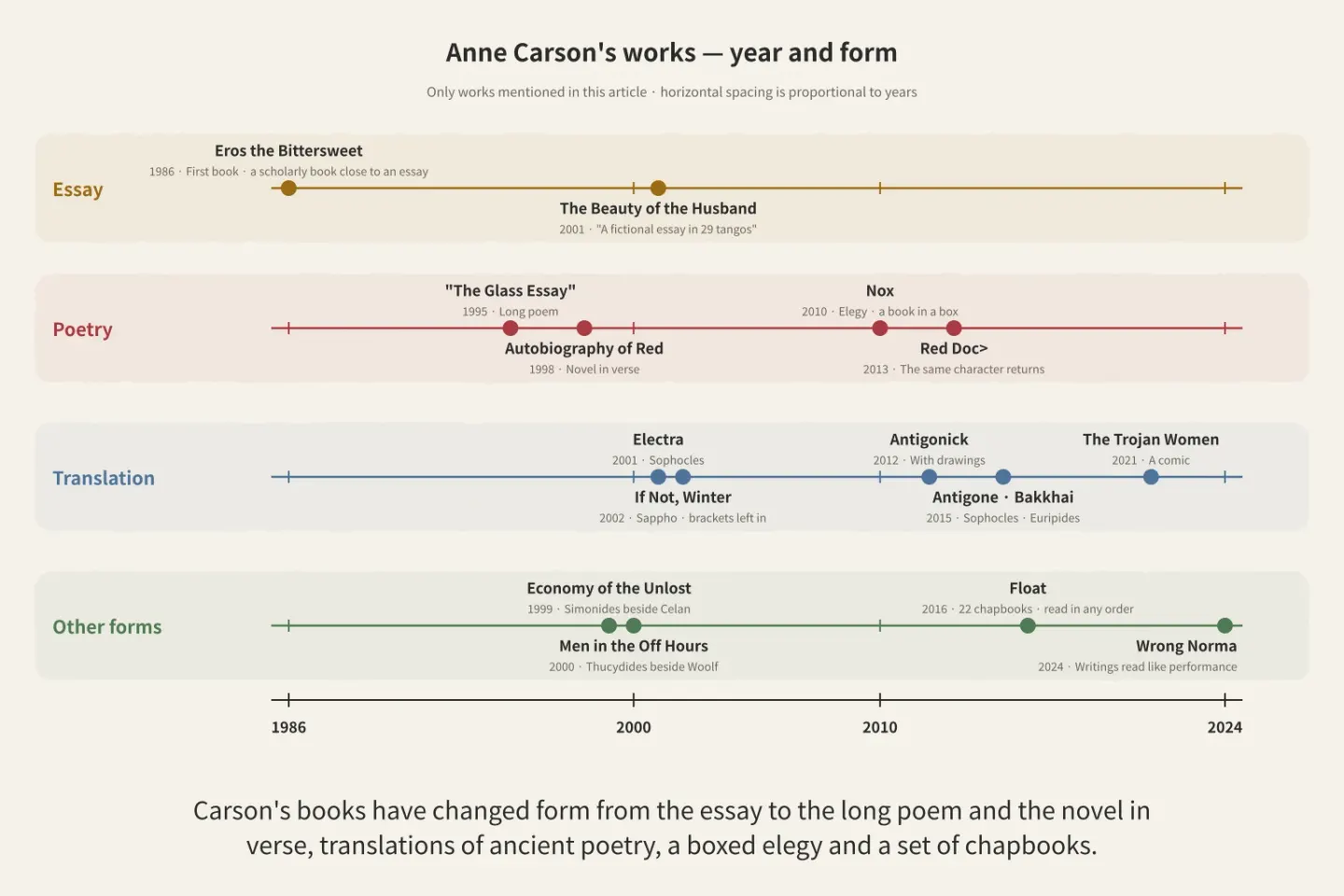
Figure: a diagram Paperis drew using only what the article says
The First Book Born from a Single Word
Carson's field for her doctoral degree is classics. Classics is a discipline that studies the languages, literatures, histories, and philosophies of ancient Greece and Rome by reading them in their original texts. According to the Swedish Academy, Carson has pointed to the roots of words—that is, etymology—as the starting point for all her work (Swedish Academy, biobibliography). Her first book also begins with a single word.
Her first book, Eros the Bittersweet, published in 1986, starts from the ancient Greek poet Sappho calling the god of love, Eros, by the single word "bittersweet." Book descriptions note that this passage is where Sappho coined the word "bittersweet" (DOI: 10.2307/j.ctv32r0376). This word, rendered in English as "bittersweet", is a compound adjective that welds pain and sweetness into a single term, as the Swedish Academy explains (Swedish Academy, biobibliography). Two opposing emotions are packed together into one word. Setting out from that single word, the book moves back and forth through ancient Greek literature and philosophy to reflect on why love is both a torment and one of the greatest joys we experience (DOI: 10.2307/j.ctv32r0376). Because it was polished and brought out from her doctoral dissertation, its exterior is an academic monograph while its interior resembles an essay (DOI: 10.17077/0021-065x.5181).
The framework through which the book reads love has three vertices: the lover, the beloved, and the distance between the two (DOI: 10.15448/1984-6746.2021.1.38535). After drawing the relationship among these three from Sappho's poetry, Carson reads Plato's dialogue Phaedrus and traces how that relationship fans out into the ways a person constructs an "I" and experiences time and space (DOI: 10.15448/1984-6746.2021.1.38535). A paper in religious studies sees this "triangle of love" as the thread connecting Carson's first book all the way to her 2005 work Decreation (DOI: 10.1353/rel.2025.a998601). The Swedish Academy explains that precisely this distance gives Eros its power and sets poetry in motion (Swedish Academy, biobibliography).
Tracing the triangle once, it looks like this. A distance is laid out between the lover and the beloved. What Carson kept her eye on is the empty space in between. Picking up the idea of "the desire to know what one does not know" from this book, a paper in philosophy of education notes that the lover and the thinker resemble each other (DOI: 10.1093/jopedu/qhag001).
The genre of this book was ambiguous from the start. Looking back on the book more than thirty years later, one researcher evaluates that what it most clearly announced was Carson's ability to forge a new genre by crossing genre boundaries (DOI: 10.1353/arn.2019.0034). The Swedish Academy likewise introduces this book as having laid the foundation for Carson's subsequent artistic world (Swedish Academy, biobibliography). The single line to take away is this: Carson's new forms began with reading a single ancient word to its limits like a scholar.
Writing That Is a Poem, a Story, and an Essay
In 1995, Carson published Glass, Irony, and God, and placed a long poem titled "The Glass Essay" at its very beginning (Swedish Academy, biobibliography). It has the shape of a line-broken poem, but when you read it, it is a story that continues from the start to the finish. A woman whose husband has left goes to visit her lonely mother living in a desolate moor village, and on her way, she packs a book by her favorite writer, Emily Brontë. The moor where Brontë lived and her inner thoughts are closely woven into this woman's story (Swedish Academy, biobibliography). The woman speaking as "I" here is the speaker of the poem. The speaker is the voice that speaks within the poem, and cannot be presumed to be the same person as the one who wrote the poem.
One reader left a note saying they read this poem every day for a month right after going through a breakup, and describes this poem as a 38-page poem (DOI: 10.1353/tyr.2022.0003). The structure of this poem that reader saw is twofold. Private thoughts chewing over a breakup and criticism reading the life of Emily Brontë are contained within a single body (DOI: 10.1353/tyr.2022.0003). A person reading the poem receives the breakup story and the literary criticism all at once.
There is a term that calls writing that mixes genres in this way. A hybrid genre is writing that mixes literary genres that were previously separated—such as poems, essays, novels, and criticism—within a single work. In contemporary poetry criticism today, the word "hybrid" broadly refers to works that blur the boundaries between poetry and other genres (DOI: 10.3390/h14060127). American critics have placed Carson's writing as a model of the lyric essay (DOI: 10.1353/esc.2011.0054). A lyric essay is writing that leaps from scene to scene without connective words like a poem, while also arguing through a question like an essay. Canadian literary researcher Ian Rae views "The Glass Essay" as Carson's representative work, and analyzes that this poem combines the leaps of modern lyric poetry and the argumentation of the essay into a single work (DOI: 10.1353/esc.2011.0054).
One device that Rae points out is the "glass" in the title. The English word glass is a transparent material, a magnifying glass, and a mirror, while the French word glace is ice and a mirror. Carson uses these various meanings as a pun spanning the entire poem (DOI: 10.1353/esc.2011.0054). The classicist's habit of unpacking the meanings of a single word in layers becomes the backbone of the breakup story here. The Academy introduces that in this poem, poetry needs a story, and the story relies on the leaps and scene shifts of poetry (Swedish Academy, biobibliography).
Criticism reads this poem in various directions. One critique focuses on Carson's stated poetics of "getting Me out of the way." That critique takes issue with this "Me" intentionally capitalized—the writer themselves placed right in the middle of the work—and reads that writing which moves this "I" out of the way first makes its appearance in "The Glass Essay." At the same time, the same critique also notes that the problem of writing about one's own life underlies Carson's works (DOI: 10.52086/001c.25596). Another critique focuses on the point that the "I" of this poem is both the person speaking and at the same time the person reading another author's poems (DOI: 10.33776/candb.v3i1-2.3040). This poem came out in 1995, but a portion of it was also included in the 2006 edition of The Norton Anthology of English Literature (DOI: 10.1353/esc.2011.0054). The single line to take away is this: "The Glass Essay" was writing that tells a story in the form of a poem, and reads another writer within that story.
The Autobiography of a Monster
In the 6th century BCE, the Greek poet Stesichorus wrote a poem about Geryon, a winged red monster (Swedish Academy, biobibliography). In mythology, the hero Heracles kills Geryon and steals his cattle to fulfill one of the labors set upon him (Swedish Academy, biobibliography). That poem by Stesichorus does not survive in full, remaining only as fragments like papyrus scraps (DOI: 10.1093/oso/9780199233731.003.0014). Sappho of the same era is in a similar situation, and the works of both poets were badly broken down as they were handed down through time (DOI: 10.1002/9781119122661.ch34).
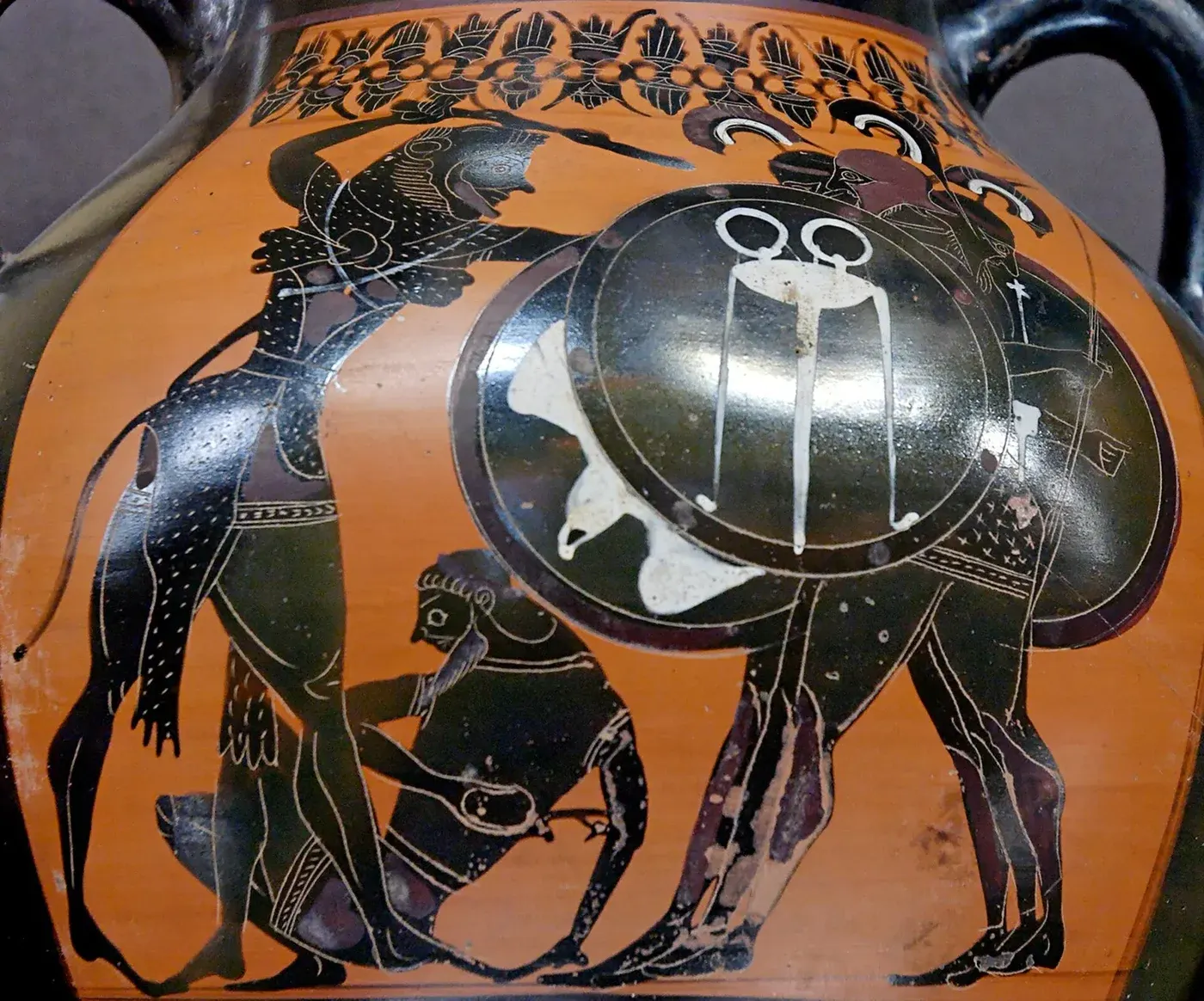
Figure: Heracles attacking Geryon, shown on this Athenian amphora as a three-bodied warrior with three helmets (c. 540 BC) · Public domain, via Wikimedia Commons
Carson published Autobiography of Red in 1998 using these fragments as a starting point. Its subtitle is "A Novel in Verse" (Swedish Academy, biobibliography). A novel in verse is a work written in the form of line-broken poetry while telling a novel's story of characters and events continuing from beginning to end. Carson turned the terrifying monster into a tender "protagonist" who cares for his mother, rewriting him into a coming-of-age story of our time where he falls in love with Heracles (Swedish Academy, biobibliography). In 2013, she published Red Doc>, in which the same character appears again (Swedish Academy, biobibliography).
The structure of the book is mixed as well. One paper summarizes this book as part scholarly essay, part classical translation, and part third-person tale of Geryon's life, and asks why the title is an "autobiography" in the first place (DOI: 10.14288/cl.v0i210-11.192819). A scholar studying classical translation views Carson's way of handling Stesichorus as resembling a translation conscious of how much has vanished from the ancient poem and thus how much must be invented and filled in (DOI: 10.1093/acprof:oso/9780199605712.003.0022). Rewriting a poem that survives only in fragments means filling the blank spaces.
Here is where the first book and this book connect. One study sees the string connecting the work on Sappho and the work on Stesichorus as the "paradox of time." The interpretation is that in both Sappho's poetry and Carson's translation, desire twists and estranges the sense that a person is inside time, and Geryon in Autobiography of Red experiencing time as a long-drawn-out anxiety is an extension of that (DOI: 10.1002/9781119122661.ch34). The person one cannot reach in Eros: The Bittersweet and the distance between them become, here, the love story of a boy with red wings.
Interpretations diverge here. One critique reads this book as a rewriting of myth into a queer love story. In this reading, Heracles is a lover who steals and breaks Geryon's heart instead of a conqueror who seizes his cattle, and Geryon, who finds it hard to tell his life story in words, takes photographs instead (DOI: 10.1080/15240657.2014.911054). Another critique pays attention to those very photographs, reading the book—unlike photographic theory, which has commonly tied photography to death—as showing photography passing through storytelling and joining hands with love (DOI: 10.1353/pmc.2008.0008). The one line to take with you is this: Autobiography of Red was a story rewritten with an ancient poem surviving only in fragments as its starting point, conscious of what has vanished.
Translating Even the Blank Parentheses
In 2002, Carson published If Not, Winter, her translation of the fragments of Sappho's poems (Swedish Academy, biobibliography). Most of Sappho's poetry survives only as fragments consisting of a few words or lines. Instead of smoothing over the missing places with fluent sentences, Carson left parentheses where the original text broke off. Thus, the book was published with its fractured, bracket-heavy appearance intact (DOI: 10.1093/crj/clag008). Carson herself explained that these parentheses leave an empty space for readers to venture into through their imagination, and one paper reads the formats of Nox and Float as the same invitation (DOI: 10.26262/exna.v1i2.6405).
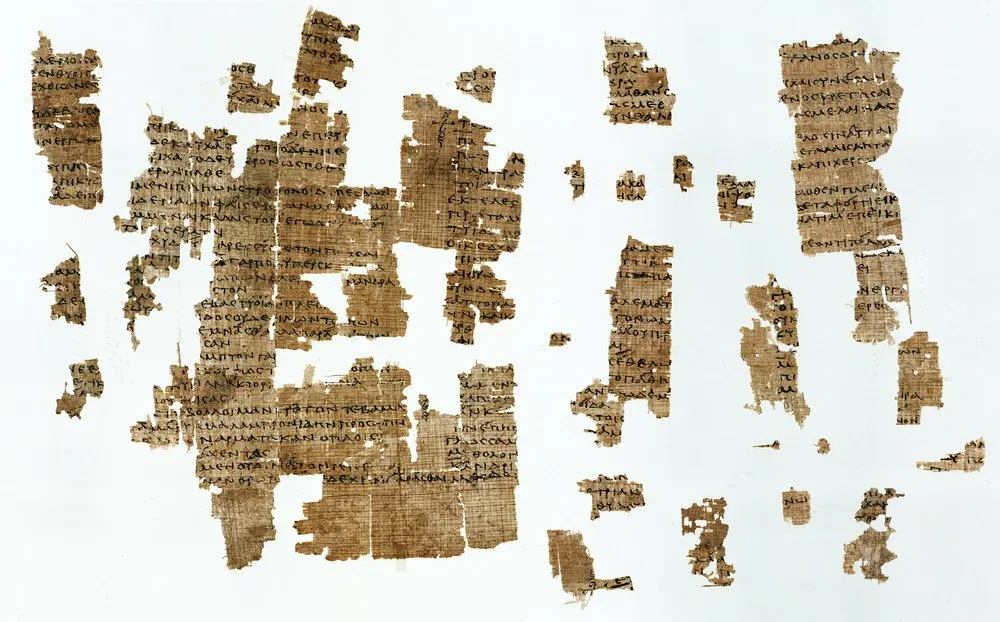
Figure: Second-century papyrus fragments from Oxyrhynchus, Egypt, which preserve several of Sappho's poems in torn pieces (2nd century) · Public domain, via Wikimedia Commons
The Academy notes that Carson's translations from the Greek can be seen as independent works in their own right. Alongside her Sappho translation, it highlights Sophocles' tragedies Electra (2001) and Antigone (2015), and Euripides' Bakkhai (2015) (Swedish Academy, biobibliography). The forms of her translations are also diverse. Her 2012 Antigonick, a translation of Sophocles' Antigone, featured artwork by the painter Bianca Stone, and in 2021 she collaborated with Rosanna Bruno to turn Euripides' The Trojan Women into a graphic novel titled The Trojan Women: A Comic (Swedish Academy, biobibliography). The forms taken by a single person's translations vary this widely, ranging from Sappho with its parentheses to picture books and comics.
There are also multiple ways of reading these translations. One paper reads If Not, Winter as a book embraced by lesbian readers as their own story, viewing the fractured, bracket-heavy appearance of the translation as holding a special weight for those readers (DOI: 10.1093/crj/clag008). A doctoral dissertation engages in dialogue with Carson's work to define translation writing as the creation of a "third space" between the original text and the translated text, putting that idea into practice by translating the entirety of Autobiography of Red into French (DOI: 10.70675/fdd06076zc7e4z4f42zbe67z89babb40d62a). There are also projects where dancers and video artists used the blank spaces of If Not, Winter as a starting point to create dance and video work (DOI: 10.4018/979-8-3373-8884-7.ch010). The single line to take away is this: Carson's translations made what was lost visible by leaving it in parentheses, and rewrote ancient works into the forms of picture books and comics.
An Elegy in a Box
The 2010 book Nox honors Carson's brother Michael, who passed away in Denmark in 2000 (Swedish Academy, biobibliography). Nox means "night" in Latin (DOI: 10.5206/tc.v8i1.24876). This book is an elegy. An elegy is a poem that honors a dead person and sings of the sorrow of losing them. Inside Nox is another elegy. It is Poem 101, written by the Roman poet Catullus to honor his brother who died in a distant land, along with Carson's translation of that poem (Swedish Academy, biobibliography). It is a structure where two people, separated by two thousand years, layer their individual sorrows of losing a brother into a single book.
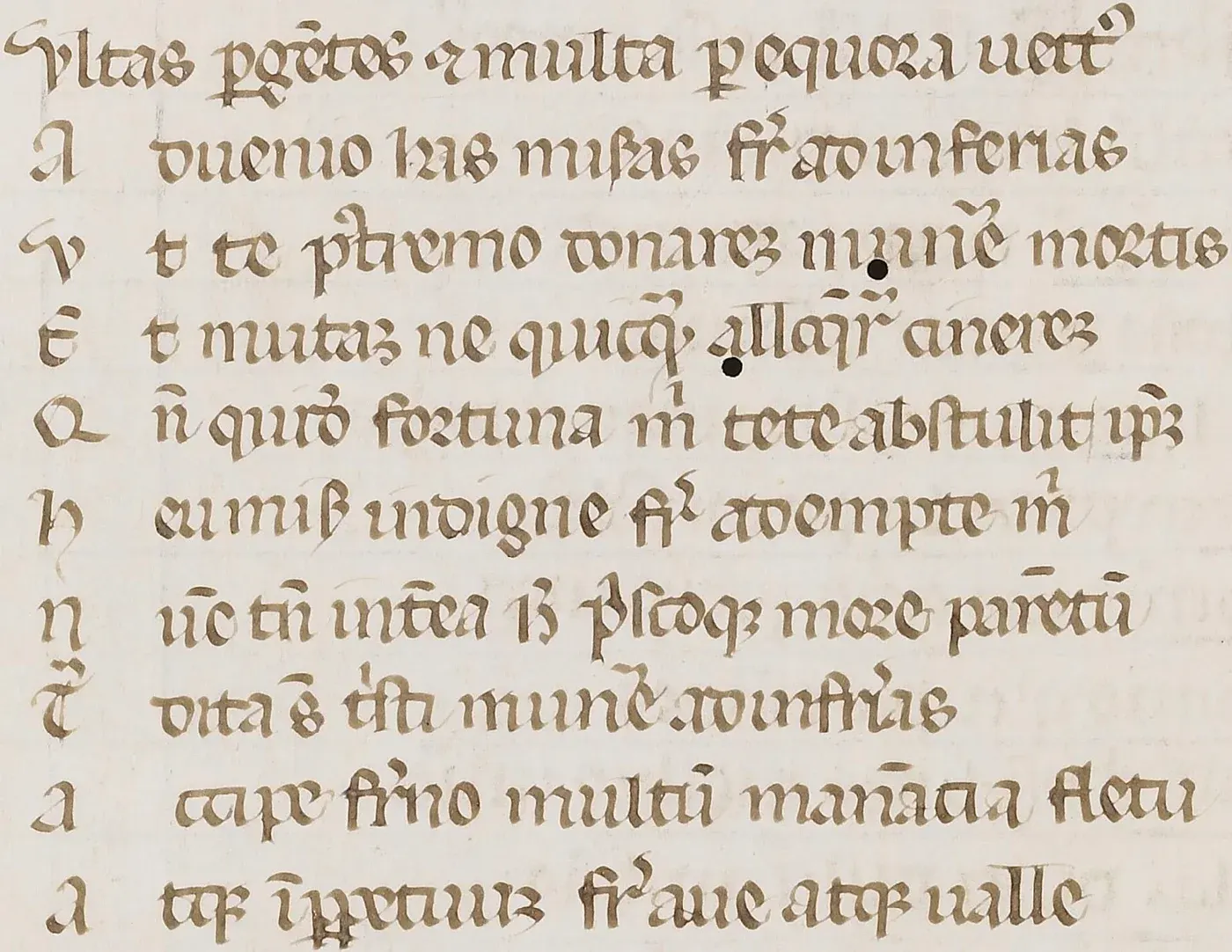
Figure: A fourteenth-century manuscript copy of Catullus 101, his elegy for his dead brother, ending "frater, ave atque vale" — "brother, hail and farewell" (14th century) · Public domain, via Wikimedia Commons
The physical form of the book is unusual. Nox comes in a box, and when you open the box, a single long sheet of paper folded like an accordion emerges. Photographs, letters, and short writings are pasted upon it (Swedish Academy, biobibliography). According to a paper, when the folded paper is fully unfolded, it reaches a length of 25 meters (DOI: 10.4467/20843933st.23.014.18184). The letters and photographs on it are the few remaining traces left by the brother, and the poems and translations form a single elegy alongside those traces (DOI: 10.5206/tc.v8i1.24876; DOI: 10.1515/9781474474627-008).
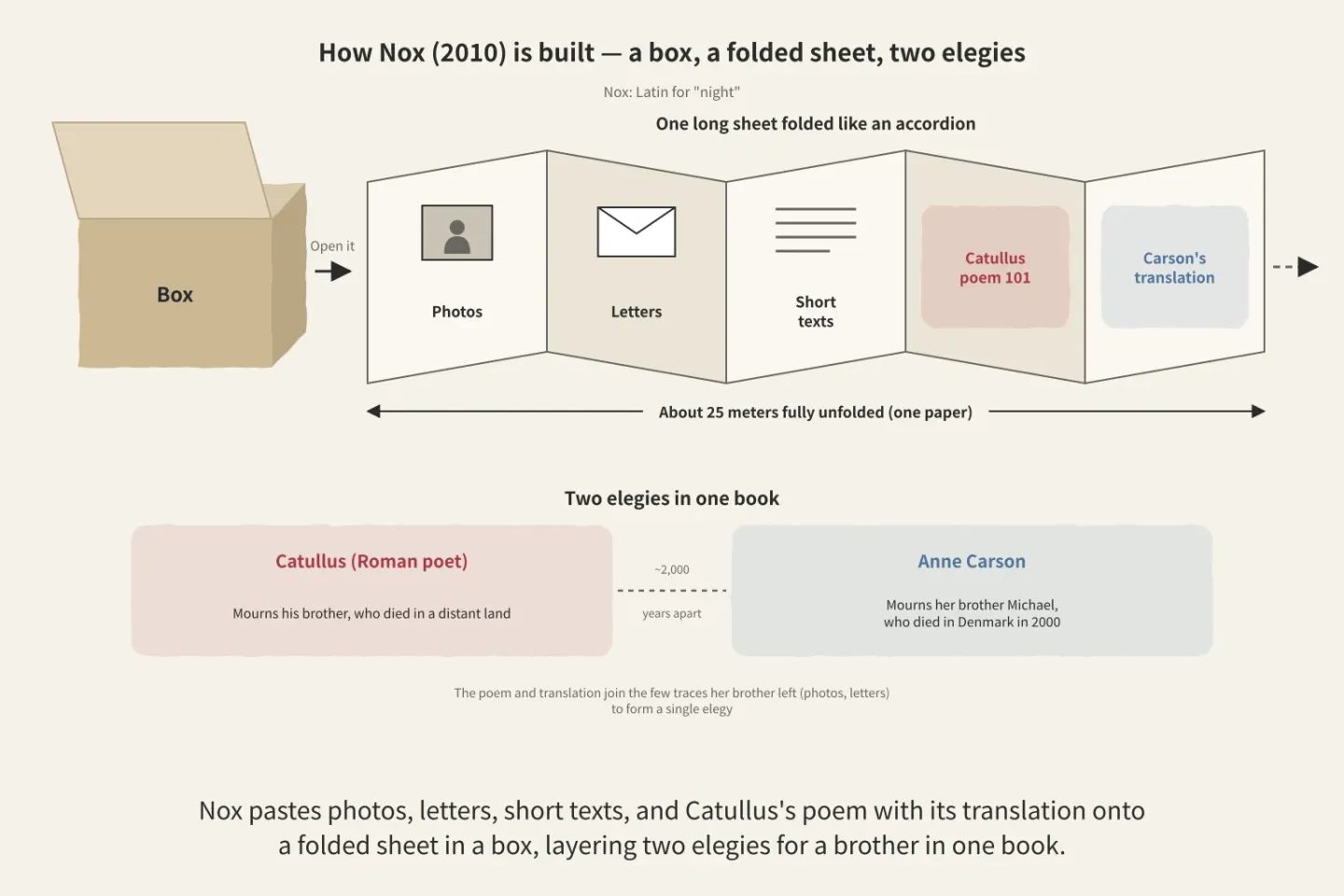
Figure: a diagram Paperis drew using only what the article says
There is a precedent for books held in boxes. British author B.S. Johnson's 1969 The Unfortunates is the first "novel in a box" in English, and it was also a book mourning a friend who had departed first (DOI: 10.4467/20843933st.23.014.18184). A paper reading both books together suggests that both Johnson's box, with its mixable loose sheets, and Carson's endless unfurling scroll reveal that mourning continues, as well as a doubt about whether mourning can ever be cleanly finished. It also points out that the boxes of both books resemble coffins (DOI: 10.4467/20843933st.23.014.18184).
Other critics look to different places. One critique reads Nox as a work combining a long elegy and a short epitaph, creating a method of mourning that stretches wide while also conserving and economizing (DOI: 10.3138/utq.89.2.02). Another critique views Nox as transforming the relationship merely sketched in words by Catullus's Poem 101 into real physical objects like letters and photographs (DOI: 10.1515/9781474474627-008). Carson later turned this book into a performance weaving together contemporary dance, music, and her own reading aloud (DOI: 10.5206/tc.v8i1.24876). The one line to take away is this: Nox moved mourning from something read in text to an object unfolded by hand.
Beyond the Book
Just as photographs became partners to the text in Nox, pictures and writing frequently stand face-to-face in Carson's work. Ekphrasis is writing that translates and paints works meant to be seen with the eye, such as paintings or sculptures, into words. In 1999, Carson wrote a poem responding to a 1988 drawing by the Canadian artist Betty Goodwin. Yet this poem does not describe the picture. It refuses to give the drawing a name, make the drawing speak, or redraw the drawing as a picture (DOI: 10.1080/02666286.2013.794916). That paper calls this "radical ekphrasis." One critique views ekphrasis and translation as recurring elements in Carson's work, both of which raise the question of what is conveyed and through which medium (DOI: 10.1080/0950236x.2021.1900360).
Collaborations are also frequent. In 2009, Carson stayed as a writer-in-residence at the American artist Roni Horn's installation piece "Library of Water" in Iceland, writing a poem dedicated to that work alongside Robert Currie (DOI: 10.1080/02666286.2015.1013272). Her 2016 work Float is a book containing twenty-two small booklets with differing themes in a single bundle, which can be read in any order (Swedish Academy, biobibliography). One paper interprets both Nox and Float as pulling readers physically into the book as a physical object and drawing them into the making of it (DOI: 10.26262/exna.v1i2.6405).
Her 2001 The Beauty of the Husband bears the subtitle "A Fictional Essay in 29 Tangos," and opens each of its 29 segments with a line of verse by the English Romantic poet John Keats (Swedish Academy, biobibliography). Her 1999 Economy of the Unlost places the 6th-century BCE Greek poet Simonides side by side with the 20th-century poet Paul Celan, while her 2000 Men in the Off Hours places the ancient Greek historian Thucydides side by side with the English writer Virginia Woolf (Swedish Academy, biobibliography). This is a method of seating two writers separated by more than two thousand years at a single table. The Academy traces the root of this method back to her first book. It notes that in Eros the Bittersweet, Carson spoke of a "stereoscopic vision"—an eye that can "hold in equipoise" two lines of sight in balance all at once—and that these books, which pit two writers against one another, are examples of that. The Academy explains that Carson continually brings in such differing voices and sets them against each other (Swedish Academy, biobibliography). This text reads that phrase to mean an eye that holds both together without choosing one over the other, much like how two eyes combine slightly different images to see in three dimensions. Her 2024 Wrong Norma collects various multi-branched texts meant to be read as if performed on a stage (Swedish Academy, biobibliography). The Academy introduces her collaborations with artists, choreographers, and opera and theater directors as evidence of how free Carson is from the expectations and rules of literature (Swedish Academy, biobibliography). The one line to take away is this: Carson's formal experiments extend beyond the shape of the paper book into paintings, stages, and books without a set order.
How Criticism Is Read
In 2023, the first research book dedicated in earnest to Carson's creative world, Anne Carson: The Glass Essayist, was published (DOI: 10.1093/oso/9780197680919.001.0001). Elizabeth Coles's book is introduced by saying that readers of Carson must temporarily set aside the distinction that scholars are transparent and accountable while poets dig inward and get lost. Coles points to the care given to sources—whether old or new, in writing or in art—as one of the few unchanging elements in Carson's body of work spanning nearly 40 years. And the book argues that the most urgent way to read Carson today is to read "Carson as a reader" (DOI: 10.1093/oso/9780197680919.001.0001). Earlier, in 2015, the first collection of criticism dealing with various Carson works one by one was published, gathering pieces by poets, translators, and collaborators (DOI: 10.3998/mpub.7573555).
Assessments were divided. Ray's 2011 paper outlines how Carson's genre-defying writing left critics quite confused. Some critics viewed Carson's writing as having failed as poetry (what Ray gives as an example is a critic's remark on The Beauty of the Husband), and several Canadian critics asked how to place her poetry—in which Canadian places or figures almost never appear—within Canadian literature (DOI: 10.1353/esc.2011.0054). A Canadian poet wrote that what Carson does had already been done better by other poets, and a paper introducing that criticism counters that Carson's deep interest in Celan cannot be dismissed as mere imitation (DOI: 10.14288/cl.v0i176.193090). A doctoral dissertation examines the controversies surrounding Carson's books and awards, then argues that her work creates another tradition distinct from the mainstream of Canadian lyric poetry (DOI: 10.11575/prism/27947).
Thus, open questions remain. First is the question of whether mixing genres is in itself a new form. A French-language paper that reads "The Glass Essay" alongside another poet's book suggests that the hybridity of the lyric essay reveals porous holes in the boundary between lyrical speech and academic speech, but that alone is not enough to redraw the literary landscape. Both works still rely on the long-standing combination of the lyric poetry of the post-Romantic era, at least, which elevates personal experience into universal expression (DOI: 10.7202/1102655ar). Second is where translation ends and rewriting begins. The translation of Sappho with brackets left in and the comic-book adaptation The Women of Troy are translations by the same person, yet their forms are completely different. Just where translation ends and rewriting begins remains unanswered. Third is where the author herself resides within the work. The criticism seen above holds that questions of her own life lie at the foundation of Carson's work, yet maintains that her writing, which steps away from the "I," leaves readers with difficult paradoxes to solve. An example given of that paradox is "The Dreams of Letters," where the writer is pushed from the center of the work and disappears into the narrative (DOI: 10.52086/001c.25596).
The Academy stated the reason for her award was that Carson's work playfully converses with the classical tradition while creating a new form for today's literature (Swedish Academy, prize announcement), and introduced her work since the 1990s as having brought profound significance to the international art and literary worlds (Swedish Academy, biobibliography). That is the assessment of a single institution. What that new form is and just how new it remains are matters that criticism is still debating, much like the questions above.
Where to Look Next
If you want to equip yourself with the basic tools for reading poetry before diving into Carson's works directly, the articles below connect with this one.
- Figures and Images — The Old Vow, Firm and Shining Like a Flower of Gold — Carson's first book opens with a story about the joy that metaphor brings (DOI: 10.14288/cl.v0i176.193087). Seeing how metaphor works first makes it clear why his writing lingers so long on a single word.
- Rhythm in Poetry — Where the Breath Breaks on Its Own — Autobiography of Red and Glass, Irony, & God tell stories in the form of line-broken verse. Knowing what the spot where a line breaks does makes a verse novel sound different.
- Speaker and Point of View — "Hearken!": A Voice That Begs to Be Believed — This is the piece you need when thinking about the distance between the "I" in Glass, Irony, & God and Carson.
- How Stories Are Built — The Order Things Happen and the Order They Are Told — This helps when following Carson's handling of sequence, where he rewrites myth into a coming-of-age story and unfolds mourning like a folded scroll.
Winners in other categories from the same year continue in The 2026 Nobel Prize in Physiology or Medicine — A Door Opened by Light, From Pond Algae to a Switch for the Brain, The 2026 Nobel Prize in Physics — Messengers from the Cosmos, Caught in a Cubic Kilometer of Ice, The 2026 Nobel Prize in Chemistry — Chemistry That Makes One Hand on Its Own, and Did Life Take That Path?, The 2026 Nobel Prize in Economics — From One Household's Arithmetic to a Nation's Business Cycle, and The 2026 Nobel Peace Prize — Crimes Named in Court: Navi Pillay and the International Criminal Tribunal for Rwanda.
Source Materials
- “2026년 노벨 문학상 수상 발표” (2026) — https://www.svenskaakademien.se/en/the-nobel-prize-in-literature/2026 — The Swedish Academy's announcement of the laureate and a single sentence explaining the reason for the award.
- “앤 카슨 작가 소개(Biobibliography)” (2026) — https://www.svenskaakademien.se/en/the-nobel-prize-in-literature/2026/anne-carson-biobibliography — Author introduction and list of works written by Anders Olsson, Chairman of the Nobel Committee of the Swedish Academy. The basis for birth dates, degrees, and the publication years and forms of major works.
Source Papers
- "Eros the Bittersweet: An Essay" (1986) — DOI: 10.2307/j.ctv32r0376 — Carson's first book. Starting from Sappho calling Eros "bittersweet," it reflects on the conflicting nature of love through ancient Greek literature and philosophy.
- "Erotic Sufferings: "Autobiography of Red" and Other Anthropologies" (1999) — DOI: 10.17077/0021-065x.5181 — A reader's essay. Eros the Bittersweet is a scholarly yet poetic reflection refined from a doctoral dissertation in classics.
- "problema do amor e da distância em Anne Carson" (2021) — DOI: 10.15448/1984-6746.2021.1.38535 — Reading love as a relation between the lover, the beloved, and the distance between them, and expanding via a reading of the Phaedrus into subject formation and the experience of time and space.
- "Anne Carson and the Erotic Triangle of Spiritual Ascent" (2025) — DOI: 10.1353/rel.2025.a998601 — Tracing the triangular composition of love and the spiritual question of the "empty self" from Eros (1986) to Decreation (2005).
- "Between Butes and the digital player: paradoxes of Eros" (2026) — DOI: 10.1093/jopedu/qhag001 — Inheriting Carson's Eros as "the desire to know what one does not know" and emphasizing the likeness between the lover and the thinker (educational philosophy).
- "Reach Without Grasping: A Retrospective Appreciation of Anne Carson's Eros the Bittersweet" (2019) — DOI: 10.1353/arn.2019.0034 — A retrospective essay rather than a book review (confirmed in the first line of the text). Praising the first book for rejecting genre and practically creating a genre.
- "A Glass Essay: Reading Anne Carson post-breakup" (2022) — DOI: 10.1353/tyr.2022.0003 — A reader's essay read daily for a month after a breakup. A 38-page poem holding together both a private reflection on heartbreak and a critical reading of Emily Brontë's life.
- "Ritual and Assemblage: Reading Hybrid Elegy Through Changing American Death Practices" (2025) — DOI: 10.3390/h14060127 — Today, "hybrid" refers generally to works that blur the boundaries between poetry and other genres. Nox as an example of a hybrid elegy.
- "Verglas: Narrative Technique in Anne Carson's "The Glass Essay"" (2011) — DOI: 10.1353/esc.2011.0054 — Narrative technique in "The Glass Essay." The combination of lyric skipping and essayistic argument, the glass/glace pun, its inclusion in anthologies, and controversies over the critique that it "fails as poetry" and its place within Canadian literature.
- "The 'impossible truth' of writing off the subject: Anne Carson's decreation poetics and 'The glass essay'" (2018) — DOI: 10.52086/001c.25596 — The poetics of decreation that sidesteps the "I" appears in "The Glass Essay," but because it is grounded in autobiographical questioning, it leaves readers with a difficult paradox to unravel.
- "Figuring an Ethical Reading Practice: Anne Carson's 'Whaching'" (2013) — DOI: 10.33776/candb.v3i1-2.3040 — The lyrical "I" of "The Glass Essay" is both a speaking subject and a reader reading other poems.
- "The Autobiography of the Western Subject: Carson's Geryon" (2009) — DOI: 10.1093/oso/9780199233731.003.0014 — Stesichoros's Geryoneis survives in fragments such as papyri (P.Oxy 2617). Reading Autobiography of Red as a history of the Western idea of the self.
- "Anne Carson's Lyric Temporalities" (2022) — DOI: 10.1002/9781119122661.ch34 — The works of Sappho and Stesichoros are heavily damaged in transmission. The paradox of time is the thread connecting Carson's work on Sappho and her work on Stesichoros.
- ""Shifting Ground": Breaking (from) Baudrillard's "Code" in Autobiography of Red" (2020) — DOI: 10.14288/cl.v0i210-11.192819 — Autobiography of Red is a book mixed with scholarly essays, classical translation, and third-person narrative. Asking why it is called an "autobiography."
- "Epic Zoom: Christopher Logue's Homer (with Anne Carson's Stesichoros and Seamus Heaney's Beowulf)" (2011) — DOI: 10.1093/acprof:oso/9780199605712.003.0022 — A translation method conscious of what has vanished and what must be invented, resembling Carson's treatment of Stesichoros.
- "Discarded Histories and Queer Affects in Anne Carson's Autobiography of Red" (2014) — DOI: 10.1080/15240657.2014.911054 — Read as a rewriting of the Hercules and Geryon myths into a queer love story. Geryon takes photographs instead of speaking.
- "Toward a Photography of Love: The Tain of the Photograph in Anne Carson's Autobiography of Red" (2007) — DOI: 10.1353/pmc.2008.0008 — Challenging the theory that binds photography to death, proposing instead a union of photography passed through narrative and love.
- "Let loose your longing: erasure, citation, and lesbian matter in Anne Carson's translation of Sappho's poetry" (2026) — DOI: 10.1093/crj/clag008 — Analyzing the process by which fragmented, bracket-filled translations of Sappho were embraced by lesbian readers as their own text.
- ""And how does it alter you to see it there floating? Nox, Float and the Reader." (2018) — DOI: 10.26262/exna.v1i2.6405 — The physical materiality of Nox and Float invites the reader into the book and into the creative process. Open spaces akin to the brackets in Sappho's translations.
- "Rouges : une exploration du tiers espace de l'écriture traductive à travers Anne Carson et son Autobiography of Red" (2022) — DOI: 10.70675/fdd06076zc7e4z4f42zbe67z89babb40d62a — Defining translation writing as the creation of a "third space" between the source text and the translated text (doctoral dissertation).
- "Memory, Gaps, Margins: Performing Sappho" (2026) — DOI: 10.4018/979-8-3373-8884-7.ch010 — Methodology for writing, choreography, and video work taking the blank spaces of If Not, Winter as a starting point.
- "Filling the Brother's Elegy with Light and Shadow" (2026) — DOI: 10.5206/tc.v8i1.24876 — The interaction of photographs and text in Nox (Latin for night), and its expansion into dance, music, and spoken-word performances.
- "Material Loss: Multimodality and Mourning in B.S. Johnson's The Unfortunates and Anne Carson's Nox" (2023) — DOI: 10.4467/20843933st.23.014.18184 — Nox is a 25-meter scroll, while Johnson's 1969 work is a novel in a small English box. Both formats reveal skepticism toward the persistence and closure of mourning.
- "Nox, Unboxed: Anne Carson's Uncommon Long Verse "Epitaph" (or Economies of the Unlost)" (2020) — DOI: 10.3138/utq.89.2.02 — Combining a long elegy and an epitaph to create a poetics of mourning that is both expansive and restrained.
- "5. Lyrical Matters and Posthuman Poetics in Anne Carson's Nox" (2020) — DOI: 10.1515/9781474474627-008 — An accordion-fold book inside a box. Transforming the relationship depicted in Catullus 101 into physical matter such as letters and photographs.
- "Drawing out a new image of thought: Anne Carson's radical ekphrasis" (2013) — DOI: 10.1080/02666286.2013.794916 — A 1999 poem responding to a 1988 drawing by Betty Goodwin. A "radical ekphrasis" that neither describes nor makes the picture speak.
- "Medium and mediality in Anne Carson" (2021) — DOI: 10.1080/0950236x.2021.1900360 — Ekphrasis and translation as recurring, medium-interrogating elements in Carson's work.
- "Tongues of glaciers: sedimenting language in Roni Horn's Vatnasafn/Library of Water and Anne Carson's "Wildly Constant"" (2015) — DOI: 10.1080/02666286.2015.1013272 — A collaboration between a poem written with Robert Currie during a 2009 residency at Iceland's "Library of Water" and an installation by Roni Horn.
- "Anne Carson: The Glass Essayist" (2023) — DOI: 10.1093/oso/9780197680919.001.0001 — The first full-length study. Proposing to suspend the scholar/poet distinction, treat attention to sources as a 40-year constant, and read "Carson as a reader."
- "Anne Carson: Ecstatic Lyre" (2015) — DOI: 10.3998/mpub.7573555 — The first collection of critical essays treating Carson's works individually (featuring contributions from poets, translators, and collaborators).
- "Reading Paul Celan with Anne Carson: "What Kind of Withness Would That Be?"" (2019) — DOI: 10.14288/cl.v0i176.193090 — Introducing criticisms that dismissed Carson as derivative, and rebutting that her interest in Celan cannot be viewed as mere imitation.
- "Symbolon: The Poetry of Anne Carson" (2015) — DOI: 10.11575/prism/27947 — Tracing the controversies surrounding her publication and awards, and arguing that Carson creates an alternative tradition distinct from mainstream Canadian lyric poetry (doctoral dissertation).
- "L'essai lyrique : une question de genre ? The Glass Essay de Anne Carson et Citizen de Claudia Rankine" (2023) — DOI: 10.7202/1102655ar — The hybridity of the lyric essay reveals that the boundaries between lyrical and scholarly discourse are porous, yet it is insufficient to reorganize the literary space, still relying on the individual-universal pairing since Romanticism.
- ""I am writing this to be as wrong as possible to you": Anne Carson's Errancy" (2019) — DOI: 10.14288/cl.v0i176.193087 — Her first book opens with a prose piece on the pleasures afforded by metaphor.
Sources (34)
- Eros the Bittersweet: An EssayDOI 10.2307/j.ctv32r0376
- Erotic Sufferings: \DOI 10.17077/0021-065x.5181
- problema do amor e da distância em Anne CarsonDOI 10.15448/1984-6746.2021.1.38535
- Anne Carson and the Erotic Triangle of Spiritual AscentDOI 10.1353/rel.2025.a998601
- Between Butes and the digital player: paradoxes of ErosDOI 10.1093/jopedu/qhag001
- Reach Without Grasping: A Retrospective Appreciation of Anne Carson's Eros the BittersweetDOI 10.1353/arn.2019.0034
- A Glass Essay: Reading Anne Carson post-breakupDOI 10.1353/tyr.2022.0003
- Ritual and Assemblage: Reading Hybrid Elegy Through Changing American Death PracticesDOI 10.3390/h14060127
- Verglas: Narrative Technique in Anne Carson's \DOI 10.1353/esc.2011.0054
- The 'impossible truth' of writing off the subject: Anne Carson's decreation poetics and 'The glass essay'DOI 10.52086/001c.25596
- Figuring an Ethical Reading Practice: Anne Carson's 'Whaching'DOI 10.33776/candb.v3i1-2.3040
- The Autobiography of the Western Subject: Carson's GeryonDOI 10.1093/oso/9780199233731.003.0014
- Anne Carson's Lyric TemporalitiesDOI 10.1002/9781119122661.ch34
- Shifting Ground\DOI 10.14288/cl.v0i210-11.192819
- Epic Zoom: Christopher Logue's Homer (with Anne Carson's Stesichoros and Seamus Heaney's Beowulf)DOI 10.1093/acprof:oso/9780199605712.003.0022
- Discarded Histories and Queer Affects in Anne Carson's Autobiography of RedDOI 10.1080/15240657.2014.911054
- Toward a Photography of Love: The Tain of the Photograph in Anne Carson's Autobiography of RedDOI 10.1353/pmc.2008.0008
- Let loose your longing: erasure, citation, and lesbian matter in Anne Carson's translation of Sappho's poetryDOI 10.1093/crj/clag008
- And how does it alter you to see it there floating? Nox, Float and the ReaderDOI 10.26262/exna.v1i2.6405
- Rouges : une exploration du tiers espace de l'écriture traductive à travers Anne Carson et son Autobiography of RedDOI 10.70675/fdd06076zc7e4z4f42zbe67z89babb40d62a
- Memory, Gaps, Margins: Performing SapphoDOI 10.4018/979-8-3373-8884-7.ch010
- Filling the Brother's Elegy with Light and ShadowDOI 10.5206/tc.v8i1.24876
- Material Loss: Multimodality and Mourning in B.S. Johnson's The Unfortunates and Anne Carson's NoxDOI 10.4467/20843933st.23.014.18184
- Nox, Unboxed: Anne Carson's Uncommon Long Verse \DOI 10.3138/utq.89.2.02
- 5. Lyrical Matters and Posthuman Poetics in Anne Carson's NoxDOI 10.1515/9781474474627-008
- Drawing out a new image of thought: Anne Carson's radical ekphrasisDOI 10.1080/02666286.2013.794916
- Medium and mediality in Anne CarsonDOI 10.1080/0950236x.2021.1900360
- Tongues of glaciers: sedimenting language in Roni Horn's Vatnasafn/Library of Water and Anne Carson's \DOI 10.1080/02666286.2015.1013272
- Anne Carson: The Glass EssayistDOI 10.1093/oso/9780197680919.001.0001
- Anne Carson: Ecstatic LyreDOI 10.3998/mpub.7573555
- Reading Paul Celan with Anne Carson: \DOI 10.14288/cl.v0i176.193090
- Symbolon: The Poetry of Anne CarsonDOI 10.11575/prism/27947
- L'essai lyrique : une question de genre ? The Glass Essay de Anne Carson et Citizen de Claudia RankineDOI 10.7202/1102655ar
- I am writing this to be as wrong as possible to you\DOI 10.14288/cl.v0i176.193087