Paperis Articles
The 2026 Nobel Prize in Physics — Messengers from the Cosmos, Caught in a Cubic Kilometer of Ice
The neutrino, a particle that barely interacts with anything, is a messenger that can point straight back to where cosmic rays are born. After IceCube, which embeds 5,160 light sensors in a cubic kilometer of Antarctic ice, caught the first evidence of neutrinos from space in 2013, it pointed to the blazar TXS 0506+056 and the active galaxy NGC 1068 as the first candidate sources and then saw the disk of our own Galaxy. Where most of the sky's neutrinos come from, and where cosmic rays originate, is still unknown.
Your field's papers, as audio
Pick your fields and journals — Paperis summarizes the key papers and turns them into audio. Listen on your commute.
Start Paperis free →The 2026 Nobel Prize in Physics — Messengers from the Cosmos, Caught in a Cubic Kilometer of Ice
The Observatory in the South Pole Ice
On October 6, 2026, the Royal Swedish Academy of Sciences announced Francis Halzen of the University of Wisconsin–Madison as the laureate of the Nobel Prize in Physics (Nobel Committee, press release). The citation reads, “for decisive contributions to the IceCube Neutrino Observatory and the discovery of high-energy neutrinos of astrophysical origin”. Put simply into Korean, it is for his decisive contributions to IceCube, the observatory inside the Antarctic ice, and for discovering tiny, high-energy particles that flew in from celestial bodies. IceCube is located deep within the ice at the South Pole, at the southern end of the Earth. It is a facility that stitches 5,160 light-measuring sensors into a single chunk of ice with a volume of roughly one cubic kilometer, using the entire ice mass as a single gigantic measuring device (DOI: 10.1063/1.3480478). The guest this observatory waits for is an extremely tiny speck that flies in from the far side of the universe, passing right through the ground and people alike. Most of those specks simply pass straight through the ice, and the observatory can only catch the rare instances when they collide with something inside the ice.
This observatory was not built by one person alone. The IceCube Collaboration, consisting of many researchers, has operated the device and read the data (DOI: 10.1140/epjc/s10052-019-6680-0), and before them lies a lineage of concepts stretching back over half a century. The Nobel Committee's scientific background notes that this collaboration comprises about 450 people across 58 institutions in 14 countries, explaining that Halzen has led the collaborative work of scientists and engineers as the principal investigator from the very beginning (Nobel Committee, scientific background). This article follows that path in turn. First, there was a question that had aged for over a century; then a gigantic device was built to catch the messenger that would bring the answer; and starting in 2013, that device began receiving news items one by one. And questions for which answers have not yet emerged still remain.
A 100-Year-Old Question, and the Messenger
In 1912, the physicist Victor Hess discovered particles pouring down from space to Earth, and the physics community celebrated the centenary of that discovery in 2012 (DOI: 10.3367/ufne.0184.201405e.0510). Cosmic rays are high-energy particles like atomic nuclei that fly in from space and constantly slam into Earth's atmosphere. The "ray" in the name means a beam, not a ship.

Figure: Victor Hess's cosmic-ray balloon flight, with onlookers gathered around the gondola (1912) · Public domain, via Wikimedia Commons
The problem was that no one knew where these particles came from. Cosmic rays are bent by magnetic fields spread between stars, so even those created within our own galaxy arrive at Earth looking as though they flew in randomly from all directions (DOI: 10.1126/science.adc9818). Even if you try to find the archer by looking at the direction an arrow flew from, you cannot find them if the arrow was twisted back and forth along its path. Nature accelerates protons to energies exceeding 10 to the 20th power electronvolts, but as a 2002 review put it, where and how that happens is "we do not know" (DOI: 10.1088/0034-4885/65/7/201).
The clue lies in the traces left behind along the path of cosmic rays. Cosmic rays collide with other matter near where they were born and along their journey, and at that time they create new particles (DOI: 10.1126/science.adc9818). One of those new particles is the protagonist of this article. Neutrinos are elementary particles that carry no electric charge and are extremely light, passing through other matter with almost no collisions. Because they carry no electric charge, they are not bent by magnetic fields, and because they barely collide, they are neither blocked nor absorbed along their way. Therefore, if you trace back the direction from which a neutrino flew, you can reach the place that created it—namely, where the cosmic ray was accelerated. That 2002 review explained that cosmic accelerators are expected to simultaneously be "cosmic beam dumps," places where accelerated particles are crashed together to emit neutrinos and high-energy light at the same time (DOI: 10.1088/0034-4885/65/7/201).
That same property becomes an obstacle in reverse. Particles that barely collide are also barely caught by detectors. Prior to 2018, the astronomical bodies individually confirmed as sources of neutrinos flying from space were only two: the Sun and a single supernova that exploded in 1987 (DOI: 10.1126/science.aat1378). Neutrinos are messengers that can point straight to the source of cosmic rays, but catching that messenger is stubbornly difficult.
Why 1 Cubic Kilometer Was Needed
In 1960, Soviet physicist M. A. Markov proposed catching the traces of light left by neutrinos in water. According to a historical preprint (before peer review) released in 2026, what he was mainly targeting was neutrinos produced in the atmosphere (DOI: 10.48550/arxiv.2610.09507). The Nobel Committee's scientific background notes that F. Reines and K. Greisen also independently suggested using a large body of water as a detector that same year (Nobel Committee, scientific background). Afterward, the idea grew. Neutrino astronomy beyond the Sun was first sketched in the late 1950s, and by the 1970s researchers realized that such a detector would need to be on a kilometer scale (DOI: 10.1063/1.3480478). The first concepts for building this kind of detector were discussed at the 1973 International Cosmic Ray Conference, and it took 40 years after that until the first discovery (DOI: 10.3367/ufne.0184.201405e.0510). A 2002 review paper recorded as an important conclusion of that article that, whatever the shape of cosmic accelerators, a kilometer-scale observatory is required to catch their neutrino streams (DOI: 10.1088/0034-4885/65/7/201).
Why did it need to be so large? Neutrinos pass through countless times and collide only very rarely, so to increase the chances of a collision, the actual amount of matter being watched must be increased. That matter must be transparent. This is because the faint light generated at the moment of collision must reach distant sensors. There is a name for the light used here. Cherenkov light is the faint light emitted when a charged particle travels through water or ice faster than the light inside it. Just as a shock wave spreads like a cone behind an airplane faster than sound, this light also spreads in a cone shape along the path the particle traveled. Therefore, if you know which sensors the light reached and when, you can trace backward in the direction the particle traveled.
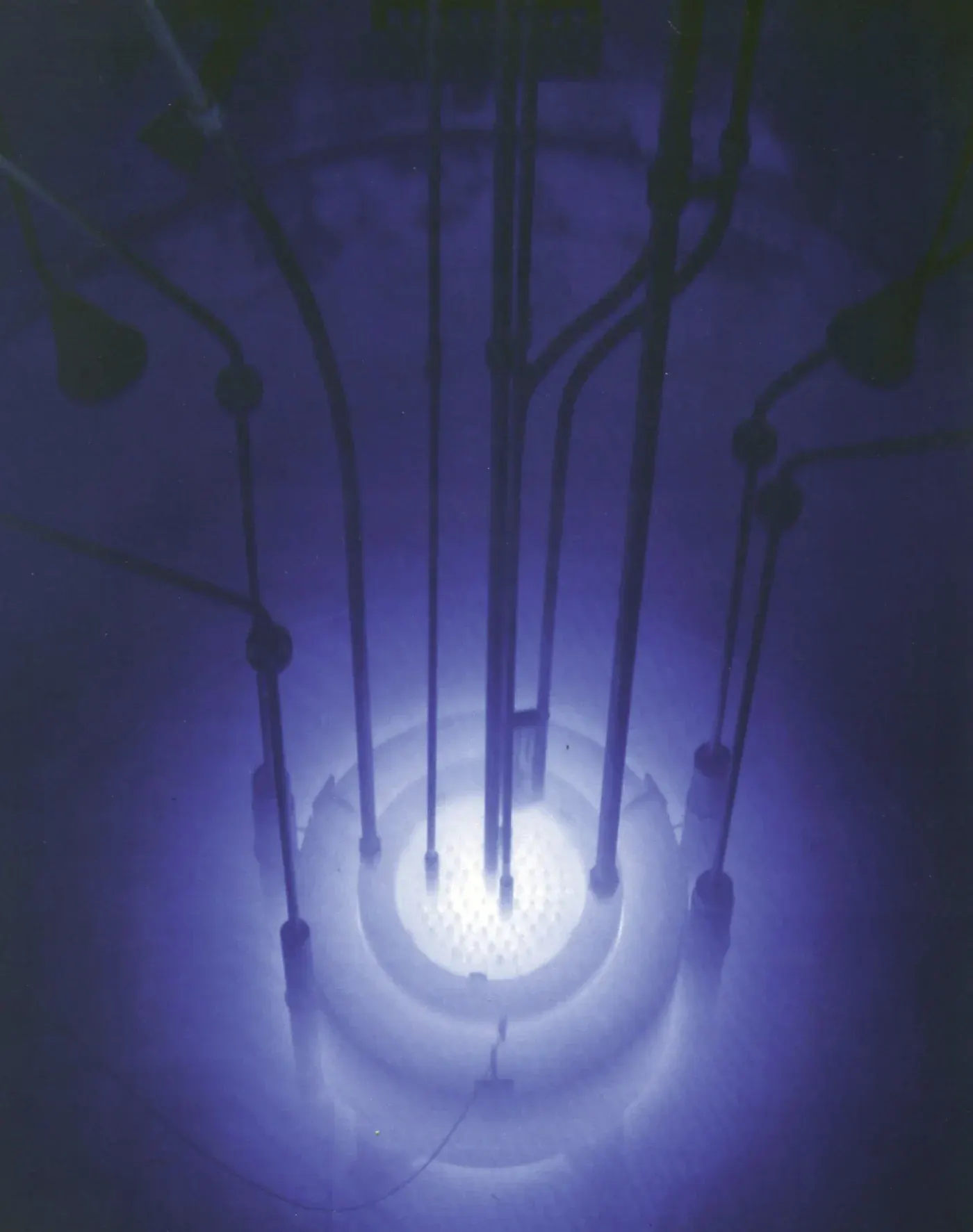
Figure: Blue Cherenkov light around the underwater core of the Reed College research reactor, USA (date unknown) · Public domain, via Wikimedia Commons
Attempts also continued in the oceans and lakes. Soviet researchers participated in DUMAND, an underwater neutrino detection project, and a neutrino observation project in Lake Baikal was also organized. The idea of using Antarctic ice first emerged in the Soviet Union as a method using radio waves, as the earlier historical preprint outlines. That paper separately notes that these branches each connect to IceCube in different ways (DOI: 10.48550/arxiv.2610.09507). The method of burying light sensors deep inside polar ice was first reported in June 1988 by Halzen and physicist John G. Learned, then spokesperson for the DUMAND project. The Nobel Committee explains that Halzen foresaw that neutrinos could be tracked using Antarctic ice, and his concept and scientific leadership became the foundation of IceCube (Nobel Committee, press release). The same document notes that Learned subsequently continued to lead DUMAND's development while Halzen devoted his career to ice detection (Nobel Committee, scientific background).
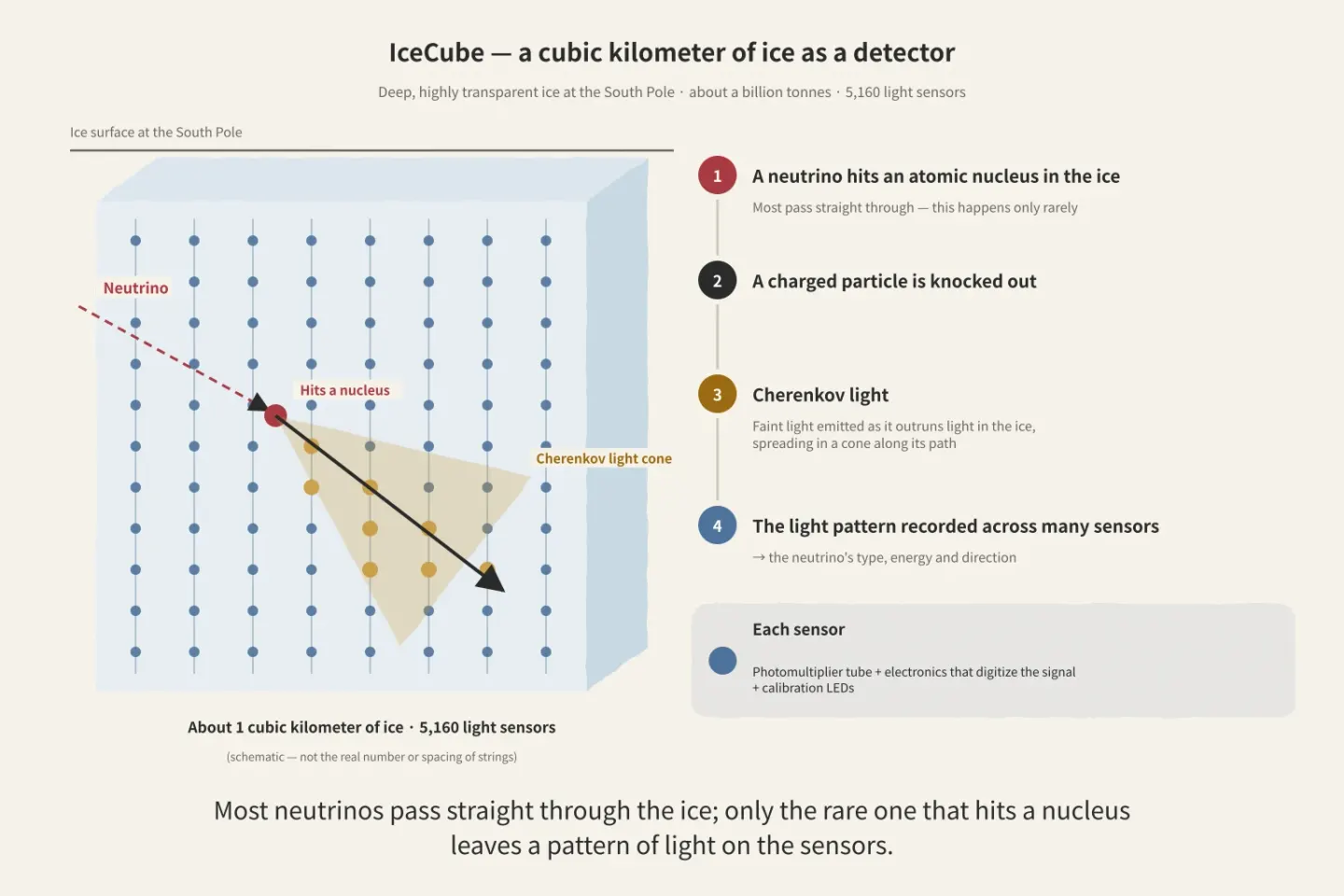
Figure: a diagram Paperis drew using only what the article says
That concept became IceCube. IceCube is a device that converted 1 cubic kilometer of deep, highly transparent Antarctic ice into a particle detector, with 5,160 light sensors embedded in 1 billion tons of ice (DOI: 10.1063/1.3480478). Each individual sensor is a complete measurement device containing a photomultiplier tube that receives light, electronics that convert those signals into numbers, and a calibration light-emitting diode (DOI: 10.1063/1.3480478). When a neutrino collides with an atomic nucleus in the ice, a charged particle pops out and emits Cherenkov light, and the patterns of light captured by multiple sensors reveal the neutrino's type, energy, and direction (DOI: 10.1063/1.3480478). The ice itself was also an object of study. Most of IceCube's scientific goals rely on knowing precisely how light scatters and attenuates in the ice. The phenomenon where light attenuates differently along the direction the ice flows was even observed, and a model was constructed suggesting that the cause is most likely the microstructure of the ice crystals (DOI: 10.1088/1748-0221/16/09/c09014).
IceCube is a device that withstands rare neutrino collisions through the amount of ice it watches, and reads the direction from which those neutrinos came through the light patterns in the ice. The energy of the neutrinos studied with this device far exceeds the energy of beams produced by ground-based accelerators (DOI: 10.1063/1.3480478).
In 2013, 28 Guests
IceCube looked for high-energy neutrinos that flew in from all over the sky and collided inside the detector between May 2010 and May 2012. It had already caught two events whose energies reached a peta-electronvolt (PeV, 1,000 trillion electronvolts), and this search raised the sensitivity to widen the range to about 30 TeV (tera-electronvolts, 30 times 1 trillion electronvolts). Twenty-six more events came out, far more than the number expected from particles generated in the atmosphere alone (DOI: 10.1126/science.1242856).
The baseline matters here. Cosmic rays colliding with Earth's atmosphere also produce neutrinos and other particles that enter the detector, and this is the constant background noise. The probability that 28 events appeared by chance from that background alone is measured in $\sigma$. $\sigma$ (sigma) is a scale that takes the width of random measurement fluctuations as a single unit and counts how many such units separate two values. The larger the number of units, the harder it is to explain the result as a fluke. The 28 combined from the two searches rejected the explanation that "all of them came from the atmosphere" at the $4\sigma$ level. These 28 contained the highest-energy neutrinos observed up to that time, and instead of matching the atmospheric background in type, direction, and energy, they matched general predictions for a component coming from outside Earth (DOI: 10.1126/science.1242856).
The evidence solidified in an analysis adding another year of data. In fact, over 988 days of detector operation, 37 neutrino candidates accumulated, and the energies they left in the detector ranged from 30 TeV to 2,000 TeV. The data combining three years rejected the atmosphere-only explanation at $5.7\sigma$, and the 2,000 TeV event was the highest-energy neutrino collision observed up to that time (DOI: 10.1103/physrevlett.113.101101).
Yet these guests arrived evenly from all over the sky. Noting that their arrival directions were evenly spread, the same paper suggested that the sources must be very numerous or widely distributed (DOI: 10.1103/physrevlett.113.101101). A 2022 review supported the idea that this even distribution came from outside our galaxy, summarizing that countless widely scattered celestial objects might have produced them (DOI: 10.1146/annurev-nucl-011122-061547). The findings released in 2013 were the first evidence that "there are high-energy neutrinos coming from outside Earth," solidified the following year at $5.7\sigma$. The "where" was left blank.
The Alert of September 22, 2017
On September 22, 2017, IceCube caught a neutrino with an energy of about 290 TeV. Its name is IceCube-170922A, derived from the date. In the direction it flew from lay a known celestial object, TXS 0506+056, which happened to be emitting gamma rays—light with the greatest energy—more intensely than usual (DOI: 10.1126/science.aat1378). A blazar is a celestial object where a jet of matter, spewing out at close to the speed of light from the center of a galaxy harboring a massive black hole, happens to be pointed straight toward Earth. TXS 0506+056 was just such an object.
When the alert went out, observations poured in, watching this object across nearly every wavelength of light, from radio waves to gamma rays (DOI: 10.1126/science.aat1378). Multi-messenger astronomy is an astronomy that observes a single celestial object not only with light but also with other messengers like neutrinos, reading them together. This event, where a single neutrino served as a flare and telescopes turned collectively in that direction, is a textbook example. The possibility that this neutrino and the blazar that hurled out the gamma rays overlapped by chance was rejected at about the 3σ level. The MAGIC telescopes on the ground observed this object for about 41 hours between 1.3 and 40.4 days after the alert (DOI: 10.3847/2041-8213/aad083).
Bolstered by this discovery, the IceCube Collaboration re-examined data from the previous few years and found that lower-energy neutrinos had been arriving from the direction of the same object in greater numbers than the background (DOI: 10.1126/science.aat2890). According to one analysis, a flare of neutrinos from the same direction occurred in 2014–2015, and at that time, the gamma rays from the same object did not brighten together and remained low (DOI: 10.1093/mnras/sty1852). That analysis concluded that, fitting all these clues together, TXS 0506+056 is the sole partner of the neutrinos in that region, the first neutrino source among non-stellar objects, and therefore most likely the first cosmic-ray source (DOI: 10.1093/mnras/sty1852).
The phrasing of the discovery paper itself is cautious. That paper wrote that “it suggests that blazars may be the source of high-energy neutrinos” (DOI: 10.1126/science.aat1378). A model analysis from the same year viewed that if this connection is correct, the conditions inside the material jet of that blazar must be nearly optimal for producing neutrinos, and disadvantageous for accelerating very high-energy cosmic rays. Or it noted that this could mean the simple model where gamma rays and neutrinos emerge together from a single location is incorrect (DOI: 10.3847/1538-4357/aad59a). And a single blazar did not explain the entire sky. An analysis that searched for steadily shining point sources using about 497,000 neutrinos gathered from 2009 to 2017 found no evidence of new sources, even when scanning the entire sky or separately pointing to lists of gamma-ray objects (DOI: 10.1140/epjc/s10052-019-6680-0). 2017 was the year that a single celestial object was first pointed to with a neutrino, but that did not mean that object was the master of all neutrinos across the sky.
Neutrinos from Where Light Is Blocked
The next clue came from where gamma rays were actually not seen. An active galaxy is a galaxy where a giant black hole at the center pulls in surrounding matter, spitting out intense light and particles. In NGC 1068, an active galaxy close to Earth, the giant black hole at its center is hidden behind cosmic dust (DOI: 10.1126/science.abg3395).
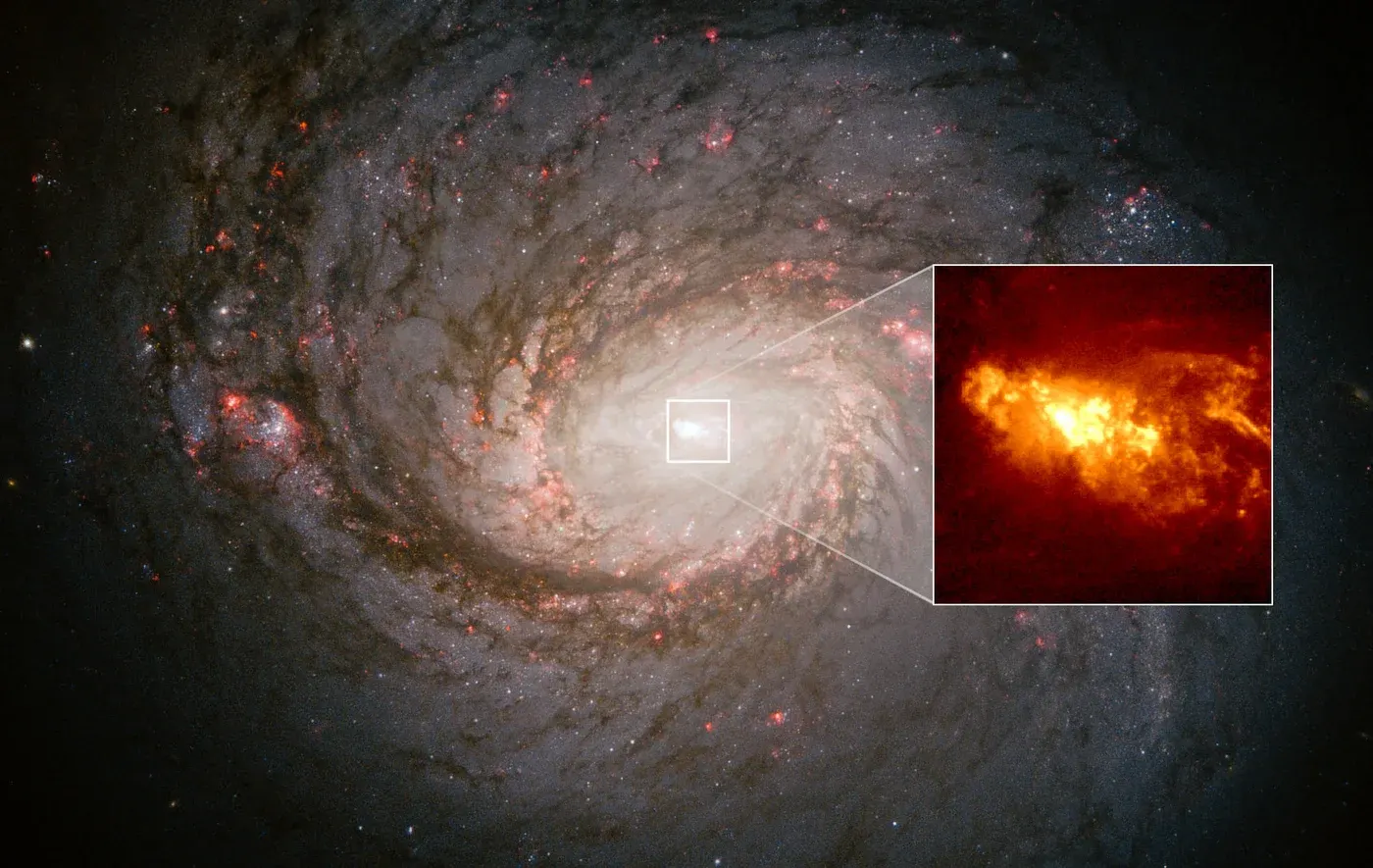
Figure: The active galaxy NGC 1068 seen by the Hubble Space Telescope; the inset shows hydrogen clouds lit by radiation from the central black hole (2021) · Public domain, via Wikimedia Commons
IceCube examined the positions of 110 already-known gamma-ray sources one by one using data from 2011 to 2020. From the direction of NGC 1068, teraelectronvolt-energy neutrinos came out more than the background, and the significance considering the whole was 4.2σ. The researchers interpreted this as being connected to that active galaxy. The measured amount of neutrinos was more than 10 times higher than the upper limit of teraelectronvolt gamma rays coming from the same object (DOI: 10.1126/science.abg3395). Ground-based MAGIC telescopes had spent 125 hours looking at this galaxy prior to that, but did not find very high-energy gamma rays (DOI: 10.3847/1538-4357/ab3a51).
The key to the mystery was that there are many neutrinos, but the gamma rays that should be born together in the same reaction are not seen. IceCube's follow-up analysis, which took over these results, viewed that the absence of gamma rays means neutrinos are produced close to the giant black hole, where light is too dense for gamma rays to escape (DOI: 10.3847/1538-4357/addd05). A 2016 study had already compared the amount of all-sky neutrinos and the gamma-ray background, proposing that the source would be cosmic-ray accelerators hidden so they cannot be seen as gamma rays (DOI: 10.1103/physrevlett.116.071101). The interpretation that NGC 1068 opened up is that we can peer with neutrinos into the side of black holes that cannot be looked into with light. However, this is an interpretation explaining the observation, not the observed fact itself.
The work of testing this interpretation continues today. In a 2026 analysis that re-scanned the northern sky with 13.1 years of data, NGC 1068 was once again the clearest neutrino source among the 110 pre-selected gamma-ray sources, and the amount of neutrinos was at least 100 times greater than the gamma rays. When the same analysis tested 47 X-ray-bright active galaxies excluding NGC 1068, an excess of 3.3σ came out from a group of 11 of them, and the researchers concluded that this strengthens the evidence that the centers of X-ray-bright active galaxies emit neutrinos (DOI: 10.3847/2041-8213/ae4aad). Another analysis in 2025 did not find a clear signal in a search grouping multiple active galaxies, but saw a 2.9σ-level excess in the direction of NGC 4151 viewed individually (DOI: 10.3847/1538-4357/ada94b). The 2022 NGC 1068 paper also did not call this result a "discovery" in its title, but called it "evidence" (DOI: 10.1126/science.abg3395).
The Path Traveled by a Single Neutrino
Connecting the facts so far, we can trace the journey of a single neutrino. However, the starting point of the scene below follows the interpretation seen in the previous section. The starting point is right in the middle of NGC 1068, next to a giant black hole hidden by dust (DOI: 10.1126/science.abg3395). The center of an active galaxy is a place rich in matter and light to collide with, so when particles accelerated to high energy collide there, neutrinos and gamma rays can be produced together (DOI: 10.3847/1538-4357/ada94b). Yet according to the interpretation, that spot is so packed with light that gamma rays cannot escape and are weakened (DOI: 10.3847/1538-4357/addd05).
Because neutrinos carry no electric charge, they are not bent by magnetic fields between galaxies, and because they rarely collide, they are not blocked by dust and gas either. Therefore, they reach Earth in the exact direction they left (DOI: 10.1126/science.abg3395). Even the neutrinos that reach Earth mostly pass straight through the Antarctic ice. On very rare occasions, when one collides with an atomic nucleus in or around the ice, a charged particle pops out, emits Cherenkov light as it passes through the ice, and the energy and direction of that neutrino are read from the patterns of light captured by sensors in the ice (DOI: 10.1063/1.3480478). As in the analysis of NGC 1068, the direction read from a long trajectory piercing the detector becomes accurate to a median of about 1 degree for neutrinos with an energy of 1 TeV, and about 0.3 degrees at 1 PeV, from 8 years of samples (DOI: 10.1140/epjc/s10052-019-6680-0). When such directions are accumulated on a sky map over many years, more dots gathering at the position of NGC 1068 than the background was the result of 2022 (DOI: 10.1126/science.abg3395). Neutrino astronomy is the work of pinpointing the locations of places light cannot reach, by accumulating countless blurry directional indicators one by one.
Our Galaxy Shone Too, Faintly
After pointing at distant galaxies, IceCube turned its gaze toward our own galaxy. If cosmic rays collide with gas inside our galaxy as well, neutrinos should emerge along the galactic disk that looks like a band across the night sky, and for this reason the galactic disk has long been picked as a candidate neutrino source (DOI: 10.22323/1.444.1108). The IceCube Collaboration used machine learning techniques on 10 years of data to hunt for this signal, and confirmed neutrinos coming from the galactic disk by rejecting the assumption of only background at the 4.5σ level (DOI: 10.1126/science.adc9818). The Nobel Committee's scientific background notes that in an analysis updated with 12 years of data, this signal reached 5.7σ (Nobel Committee, scientific background). This achievement is summarized as the first instance of observing our galaxy not in light, but in particles (DOI: 10.17918/00001635).
What that signal is remains open to two possibilities. The paper noted that while the signal matches neutrinos spread across the entire galactic disk, it could also have come from a crowd of point-like sources that cannot be individually distinguished (DOI: 10.1126/science.adc9818). One analysis pointed out that even if you add up all known gamma-ray sources while excluding objects like pulsars that appear to emit hardly any neutrinos, it still falls short of this amount of neutrinos, seeing it as likely that cosmic rays diffused in the galaxy and as-yet indistinguishable individual sources make up the main share, and added that the next observations from the Southern Hemisphere are needed to know for sure (DOI: 10.3847/2041-8213/ad012f).
The more surprising part was the amount. An analysis comparing the neutrino background of our galaxy and distant galaxies calculated that the neutrino brightness of our galaxy is 10 to 100 times lower than the average of distant galaxies. That analysis concluded that this means there has not been a type of object in our galaxy that mainly produces the all-sky neutrinos for at least the past tens of thousands of years, and the paper's title called our galaxy a "neutrino desert" (DOI: 10.1038/s41550-023-02128-0). Neutrinos come from our galaxy too, but most of the neutrinos filling the sky appear to come from outside our galaxy. This picture also fits with the evenly spread visitors from 2013.
Now, and Open Questions
IceCube found a flux of neutrinos coming from the entire sky, and provided evidence for the first sources: the blazar TXS 0506+056 and the active galaxy NGC 1068. Still, the sources that make up most of the all-sky neutrinos have not been caught yet (DOI: 10.22323/1.444.1108). The list of candidates has grown. Three "accretion flares"—events where a massive black hole tears apart and swallows a star, suddenly turning bright—overlapped with neutrino alerts, and one analysis estimated the significance of this connection at 3.6σ, suggesting that at least roughly 10% of IceCube alerts could come from such flares (DOI: 10.1093/mnras/stae610). Blazars, the gamma-ray-obscured centers of active galaxies, sudden flares, and our galaxy's disk are all on the list of candidates. A 2022 analysis that separately searched for galactic components concluded that the neutrino sky is a rich sky to which multiple classes of sources contribute together (DOI: 10.3847/2041-8213/aca1ae).
The initial question, namely where high-energy cosmic rays come from, also remains open. A 2023 paper on the galactic disk stated in its first sentence that its origin "remains unknown" (DOI: 10.1126/science.adc9818), and a 2024 analysis also wrote that the origin of high-energy neutrinos remains largely unexplained (DOI: 10.1093/mnras/stae610). A 2022 review predicted that current and future observational instruments will address the fundamental questions of this infant field (DOI: 10.1146/annurev-nucl-011122-061547).
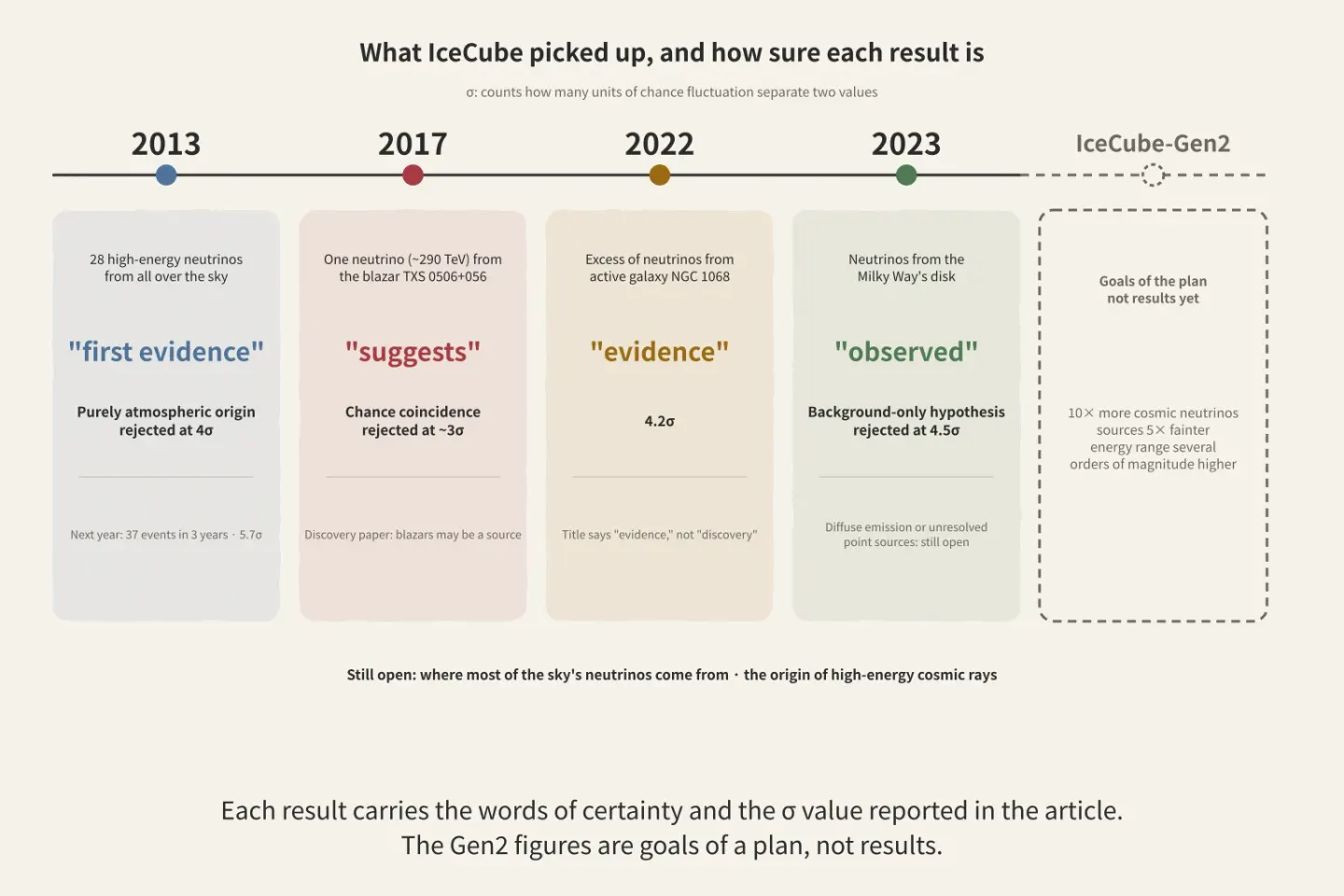
Figure: a diagram Paperis drew using only what the article says
Next-generation instruments are already being designed. IceCube-Gen2, an expansion plan for IceCube, aims to increase the number of observed cosmic neutrinos by a factor of 10, find sources 5 times fainter, and extend the energy range upward by several orders of magnitude. The design involves enlarging the array of light sensors in the ice, placing cosmic-ray detectors on the surface, and adding a shallow array that detects neutrinos above 100PeV using radio waves (DOI: 10.1088/1748-0221/16/10/c10007). These figures are goals set by the plan, not yet achieved results. Predictions from other next-generation neutrino telescopes like KM3NeT indicate that one class of nearby active galaxies is a promising target (DOI: 10.3847/1538-4357/ac1c77).
The 2026 prize was awarded in one person's name, but behind it lie multiple distinct paths with different characters. The idea of a water detector in 1960, the conference discussion in 1973, attempts in oceans and lakes, and the ice detector concept in 1988 did not connect into a single straight line; on top of them stand a collaboration that turned a cubic kilometer of ice into an instrument and has spent more than 10 years reading the data. The door to neutrino astronomy has been opened, and the map beyond that door is still mostly empty. The IceCube Collaboration itself introduces this achievement as opening the window of neutrino astronomy (DOI: 10.1088/1748-0221/16/10/c10007).
Where to Read More
The galaxies, giant black holes, and big picture of the sky introduced in this article continue in Galaxies and the Universe — Farmhouses on a Widening Field, Old Light Arriving from Every Side. Why the sky looks different at each wavelength of light and how telescopes collect light are covered in Light and Telescopes — A Letter That Arrives Late, a Fingerprint in the Envelope. How stars explode at the end of their lives, like the supernova of 1987, is in The Life of Stars — A Star's Arms Holding Up Its Own Weight, the Floor It Falls To, and the properties of waves like the shock wave borrowed to explain Cherenkov light are in Waves — Fans Rising in Their Seats, a Wave Circling the Stadium.
Awards in other categories that same year continue in The 2026 Nobel Prize in Physiology or Medicine — A Door Opened by Light, From Pond Algae to a Switch for the Brain, The 2026 Nobel Prize in Chemistry — Chemistry That Makes One Hand on Its Own, and Did Life Take That Path?, The 2026 Nobel Prize in Economics — From One Household's Arithmetic to a Nation's Business Cycle, The 2026 Nobel Prize in Literature — Anne Carson, New Forms from a Dialogue with Ancient Poetry, and The 2026 Nobel Peace Prize — Crimes Named in Court: Navi Pillay and the International Criminal Tribunal for Rwanda.
Award Materials
- “2026 Nobel Prize in Physics Press Release” (2026) — https://www.kva.se/en/news/the-nobel-prize-in-physics-2026/ — Laureates, affiliation (University of Wisconsin-Madison), reasons for the prize, and committee explanation of Halzen's 1988 conception and leadership
- “2026 Nobel Prize in Physics Scientific Background” (2026) — https://www.kva.se/app/uploads/2026/10/nobel-physics-2026-scientific-background-2.pdf — The lineage of neutrino astronomy (1960 proposals, DUMAND, AMANDA), the IceCube structure and collaboration size, and Halzen's role as principal investigator
Source Papers
- "Invited Review Article: IceCube: An instrument for neutrino astronomy" (2010) — DOI: 10.1063/1.3480478 — 1 km³ of Antarctic ice and 5,160 optical sensors read type, energy, and direction from the pattern of Cherenkov light; the need for a kilometer-scale size was recognized in the 1970s.
- "High-energy neutrino astronomy: a glimpse of the Promised Land" (2014) — DOI: 10.3367/ufne.0184.201405e.0510 — The centenary of Hess's discovery of cosmic rays (2012), the first proposal at the 1973 International Cosmic Ray Conference, and 40 years to the first discovery.
- "Observation of high-energy neutrinos from the Galactic plane" (2023) — DOI: 10.1126/science.adc9818 — Cosmic ray origins are unknown and they are deflected by magnetic fields; 10 years of data and machine learning show Galactic plane neutrinos at 4.3σ, indicating diffuse emission or an unresolved population of point sources.
- "High-energy neutrino astronomy: the cosmic ray connection" (2002) — DOI: 10.1088/0034-4885/65/7/201 — The acceleration sites of cosmic rays are unknown, cosmic accelerators act as "beam dumps," and any design requires a kilometer-scale observatory.
- "Multimessenger observations of a flaring blazar coincident with high-energy neutrino IceCube-170922A" (2018) — DOI: 10.1126/science.aat1378 — Coincidence of a ~290 TeV neutrino on 2017-09-22 with the flaring blazar TXS 0506+056, multiwavelength observations, suggesting blazars may be the source.
- "The contribution of Soviet scientists to the emergence of high-energy neutrino astrophysics: from the Cherenkov effect to underwater and in-ice telescopes" (2026, preprint) — DOI: 10.48550/arxiv.2610.09507 — Markov's 1960 proposal, Antarctic ice radio method, Halzen and Learned's 1988 optical concept, DUMAND and Baikal; the character of the lineage differs across branches.
- "Advances in IceCube ice modelling & what to expect from the Upgrade" (2021) — DOI: 10.1088/1748-0221/16/09/c09014 — 5,160 photomultiplier tubes, ice optical property models as the foundation of measurements, anisotropic attenuation along ice flow directions explained by birefringence.
- "Evidence for High-Energy Extraterrestrial Neutrinos at the IceCube Detector" (2013) — DOI: 10.1126/science.1242856 — 2010.5~2012.5, 2 PeV events + 26 events, 28 events rejecting an atmospheric-only origin at 4σ, consistent with extraterrestrial component predictions.
- "Observation of High-Energy Astrophysical Neutrinos in Three Years of IceCube Data" (2014) — DOI: 10.1103/physrevlett.113.101101 — 37 events in 988 days, 30~2,000 TeV, 5.7σ, directional isotropy → many sources or diffuse.
- "High-Energy Extragalactic Neutrino Astrophysics" (2022) — DOI: 10.1146/annurev-nucl-011122-061547 — Isotropy supports an extragalactic origin, TXS 0506+056 and NGC 1068 evidence, future observational prospects.
- "The Blazar TXS 0506+056 Associated with a High-energy Neutrino: Insights into Extragalactic Jets and Cosmic-Ray Acceleration" (2018) — DOI: 10.3847/2041-8213/aad083 — MAGIC observation for ~41 hours, chance coincidence rejected at ~3σ.
- "Neutrino emission from the direction of the blazar TXS 0506+056 prior to the IceCube-170922A alert" (2018) — DOI: 10.1126/science.aat2890 — Excess of lower-energy neutrinos from the same direction in previous years' data.
- "Dissecting the region around IceCube-170922A: the blazar TXS 0506+056 as the first cosmic neutrino source" (2018) — DOI: 10.1093/mnras/sty1852 — No accompanying gamma-ray increase during the 2014–2015 neutrino flare, TXS 0506+056 as the most plausible first non-stellar neutrino and cosmic ray source.
- "A Multimessenger Picture of the Flaring Blazar TXS 0506+056: Implications for High-energy Neutrino Emission and Cosmic-Ray Acceleration" (2018) — DOI: 10.3847/1538-4357/aad59a — If the association is correct, jet conditions are nearly optimal for neutrino production and unfavorable for ultra-high-energy cosmic ray acceleration, or single-zone models are unfavorable.
- "Search for steady point-like sources in the astrophysical muon neutrino flux with 8 years of IceCube data" (2019) — DOI: 10.1140/epjc/s10052-019-6680-0 — ~497,000 events from 2009 to 2017, no evidence of new sources.
- "Evidence for neutrino emission from the nearby active galaxy NGC 1068" (2022) — DOI: 10.1126/science.abg3395 — 2011~2020, 110 gamma-ray sources, NGC 1068 at 4.2σ, neutrino amount more than 10 times the TeV gamma-ray upper limit.
- "Constraints on Gamma-Ray and Neutrino Emission from NGC 1068 with the MAGIC Telescopes" (2019) — DOI: 10.3847/1538-4357/ab3a51 — 125 hours of observation, no significant ultra-high-energy gamma rays.
- "IceCube Search for Neutrino Emission from X-Ray Bright Seyfert Galaxies" (2025) — DOI: 10.3847/1538-4357/addd05 — The lack of TeV gamma rays in NGC 1068 indicates creation in dense radiation fields near the black hole; NGC 4151 and others show a 2.7σ excess.
- "Hidden Cosmic-Ray Accelerators as an Origin of TeV-PeV Cosmic Neutrinos" (2016) — DOI: 10.1103/physrevlett.116.071101 — Tension with the gamma-ray background → proposing an accelerator population obscured in GeV~TeV gamma rays as the source.
- "Evidence for Neutrino Emission from X-Ray-bright Active Galaxies with IceCube" (2026) — DOI: 10.3847/2041-8213/ae4aad — 13.1 years, NGC 1068 remains most significant, over 100 times compared to gamma rays; 11 out of 47 X-ray bright sources stacked at 3.3σ, strengthening evidence.
- "Search for Neutrino Emission from Hard X-Ray AGN with IceCube" (2025) — DOI: 10.3847/1538-4357/ada94b — Stacked search not significant, NGC 4151 direction at 2.9σ after trial correction.
- "Observation of neutrinos from the Milky Way Galaxy" (2023) — DOI: 10.17918/00001635 — Dissertation: first observation of the Galactic disk in particles rather than light, 4.5σ.
- "Decomposing the Origin of TeV–PeV Emission from the Galactic Plane: Implications of Multimessenger Observations" (2023) — DOI: 10.3847/2041-8213/ad012f — Galactic neutrinos exceed the sum of resolved sources → diffuse cosmic ray component likely dominant, southern hemisphere observations needed.
- "The Milky Way revealed to be a neutrino desert by the IceCube Galactic plane observation" (2023) — DOI: 10.1038/s41550-023-02128-0 — Milky Way neutrino luminosity 10 to 100 times lower than distant galaxy averages, absence of mainstream source-type celestial bodies over the past tens of thousands of years.
- "Observation of High-Energy Neutrinos from the Galactic Plane" (2023) — DOI: 10.22323/1.444.1108 — Conference presentation: the origin of most all-sky neutrinos remains unknown.
- "Establishing accretion flares from supermassive black holes as a source of high-energy neutrinos" (2024) — DOI: 10.1093/mnras/stae610 — 3 accretion flares associated with neutrinos at 3.6σ, at least ~10% of alerts.
- "Galactic Contribution to the High-energy Neutrino Flux Found in Track-like IceCube Events" (2022) — DOI: 10.3847/2041-8213/aca1ae — Galactic component at 4.1σ in public events above 200 TeV, neutrino sky composed of multiple classes of sources.
- "The IceCube-Gen2 Neutrino Observatory" (2021) — DOI: 10.1088/1748-0221/16/10/c10007 — Plan: 10 times observation rate, 5 times fainter sources, radio array above 100 PeV.
- "High-energy Neutrinos from Magnetized Coronae of Active Galactic Nuclei and Prospects for Identification of Seyfert Galaxies and Quasars in Neutrino Telescopes" (2021) — DOI: 10.3847/1538-4357/ac1c77 — Nearby Seyfert galaxies are promising targets for next-generation telescopes like KM3NeT and IceCube-Gen2.
Sources (29)
- Invited Review Article: IceCube: An instrument for neutrino astronomyDOI 10.1063/1.3480478
- High-energy neutrino astronomy: a glimpse of the Promised LandDOI 10.3367/ufne.0184.201405e.0510
- Observation of high-energy neutrinos from the Galactic planeDOI 10.1126/science.adc9818
- High-energy neutrino astronomy: the cosmic ray connectionDOI 10.1088/0034-4885/65/7/201
- Multimessenger observations of a flaring blazar coincident with high-energy neutrino IceCube-170922ADOI 10.1126/science.aat1378
- The contribution of Soviet scientists to the emergence of high-energy neutrino astrophysics: from the Cherenkov effect to underwater and in-ice telescopesDOI 10.48550/arxiv.2610.09507
- Advances in IceCube ice modelling & what to expect from the UpgradeDOI 10.1088/1748-0221/16/09/c09014
- Evidence for High-Energy Extraterrestrial Neutrinos at the IceCube DetectorDOI 10.1126/science.1242856
- Observation of High-Energy Astrophysical Neutrinos in Three Years of IceCube DataDOI 10.1103/physrevlett.113.101101
- High-Energy Extragalactic Neutrino AstrophysicsDOI 10.1146/annurev-nucl-011122-061547
- The Blazar TXS 0506+056 Associated with a High-energy Neutrino: Insights into Extragalactic Jets and Cosmic-Ray AccelerationDOI 10.3847/2041-8213/aad083
- Neutrino emission from the direction of the blazar TXS 0506+056 prior to the IceCube-170922A alertDOI 10.1126/science.aat2890
- Dissecting the region around IceCube-170922A: the blazar TXS 0506+056 as the first cosmic neutrino sourceDOI 10.1093/mnras/sty1852
- A Multimessenger Picture of the Flaring Blazar TXS 0506+056: Implications for High-energy Neutrino Emission and Cosmic-Ray AccelerationDOI 10.3847/1538-4357/aad59a
- Search for steady point-like sources in the astrophysical muon neutrino flux with 8 years of IceCube dataDOI 10.1140/epjc/s10052-019-6680-0
- Evidence for neutrino emission from the nearby active galaxy NGC 1068DOI 10.1126/science.abg3395
- Constraints on Gamma-Ray and Neutrino Emission from NGC 1068 with the MAGIC TelescopesDOI 10.3847/1538-4357/ab3a51
- IceCube Search for Neutrino Emission from X-Ray Bright Seyfert GalaxiesDOI 10.3847/1538-4357/addd05
- Hidden Cosmic-Ray Accelerators as an Origin of TeV-PeV Cosmic NeutrinosDOI 10.1103/physrevlett.116.071101
- Evidence for Neutrino Emission from X-Ray-bright Active Galaxies with IceCubeDOI 10.3847/2041-8213/ae4aad
- Search for Neutrino Emission from Hard X-Ray AGN with IceCubeDOI 10.3847/1538-4357/ada94b
- Observation of neutrinos from the Milky Way GalaxyDOI 10.17918/00001635
- Decomposing the Origin of TeV–PeV Emission from the Galactic Plane: Implications of Multimessenger ObservationsDOI 10.3847/2041-8213/ad012f
- The Milky Way revealed to be a neutrino desert by the IceCube Galactic plane observationDOI 10.1038/s41550-023-02128-0
- Observation of High-Energy Neutrinos from the Galactic PlaneDOI 10.22323/1.444.1108
- Establishing accretion flares from supermassive black holes as a source of high-energy neutrinosDOI 10.1093/mnras/stae610
- Galactic Contribution to the High-energy Neutrino Flux Found in Track-like IceCube EventsDOI 10.3847/2041-8213/aca1ae
- The IceCube-Gen2 Neutrino ObservatoryDOI 10.1088/1748-0221/16/10/c10007
- High-energy Neutrinos from Magnetized Coronae of Active Galactic Nuclei and Prospects for Identification of Seyfert Galaxies and Quasars in Neutrino TelescopesDOI 10.3847/1538-4357/ac1c77