
Paperis Articles
The 2026 Nobel Prize in Economics — From One Household's Arithmetic to a Nation's Business Cycle
Hall's theory of consumption and the New Keynesian model as Woodford laid it out — how an interest-rate decision reaches the economy through household and firm choices, and the criticisms and open questions after the crisis
Your field's papers, as audio
Pick your fields and journals — Paperis summarizes the key papers and turns them into audio. Listen on your commute.
Start Paperis free →The 2026 Nobel Prize in Economics — From One Household's Arithmetic to a Nation's Business Cycle
If We Lower Interest Rates, Do People Really Spend More?
On October 12, 2026, the Royal Swedish Academy of Sciences announced that it was awarding the year's Nobel Prize in Economics to two economists: Robert E. Hall of Stanford University in the United States and Michael Woodford of Columbia University in the United States. The official name of the prize is the Sveriges Riksbank Prize in Economic Sciences in Memory of Alfred Nobel. The reason for the award is "for microeconomic foundations of macroeconomic stabilisation," which, translated into everyday language, is the achievement of laying a foundation of the choices made by every household and every company for policies that calm the fluctuations of a national economy heating up and cooling down (Nobel Committee, press release).
The stage is set like this: when the economy cools and jobs decrease, the central bank lowers interest rates, and when prices rise too fast, it raises them. A central bank is a bank tasked with influencing the entire national economy by raising or lowering interest rates. However, the single interest rate is the only thing the central bank sets directly. Whether people open their wallets wider and whether companies raise their prices are decided by each individual and firm. Therefore, to foresee how much and when an interest rate decision will move the economy and prices, two things must be known: how a household decides when to spend money and when to save it, and when a company changes its prices.
The Nobel Committee points to the oil crisis of the 1970s as the backdrop for this prize. According to the committee's explanation, ever since the economist John Maynard Keynes put forward his theory about 100 years ago, policies to manage the ups and downs of the economy became important, but during the oil crisis, the Keynesian models used to determine when and how to implement policies seemed to work no longer. Unemployment did not decrease while prices alone rose uncontrollably, the West went through a decade where low growth, high unemployment, and high inflation overlapped, and there were loud voices saying that such policies brought more harm than good and should be stopped (Nobel Committee, press release).
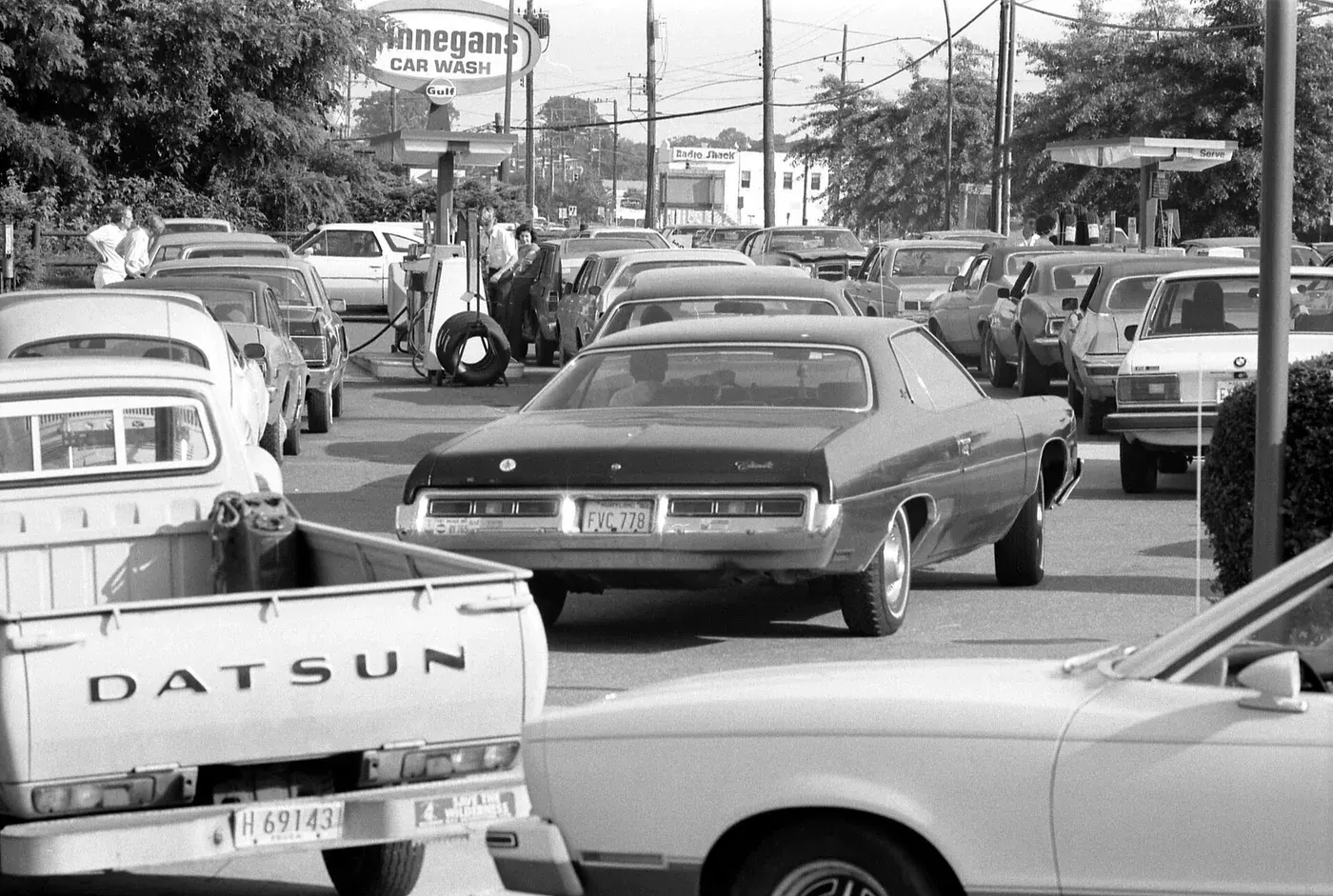
Figure: Cars lined up for fuel at a service station in Maryland during the second oil crisis (1979) · Public domain, via Wikimedia Commons
The Nobel Committee describes the core achievements of the two men as follows: Hall turned the theory of the forward-looking consumer into a form that could be directly tested with data in a 1978 paper, and Woodford, building upon Hall’s consumption framework and other developments in the 1970s and 1980s, became the core architect of the macroeconomic model that has become the primary tool of policy authorities today through a series of papers, including those co-authored with Julio Rotemberg, and a 2003 book. The committee also notes that the two pieces of work were done separately and with quite a time lag, and that the completed framework stands on the contributions of many researchers, including several Nobel laureates (Nobel Committee, scientific background). This article traces in turn how the two pieces of work connected, how they entered into the words and decisions of central banks, and what criticisms they received after the 2008 financial crisis. The committee describes the two men's work as a new framework for policies to manage the economy, handling monetary policy and fiscal policy together (Nobel Committee, scientific background). This article primarily follows the branch where household spending habits and central bank interest rates meet, and only briefly touches upon fiscal policy, which uses the state budget. Behind the names of the two men are countless researchers who have modified and tested that framework, and a significant portion of the evidence presented below is also their work.
1978, Can We Predict Next Consumption?
Hall's paper, published in the 1978 journal Journal of Political Economy, tested a single question (DOI: 10.1086/260724, DOI: 10.1142/s2010139213500018). The question was whether we can predict future consumption by looking at past income or other economic indicators.
The starting point was a preceding idea. The permanent income hypothesis is the idea that people set their consumption not according to the money they earn in a given year, but according to the income they expect to earn over a long period. Hall adopted the life cycle-permanent income hypothesis, which adds the meaning of a lifelong plan to this, and followed that assumption through to the end.
What happens if consumers make the best possible plan while looking ahead to the future? The answer Hall drew was that the satisfaction derived from consumption follows a random walk with a drift, and roughly speaking, consumption itself moves in the same shape (DOI: 10.1086/260724). A random walk is a movement where no matter how closely you examine the path walked so far, you cannot guess which way the next step will go. To translate Hall's conclusion directly, no variable other than current consumption should be useful for forecasting future consumption (DOI: 10.1086/260724).
Translating this conclusion into everyday language, it looks like this: things that can be known in advance must already be baked into today's spending, and therefore past records should not be able to predict the direction of future consumption. From the assumption of consumers making optimal plans while looking ahead, a prediction that could be tested with data emerged.
Hall tested this prediction against post-war U.S. time series data. The results split in two. Disposable income after taxes and adjusted for inflation—namely, real disposable income—had no power to forecast future consumption, so the prediction held up. On the other hand, stock price indices had the power to forecast future consumption, meaning the prediction was rejected at this point (DOI: 10.1086/260724). Hall concluded that this evidence supported a modified version of the life cycle-permanent income hypothesis (DOI: 10.1086/260724). The Nobel Committee explained that this prediction largely held up in aggregate consumption data, surprising the academic world, while also noting that the fact that asset market values predicted changes in consumption to some extent did not fit the pure form of the theory (Nobel Prize Scientific Background). The single line to take away is this: the idea that explaining consumption requires considering how people forecast the future was put to the test in this paper.
Where Hall's Calculation Floated
Following Hall's paper, researchers used the same calculation framework to compare the speed at which consumption grows against the after-tax interest rate (DOI: 10.1142/s2010139213500018). This aims to measure how much people delay consumption when interest rates rise, and the magnitude of this response is counted among the most important behavioral indicators in macroeconomics (DOI: 10.1142/s2010139213500018). It is a number that gauges how much interest rates move household spending.
However, the results of studies measuring this number differed widely. A 2013 study argued that the reason for this is that the factors moving interest rates over time may themselves be intertwined with consumption or savings decisions. That study tried to avoid this problem by using individual differences in capital income tax rates, and from 20 years of consumer expenditure survey data, it obtained a value of 2, which the authors themselves described as "strikingly high" (DOI: 10.1142/s2010139213500018). This is a result leaning toward the view that the timing of consumption shifts quite significantly depending on interest rates, though it is the estimate of a single study.
Hall's influence also spread along other paths. A 2022 history of economics paper assesses that Hall's paper sought to change consumption research and indeed did change it, but that the way it did so was not by becoming the dominant research method. Hall's work sparked an exchange among researchers in consumption, finance, monetary policy, and econometric modeling, and in the process, a single consumption theory grew into a cross-disciplinary research domain until it became a component of large macroeconomic models that solve the entire economy at once around the year 2000 (DOI: 10.1215/00182702-10213653). The same paper noted that the actual building of consumption models moved away from Hall's original proposal, or in other words, drifted. That drift took place within the boundaries set by the assumption of making plans over time and looking ahead rationally, and the authors viewed this as a reason to look more delicately at the concept of influence (DOI: 10.1215/00182702-10213653).
2003, Interest and Prices
In 2003, Woodford published a book titled Interest and Prices. The title matches the English title of a book published in 1898 by the late-19th-century economist Knut Wicksell (DOI: 10.1080/10427710600676447). A 2006 review viewed this title as a deliberate revival of Wicksell’s book, reading it as an effort to restructure monetary policy analysis around interest rates (DOI: 10.1080/10427710600676322). It connected Wicksell’s proposal to eliminate inflation by adjusting interest rates in response to price changes with today's interest rate rules (DOI: 10.1080/10427710600676447).
The framework that this book organized influentially is the New Keynesian model, and several textbooks cover the same framework (DOI: 10.1007/978-1-137-49449-8_10). The New Keynesian model is a framework that calculates how interest rate decisions move output and prices by accumulating the choices of forward-looking households and firms in an economy where prices change slowly. Here, the property that prices change slowly has its own name. Price stickiness is the tendency of firms to keep prices unchanged for a while rather than adjusting them immediately when costs or demand change. According to a 2016 summary published after the financial crisis, this model combines, in its most basic form, price stickiness and the forward-looking decisions made by both households and firms. It captured how output and prices respond when demand or supply is shaken in a way that is easy to handle, and intuitively explained the channels through which monetary policy is transmitted to the economy (DOI: 10.1007/978-1-137-49449-8_10).
The skeleton of the model consists of three parts: the side determining how much households spend, the side determining how firms set prices, and the rule by which the central bank sets interest rates (DOI: 10.1080/10427710600676447). An example of the third part is the rule put forward by John B. Taylor in 1993, which is a formula that sets interest rates according to the state of inflation and output (DOI: 10.3386/w6618). As seen in the previous section, Hall's research on consumption became a component of such large macroeconomic models around 2000. However, that path drifted far from Hall's original proposal (DOI: 10.1215/00182702-10213653). The Nobel Committee explains that the first equation concerning consumption among the three equations of the simplest New Keynesian model is precisely Hall's theory of consumption (Nobel Committee, scientific background).
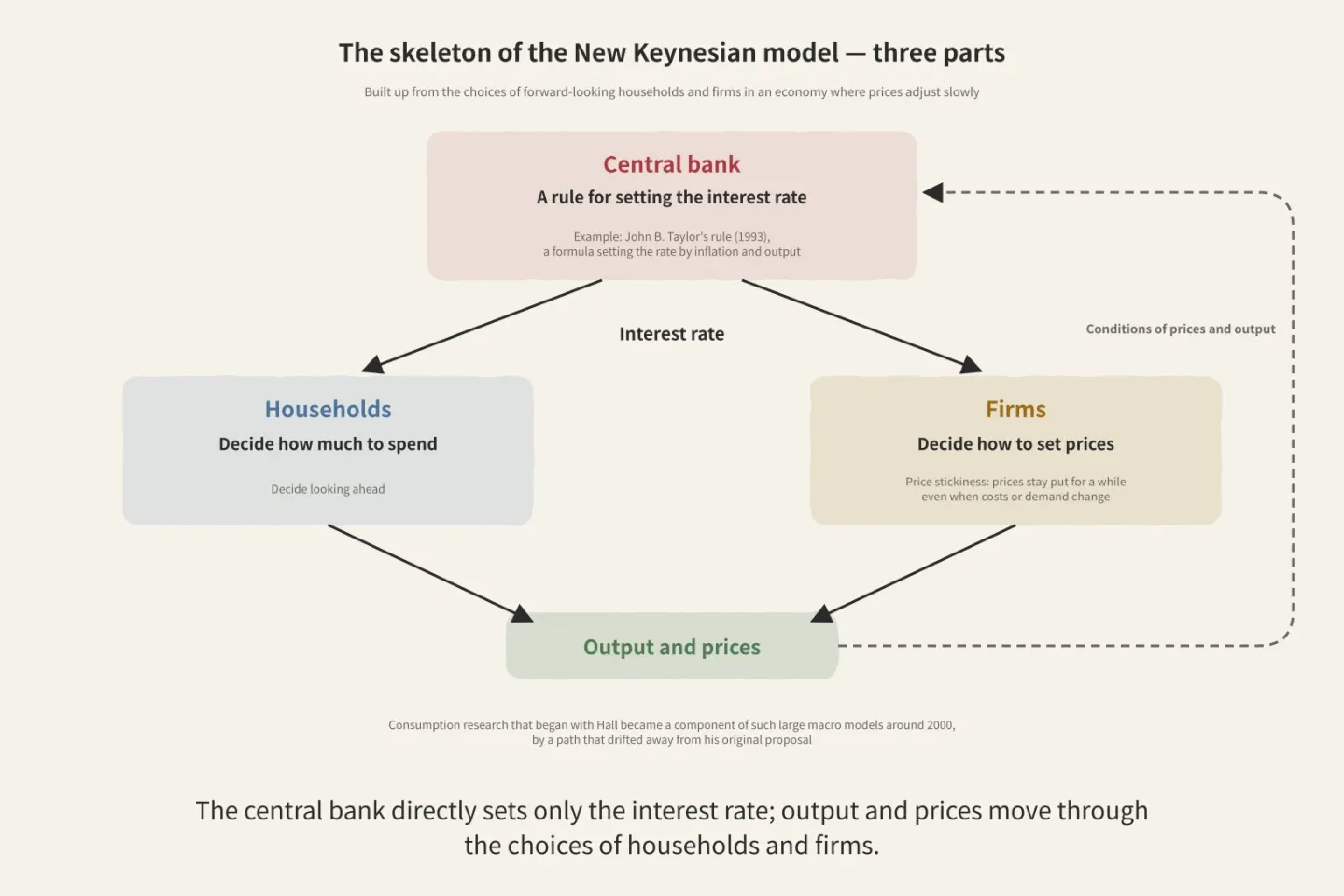
Figure: a diagram Paperis drew using only what the article says
The biggest idea this framework changed is the unit of policy. In this framework, monetary policy is the task of choosing a rule for current and future interest rates (DOI: 10.1007/978-1-137-49449-8_10). If households and firms look ahead, their expectations about future interest rates and prices also enter into today's choices. Working in the same place is expectations. Expectations are the expectations of firms and households about how much prices will rise in the future.
The target of this framework is stabilization policy. Stabilization policy is policy that moves interest rates or the government budget to cushion shocks when the economy overheats or cools excessively. The book explains why Woodford placed special emphasis on price stability among them. He wrote that price stability is important because if the overall price level becomes unstable, substantial distortions arise in the real economy, causing aggregate employment, output, and the composition across industries to fluctuate inefficiently (DOI: 10.1080/10427710600676447). A 2006 methodological review discussing this book relayed Woodford's own point that while this approach centered on interest rate rules had already become standard at central banks, it had not yet found a place in university textbooks (DOI: 10.1080/10427710600676322). The one-line takeaway is this: in this framework, the central bank becomes both an institution that chooses interest rates and an institution that manages people's expectations.
Becoming the Language of Policy
Even before these ideas were settled, a similar pattern appeared in the actual behavior of central banks. A 1997 working paper estimated that the central banks of Germany, Japan, and the US had effectively targeted inflation since 1979 without officially declaring an inflation target, and had responded to expected future inflation rather than past inflation. The authors suggested this may be why monetary policy in the three countries was largely successful (DOI: 10.3386/w6254). According to a 2014 overview, most central banks target an inflation rate of around 2% (DOI: 10.1257/jel.52.3.679).
How did countries that adopted inflation targets perform? A 2009 overview concluded that in advanced economies, the economic performance of countries with targets was similar to those without them, whereas in developing economies, the performance of those with targets improved, and in neither group did targets make the real economy more volatile (DOI: 10.1111/j.1468-2362.2009.01236.x). This means that in advanced economies, performance was not divided simply by whether a target was adopted, and the difference appeared in developing economies. The author noted that while central banks must make difficult choices in the face of cost shocks such as soaring raw material prices, committing to a clear target can increase their ability to cope with demand shocks and financial crises (DOI: 10.1111/j.1468-2362.2009.01236.x).
In 2008, this framework was put to the test. By November of that year, the Federal Reserve, the US central bank—known as the Fed—had already lowered its policy rate to effectively 0 amid a worsening economy and a spreading financial crisis. With no room to cut rates further, the Fed turned to other tools, and starting in December of that year, its policy statements began to explicitly mention the expected future path of interest rates (DOI: 10.1257/jep.32.4.121). This is forward guidance. Forward guidance is a policy in which a central bank communicates in advance how it plans to move interest rates.
The Nobel Committee explained that forward guidance was proposed by Woodford and other researchers as an additional tool to stimulate the economy when interest rates cannot be cut further, and noted that its effectiveness depends on whether people believe the path announced by the central bank (Nobel Committee, scientific background). Forward guidance was a tool that had already been studied before the crisis. A 2004 study pointed out that once interest rates are pinned near a floor of 0, central banks can no longer cut rates to stimulate demand, and reported that there is some evidence central bank announcements can help shape public expectations about future policy (DOI: 10.1353/eca.2005.0002). A 2012 study divided forward guidance into two types: guidance that makes a public commitment to future actions, and guidance that merely forecasts economic outlooks and the corresponding policies. Previous research showed that the former—a promise to keep interest rates at 0 longer than circumstances would otherwise require—can have the effect of easing monetary conditions if it gains public trust. This study concluded that because the Fed's rate-setting meetings had extensive experience successfully signaling policy adjustments in advance, communication difficulties were not an insurmountable wall preventing commitment-style guidance. Using an estimation model of the entire economy at once, this study also examined how pairing such guidance with clear criteria for when to start raising interest rates could reduce risks to the price stability mandate (DOI: 10.1353/eca.2012.0004).
How large was the effect? A lecture published in the American Economic Review in 2020 argued that new tools like asset purchases and forward guidance were effective at easing financial conditions when interest rates were pinned at the floor, and therefore should become standard tools for central banks. Simulations using the Fed's model estimate that when the neutral interest rate—the level that neither pushes nor pulls the economy—is 2 to 3%, as indicated by most US estimates, combining the two tools creates room equivalent to a further rate cut of about 3 percentage points, offsetting most of the impact of the interest rate floor. However, it added that if that interest rate level is much lower, additional measures such as moderately raising the inflation target or relying more on fiscal policy may be necessary (DOI: 10.1257/aer.110.4.943). There are also more cautious evaluations. A 2018 reassessment concluded that while there is sufficient evidence that these tools influenced financial conditions to varying degrees, the ultimate effect on output and inflation is harder to isolate, the benefit-to-cost ratio is likely to worsen over time, and they are best viewed as exceptional tools for use in very specific situations. It added, however, that whether they will actually remain exceptions is doubtful (DOI: 10.4337/9781784719227.00026). The Nobel Committee also explained that this framework was of great practical help during the 2008 Great Recession, while noting that it is difficult to prove beyond doubt that faster economic recoveries over the past half-century were thanks to better stabilization policy. However, the committee added that there appears to be a consensus that the policy played a very important role (Nobel Committee, scientific background). The one-line takeaway is this: forward guidance is a policy that seeks to manage the economy by moving expectations, and while its effects have been visible in financial markets, the effects beyond that are still being debated.
The Path One Promise Takes
Let's follow a single promise. A central bank announces, "We will keep interest rates low for quite a long time." Within standard monetary models, the further into the distant future this promise reaches, the enormous effect it has on today's economy, and that effect grows larger the longer the duration of the promise (DOI: 10.1257/aer.20150063). This is because households in the standard model are assumed to foresee interest rates in the distant future without omission, and to be able to block all risks of interrupted income with insurance (DOI: 10.1257/aer.20150063, DOI: 10.1257/aer.20162005).
In financial markets, announcements actually leave traces. In a study that captured the surprise of policy through interest rate changes appearing in the brief moments around policy announcements, "small" movements in short-term rates led to "large" movements in borrowing costs, and most of that came from the response of the premium attached to long-term borrowing and the credit premium added when the private sector borrows. The same study reported that forward guidance is important for the entire transmission power of monetary policy (DOI: 10.1257/mac.20130329). A study analyzing European Central Bank announcement days also found that three factors—the interest rate decision itself, forward guidance, and asset purchases—explained almost all interest rate movements across maturities (DOI: 10.1016/j.jmoneco.2019.08.016).
When we reach the household's kitchen, the picture changes. A 2021 study showed with theory and data that households expecting prices to rise further actually increase consumption, and then compared two policies intended to move expectations to increase demand. Unusual fiscal policy raised household expectations and consumption, but forward guidance announcements did not (DOI: 10.1093/rfs/hhab083). On the corporate side, there are results measured against inflation targets instead of forward guidance. Even though the Reserve Bank of New Zealand has maintained an inflation target for 25 years, the inflation expectations of business managers in that country were hardly anchored near the target. Managers mostly did not know who led the central bank or what its target was, and their expected future inflation was widely scattered among individuals (DOI: 10.1353/eca.2015.0007).
The facts placed in this scene speak of different layers. Promises inside models are very strong, and in financial markets promises moved borrowing costs significantly, but in one study household expectations and consumption did not move with forward guidance announcements. The inflation expectations of New Zealand business managers were measured against a long-standing inflation target rather than forward guidance, and they too were not anchored near the target. This distance between the households and businesses assumed by the model and actual people is where the criticism in the next section digs in.
Crisis and Criticism
When the first signs of the global financial crisis—the most damaging since the Great Depression—appeared in August 2007, the framework dominating macroeconomics was the New Keynesian model. According to a 2018 evaluation paper, over the following decade, criticism poured in against modern macroeconomics, especially large models built on the New Keynesian framework. Nevertheless, the author assessed that the New Keynesian model could still be considered the dominant framework in classrooms, academic research, and policy modeling, and that its scope had even widened (DOI: 10.1257/jep.32.3.87).
The sharpest criticisms targeted its very foundations. A 2017 critique paper argued that the core of the failure lay in flawed foundational assumptions. It contended that the models failed to capture essential aspects of economic behavior such as incomplete information or insights from behavioral economics, failed to properly depict the financial sector, making them ill-suited for predicting or responding to the financial crisis, and made it difficult to analyze both the role of distribution in business cycles and crises and the consequences of business cycles for inequality, due to the assumption that the entire economy is represented by a single average household (DOI: 10.1093/oxrep/grx057). Efforts to fix the framework continued from within as well. A 2009 working paper using a credit friction model created by Curdia and Woodford suggested that adjusting interest rate rules in response to changes in credit spreads could outperform standard rules, though the appropriate degree of adjustment depended on why the spread moved (DOI: 10.3386/w15289).
Corporate-side components were also put to the test. In 2001, Woodford presented evidence that when the labor income share was used as a business cycle yardstick, the New Keynesian price equation fit actual price movements quite well (DOI: 10.17016/feds.2002.30). However, a 2002 working paper countered that, overall, the evidence showed that equation to be a very poor model for explaining prices (DOI: 10.17016/feds.2002.30). There is also contention over the cost of inflation. In the standard New Keynesian model, when inflation rises from 0% to 10%, the loss arising from dispersed prices is ten times larger in magnitude than the loss from business cycles. Yet US data from the high-inflation period of the late 1970s and early 1980s yielded no evidence that the magnitude of price changes increased when prices were adjusted. The authors concluded that this result implies standard analyses of the cost of inflation are wrong and that the implications for an appropriate inflation rate must be reassessed, while also reporting that prices excluding sales have not become more flexible over the past 40 years (DOI: 10.1093/qje/qjy017).
The problem from the previous section's scene—namely, that the promises made within models are too strong—is commonly called the forward guidance puzzle. Attempts to solve this converged on revising the assumption of households planning by looking far ahead. Households that cannot insure against the risk of a sudden loss of income and face borrowing limits save for a rainy day, making them less responsive to future interest rate changes. Incorporating such households greatly reduces the power of forward guidance to stimulate the economy (DOI: 10.1257/aer.20150063). In behavioral New Keynesian models that incorporate myopia—partially overlooking strange occurrences in the distant future—this puzzle does not arise at all (DOI: 10.1257/aer.20162005). When household heterogeneity and bounded rationality—thinking through an opponent's thoughts only up to a few steps—are incorporated together, the effects of monetary policy are significantly dampened, and the difference grows larger the further into the future it reaches, with the combination producing a much larger difference than when the two are introduced separately (DOI: 10.1257/aer.20171400). However, one analytical model incorporating household heterogeneity uncovered a catch-22 where the demand-boosting effect and the puzzle-solving effect collide depending on the direction in which inequality co-moves with the business cycle, and suggested this could be resolved by incorporating risk channels or alternative policy rules such as price-level targeting (DOI: 10.1093/restud/rdae066). The Nobel Committee also points to the forward guidance puzzle as a weakness of the New Keynesian model, noting that while various solutions each have merit, there is as yet no single agreed-upon explanation (Nobel Committee, scientific background). The one-line takeaway to carry away is this: criticism flowed much more toward modifying foundational components like households and firms to more closely resemble real people than toward discarding the framework.
Still Open Questions
First is the relationship between prices and the economy. The relationship that prices rise more as the economy heats up is a core component of central bank policy frameworks, but as prices have seemed to move independently of the economy, arguments have emerged that the relationship has weakened or vanished. A 2020 study explains that because central banks know this relationship and try to push up prices when the economy is bad, the relationship gets blurred in the data, and presents evidence that the relationship remains robust in U.S. data (DOI: 10.1086/707181). Whether the relationship has weakened or policy has masked it depends on how the data is read.
Second is the height of the inflation target. Several proposals have emerged to raise the long-term inflation target to reduce the frequency of interest rates getting stuck at the bottom. However, a 2014 review noted that in New Keynesian models where the inflation trend is set to a non-zero value, a higher trend makes the economy more volatile and unstable, and makes inflation expectations prone to wavering, urging caution toward this proposal (DOI: 10.1257/jel.52.3.679). The 2020 lecture seen earlier listed moderately raising the target depending on the situation as one of the supplementary measures (DOI: 10.1257/aer.110.4.943). Two judgments from within the same framework still stand side by side.
Third is how expectations are actually formed. When people who stated their inflation expectations in surveys were made to participate in investment experiments with real money on the line, most behaved in accordance with economic theory matching their expectations, and the authors viewed this as supporting the microeconomic foundations of modern macroeconomic models (DOI: 10.1111/iere.12113). On the other hand, the expectations of New Zealand business managers were not anchored near the target (DOI: 10.1353/eca.2015.0007). That people move according to their expectations and that central banks can anchor those expectations where they want them are different matters.
A 2018 evaluation paper also cited the problem of the interest rate floor and the problem of monetary policy interacting with the differing circumstances of individual households as the most active research agendas (DOI: 10.1257/jep.32.3.87). Within this shared framework that incorporates the work of Hall and Woodford, the questions remain open even after the prize was awarded. The framework that builds up the nation's economy from household calculations is still revising the portrait of the person going into those calculations.
Where to Look Next
The basics of central banks and interest rates in this article continue from "Interest Rates and Central Banks — A Brake in the Engine Room, a Train That Slows Long After", and how prices are measured continues from "Prices and Inflation — The Same Shopping Basket, Height Marks Drawn Every Year". How far expectations explain the causes of rising prices is covered by "The Real Cause of Inflation — Money Supply, Expectations, or Supply Chains?", and how the economy is measured is covered by "GDP and the Business Cycle — The Last Receipt, and the Day No Receipt Records".
Awards in other categories that same year continue in The 2026 Nobel Prize in Physiology or Medicine — A Door Opened by Light, From Pond Algae to a Switch for the Brain, The 2026 Nobel Prize in Physics — Messengers from the Cosmos, Caught in a Cubic Kilometer of Ice, The 2026 Nobel Prize in Chemistry — Chemistry That Makes One Hand on Its Own, and Did Life Take That Path?, The 2026 Nobel Prize in Literature — Anne Carson, New Forms from a Dialogue with Ancient Poetry, and The 2026 Nobel Peace Prize — Crimes Named in Court: Navi Pillay and the International Criminal Tribunal for Rwanda.
Prize Materials
- "2026 Nobel Prize in Economic Sciences Press Release" (2026) — https://www.kva.se/en/news/the-prize-in-economic-sciences-2026/ — Announced October 12, 2026, laureates and affiliations (Stanford University, Columbia University), prize motivation "for microeconomic foundations of macroeconomic stabilisation", background of the 1970s oil crisis
- "2026 Nobel Prize in Economic Sciences Scientific Background" (2026) — https://www.kva.se/en/news/the-prize-in-economic-sciences-2026/ — Hall's 1978 testable consumption theory, Woodford's New Keynesian model (co-authored paper with Rotemberg, 2003 book), proposal of forward guidance and puzzles, limitations of policy evaluation
Source Papers
- "Stochastic Implications of the Life Cycle-Permanent Income Hypothesis: Theory and Evidence" (1978) — DOI: 10.1086/260724 — The consumption of an optimizing consumer follows roughly a random walk with drift; real disposable income has no predictive power (confirmed), stock price indices have predictive power (rejected), supporting the revised version.
- "A Tax-Based Estimate of the Elasticity of Intertemporal Substitution" (2013) — DOI: 10.1142/s2010139213500018 — Since Hall (1978, JPE), estimates of the interest rate-consumption response have diverged widely; the value estimated from capital income tax rate differences is 2 (single study).
- "The Drifting Influence of Hall's Random-Walk Hypothesis on Consumption Modeling" (2022) — DOI: 10.1215/00182702-10213653 — Hall's paper exerted influence through cross-field interactions rather than as a dominant method, becoming a component of large macroeconomic models around 2000, while actual models drifted from Hall's original proposal (within the framework of intertemporal optimization and rational expectations), prompting a reassessment of the concept of influence.
- "Wicksell after Woodford" (2006) — DOI: 10.1080/10427710600676447 — Interest and Prices (2003) is a neo-Wicksellian framework succeeding Wicksell (1898); its core models feature household demand, supply, and interest rate rules, and Woodford's argument is that price instability generates real distortions.
- "A Neowicksellian in a New Classical World: The Methodology of Michael Woodford's Interest and Prices" (2006) — DOI: 10.1080/10427710600676322 — The title is read as a conscious revival of Wicksell and an attempt at an interest-centered reconstruction; this approach is standard in central banks but not yet in textbooks (a commentator recounting Woodford's point).
- "Post-Crisis Macrofinancial Modeling: Continuous Time Approaches" (2016) — DOI: 10.1007/978-1-137-49449-8_10 — The pre-crisis dominant paradigm was the New Keynesian model with microfoundations covered by multiple textbooks (Woodford 2003 being an influential synthesis), characterized by sticky prices plus forward-looking decisions, and monetary policy formulated as a choice of current and future interest rate rules.
- "Interest-Rate Rules in an Estimated Sticky Price Model" (1998) — DOI: 10.3386/w6618 — Generalizes the Taylor (1993) rule and evaluates rules that set interest rates based on the history of prices and output.
- "Monetary Policy Rules in Practice: Some International Evidence" (1997) — DOI: 10.3386/w6254 — Since 1979, the central banks of Germany, Japan, and the United States have engaged in implicit inflation targeting, responding to expected inflation (working paper).
- "The Macroeconomics of Trend Inflation" (2014) — DOI: 10.1257/jel.52.3.679 — Most central banks target roughly 2%; higher trend inflation makes the economy more unstable and shakes expectations, warranting caution regarding proposals to raise the target.
- "Inflation Targeting: What Have We Learned?" (2009) — DOI: 10.1111/j.1468-2362.2009.01236.x — Advanced economies showed similar performance regardless of adoption, developing economies showed improvement, and real instability did not increase.
- "Outside the Box: Unconventional Monetary Policy in the Great Recession and Beyond" (2018) — DOI: 10.1257/jep.32.4.121 — In November 2008, the policy rate effectively reached 0, and starting in December, statements began mentioning the path of interest rates (forward guidance).
- "Monetary Policy Alternatives at the Zero Bound: An Empirical Assessment" (2004) — DOI: 10.1353/eca.2005.0002 — At the interest rate floor, rate cuts are impossible, and there is some evidence that central bank announcements can shape policy expectations.
- "Macroeconomic Effects of Federal Reserve Forward Guidance" (2012) — DOI: 10.1353/eca.2012.0004 — Distinguishes between commitment-type and projection-type guidance; the Fed has extensive experience in pre-announcing adjustments, so communication is not an insurmountable wall, analyzed via estimated models.
- "The New Tools of Monetary Policy" (2020) — DOI: 10.1257/aer.110.4.943 — Asset purchases and forward guidance are effective at easing financial conditions at the interest rate floor; if the neutral interest rate is 2% to 3%, there is about 3 percentage points of room, whereas much lower rates might necessitate additional measures (lecture).
- "Unconventional monetary policies: a re-appraisal" (2018) — DOI: 10.4337/9781784719227.00026 — Evidence of effects on financial conditions is ample, but final effects on output and prices are difficult to isolate, the cost-benefit trade-off may have worsened, and these remain exceptional tools.
- "The Power of Forward Guidance Revisited" (2016) — DOI: 10.1257/aer.20150063 — In standard models, guidance about the distant future has massive effects, but introducing uninsurable income risk and borrowing constraints significantly reduces these effects through precautionary saving.
- "Monetary Policy Surprises, Credit Costs, and Economic Activity" (2015) — DOI: 10.1257/mac.20130329 — Small movements in short-term rates translate into large movements in the cost of credit via term premia and credit premia, with forward guidance playing an important role in transmission strength.
- "Measuring euro area monetary policy" (2019) — DOI: 10.1016/j.jmoneco.2019.08.016 — On European Central Bank announcement days, three components—rate decisions, forward guidance, and asset purchases—explain nearly all yield curve movements across maturities.
- "Managing Households' Expectations with Unconventional Policies" (2021) — DOI: 10.1093/rfs/hhab083 — Higher inflation expectations increase household consumption; unconventional fiscal policies raised expectations and consumption, whereas forward guidance announcements did not.
- "Inflation Targeting Does Not Anchor Inflation Expectations: Evidence from Firms in New Zealand" (2015) — DOI: 10.1353/eca.2015.0007 — Despite 25 years of inflation targeting, the expectations of New Zealand firm managers are barely anchored, and they largely remain unaware of central bank targets.
- "The State of New Keynesian Economics: A Partial Assessment" (2018) — DOI: 10.1257/jep.32.3.87 — The New Keynesian paradigm dominated in 2007 and can still be viewed as the dominant framework despite a decade of criticism (author's assessment), with the interest rate floor and household heterogeneity remaining active challenges.
- "Where Modern Macroeconomics Went Wrong" (2017) — DOI: 10.1093/oxrep/grx057 — Flawed microfoundations, financial sector weaknesses, and the representative-household assumption make the framework ill-suited for analyzing distribution and inequality (critique paper).
- "Credit Spreads and Monetary Policy" (2009) — DOI: 10.3386/w15289 — The Curdia-Woodford credit friction model shows that adjusting credit premia can improve standard rules, but the magnitude depends on the source of premium fluctuations (working paper).
- "Does the Labor Share of Income Drive Inflation?" (2002) — DOI: 10.17016/feds.2002.30 — Rebuts the evidence for Woodford's (2001) labor income share inflation equation, pointing to a very fragile model (working paper).
- "The Elusive Costs of Inflation: Price Dispersion during the U.S. Great Inflation" (2018) — DOI: 10.1093/qje/qjy017 — Standard models view the welfare loss of moving from 0% to 10% inflation as an order of magnitude larger than business cycle losses; there is no evidence of increased price adjustment amplitude during high inflation periods, and price flexibility has not changed over 40 years.
- "A Behavioral New Keynesian Model" (2020) — DOI: 10.1257/aer.20162005 — Incorporating partial myopia regarding the distant future eliminates the forward guidance puzzle.
- "Monetary Policy, Bounded Rationality, and Incomplete Markets" (2019) — DOI: 10.1257/aer.20171400 — The interaction between household heterogeneity and bounded rationality substantially dampens monetary policy effects, whereas either factor alone yields small effects.
- "Monetary Policy and Heterogeneity: An Analytical Framework" (2024) — DOI: 10.1093/restud/rdae066 — A dilemma where demand amplification and puzzle resolution collide depending on the cyclical direction of inequality.
- "Optimal Inflation and the Identification of the Phillips Curve" (2020) — DOI: 10.1086/707181 — Policy obscures the identification of the inflation-business cycle relationship, yet the relationship remains robust in U.S. data.
- "INFLATION EXPECTATIONS AND BEHAVIOR: DO SURVEY RESPONDENTS ACT ON THEIR BELIEFS?" (2015) — DOI: 10.1111/iere.12113 — Most survey respondents act in accordance with their inflation expectations, supporting the microfoundations of modern macroeconomic models.
Sources (30)
- Stochastic Implications of the Life Cycle-Permanent Income Hypothesis: Theory and EvidenceDOI 10.1086/260724
- A Tax-Based Estimate of the Elasticity of Intertemporal SubstitutionDOI 10.1142/s2010139213500018
- The Drifting Influence of Hall's Random-Walk Hypothesis on Consumption ModelingDOI 10.1215/00182702-10213653
- Wicksell after WoodfordDOI 10.1080/10427710600676447
- A Neowicksellian in a New Classical World: The Methodology of Michael Woodford's Interest and PricesDOI 10.1080/10427710600676322
- Post-Crisis Macrofinancial Modeling: Continuous Time ApproachesDOI 10.1007/978-1-137-49449-8_10
- Interest-Rate Rules in an Estimated Sticky Price ModelDOI 10.3386/w6618
- Monetary Policy Rules in Practice: Some International EvidenceDOI 10.3386/w6254
- The Macroeconomics of Trend InflationDOI 10.1257/jel.52.3.679
- Inflation Targeting: What Have We Learned?DOI 10.1111/j.1468-2362.2009.01236.x
- Outside the Box: Unconventional Monetary Policy in the Great Recession and BeyondDOI 10.1257/jep.32.4.121
- Monetary Policy Alternatives at the Zero Bound: An Empirical AssessmentDOI 10.1353/eca.2005.0002
- Macroeconomic Effects of Federal Reserve Forward GuidanceDOI 10.1353/eca.2012.0004
- The New Tools of Monetary PolicyDOI 10.1257/aer.110.4.943
- Unconventional monetary policies: a re-appraisalDOI 10.4337/9781784719227.00026
- The Power of Forward Guidance RevisitedDOI 10.1257/aer.20150063
- Monetary Policy Surprises, Credit Costs, and Economic ActivityDOI 10.1257/mac.20130329
- Measuring euro area monetary policyDOI 10.1016/j.jmoneco.2019.08.016
- Managing Households' Expectations with Unconventional PoliciesDOI 10.1093/rfs/hhab083
- Inflation Targeting Does Not Anchor Inflation Expectations: Evidence from Firms in New ZealandDOI 10.1353/eca.2015.0007
- The State of New Keynesian Economics: A Partial AssessmentDOI 10.1257/jep.32.3.87
- Where Modern Macroeconomics Went WrongDOI 10.1093/oxrep/grx057
- Credit Spreads and Monetary PolicyDOI 10.3386/w15289
- Does the Labor Share of Income Drive Inflation?DOI 10.17016/feds.2002.30
- The Elusive Costs of Inflation: Price Dispersion during the U.S. Great InflationDOI 10.1093/qje/qjy017
- A Behavioral New Keynesian ModelDOI 10.1257/aer.20162005
- Monetary Policy, Bounded Rationality, and Incomplete MarketsDOI 10.1257/aer.20171400
- Monetary Policy and Heterogeneity: An Analytical FrameworkDOI 10.1093/restud/rdae066
- Optimal Inflation and the Identification of the Phillips CurveDOI 10.1086/707181
- INFLATION EXPECTATIONS AND BEHAVIOR: DO SURVEY RESPONDENTS ACT ON THEIR BELIEFS?DOI 10.1111/iere.12113