Paperis Articles
The 2026 Nobel Peace Prize — Crimes Named in Court: Navi Pillay and the International Criminal Tribunal for Rwanda
The 2026 Nobel Peace Prize. A judgment that recognized wartime sexual violence as a means of genocide, a judgment that held speech liable for incitement (broadcasts in the Media Case at trial level), and the limits of international law that the committee itself acknowledged
Your field's papers, as audio
Pick your fields and journals — Paperis summarizes the key papers and turns them into audio. Listen on your commute.
Start Paperis free →The 2026 Nobel Peace Prize — Crimes Named in Court: Navi Pillay and the International Criminal Tribunal for Rwanda
The 2026 Peace Prize Goes to a Judge
On October 9, 2026, the Norwegian Nobel Committee announced that the year's Nobel Peace Prize would be awarded to South African jurist Navanethem "Navi" Pillay (Norwegian Nobel Committee, press release). The reason for the award is "for her efforts to promote peace and international law," meaning efforts to foster peace and international law. Pillay was born into an Indian Tamil family in the South African port city of Durban during the era of apartheid, when people were segregated and discriminated against based on race. Amid that discrimination, she became a lawyer and defended figures like Nelson Mandela who stood against apartheid. She later served as a judge on the High Court of South Africa, an international tribunal that judged the genocide in Rwanda, and the permanent International Criminal Court, and served as the United Nations High Commissioner for Human Rights (Norwegian Nobel Committee, press release). The Norwegian Nobel Committee explains that a single thread connects her early work defending Mandela to her work as a judge in international courts (Norwegian Nobel Committee, press release).

Figure: Navi Pillay as UN High Commissioner for Human Rights, at the Human Rights Council in Geneva (2014) · Public domain, via Wikimedia Commons
There is a stated reason why the Peace Prize went to a judge. The Norwegian Nobel Committee explains that Pillay played a crucial role in ensuring that crimes such as war crimes and genocide were actually brought to trial, and that she paved the way toward a broader global legal order with "extraordinary courage and integrity" (Norwegian Nobel Committee, press release). The specific judgments the committee cited in its explanation all came from a single court: the international tribunal that tried the genocide that took place in Rwanda in 1994.
This article follows two rulings left behind by that court. One is the ruling that sexual violence during wartime can serve as a means of a crime aimed at destroying a group, and the other is the ruling that held people accountable for inciting that crime even through the words of unarmed individuals. Legal scholars still debate the definitions and boundaries of both rulings. Looking together at what the prize commended and what remains unresolved reveals where this year's Peace Prize stands within international law.
Starting Point — A Crime That Had No Name
After World War II, the Nuremberg International Military Tribunal that tried war criminals did not treat sexual violence as a crime (DOI: 10.15779/z38v94q). Although international law clearly prohibited rape during wartime, until the late 1990s no treaty or international document defined what it was or explained its relationship to genocide (DOI: 10.1017/s0922156599000230). Because the prohibition existed but there was no definition to use in trials, even what the court needed to prove for a conviction was missing.
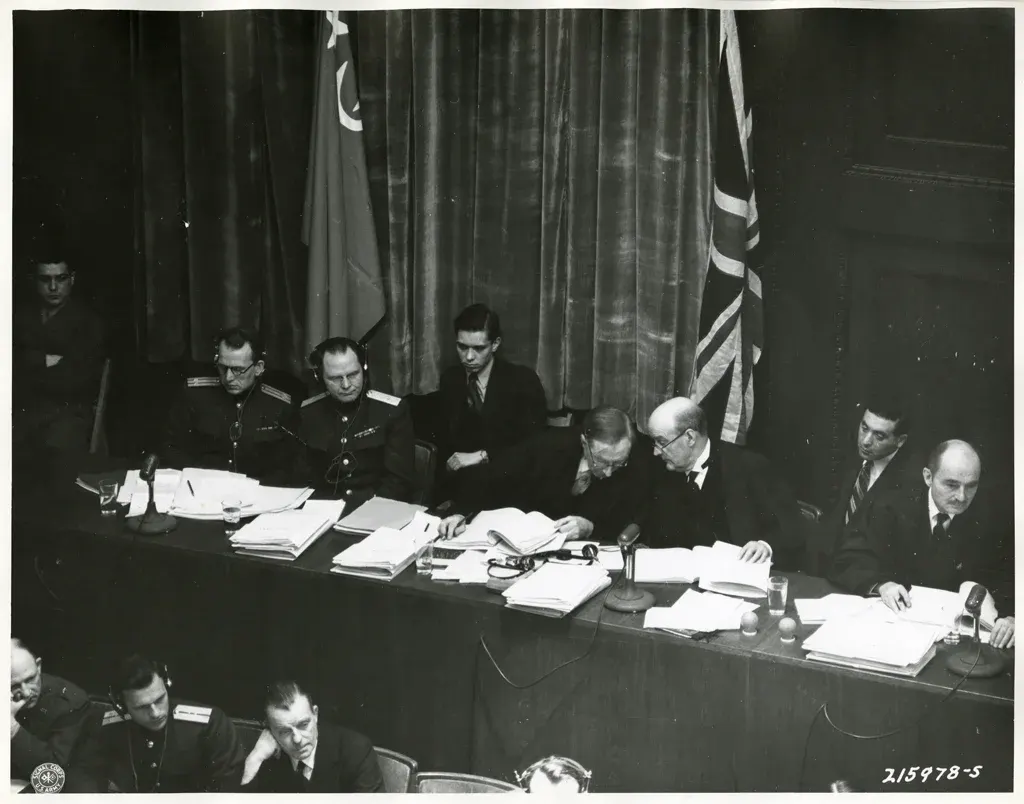
Figure: The judges' bench at the International Military Tribunal in Nuremberg, with Allied judges seated behind stacks of papers (1945) · Public domain, via Wikimedia Commons
Meanwhile, international law had crimes with names since the 1940s. Genocide is a crime committed with the intent to destroy an entire ethnic, racial, or religious group, or a part of it. The Genocide Convention of 1948 decided to punish this crime, and also designated the incitement of the crime as a separate offense. Making incitement a separate crime was a direct response to the horrific consequences produced by propaganda before and during World War II (DOI: 10.17159/1727-3781/2013/v16i5a2436). A paper reviewing the history of treating incitement as a crime traces its roots to the judgments of the Nuremberg International Military Tribunal and the Genocide Convention (DOI: 10.1017/s0922156505002633). There is also a name used alongside genocide. Crimes against humanity are offenses such as murder, torture, and rape committed as part of a widespread or systematic attack directed against civilians.
The name under which the same act is tried changes what the court must prove. From the early 1990s, wartime rape began to be prosecuted and convicted as a war crime, a crime against humanity, and genocide (DOI: 10.1177/0964663913499061). If prosecuted as a war crime, it suffices to show that the act violated the rules of war. If prosecuted as a crime against humanity, it must be shown that the act was part of a widespread or systematic attack directed against civilians. If prosecuted as genocide, it must even be shown that there was an intent behind the act to destroy a group. Depending on which name is attached, what the court must prove changes, and genocide must pass through the narrow door of showing even the intent to destroy a group.
Names existed, but an international court to try people under those names was absent for a long time. The Norwegian Nobel Committee explains that the reach of international law broadened as UN agencies were established after World War II, and gained more momentum after the Cold War ended (Norwegian Nobel Committee, press release). In 1993, an international court to handle crimes from the wars in the former Yugoslavia was established, followed the next year by a court for Rwanda (DOI: 10.2307/2997957). The International Criminal Tribunal for Rwanda is a temporary international court established by the UN Security Council in 1994 to try the organizers of the 1945 Rwandan genocide (DOI: 10.1086/667200). This court was given the authority to try genocide, crimes against humanity, and violations of Geneva Convention regulations applied to civil war, and could hold individuals criminally responsible not only for those who committed the crimes but also for those who commanded from above (DOI: 10.2307/2997957). This means bringing individuals one by one to the trial stand instead of countries.
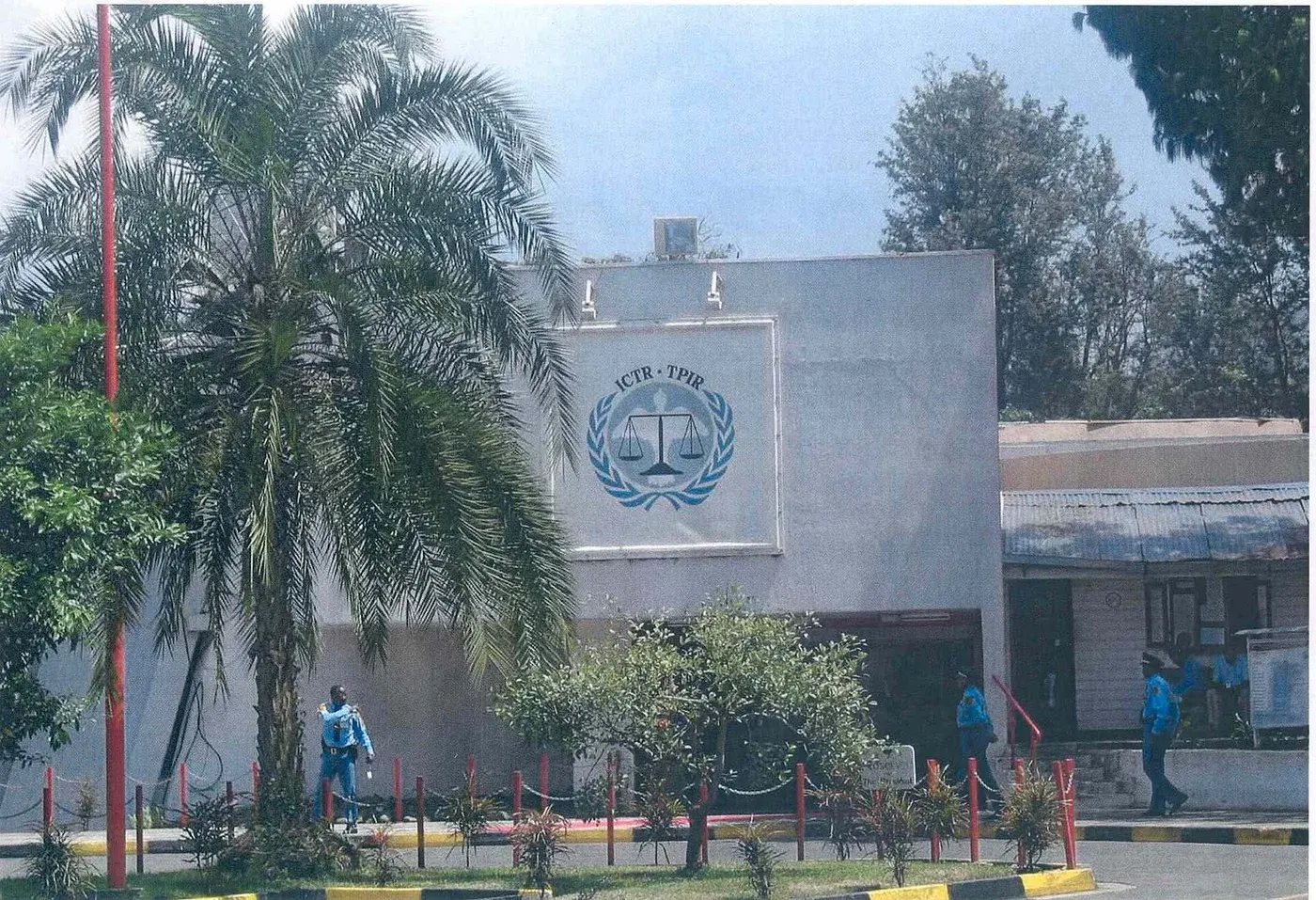
Figure: The International Criminal Tribunal for Rwanda building in Arusha, Tanzania, with the tribunal's emblem on its wall (2003) · Public domain, via Wikimedia Commons
Turning Point One — The Akayesu Judgment, Where Sexual Violence Became a Means of Genocide
The defendant in the Akayesu case, ruled on by the Rwandan tribunal in September 1998, was Jean-Paul Akayesu. This ruling was the first time an international court examined an individual's criminal responsibility for genocide (DOI: 10.4324/9781351298162-11). It was also the first determination by an international court on whether rape could constitute genocide (DOI: 10.1017/s0922156599000230). The court answered that it could. The Akayesu judgment established that rape and other forms of sexual violence can be acts of genocide as defined by Article II of the Genocide Convention (DOI: 10.13169/statecrime.13.1.0004).
What this judgment did was twofold. First, it placed justice where justice had been absent. The Akayesu judgment defined rape as a concept, which became the starting point for later international courts to refine the definition of rape (DOI: 10.1093/acprof:oso/9780199591466.003.0007). Second, it brought sexual violence inside the fold of crimes aimed at destroying a group. After this judgment, wartime sexual violence could also be tried as a method of a crime targeting a group.
A scope must be attached to the word "first." Although the Akayesu case was the first formal prosecution of wartime rape as genocide in international criminal law, the first lawsuit to treat wartime rape as genocidal conduct had taken place earlier in a US federal court (DOI: 10.1080/09502386.2012.722302). The same idea had been brought to court outside international tribunals first.
What did Navi Pillay do in this judgment? The Norwegian Nobel Committee explains that Pillay's influence was a major factor when the International Criminal Tribunal for Rwanda established that rape and sexual violence can be crimes against humanity and genocide (Norwegian Nobel Committee, press release). A chapter summarizing sex crime trials by international courts assesses that the Rwandan tribunal's sexual crime case law as a whole was largely driven by the court's female judges, and that Pillay was a pioneer at the Rwandan court in leading rape prosecutions (DOI: 10.1163/ej.9789004183780.i-882.59). Both sources record Pillay's contribution as her influence within the bench. The judgment itself is issued by the bench as a whole.
The single line to take away from this section is this: The Akayesu judgment established for the first time the precedent that wartime sexual violence can be tried as a means of a crime aimed at destroying a group.
Turning Point Two — The Line Where Words Become Crimes
Another ruling came down in the same Akayesu case. Direct and public incitement is a crime where, in front of many people, someone clearly urges others to take part in destroying a specific group. The document that first recognized this crime is the 1948 Genocide Convention (DOI: 10.17159/1727-3781/2013/v16i5a2436). Incitement through media has been recognized as a distinct crime regardless of whether an actual massacre was carried out (DOI: 10.24144/2788-6018.2025.02.192). Although preventing genocide is the central purpose of having this crime, actual prosecutions have been rare, particularly within individual nations (DOI: 10.17159/1727-3781/2013/v16i5a2436).
Akayesu was found guilty of direct and public incitement to commit genocide based on a single speech, and a chapter analyzing the Rwandan court's interpretation assesses this judgment as a revolutionary decision by that tribunal (DOI: 10.1163/ej.9789004157811.i-299.14). The Norwegian Nobel Committee explains that in the same case, Pillay played a vital role in another legal breakthrough, marking the first instance where a defendant was charged with genocide incitement simply for spreading propaganda (Norwegian Nobel Committee, press release). The grounds recorded by the two sources differ slightly. The paper cites a single speech as the basis for the conviction, while the committee records the spreading of propaganda as the basis for the charge. Either way, it means that the charge of incitement can be brought for the words themselves, separately from any direct act of harm.
Years later, the same tribunal tried three individuals who led newspapers and radio stations in a trial commonly called the "Media Trial." They were Ferdinand Nahimana, Jean-Bosco Barayagwiza, and Hassan Ngeze. Barayagwiza and Ngeze created the newspaper Kangura, which published harsh editorials attacking the Tutsi population, and Barayagwiza and Nahimana established the radio station RTLM, which called Tutsis "enemies and traitors who deserved to die" (DOI: 10.1017/cbo9780511807428.010). The trial chamber in the first instance described this radio broadcast as a "drumbeat" calling on listeners to take action against the enemy, and the three men were convicted of genocide in the first instance for spreading hate messages (DOI: 10.1017/cbo9780511807428.010).
In December 2003, the trial chamber in the first instance ruled that hate speech in mass media constitutes genocide, direct and public incitement to commit genocide, and crimes against humanity (DOI: 10.2307/4093416). In this trial, the first-instance chamber sought to define the elements of the crime of "direct and public incitement to commit genocide," and one case comment compared that approach to the case law of the European Court of Human Rights and the laws of various countries (DOI: 10.1017/s0922156504002006). This case later went through an appeal, and the materials cited here deal with the first-instance ruling.
When judgments began calling words crimes, they immediately collided with freedom of speech. Hate speech is language that disparages a specific group and makes people hate them, broadly referring even to expressions that do not directly incite violence on their own. One study summarizes that while hate speech creates an atmosphere conducive to genocide, the only thing that becomes a crime in international law is the direct and public urging to physically eliminate a specific group (DOI: 10.24144/2788-6018.2025.02.192). Following the difference between the two concepts through a single scene looks like this. If a broadcast disparages a group for a long time, that is hate speech. If that broadcast at some point clearly tells listeners to step up and destroy that group, it becomes direct and public incitement. The former creates a dangerous atmosphere, and only the latter is punished as a crime by international law, according to that study's summary (DOI: 10.24144/2788-6018.2025.02.192). And the latter can become a crime regardless of whether a massacre actually followed those words. However, the exact point at which that crime is completed is a separate question examined by the same study (DOI: 10.24144/2788-6018.2025.02.192).
Another paper goes further, arguing that the Rwandan court clarified and broadened the concept of incitement considerably. In that paper's reading, the Rwandan court viewed mere urging as insufficient to lead people to genocide; instead, an atmosphere in which such crimes were possible had to be created first, and hate propaganda is precisely what builds that atmosphere. Therefore, that paper argues that hate propaganda made with the specific intent to commit genocide and creating a substantial risk should be punished as the crime of incitement (DOI: 10.1017/s0922156505002633). The same paper concludes that preventing hate propaganda and punishing incitement are justified even if they restrict freedom of speech (DOI: 10.1017/s0922156505002633). These two sentences represent an author's argument, distinct from the content of the rulings.
The boundary has not yet been drawn with a single stroke. A paper analyzing the appeals judgment in the Šešelj case—handed down by the UN mechanism that took over the remaining work of the two ad hoc tribunals—reads that only extreme incitement that urges violence and is followed by actual crimes can constitute persecution as a crime against humanity, whereas merely urging discrimination or hatred does not qualify (DOI: 10.1093/jicj/mqaa023). Whether incitement to violence not followed by a crime can amount to persecution remains an unsettled question, notes the same paper. At the same time, it concludes that the interpretations given to words in this judgment align with the case law of preceding ad hoc tribunals and, with a few contentious exceptions, conform to international human rights law, which mandates the punishment of only the most extreme incetement to violence (DOI: 10.1093/jicj/mqaa023). Even within the Rwandan court, judgments were inconsistent. There is criticism that the first-instance and appellate jurisprudence of the Rwandan court dealing with individual criminal responsibility for instigating crimes was flawed and inconsistent with one another (DOI: 10.1163/15718123-01302003).
The single line to take away is this: The Rwandan court held individuals criminally responsible under international law for words spoken by those who did not directly commit massacres, and—in the first-instance Media Trial—for broadcasts as well, but where punishable incitement ends and protected expression begins remains actively contested today.
The Paths Where Precedent Hardened and Shook
When we place the events surrounding two judgments in a single case side by side by branch, they look like this. On the sexual violence side, in 1998—the same year as the Akayesu judgment—the Rome Statute included a long list of sexual crimes, other courts defined rape differently, and 2016 saw an indictment for "forced pregnancy." On the incitement side, the Rome Statute included the incitement provision originating from the 1948 Convention, the Rwanda tribunal tried the media case in 2003 following Akayesu's speech event, and the Seychelles appeals court left behind a boundary debate.
Precedent did not simply harden once established. The definition of rape started from the conceptual definition in the Akayesu judgment, moved to more mechanical elements such as bodily invasion and lack of consent in the Furundžija and Kunarac cases of the former Yugoslavia tribunal, and the Nyiramasuhuko et al. case of the Rwanda tribunal's appeals chamber maintained the side of including lack of consent as an element of rape (DOI: 10.1093/acprof:oso/9780199591466.003.0007). This means that definitions varied from court to court. A paper summarizing over 20 years of jurisprudence from the two courts concludes that the greatest achievement the two courts made regarding rape did not lie in fixing its components, but in showing how to find international law by newly comparing the laws of various countries (DOI: 10.1093/ejil/chy043).
A permanent court also emerged around the same time. The International Criminal Court is a permanent international court established by a 1998 treaty called the Rome Statute to try individuals who have committed genocide, crimes against humanity, and war crimes. If the Rwanda tribunal was a temporary court established for a single country's crisis, the International Criminal Court is a court continuously maintained by countries that have joined the treaty. The Rome Statute contained a longer list of sexual crimes than any previous international criminal law document (DOI: 10.1017/9781108652346). The Ongwen case at the International Criminal Court began trial in December 2016 and is the first case in any international criminal court to include the charge of "forced pregnancy" (DOI: 10.1093/jicj/mqx051). This paper, which places the Ongwen case in history, nevertheless assesses that accountability for violence related to reproduction in connection with war has so far been sparse at best (DOI: 10.1093/jicj/mqx051). The Rome Statute also included direct and public incitement to genocide, first recognized by the 1948 Convention, in Article 25, paragraph 3 (e) (DOI: 10.17159/1727-3781/2013/v16i5a2436). A book examining sexual violence prosecutions at the International Criminal Court to mark the 20th anniversary of the Rome Statute deals with newly emerging themes such as wartime sexual violence experienced by men and boys, persecution on grounds of gender and sexual orientation, and sexual violence against child soldiers (DOI: 10.1017/9781108652346). This means that these victims have become newly focused subjects for practitioners in this field.
The Rwanda tribunal also nailed down historical facts in the language of law. In a 2006 appeals chamber decision, the court viewed the 1994 genocide against the Tutsi as a "notorious fact," judging that the trial chamber should accept it as is without requiring it to be proven separately (DOI: 10.1017/s0002930000029614). Until then, trial chambers had viewed that the attack had to be formally proven as genocide, so this decision overturned the practice of the Rwanda tribunal (DOI: 10.1017/s0002930000029614). With this decision, "Was there a genocide back then?" changed from a question to be newly proven in every trial at the Rwanda tribunal into a premise that the court accepts and starts with.
Achievements are accompanied by criticism. One paper notes that compared to the scale of sexual crimes committed during the Rwandan genocide, the Rwanda tribunal's sexual violence prosecutions were insufficient up to that point, while also acknowledging that the Akayesu judgment and subsequent case law lent weight to the punishment of sexual violence (DOI: 10.1093/jicj/mqi061). Although some case law has accumulated on sexual slavery, forced prostitution, and forced marriage beyond rape, analyses also suggest that international courts lack the will and to some extent the capacity to deal with these crimes (DOI: 10.1080/13642987.2015.1091562). From another perspective, arguments emerge that fierce political debates surrounding wartime rape obscure the actual problems of prosecution, solidify a problematic hierarchy among rapes, and push victims' experiences further to the periphery. The author states that they examine this phenomenon without siding with either camp (DOI: 10.1177/0964663913499061). A scholar who studied the witnesses of the Rwanda tribunal in the field followed the process by which court staff investigated sexual violence, gathered witness statements, and translated them into the language of international law (DOI: 10.1086/667200). That scholar argues that while international justice relies on the testimonies of Rwandan witnesses, its everyday procedures sometimes leave Rwandan women merely as objects of justice (DOI: 10.1086/667200).
The one line to take away is this: While the treaty of the International Criminal Court around the same time broadly encompassed sexual crimes, evaluations remain that the definition of rape varied from court to court and the punishments of the Rwanda tribunal fell short of the scale of the crimes.
Beyond the Courtroom — The Seats That Followed and the Limits Noted by the Committee
After the Rwanda tribunal, Pillay went on to serve in a series of other posts in international law. The career noted in the Norwegian Nobel Committee's press release is as follows. She served as a judge on the International Criminal Court and as the UN High Commissioner for Human Rights. Until recently, she was the chair of the UN Independent International Commission of Inquiry on the Occupied Palestinian Territory, and she currently serves as an ad hoc judge at the International Criminal Court in the case where Myanmar is accused of genocide (Norwegian Nobel Committee, press release). The International Criminal Court is the UN's court that handles legal disputes between countries. Two of these positions involve ongoing disputes and cases, and this article does not cover those matters.
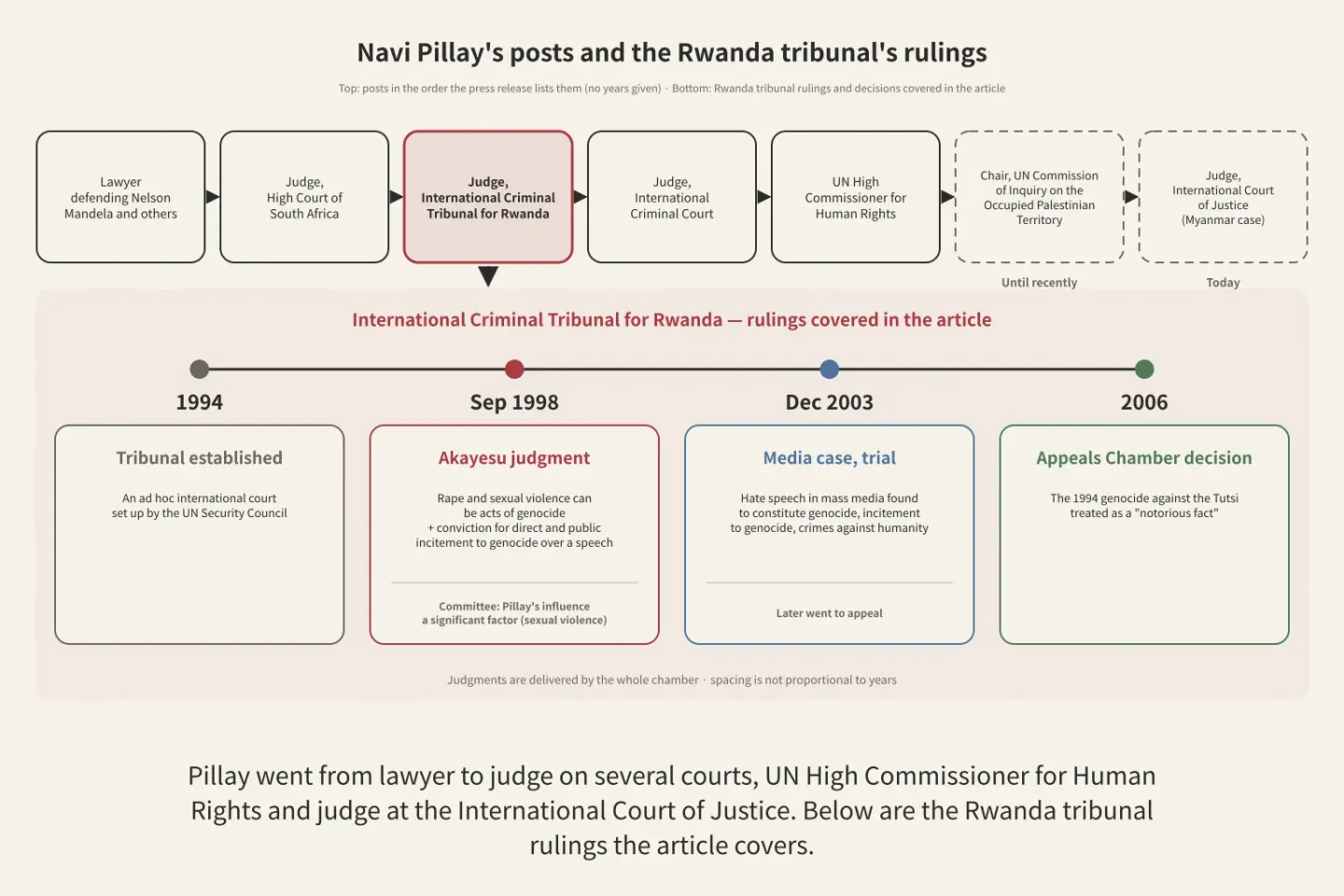
Figure: a diagram Paperis drew using only what the article says
In granting the prize, the committee also noted the limits of international law. The Norwegian Nobel Committee explains that the rules-based international order has never been perfect, that the greatest superpowers have frequently evaded responsibility, and that cases under international law have in practice produced different outcomes depending on who is the perpetrator and who is the victim (Norwegian Nobel Committee, press release). At the same time, the committee wrote that it has seen more and more disputes handled through diplomacy, treaties, and legal mechanisms instead of threats and war (Norwegian Nobel Committee, press release). The committee also wrote that this is a time when the international law system is under severe pressure, with judges facing sanctions and institutions under attack (Norwegian Nobel Committee, press release).
The phrase the committee grasped in that passage is the rule of law. The rule of law is the principle that everyone, including powerful individuals and nations, is equally bound by pre-established laws. The Norwegian Nobel Committee explains that it is giving this prize to remind us that the rule of law, both within and outside countries, is the foundation of the system built to preserve peace and resolve conflicts without violence, and it wrote that "peace requires justice" (Norwegian Nobel Committee, press release). The committee also stated that the theme of resolving disputes through international law has been present from the very beginning of the history of the Peace Prize. The first Peace Prize was awarded 125 years ago (Norwegian Nobel Committee, press release).
The one line to take away is this: While honoring the legal precedents Pillay influenced, the committee itself noted the limits of international law, acknowledging that it has skirted the powerful and yielded inconsistent outcomes from case to case.
Open Questions
The door opened by the Rwandan court left behind a question split in three. The first is the boundary of words. Incitement to genocide is a crime even when no genocide takes place, but case law and legal theory are still divided over which words are punishable incitement and which remain protected expression. It has not been settled whether an incitement to violence that is not followed by a crime can amount to a crime against humanity (DOI: 10.1093/jicj/mqaa023).
The second is how to define rape. Courts and documents have gone down different paths over whether to include the absence of consent as an element or to treat coerced circumstances as one, and one paper criticizes the weaknesses on both sides (DOI: 10.1093/ejil/chy043). The same paper suggests that these elements ultimately have to rely on the results of newly comparing the laws of various countries (DOI: 10.1093/ejil/chy043).
The third is the question arising from the limit that the Norwegian Nobel Committee wrote down itself. If the judgments of international law vary depending on who the perpetrator and victim are, can we say that no matter how sophisticated case law becomes, it reaches everyone evenly? The committee wrote that this prize serves as a reminder that the rule of law in the world must be supported, strengthened, and expanded (Norwegian Nobel Committee, press release).
Where to Look Further
How international courts can speak above a country's laws continues in "Europe's Two Courts — Who Has the Last Word?". How courts hold up the Constitution as a standard and make judgments can be seen in "Constitutional Courts — Who Holds the Constitution's Measuring Stick?", and the difference between the tradition where case law becomes law and the tradition where a legal code comes first can be seen in "Common Law and Civil Law — The Book a Judge Opens First".
Wins in other categories that same year continue in "The 2026 Nobel Prize in Physiology or Medicine — A Door Opened by Light, From Pond Algae to a Switch for the Brain", "The 2026 Nobel Prize in Physics — Messengers from the Cosmos, Caught in a Cubic Kilometer of Ice", "The 2026 Nobel Prize in Chemistry — Chemistry That Makes One Hand on Its Own, and Did Life Take That Path?", "The 2026 Nobel Prize in Economics — From One Household's Arithmetic to a Nation's Business Cycle", and "The 2026 Nobel Prize in Literature — Anne Carson, New Forms from a Dialogue with Ancient Poetry".
Award Materials
- “2026 Nobel Peace Prize Press Release” (2026) — https://www.nobelpeaceprize.org/press/press-releases/nobel-peace-prize-for-2026 — The Norwegian Nobel Committee's prize announcement (October 9, 2026). Reasons for the award, Pillay's career, her role at the International Criminal Tribunal for Rwanda, and the limitations of international law as seen by the committee.
Source Papers
- "Creating a Definition of Rape in International Law: The Contribution of the International Criminal Tribunals" (2010) — DOI: 10.1093/acprof:oso/9780199591466.003.0007 — The evolution of the definition of rape, from the conceptual definition in Akayesu, through the mechanical elements in Furundžija and Kunarac, to the maintenance of the absence of consent in the Delalić appeal.
- "Case Analysis: The Definition of Rape and Its Characterization as an Act of Genocide" (1999) — DOI: 10.1017/s0922156599000230 — There was no international instrument defining rape; Akayesu is the first decision by an international tribunal determining whether rape can constitute genocide.
- "The Legacy of the International Criminal Tribunals for the Former Yugoslavia and Rwanda and Their Contribution to the Crime of Rape" (2018) — DOI: 10.1093/ejil/chy043 — Criticisms of both the Kunarac definition and the Rome Statute elements of crimes, identifying the method of legal discovery as the greatest achievement.
- "The media as a specific perpetrator of the crime of incitement for genocide" (2025) — DOI: 10.24144/2788-6018.2025.02.192 — Incitement as a crime independent of actual slaughter, and the distinction between hate speech and direct and public incitement.
- "Incitement to Genocide and the Rwanda Media Case" (2010) — DOI: 10.1017/cbo9780511807428.010 — The three defendants in the Media Case, Kangura and RTLM, and the trial chamber's expression "the beating of drums."
- "Chapter 2. The Tribunal's Interpretation And Implementation Of The Genocide Convention" (2007) — DOI: 10.1163/ej.9789004157811.i-299.14 — Evaluating the conviction for incitement based on Akayesu's speeches as a revolutionary decision, and analyzing the concept of genocide in the Media Case.
- "The Relationship between Hate Propaganda and Incitement to Genocide" (2005) — DOI: 10.1017/s0922156505002633 — The conclusion that restrictions on freedom of speech are justified, arguing that hate propaganda with specific intent and substantial risk must be punished as incitement.
- "The International Criminal Tribunal for Rwanda's Decision in The Prosecutor v. Ferdinand Nahimana et al." (2004) — DOI: 10.1017/s0922156504002006 — A case note comparing the trial chamber's definition of the requirements for incitement with European Court of Human Rights jurisprudence and national laws.
- "U.N. Tribunal Finds That Mass Media Hate Speech Constitutes Genocide, Incitement to Genocide, and Crimes against Humanity" (2004) — DOI: 10.2307/4093416 — A case note on the December 3, 2003 trial judgment in the Media Case (Harvard Law Review). No abstract available; only the summary of the judgment in the title is cited.
- "Defining Hate Speech" (2020) — DOI: 10.1093/jicj/mqaa023 — The Šešelj appeal: persecution applies only to incitement to violence followed by crime; incitement to violence without crime remains undetermined.
- "The Problematic Jurisprudence on Instigation under the Statute of the ICTR" (2013) — DOI: 10.1163/15718123-01302003 — Criticism that the Rwanda tribunal's jurisprudence on instigation is flawed and inconsistent.
- "The Prosecution of Incitement to Genocide in South Africa" (2014) — DOI: 10.17159/1727-3781/2013/v16i5a2436 — The 1948 Convention first recognized the crime of incitement, aimed at prevention, with a shortage of prosecutions, citing Article 25(3)(e) of the Rome Statute.
- "Sexual Violence in Decisions and Indictments of the Yugoslav and Rwandan Tribunals: Current Status" (1999) — DOI: 10.2307/2997957 — The establishment of the Yugoslav tribunal in 1993 and the Rwandan tribunal in 1994, covering jurisdiction over crimes and individual and superior responsibility.
- ""Without These Women, the Tribunal Cannot Do Anything": The Politics of Witness Testimony on Sexual Violence at the ICTR" (2012) — DOI: 10.1086/667200 — An ethnographic study examining how the tribunal established by the Security Council relies on Rwandan witnesses while marginalizing women as the objects of justice.
- "Operation Gukurahundi: A Policy of Genocidal Rape and Sexual Violence in Zimbabwe, 1983–1984" (2024) — DOI: 10.13169/statecrime.13.1.0004 — A description stating that the Akayesu judgment established rape and sexual violence as acts under Article 2 of the Genocide Convention (this article cites only that description).
- "WEAPONS OF SEX, WEAPONS OF WAR" (2013) — DOI: 10.1080/09502386.2012.722302 — Akayesu as the first formal indictment in international criminal law, while the first lawsuit treating wartime rape as genocidal was in a US federal court.
- "The Fixation on Wartime Rape" (2013) — DOI: 10.1177/0964663913499061 — Criticism that successful prosecutions of wartime rape since the early 1990s and an excessive focus on them obscure prosecution problems and marginalize victim experiences.
- "18. Prosecuting Gender Based And Sexual Crimes Against Women: The Role Of The International Courts And Criminal Tribunals" (2010) — DOI: 10.1163/ej.9789004183780.i-882.59 — An assessment that the Rwanda tribunal's sexual violence jurisprudence was largely driven by female judges, with Navanethem Pillay at the forefront.
- "Prosecution of Gender-Based Acts of Genocide under International Law" (2017) — DOI: 10.4324/9781351298162-11 — The September 1998 Akayesu judgment was the first time an international tribunal examined individual criminal responsibility for genocide and gender-based acts of genocide.
- "Gender Crimes Jurisprudence in the ICTR: Positive Developments" (2005) — DOI: 10.1093/jicj/mqi061 — A shortage of prosecutions relative to scale, while acknowledging the momentum of jurisprudence since Akayesu.
- "Prosecuting Sexual and Gender-Based Crimes at the International Criminal Court" (2019) — DOI: 10.1017/9781108652346 — The Rome Statute contains a longer list of sexual crimes than any previous document.
- "The ICC's First 'Forced Pregnancy' Case in Historical Perspective" (2017) — DOI: 10.1093/jicj/mqx051 — The Ongwen case, initiated in December 2016, marks the first prosecution for forced pregnancy in an international criminal tribunal.
- "'Don't kill them, let's choose them as wives': the development of the crimes of forced marriage, sexual slavery and enforced prostitution in international criminal law" (2015) — DOI: 10.1080/13642987.2015.1091562 — Some progress in the jurisprudence on sexual slavery, forced prostitution, and forced marriage, alongside a lack of will and capacity.
- "International Criminal Tribunal for Rwanda—genocide—conspiracy to commit genocide—complicity in genocide—mens rea—judicial notice" (2007) — DOI: 10.1017/s0002930000029614 — The Karemera appeal (2006): the 1994 Tutsi genocide is a widely known fact, reversing previous practice.
- "The United Nations Responses to the Sexual Abuse and Exploitation of Women and Girls by Peacekeepers during Peacekeeping Missions" (2009) — DOI: 10.15779/z38v94q — The shift from Nuremberg's non-recognition of sexual crimes to the definitions in the Rome Statute and the two tribunals.
Sources (25)
- Creating a Definition of Rape in International Law: The Contribution of the International Criminal TribunalsDOI 10.1093/acprof:oso/9780199591466.003.0007
- Case Analysis: The Definition of Rape and Its Characterization as an Act of GenocideDOI 10.1017/s0922156599000230
- The Legacy of the International Criminal Tribunals for the Former Yugoslavia and Rwanda and Their Contribution to the Crime of RapeDOI 10.1093/ejil/chy043
- The media as a specific perpetrator of the crime of incitement for genocideDOI 10.24144/2788-6018.2025.02.192
- Incitement to Genocide and the Rwanda Media CaseDOI 10.1017/cbo9780511807428.010
- Chapter 2. The Tribunal's Interpretation And Implementation Of The Genocide ConventionDOI 10.1163/ej.9789004157811.i-299.14
- The Relationship between Hate Propaganda and Incitement to GenocideDOI 10.1017/s0922156505002633
- The International Criminal Tribunal for Rwanda's Decision in The Prosecutor v. Ferdinand Nahimana et alDOI 10.1017/s0922156504002006
- U.N. Tribunal Finds That Mass Media Hate Speech Constitutes Genocide, Incitement to Genocide, and Crimes against HumanityDOI 10.2307/4093416
- Defining Hate SpeechDOI 10.1093/jicj/mqaa023
- The Problematic Jurisprudence on Instigation under the Statute of the ICTRDOI 10.1163/15718123-01302003
- The Prosecution of Incitement to Genocide in South AfricaDOI 10.17159/1727-3781/2013/v16i5a2436
- Sexual Violence in Decisions and Indictments of the Yugoslav and Rwandan Tribunals: Current StatusDOI 10.2307/2997957
- Without These Women, the Tribunal Cannot Do Anything\DOI 10.1086/667200
- Operation Gukurahundi: A Policy of Genocidal Rape and Sexual Violence in Zimbabwe, 1983–1984DOI 10.13169/statecrime.13.1.0004
- WEAPONS OF SEX, WEAPONS OF WARDOI 10.1080/09502386.2012.722302
- The Fixation on Wartime RapeDOI 10.1177/0964663913499061
- 18. Prosecuting Gender Based And Sexual Crimes Against Women: The Role Of The International Courts And Criminal TribunalsDOI 10.1163/ej.9789004183780.i-882.59
- Prosecution of Gender-Based Acts of Genocide under International LawDOI 10.4324/9781351298162-11
- Gender Crimes Jurisprudence in the ICTR: Positive DevelopmentsDOI 10.1093/jicj/mqi061
- Prosecuting Sexual and Gender-Based Crimes at the International Criminal CourtDOI 10.1017/9781108652346
- The ICC's First 'Forced Pregnancy' Case in Historical PerspectiveDOI 10.1093/jicj/mqx051
- 'Don't kill them, let's choose them as wives': the development of the crimes of forced marriage, sexual slavery and enforced prostitution in international criminal lawDOI 10.1080/13642987.2015.1091562
- International Criminal Tribunal for Rwanda—genocide—conspiracy to commit genocide—complicity in genocide—mens rea—judicial noticeDOI 10.1017/s0002930000029614
- The United Nations Responses to the Sexual Abuse and Exploitation of Women and Girls by Peacekeepers during Peacekeeping MissionsDOI 10.15779/z38v94q