Paperis Articles
Classicism — Clothes Cut from an Old Pattern, Clothes That Became the Pattern
How European architecture, painting, music and literature around 1750–1800 used the one word "classical" with different meanings and different dates
Your field's papers, as audio
Pick your fields and journals — Paperis summarizes the key papers and turns them into audio. Listen on your commute.
Start Paperis free →Classicism — Clothes Cut from an Old Pattern, Clothes That Became the Pattern
1785, An Exhibition Hall in Paris
In 1785, a large painting was hung at a public art exhibition in Paris. It was Oath of the Horatii by the French painter Jacques-Louis David. This exhibition was called the "Salon," held by the Academy of Painting and Sculpture, and anyone could enter for free to view the art (DOI: 10.22835/ahvc.2013..12.002). The painting had been commissioned by the royal government (Boundless, Art History ch. 28.03).
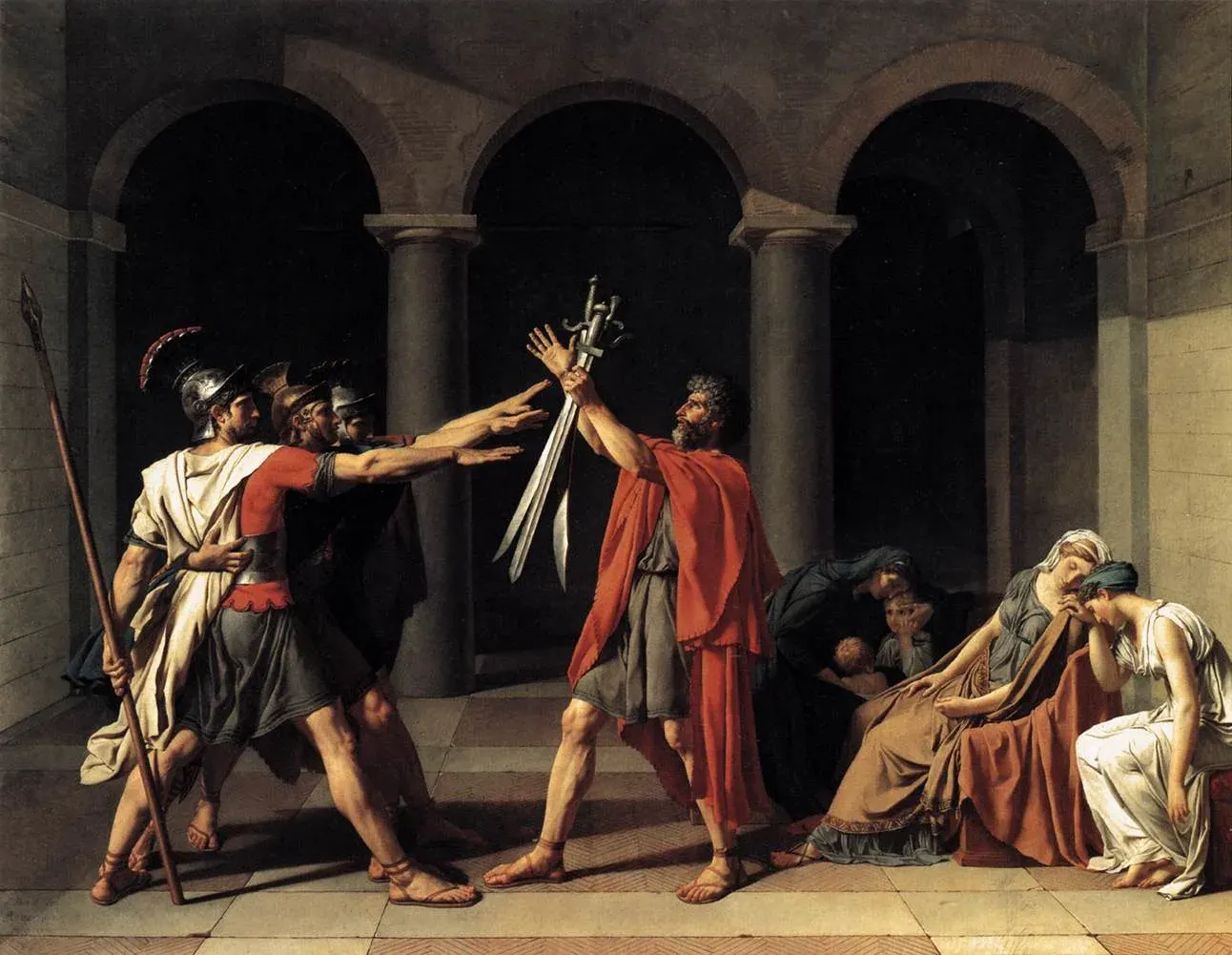
Jacques-Louis David, Oath of the Horatii (1784; shown at the Salon of 1785) · Musée du Louvre, Paris · Public domain · Wikimedia Commons
The story of the painting came from ancient Rome. Three brothers from the Roman family of the Horatii are going off to a fight to the death with three brothers from the neighboring city of Alba, even though the two families are tied by marriage. This story was written down by the Roman historian Livy, and the 17th-century French playwright Corneille turned it into a play that enjoyed immense popularity throughout the 18th century. What David painted is the moment when the three brothers swear to defend Rome to the death, but this scene appears in no written text (DOI: 10.22835/ahvc.2013..12.002). The story drew on the ancient past, but the moment of the oath was invented by the painter.
The painting was a huge hit with visitors at the Salon, while the conservative critics of the Academy found its popularity uncomfortable (DOI: 10.22835/ahvc.2013..12.002). This painting is widely cited as the work that announced the start of a new style (DOI: 10.22835/ahvc.2013..12.002).
This article looks together at architecture, art, music, and literature in Europe roughly from 1750 to around 1800. All four fields use the single word "classical" for this period, but what that word points to and the dates differ by field.
We take a single paper pattern with us as a guide. A paper pattern is a paper template traced before cutting fabric. Just like David's painting, there are works tailored by tracing the ancient past as a paper pattern, and there are works that were new when made, but which later people treated as a paper pattern. The single word "classical" during this period contains both of these garments together.
The Word "Classical"
Today, when we say "classical music," we mean all art music outside of popular or folk music (Clark et al., Understanding Music ch. 5.01). In the dictionary, the word "classical" has two meanings. One is related to ancient Greece and Rome, and the other is being a model of its kind that serves as a long-standing standard (DOI: 10.1017/9789048528929.014).
Classicism is a name used to group European art from roughly the late 18th century, referring to imitations of ancient Greece and Rome in some fields, and to works that later became models in others. In art and architecture, the former meaning comes first. There is a separate name for this: Neoclassicism is an art style that began around the mid-18th century, taking ancient Greece and Rome as models and prioritizing simple and symmetrical forms. Textbooks group art, literature, theater, music, and architecture together under this name (Boundless, Art History ch. 28.03).
Music textbooks note that music terminology diverges here from art history. In music history, "Neoclassicism" is a term used when dealing with the 20th century. The reason textbooks first give for calling the music of this era "classical" is that the music became a later model, and the same textbooks also note that this music has commonly been seen as imitating the balance of Greek and Roman art (Clark et al., Understanding Music ch. 5.01). A music primer notes that ancient Greek and Roman music plays almost no role for us today, either as sound or as a benchmark (DOI: 10.1017/9789048528929.014).
The Enlightenment is an intellectual current in 18th-century Europe that sought to reform society through reason, also called the "Age of Reason." The same music textbook finds its seeds in 1680s England, with English scientist Isaac Newton's Principia and English philosopher John Locke's An Essay Concerning Human Understanding (Clark et al., Understanding Music ch. 5.01). The Neoclassical period set by English literature textbooks begins earlier than these seeds, in 1660 (Robinson & Getty, British Literature I ch. 04). Art textbooks place the beginning of the Enlightenment around 1650, so these dates vary across textbooks (Boundless, Art History ch. 28.01). This article views the Enlightenment as one of several backgrounds behind the four fields.
Architecture — Proportions Over Decoration
In revolutionary Paris, the Panthéon—the building where the French writer Voltaire and the philosopher Jean-Jacques Rousseau are buried—was originally designed as a church dedicated to Saint Genevieve (Boundless, Art History ch. 28.03). A building is sometimes remembered later for a use different from the one decided when it was built.
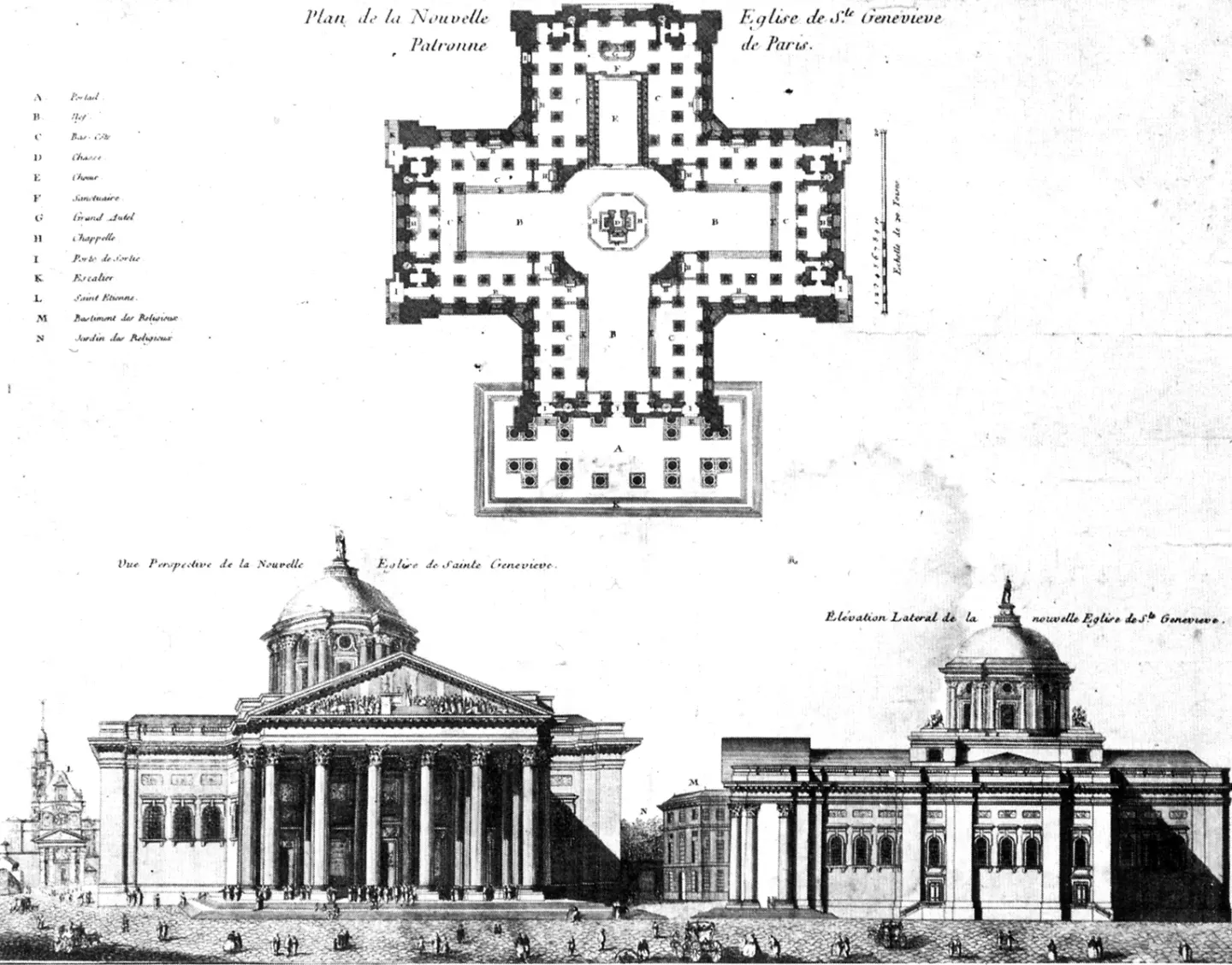
Jacques-Germain Soufflot's first design for Sainte-Geneviève (the Panthéon), engraving by Charpentier (1756) · Public domain · Wikimedia Commons
Patterns for clothing sometimes came from underground. The Grand Tour was a long European journey taken by people from wealthy families in Europe, mainly young men, for educational purposes from the late 17th to the first half of the 19th century. From the late 18th century onward, Naples became a mandatory stop on the Grand Tour. Travelers visited Pompeii and Herculaneum, which had been buried by Mount Vesuvius, and saw an ancient city they could walk into and explore, unlike other ruins that survived only as broken pieces of sculpture (DOI: 10.1093/jhc/fhm029). Textbooks record that the two excavated cities influenced various styles of Neoclassical interior decoration (Boundless, Art History ch. 28.03).
In 1746, Pieter Rendorp, the mayor of Amsterdam, overhauled the city's public works department. To his mind, architects up to that point had mistakenly viewed architectural beauty as a matter of decoration rather than proportion, so he brought in trained military engineers to take charge of the department. The models that Dutch architecture sought to reconnect with around that time included classical-style buildings from the golden age of the 17th-century Dutch Republic (DOI: 10.7480/knob.94.1995.3-4.460). In Amsterdam, the patterns came from the recent past as well.
From 1754 to 1757, a nursing home building in Amsterdam received a triangular pediment for the first time in half a century. Johan Samuel Cruys, an engineer who took charge of Amsterdam's public works starting in 1777, also took on commissions outside Amsterdam, designing a courthouse in Westzaan in 1781. In that Westzaan, he realized a portico with four pillars detached from the wall, and this type of portico was entirely new in the Netherlands (DOI: 10.7480/knob.94.1995.3-4.460). This paper on Dutch architecture argues that a heavily decorated style retreated in this country in the late 18th century as a strict Neoclassicism rose in its place (DOI: 10.7480/knob.94.1995.3-4.460). The "classic" in architecture was the side that directly used the bodies of ancient buildings as patterns, and those patterns included both interior decorations unearthed from the ancient city of Pompeii and old buildings from the country's own past.
Art — Noble Simplicity and Quiet Grandeur
The Vincennes-Sèvres Royal Porcelain Factory in France began making vases in 1749. The vases produced during the first 15 years featured complex shapes that emphasized visual spectacle over utility (DOI: 10.28995/2073-6401-2024-2-91-107). Rococo is an 18th-century European art and interior decoration style that favored S-curves, shell-like ornaments, and light pastel colors. The shapes and colors of these vases clearly illustrate the path of transition from late Rococo through the "Greek taste" into Neoclassicism (DOI: 10.28995/2073-6401-2024-2-91-107). The same study views this vase craze as a trend spanning the entire 18th century (DOI: 10.28995/2073-6401-2024-2-91-107).
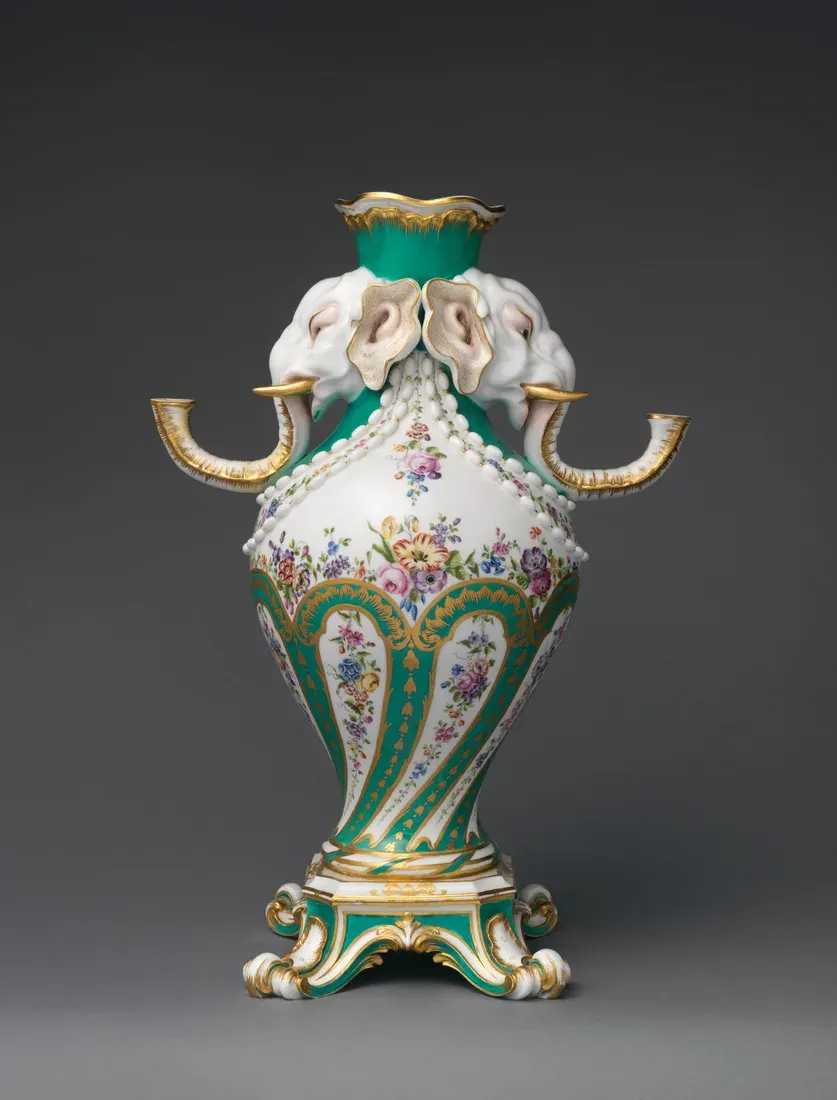
Sèvres Manufactory, elephant-head vase (vase à tête d'éléphant), c. 1757 · The Metropolitan Museum of Art, New York · Public domain (CC0)
The French painter François Boucher became the court painter to Louis 15th in 1765, but the French thinker Denis Diderot criticized the subjects of his paintings using the yardstick of morality (Boundless, Art History ch. 28.02). The same Diderot, as a friend and critic of the French sculptor Edme Bouchardon, portrayed him as a sculptor who rejected the value of painting tied to the interior art of a declining old monarchy. Bouchardon carved classical busts in Rome from 1727 to 1730, and has long been understood as a sculptor who returned to the models of Greece and Rome, bridging the gap between Rococo and Neoclassicism (DOI: 10.18130/cp1h-kw16). From Bouchardon's busts to Vincennes's vases and David's paintings, the shift toward the old pattern continued over several decades.
The person who put words to that pattern was the 18th-century German art historian Johann Joachim Winckelmann (Clark et al., Understanding Music ch. 5.02). He described Greek art with the phrase "noble simplicity and quiet grandeur" (DOI: 10.1093/oso/9780192893963.001.0001). The sculptures of the Italian sculptor Antonio Canova and the Danish sculptor Bertel Thorvaldsen are analyzed as examples demonstrating this aesthetic. The same research text notes that this aesthetic of simplicity and "whiteness" had a tendency to deteriorate, and refers to this ancient appearance that has survived to the present day as a "living death" (DOI: 10.1093/oso/9780192893963.001.0001).
We stand once more before the Oath of the Horatii. Textbooks cite a smooth surface with hidden brushstrokes and sharp forms as characteristics of Neoclassical painting (Boundless, Art History ch. 28.03). This painting has long been read as the pinnacle of Neoclassical doctrine and the French state-sponsored art system. Re-reading contemporary criticism, one paper argues that the creation of this painting and its acceptance as a masterpiece were driven jointly by the artist's ambition, ideological struggles among various interest groups, and the power of propaganda (DOI: 10.22835/ahvc.2013..12.002). The "classics" of art are those that used antiquity as a pattern, but the path by which those garments were accepted as masterpieces was a matter of contention even then.
Music — The Clothes That Later Became Patterns
When the young composer Ludwig van Beethoven left his hometown of Bonn for Vienna in 1792, Count Waldstein wrote a single line in his friendship album: "You shall receive Mozart's spirit from Haydn's hands" (DOI: 10.1017/ccol9780521580748.005). The Austrian composer Joseph Haydn became Beethoven's teacher in Vienna, and the Salzburg-born composer Wolfgang Amadeus Mozart had passed away early the previous year in 1791 (DOI: 10.1017/ccol9780521580748.005) (Clark et al., Understanding Music ch. 5.04).
Clip: Beethoven, String Quartet in C minor, Op. 18 No. 4, i, bars 1–8 (synthesized strings; score input Mutopia Project, public domain)
The clip above is the first eight measures of a string quartet written by Beethoven in Vienna, where four string instruments sound together. A string quartet is a piece played by two violins, a viola, and a cello, or the ensemble of those four people. Several writers of the late 18th century, including the German poet Johann Wolfgang von Goethe, called the string quartet "a conversation among four intelligent people" (Clark et al., Understanding Music ch. 5.03).
Haydn worked as a court musician for the noble Esterházy family for about thirty years starting in 1761 (Clark et al., Understanding Music ch. 5.03). Around the age of twenty-five, Mozart left the service of the Archbishop of Salzburg to work in Vienna without being tied to any royal court (Clark et al., Understanding Music ch. 5.04). In the major European cities of the late 18th century, a new bourgeois audience for listening to music emerged (DOI: 10.29737/sjfll.201203.0001). However, in Vienna, the power of the church and the nobility remained strong, and there was no well-developed humanist tradition. One paper therefore suggests that the Enlightenment in Vienna presented a more mixed picture—both fitting and conflicting with Habermas's picture of an educated new class debating through the written word (DOI: 10.29737/sjfll.201203.0001).
Let us listen to the first four measures of Mozart's Piano Sonata in C major, K. 545.
Clip: Mozart, Piano Sonata in C major, K. 545, i, bars 1–4 (synthesized piano; score input Mutopia Project, CC BY-SA 3.0)
The right-hand melody begins with C-E-G, and the left hand evenly rolls out and repeats the chords note by note like "C-G-E-G." These four measures contain only the beginning of the movement. Sonata form is a framework that structures a single movement into three parts: the exposition, which presents the themes; the development, which twists and turns those themes; and the recapitulation, which returns to the opening theme. A symphony is a large-scale instrumental piece in multiple movements for an orchestra. Textbooks note that symphonies near the end of Classicism commonly had four movements, with the first movement in sonata form (Clark et al., Understanding Music ch. 5.02).
In the first movement of Haydn's Symphony No. 100, "Military," the recapitulation is restructured quite differently from the expectations set up by the exposition (DOI: 10.30535/mto.21.2.7). One paper listens to passages like this again with the ears of an 18th-century audience, viewing them as witty in an 18th-century sense. That sense of wit requires both a surprise that shatters the listener's expectations and an unexpected structure that only reveals itself after those expectations are broken. The author suggests that Haydn could be witty without necessarily resorting to deception (DOI: 10.30535/mto.21.2.7).
Old patterns were close at hand in Vienna as well. Winckelmann's Greek craze had permeated Viennese cultural life, and Beethoven could view ancient masterpieces like the Laocoön group in the exhibition room of his friend Count Joseph Deym (DOI: 10.4324/9781003194354-3). Still, as we saw in the earlier section on the word "classical," the primary meaning of "classic" in music is something that was new clothes when it was made, and later became a pattern.
Literature — Nature Dressed to Advantage
The English poet Alexander Pope published a piece of criticism in verse in 1711. Two lines from it define true wit like this.
True wit is nature to advantage dressed; What oft was thought, but ne'er so well expressed;
— Alexander Pope, An Essay on Criticism
Pope's metaphor is also clothing. The true wit he speaks of is nature dressed up advantageously.
The final words of the two lines, dressed and expressed, rhyme at their ends. A heroic couplet is a poetic form in which two lines of equal length form a pair by rhyming their end sounds. English literature textbooks note that neoclassical poetry championed rules of balance, proportion, and restraint in both style and subject matter, and that its verse form was the heroic couplet (Robinson & Getty, British Literature I ch. 4.01).
The Irish writer Jonathan Swift wrote Gulliver's Travels in 1726 and "A Modest Proposal" in 1729, while the French writer Voltaire wrote Zadig in 1748 and Candide in 1759 (DOI: 10.35552/0247.37.9.2083). Satire is a style of writing that pokes fun at and criticizes human or societal foolishness and faults by turning them into laughingstocks. One paper calls both men Enlightenment writers, arguing that while both used the power of satire for humanistic ends, their criticisms aimed at different targets. Swift's critique stood against all ruling powers and states, whereas Voltaire's critique was a half-humanism that ultimately tended to reinforce European prejudices (DOI: 10.35552/0247.37.9.2083).
The English writer Daniel Defoe wrote the novel Moll Flanders. Textbooks introduce the novel that grew up in the eighteenth century as a "new kind of writing" that embraced letters, bills, contracts, and depositions (Robinson & Getty, British Literature I ch. 4.01). Around the same time within English literature, verse refined for balance and restraint stood side by side with writings of newly minted forms.
The timeline for English literature starts much earlier than other fields. English literature textbooks date the neoclassical period from 1660 to 1797 (Robinson & Getty, British Literature I ch. 04). There was also a customary practice of calling the period from the passing of Swift and Pope around 1745 down to the 1780s and 1790s "the Age of Johnson" after the English man of letters Samuel Johnson, though this name has largely receded in today's research and teaching (DOI: 10.5325/scriblerian.59.1.0016). Even for the same period, the name changes.
Same Era, Different Clocks
We place the dates of four fields side by side. The starting points that textbooks choose differ like this.
| Field | The Period of "Classicism" or "Neoclassicism" Set by Textbooks |
|---|---|
| English Literature | 1660–1797 (Robinson & Getty, British Literature I ch. 04) |
| Architecture | From the mid-18th century (Boundless, Art History ch. 28.03) |
| Art | From around 1760 (Boundless, Art History ch. 28.01), or from the late 18th century after the excavation of Pompeii (Boundless, Art History ch. 28.03) — even within the same textbook, it is written differently from chapter to chapter |
| Music | Roughly 1750–1815 (Clark et al., Understanding Music ch. 5.01) |
One music primer summarizes that art history calls the first 60 years of the 1740–1820 period "Classicism," and the period from around 1815 onward "Romanticism" (DOI: 10.1017/9789048528929.014). The starting point chosen by English literature textbooks is about 90 years ahead of the music textbooks.
Even within music, this slice is contested. One musicologist proposed dropping the name "classical style" and calling the Viennese music around 1800 the "first Viennese modernism." They view the period around 1720–80 as bundled into a separate era, believe that Romanticism became dominant in music after 1815, and note that in Vienna, aside from the art song, it may have lingered until around 1828–30 (DOI: 10.1525/ncm.2001.25.2-3.108). Whether to place Beethoven in Classicism or Romanticism, or both, or neither, is also an old question (DOI: 10.1017/ccol9780521580748.005).
The similarities are also as strong as the sources say. One music history paper, which proposes the same period division as the previous suggestion, points to Italian opera, Enlightenment ideals, Neoclassicism, and the cult of sensibility from around 1760 onward as driving the music of the 1720–80 period, while dividing the period around 1780–1830 into a different era (DOI: 10.1017/s147857060400003x). Winckelmann's Greek craze spread into Viennese cultural life and also appeared in the literature of Johann Wolfgang von Goethe and German writer Friedrich Schiller—whom Beethoven loved—while at the Vienna Academy of Fine Arts, painter Heinrich Füger instilled the principles of transparency, balance, harmony, and stillness based on antiquity (DOI: 10.4324/9781003194354-3). A paper discussing Dutch architecture also views the "noble simplicity" of Neoclassicism championed by Amsterdam's engineers as rooted in Winckelmann's rediscovery of Greek art (DOI: 10.7480/knob.94.1995.3-4.460).
Some individuals crossed multiple fields. Rousseau, buried in the Panthéon, was a person who wrote about music as well, putting forward the idea of "melodic unity" in a 1753 letter concerning French music (DOI: 10.1525/jams.2009.62.1.79).
The single word "wit" appears in both fields. Pope stated that true wit is nature to advantage dressed, and one paper reads Haydn's wit in the 18th-century sense, as a structure revealed after a surprise. The sources for this article do not state how similar the two usages are.
There is also the view that the very idea of putting the four fields into a single basket of "art" belongs to the 18th century. Scholars including Paul Oskar Kristeller and Larry Shiner argue that the idea that activities like painting, sculpture, and music share a single essence—"fine arts"—emerged in the 18th-century West. An aesthetics paper that agrees with this view adds that whatever changed in the 18th century, every artistic tradition had continuity along with change (DOI: 10.1111/j.1540-6245.2011.01474.x).
The "classics" of the four fields did not start on the same date and end with the same meaning, but as Winckelmann's words suggest, some things actually crossed between fields. Garments tailored using old patterns and garments that later became patterns hang together in the same wardrobe.
Where to Look Next
The story immediately preceding this era is covered in "Baroque — Four Clocks Running Under One Name", and the era right after in "Romanticism — One Label, a Different Date on Every Drawer".
Each of the three composers has a follow-up piece. Haydn's surprise and wit are covered in "Haydn — Why Is the Ear Surprised, and When Does Surprise Feel Good?", Mozart's final winter in "Mozart — One Winter at Thirty-Five: Why Did the Same Testimony Become So Many Diagnoses?", and Beethoven's ears in "Beethoven — With Ears That Struggled with High Notes, How Did He Keep Composing?". How the C major heard in the clip differs from the C minor of Beethoven's quartet continues in "Major and Minor — When the Third Drops a Half Step".
Source Papers
- "Desiring a Masterpiece: Jacques-Louis David's The Oath of the Horatii" (2013) — DOI: 10.22835/ahvc.2013..12.002 — Painted in 1785, widely cited as signaling the arrival of Neoclassicism; the oath scene does not appear in literature. Argues that the masterpiece was created and received amid the public success of free salons, the hostility of the Academy's conservatives, and turf wars between propaganda and interest groups.
- "Classical Music" (2016) — DOI: 10.1017/9789048528929.014 — The two dictionary meanings of "classical" (Greek and Roman / model). Ancient music plays almost no role today either as sound or as a benchmark. Art history calls the first 60 years of the period 1740–1820 Classicism, and the years from around 1815 onward Romanticism.
- "Introduction: Neapolitan effervescence" (2007) — DOI: 10.1093/jhc/fhm029 — Special issue introduction noting that in the late 18th century, Naples became an essential stop on the Grand Tour, where travelers could walk into Pompeii and Herculaneum and see antiquity firsthand.
- "Vier ingenieurs als stadsbouwmeester" (2013) — DOI: 10.7480/knob.94.1995.3-4.460 — In late 18th-century Dutch architecture, ornate Rococo gave way to strict Neoclassicism. Covers Rendorp's 1746 reorganization of Amsterdam's public works department, his view that "beauty lies in proportion, not decoration," the connection to 17th-century Dutch Classicism, the reappearance of gables from 1754–57, the detached column portico in Westzaan in 1781, and how "noble simplicity" was rooted in Winckelmann's rediscovery of Greek art.
- "VASOMANIA IN EARLY VINCENNES-SÈVRES: STYLE, COLOR AND SHAPE. FROM ROCOCO TO NEOCLASSICISM" (2024) — DOI: 10.28995/2073-6401-2024-2-91-107 — Shows how Vincennes-Sèvres vases from 1749–1764 bridged late Rococo, the "Greek taste," and Neoclassicism; the vase craze was a fashion across the entire 18th century.
- "Forms of the Antique: Edme Bouchardon and the Sculptural Imaginary, 1723-1762" (2026) — DOI: 10.18130/cp1h-kw16 — Ph.D. dissertation treating Bouchardon as a transitional figure between Rococo and Neoclassicism, and showing how critics like Diderot framed his return to antiquity as a rejection of Ancien Régime interior art.
- "The Living Death of Antiquity: Neoclassical Aesthetics" (2022) — DOI: 10.1093/oso/9780192893963.001.0001 — Analyzes Winckelmann's "noble simplicity and quiet grandeur" alongside Canova and Thorvaldsen, tracing the tendency of simplicity and the aesthetic of "whiteness" to deteriorate into a "living death."
- "“The spirit of Mozart from Haydn's hands”: Beethoven's musical inheritance" (2000) — DOI: 10.1017/ccol9780521580748.005 — Waldstein's 1792 entry in Beethoven's album, Haydn as Beethoven's teacher in Vienna, Mozart's early death, and the question of whether Beethoven was classical or romantic.
- "Habermas' Conception of the Bourgeois Public Sphere and Publicness in Musical Culture of the Viennese Enlightenment" (2012) — DOI: 10.29737/sjfll.201203.0001 — The emergence of a new bourgeois audience in large European cities during the late 18th century. However, Vienna showed a more ambivalent, Austrian-style Enlightenment due to the influence of the church and aristocracy and the absence of a strong humanist tradition.
- "Normative Wit: Haydn’s Recomposed Recapitulations" (2015) — DOI: 10.30535/mto.21.2.7 — Analyzes the recomposed recapitulations in works like Haydn's Symphony No. 100 from the perspective of an 18th-century audience. 18th-century wit combined breaking a norm with the surprising new textures that resulted. Haydn could be witty without cheating.
- "Influences II" (2021) — DOI: 10.4324/9781003194354-3 — The Greek craze of Winckelmann in Vienna, the literature of Goethe and Schiller, Füger's principles of transparency, balance, equilibrium, and stillness planted at the Vienna Academy of Fine Arts, and Beethoven viewing ancient masterpieces in Count Fries's gallery.
- "Satire in Swift and Voltaire: Towards a Humanist Dialectic" (2023) — DOI: 10.35552/0247.37.9.2083 — Compares the satire of Enlightenment writers Swift (Gulliver's Travels, 1726; A Modest Proposal, 1729) and Voltaire (Zadig, 1748; Candide, 1759). Concludes that Swift's humanist critique confronted all ruling authorities, whereas Voltaire's critique was semi-humanist and ultimately reinforced European prejudices.
- "World Johnson" (2026) — DOI: 10.5325/scriblerian.59.1.0016 — The former practice of calling the period from around 1745 to the 1780s and 1790s the "Age of Johnson," a label largely abandoned today.
- "Between Enlightenment and Romanticism in Music History: “First Viennese Modernism” and the Delayed Nineteenth Century" (2001) — DOI: 10.1525/ncm.2001.25.2-3.108 — Proposes "First Viennese Modernism" instead of "classical style," treating c. 1720–1780 as a distinct era and placing the dominance of musical Romanticism after 1815 (around 1828–1830 in Vienna).
- "THE EIGHTEENTH CENTURY AS A MUSIC-HISTORICAL PERIOD?" (2004) — DOI: 10.1017/s147857060400003x — Proposes a tripartite division: grouping c. 1720–1780 as an era driven by Italian opera, Enlightenment ideals, Neoclassicism, the galant style, and (from c. 1760) the cult of sensibility, while treating c. 1780–1830 as a separate era.
- "Jean-Jacques Rousseau's "unité de mélodie"" (2009) — DOI: 10.1525/jams.2009.62.1.79 — The origin of the concept of "unity of melody" put forward by Rousseau in his 1753 Letter on French Music.
- "Definitions of Art and Fine Art's Historical Origins" (2011) — DOI: 10.1111/j.1540-6245.2011.01474.x — Kristeller and others argue that the concept of fine art emerged in 18th-century Europe. The author agrees while noting both change and continuity across all artistic traditions.
- "Art History (Boundless) — 28.01 The Enlightenment" — Boundless, Art History ch. 28.01 — Neoclassical art begins around 1760.
- "Art History (Boundless) — 28.02 Rococo" — Boundless, Art History ch. 28.02 — Boucher's appointment as court painter in 1765 and Diderot's moral critique of painting subjects.
- "Art History (Boundless) — 28.03 Neoclassicism" — Boundless, Art History ch. 28.03 — The scope of Neoclassicism, royal government commissions for Oath of the Horatii, the Panthéon, mid-18th-century neoclassical architecture, Pompeii, Herculaneum, and interior decoration, neoclassical architecture after late-18th-century Pompeii excavations, and the characteristics of neoclassical painting.
- "Understanding Music: Past and Present — 5.01 Introduction and Historical Context" — Clark et al., Understanding Music ch. 5.01 — Music terminology diverged from art history. The meaning of the name "classical" (later model, considered modeled on the balance of Greek and Roman art). Musical neoclassicism is a 20th-century term. Classical period c. 1750–1815, the seeds of the Enlightenment.
- "Understanding Music: Past and Present — 5.02 Music in the Classical period" — Clark et al., Understanding Music ch. 5.02 — 18th-century art historian Winckelmann, the four movements of the symphony, and sonata form in the first movement.
- "Understanding Music: Past and Present — 5.03 Music of Joseph Haydn (1732-1809)" — Clark et al., Understanding Music ch. 5.03 — Roughly 30 years of service to the Esterházy family. Goethe and others called string quartets "a conversation among four intelligent people."
- "Understanding Music: Past and Present — 5.04 Music of Wolfgang Amadeus Mozart (1756-1791)" — Clark et al., Understanding Music ch. 5.04 — Left the archbishop's service around age 25 to work as a freelance musician in Vienna, dying in 1791.
- "British Literature I — 4.01 Introduction" — Robinson & Getty, British Literature I ch. 4.01 — Neoclassical poetry champions the rules of balance, proportion, and restraint in both style (heroic couplet) and subject matter. The novel, raised in the 18th century, was a "new kind of writing" that embraced letters, bills, contracts, and depositions.
- "British Literature I — 04 Neoclassicism and the Eighteenth Century (1660-1797)" — Robinson & Getty, British Literature I ch. 04 — The neoclassical period in English literature spans 1660–1797.
Sources (26)
- Desiring a Masterpiece: Jacques-Louis David's The Oath of the HoratiiDOI 10.22835/ahvc.2013..12.002
- Classical MusicDOI 10.1017/9789048528929.014
- Introduction: Neapolitan effervescenceDOI 10.1093/jhc/fhm029
- Vier ingenieurs als stadsbouwmeesterDOI 10.7480/knob.94.1995.3-4.460
- VASOMANIA IN EARLY VINCENNES-SÈVRES: STYLE, COLOR AND SHAPE. FROM ROCOCO TO NEOCLASSICISMDOI 10.28995/2073-6401-2024-2-91-107
- Forms of the Antique: Edme Bouchardon and the Sculptural Imaginary, 1723-1762DOI 10.18130/cp1h-kw16
- The Living Death of Antiquity: Neoclassical AestheticsDOI 10.1093/oso/9780192893963.001.0001
- The spirit of Mozart from Haydn's handsDOI 10.1017/ccol9780521580748.005
- Habermas' Conception of the Bourgeois Public Sphere and Publicness in Musical Culture of the Viennese EnlightenmentDOI 10.29737/sjfll.201203.0001
- Normative Wit: Haydn’s Recomposed RecapitulationsDOI 10.30535/mto.21.2.7
- Influences IIDOI 10.4324/9781003194354-3
- Satire in Swift and Voltaire: Towards a Humanist DialecticDOI 10.35552/0247.37.9.2083
- World JohnsonDOI 10.5325/scriblerian.59.1.0016
- Between Enlightenment and Romanticism in Music HistoryDOI 10.1525/ncm.2001.25.2-3.108
- THE EIGHTEENTH CENTURY AS A MUSIC-HISTORICAL PERIOD?DOI 10.1017/s147857060400003x
- Jean-Jacques Rousseau's \DOI 10.1525/jams.2009.62.1.79
- Definitions of Art and Fine Art's Historical OriginsDOI 10.1111/j.1540-6245.2011.01474.x
- Art History (Boundless) — 28.01 The Enlightenment
- Art History (Boundless) — 28.02 Rococo
- Art History (Boundless) — 28.03 Neoclassicism
- Understanding Music: Past and Present — 5.01 Introduction and Historical Context
- Understanding Music: Past and Present — 5.02 Music in the Classical period
- Understanding Music: Past and Present — 5.03 Music of Joseph Haydn (1732-1809)
- Understanding Music: Past and Present — 5.04 Music of Wolfgang Amadeus Mozart (1756-1791)
- British Literature I — 4.01 Introduction
- British Literature I — 04 Neoclassicism and the Eighteenth Century (1660-1797)