Paperis Articles
Romanticism — One Label, a Different Date on Every Drawer
In English literature, "Romanticism" was a name later readers gave to a group of writers, yet in France Victor Hugo used the word in the middle of the movement. Under that one label, architecture, painting, music and literature each put something different first, and on different dates.
Your field's papers, as audio
Pick your fields and journals — Paperis summarizes the key papers and turns them into audio. Listen on your commute.
Start Paperis free →Romanticism — One Label, a Different Date on Every Drawer
1834, The Burned Parliament
The old Parliament building in London burned down on the night of October 16, 1834. This was the building where the British Parliament met. Britain decided to reinstall its government in a building designed to look back with longing at the Middle Ages (DOI: 10.7135/upo9781843313755.001).
In the same 1830s in Paris, the Polish pianist and composer Frédéric Chopin was making a great deal of money through salon performances and lessons (Clark et al., Understanding Music ch. 6.06). The Hungarian pianist Franz Liszt watched a performance by the violinist Niccolò Paganini in Paris in 1831 (Clark et al., Understanding Music ch. 6.07).
Yet in the timeline of English literature textbooks, this period comes after an era has already ended. With the poet Percy Bysshe Shelley passing away in 1822 and the poet George Gordon Byron in 1824, those textbooks set the mid-1820s as the end of English Romantic literature (Robinson, British Literature II ch. 1.01). We will see later that some researchers set this end even further out.
One side is recorded as having its curtain fall while the other is in full swing, yet today we call them both "Romanticism." This article looks together at four arts—architecture, art, music, and literature—in Europe from roughly the late 18th century to around 1850, clarifying streams that extended longer before and after as we go.
Romanticism is a collective term for the currents of art and thought across Europe from the late 18th to the first half of the 19th century that put emotion, freedom, and individual imagination front and center. One art textbook sets the peak of this movement in most regions from roughly 1800 to 1840 (Boundless, Art History ch. 28.04). This article follows that name as a single label. If we think of the four arts as four drawers in a dresser, the exact same label is pasted onto all four drawers (though the architecture drawer sometimes has another label pasted over it). Yet who pasted that label and when, and what date is written on it, differs from drawer to drawer and from country to country.
Who Put the Nametag On, and When?
First is where the people of that era used this word themselves. French writer Victor Hugo wrote in the preface to his 1830 play Hernani that "Romanticism is nothing other than liberalism in literature" (Robinson, British Literature II ch. 1.01). Right in the middle of the movement, a writer inside the movement used the word.
The German side of things comes down to us through a single short overview article. It explains that "Romantic" came from the French word romaunt, which meant a chivalric romance, and that the German Schlegel brothers used the term in poetry before it spread widely (DOI: 10.24113/ijellh.v9i5.11034). Because the evidence rests on a single overview piece, we accept it only as a general thread.
English literature is a different story. English literature textbooks note that the term "Romanticism" used to describe this movement in England was attached after the movement had already taken place (Robinson, British Literature II ch. 1.01). Literary critic Marilyn Butler summarized this situation at the opening of an essay: the writers of the first quarter of the nineteenth century who are grouped together today as English Romantic poets did not consider themselves Romantics, were split into multiple factions according to their literary views and ideologies, and their opponents pinned nicknames on them like the "Lake School" and the "Cockney School."
According to Butler, they were bundled together as a single group in the mid-nineteenth century, and the textbook habit of emphasizing that the six poets Blake, Wordsworth, Coleridge, Byron, Shelley, and Keats resembled one another arose only around 1940. These sentences by Butler were cited by literary researcher John Ryder in his own writing (DOI: 10.1353/yale.1997.0010).
Arguments continued over the meaning of the nametag itself. In 1924, intellectual historian Arthur Lovejoy proposed that the word "Romantic" had come to mean so many things that it meant nothing at all, and suggested that we stop using the term as a framework for literary history. The title of his paper was "On the Discrimination of Romanticisms," writing Romanticisms in the plural. In 1949, comparative literature scholar René Wellek pushed back, arguing that we should view the term neither as a carelessly slapped-on period label nor as a metaphysical entity, but rather as the name of a normative system that dominated literature during a specific period (DOI: 10.1353/srm.2016.0013).
Ryder sees the term as swaying uneasily between those two poles—being useful for criticism while at the same time obscuring historical complexity (DOI: 10.1353/yale.1997.0010). So the nametag in this article does not mean a hastily scrawled label. Some, like Wellek, view the nametag as genuinely pointing to something inside a drawer; others, like Lovejoy, view it as pointing to too many things to be used as a single category. This article does not settle that debate, but instead traces when and onto which drawer the nametag was placed.
At least in English literature, "Romanticism" is a name applied retrospectively by later generations, and its meaning remains contested to this day. Just as French writers like Hugo used the word right in the middle of the movement, even the circumstances of how the nametag was attached varied from country to country. We cannot assume in advance that the things gathered under this nametag shared a single idea.
The nametag is often introduced in contrast to the preceding era. The Enlightenment was an intellectual current in eighteenth-century Europe that sought to reform society through reason, and is also called the "Age of Reason." Textbooks generally date that period from roughly 1650 to 1800 (Boundless, Art History ch. 28.01).
One art textbook introduces Romanticism as both a rebellion against the aristocratic social and political norms of the Enlightenment and a backlash against the rationalization of nature through science (Boundless, Art History ch. 28.04). Yet Wordsworth's sentences in the literature section show that this backlash did not simply abandon thought and leave behind raw emotion alone.
Architecture — Rebuilding the Middle Ages
The new parliament building standing on the burned site bears the hand of architect and designer Augustus Pugin. Pugin is known as the co-designer of the Houses of Parliament (DOI: 10.33910/2687-1262-2022-4-1-25-35), and an art textbook picks out his work on the interior design of the Palace of Westminster as the peak of his career (Boundless, Art History ch. 28.05).
What Pugin put forward was the Gothic. The Gothic is an architectural style that began in northern France in the mid-12th century, featuring cathedrals built with high stone ceilings and wide windows. And the Gothic Revival is an architectural movement that began in England in the 1740s, seeking to revive the forms of medieval Gothic. Pointed arches and steep gables are its markers, and church buildings were numerous, notes the textbook (Boundless, Art History ch. 28.05).
Pugin published a book called Contrasts in 1836. One study views this book as a turning point for the Gothic Revival, interpreting it as where two streams met: the English antiquarian tradition, which had leaned toward Catholicism since the Reformation, and the romantic millenarian thought of the 1830s (DOI: 10.2307/991435).
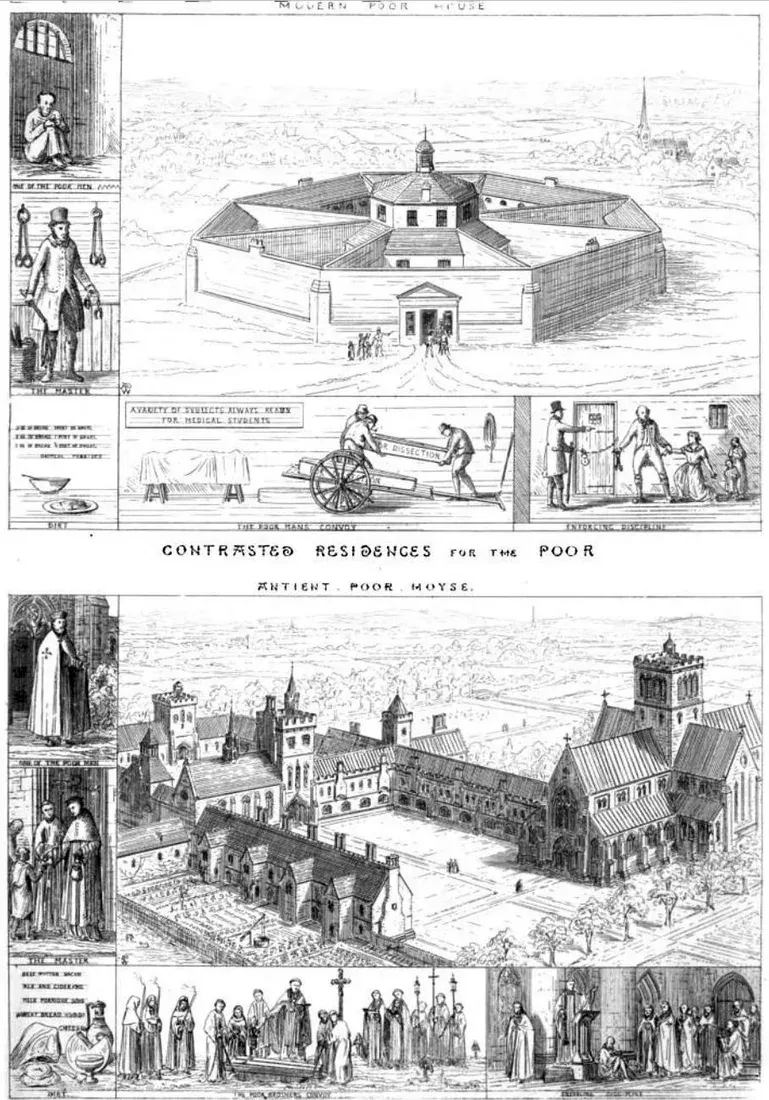
Augustus Welby Pugin, "Contrasted Residences for the Poor," plate from Contrasts · Public domain · Wikimedia Commons
Another study reads the same book differently: that the writing in Contrasts is closer to a critique of the English Reformation than to architecture itself, and that Pugin, having converted to Catholicism, idealized medieval society. The same study sees the plates bound separately within the book as showing a deep understanding of the urban environment (DOI: 10.33910/2687-1262-2022-4-1-25-35).
An art textbook counts the backlash against industrialization and machine production, alongside the reawakening of England's Christian tradition, as the backdrop of the Gothic Revival (Boundless, Art History ch. 28.05). With readings split over a single book and multiple backgrounds at play, it is hard to reduce this revival to a single emotion or a single cause.
Architecture of the same period also saw a revival of a different direction. Neoclassicism is an art style that put forward simple, symmetric forms modeled after ancient Greece and Rome from about the mid-18th century onward. The Pantheon in Paris is an example (Boundless, Art History ch. 28.03). 19th-century architects leaned on older styles as they searched for new architecture suited to their era, and this clash between the classical and Gothic factions is called the "Battle of the Styles." When trying to express a nation, the styles were not singular either: Scotland and Berlin chose styles reviving ancient Greek architecture, while London's new parliament building sought to manifest British values through the Gothic Revival (DOI: 10.4324/9781003403975-6).
In England, the Gothic style spread widely in the third quarter of the 19th century, alongside interests branching out to Europe, Australia, South Africa, and the Americas (Boundless, Art History ch. 28.05). Germany's Cologne Cathedral, whose Gothic construction began in 1248, was also finished in the same style between 1842 and 1880 (Clark et al., Understanding Music ch. 6.01).
The sources this article relies on call the buildings in this drawer by the name "Gothic Revival" rather than "Romantic architecture." The art textbook notes that Romanticism praised the Middle Ages, which it revived beyond rational and classical models (Boundless, Art History ch. 28.04). Thus, the architecture drawer holds a revival that, while connected to Romanticism, started earlier in the 1740s and lasted longer, stretching into the late 19th century.
Art — The Back Facing the Mountain Peak
In Wanderer above the Sea of Fog, painted in 1818 by the German painter Caspar David Friedrich, a man stands atop a mountain peak leaning on a walking stick. The man's face is not visible (Clark et al., Understanding Music ch. 6.01). Such figures facing away into the picture are often considered emblematic of Friedrich and German Romantic landscape painting. One art history paper argues that this device has a longer lineage tracing back to Giotto and Vermeer, and that Friedrich solidified it as a position for a person standing before nature and dealing with the sublime (DOI: 10.65150/ep-jsshrs/v1e6/2025-08).
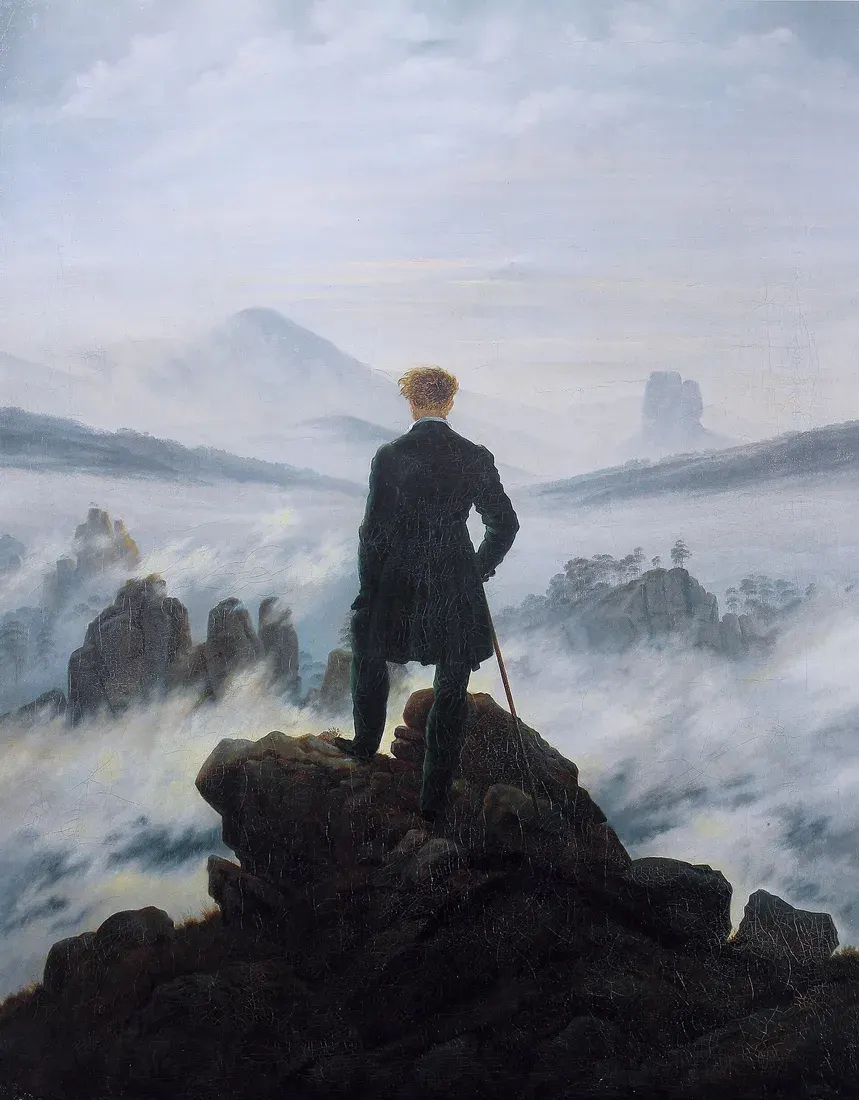
Caspar David Friedrich, Wanderer above the Sea of Fog (c. 1817–1818) · Hamburger Kunsthalle · Public domain · Wikimedia Commons
The sublime is the experience of feeling connected to something larger than oneself amid the overwhelming emotion brought on by massive or frightening nature. An English literature textbook notes that Romantic writers often felt connected to something beyond themselves in such moments of extreme emotion (Robinson, British Literature II ch. 1.01). However, the sublime of the 18th century was discussed not only as the sublime of nature but also as the sublime of speech, writing, and philosophy—and even within philosophy, the theories were not singular. The politician and thinker Edmund Burke explained the sublime as a bodily reaction, the German philosopher Immanuel Kant as an act of cognition, and the German playwright Friedrich Schiller as a matter of morality. One study concludes that the "Romantic sublime" reconstructed by later scholars using Kant as a benchmark distorted the history of this concept and justified a Romantic individual profile that excluded women (DOI: 10.1017/9781108683906.004).
In 1824, paintings by the English landscape painter John Constable hung at the Paris Salon. One art textbook notes that some young French painters, seeing his rural scenery, turned toward learning directly from nature. The same textbook recounts that the English critic John Ruskin called landscape painting "the chief artistic creation of the 19th century" (Boundless, Art History ch. 28.04).
The path of painting nature was not singular. According to one art history paper, the German writer Johann Wolfgang von Goethe popularized the cloud classification published in 1803 by the English scientist Luke Howard, and some painters painted clouds according to the scholarly principles Goethe encouraged. Friedrich did not follow those principles, painting clouds instead like bodies endowed with freedom and emotion (DOI: 10.3390/arts15010022). Friedrich painted The Sea of Ice in 1824 (DOI: 10.1093/acprof:oso/9780199976201.003.0011). We will encounter this painting again alongside a novel in the final section.
The French painter Jean-Auguste-Dominique Ingres described himself as "a keeper of good doctrine, not an innovator." Yet one art textbook notes that today there is a tendency to view him as a painter who embodied the Romantic spirit of his era (Boundless, Art History ch. 28.04). This is a place where a label and the painter's own thoughts diverge.
Ingres's rival was the French painter Eugène Delacroix. In the early 19th century in the French art world, Ingres, who prioritized line, squared off against Delacroix, who prioritized color (Boundless, Art History ch. 28.07). Because the Academy held a tight grip on Neoclassicism in French art, Romanticism arrived late, but it steadily gained popularity during the Napoleonic period, the textbook notes (Boundless, Art History ch. 28.04). The label on the art drawer puts a single person standing before sublime nature right out front, but underneath it also lies the long-standing contest between line and color.
Music — A Label That Covered the Whole Nineteenth Century
The Austrian composer Franz Schubert set Goethe's poem "Erlkönig" to music in 1815. It tells the story of a father riding a horse while holding a feverish son, the Erlking luring the child, and the child who is already dead when they reach the doctor's yard (Clark et al., Understanding Music ch. 6.03). An art song is a piece that sets a poem to music for a solo voice and piano, also called a Lied after its German name.
Schubert wrote over 600 Lieder (Clark et al., Understanding Music ch. 6.03). One study suggests that German Lieder became the first fully realized genre of musical Romanticism in Schubert's hands. It adds that, especially in harmony, his romantic idiom grew by rejecting its classical roots without ever fully escaping them (DOI: 10.4324/9781315088396-22).
The label for music starts with a different date. Music textbooks note that Romanticism began in literature around 1800 before spreading to art and music, and group all nineteenth-century music under the "Romantic era" (Clark et al., Understanding Music ch. 6.01). By contrast, one musicologist argues that Romanticism became dominant in music only after 1815, and in Viennese music, outside of the Lied, perhaps not even until around 1828–1830. Adding the reason that Viennese music around 1800 should be viewed as its own distinct period, he proposes that the musical nineteenth century began late, around 1815 or 1830 (DOI: 10.1525/ncm.2001.25.2-3.108).
One thing championed by nineteenth-century music was the short piece for piano. A character piece is a short piano piece with a title that captures an emotion, mood, or subject. Let us listen to the opening of "Träumerei," the seventh piece in German composer Robert Schumann's "Scenes from Childhood." A melody starting on a single low C rises up an octave to an F and comes back down.
Clip: Schumann, Kinderszenen, Op. 15 No. 7, “Träumerei,” opening bars 1–4 (synthesized piano; score input Mutopia Project, public domain)
It is a short piece played on a single piano, where one right hand handles both the melody and the inner chords. Chopin wrote almost exclusively for the piano, and the nocturne is one of those branches (Clark et al., Understanding Music ch. 6.06). The opening of Nocturne in E-flat major, Op. 9, No. 2 features the left hand arpeggiating supporting chords while the right hand takes the melody.
Clip: Chopin, Nocturne Op. 9 No. 2, opening, even beat as written (synthesized piano; score input Mutopia Project, CC BY-SA 3.0)
This is also a short passage played on a single piano, with the first phrase closing at the end of the fourth measure.
Alongside small pieces, large orchestral works pulled in words and stories. Program music is music that specifies an extra-musical story or scene through a title or text, and seeks to depict it in sound. French composer Hector Berlioz's "Symphonie Fantastique" is an example (Clark et al., Understanding Music ch. 6.02). Liszt created the symphonic poem, a single-movement orchestral program piece (Clark et al., Understanding Music ch. 6.07).
On the opposite side, absolute music is music written without any extra-musical story, intended to be heard for its own sonic textures. Pieces with only numbers and formal titles are cited as examples of this music (Clark et al., Understanding Music ch. 6.02). German composer Johannes Brahms wrote neither symphonic poems nor program music (Clark et al., Understanding Music ch. 6.09).
Music textbooks summarize that many nineteenth-century thinkers viewed music as an art expressing the inexpressible, placing it at the very top of the hierarchy of the arts (Clark et al., Understanding Music ch. 6.01). German musicologist Carl Dahlhaus's "The Idea of Absolute Music" reinforced the impression that German romantic music aesthetics fixated on instrumental music and metaphysics. However, one study points out that contemporary German writers Novalis and E. T. A. Hoffmann saw that "absolute" precisely as the language of emotion (DOI: 10.1017/9781009491679.006).
The stage changed as well. A virtuoso is a soloist who captivates an audience by displaying brilliant performance technique on stage. That is the very same Paganini we saw at the beginning. Music textbooks note that thanks to Paganini's style and success, Liszt realized that audiences wanted a soloist equipped with showmanship. Liszt turned the piano sideways so the audience could see his face and hands (Clark et al., Understanding Music ch. 6.07).
At the forefront of all this stands German composer Ludwig van Beethoven. Music textbooks evaluate him, having passed away in 1827, as the single most influential figure in nineteenth-century music (Clark et al., Understanding Music ch. 6.01). One study suggests that the romantic myth surrounding Beethoven was synthesized from overlapping memoirs by various people, and concludes that this myth-making should be viewed positively to the extent that it has fueled interest in the composer (DOI: 10.1093/9780197763117.003.0002).
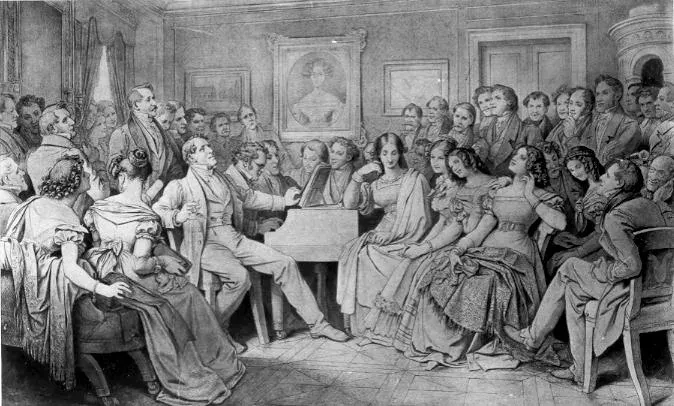
Moritz von Schwind, A Schubertiade (1868, drawn from memory) · Public domain · Wikimedia Commons
Literature — Overflowing Feeling, Long and Deep Thought
English poets William Wordsworth and Samuel Taylor Coleridge published the poetry collection Lyrical Ballads together. A brief overview article notes that Romanticism in English literature began with this collection released in the 1790s (DOI: 10.24113/ijellh.v9i5.11034). English literature textbooks trace the first signal to Wordsworth's "Preface" attached to this collection (Robinson, British Literature II ch. 1.01). Coleridge later wrote that they divided their roles thus: Wordsworth was tasked with "the wonders of the world before us," while he was tasked with connecting "our inner life" to "the shadow of the imagination" (DOI: 10.2307/460334).
In the Preface added to the 1800 edition, Wordsworth stated what poetry is (DOI: 10.24113/ijellh.v9i5.11034). Carrying the sentence containing the most famous passage through to its end yields this (DOI: 10.1002/9781118843109.ch6).
For all good poetry is the spontaneous overflow of powerful feelings; but though this be true, Poems to which any value can be attached, were never produced on any variety of subjects but by a man who being possessed of more than usual organic sensibility had also thought long and deeply.
— William Wordsworth, Preface to the 1800 Edition of Lyrical Ballads
Right in the sentence about feelings overflowing, Wordsworth adds that only a person who has thought long and deeply has ever written valuable poetry. In the same Preface, he wrote that he hoped habits of meditation had governed his feelings. One study notes that Wordsworth believed thought alters the very quality of emotion to produce feelings different from ordinary ones, and that he received that idea from the English critic John Dennis (DOI: 10.2307/460772).
The writing process was also far from improvisational. Romantic poets believed that the impulse to write arrived spontaneously, uncalculated in advance. Yet Wordsworth revised his long poem The Prelude across five decades, leaving multiple versions and publishing none during his lifetime. The manuscripts of the poet Percy Shelley likewise show traces of writing and rewriting line by line (DOI: 10.1002/9781118843109.ch6).
English literature textbooks summarize that this literature elevated imagination into a personal power and freedom possessed by everyone (Robinson, British Literature II ch. 1.01). The roster under the label has also broadened. The sonnets of the English poet Charlotte Smith directly influenced Wordsworth and Coleridge (Robinson, British Literature II ch. 01), and the roster of Romantic poets spoken of in English departments continues to expand beyond the six poets to include names like Felicia Hemans, Charlotte Smith, and Anna Barbauld (DOI: 10.1353/srm.2016.0013).
The German side of the label is more entangled. Sturm und Drang was a literature- and music-focused movement in late 18th-century Germany that placed intuition and emotion ahead of Enlightenment rationalism. Textbooks classify this as a proto-Romanticism preceding Romanticism, noting that German Romanticism grew later than England's and initially overlapped with Weimar Classicism (Boundless, Art History ch. 28.04). Goethe and Schiller are counted among Germany's greatest Romantics in comparative European literature, yet to German scholars they are the faces of "Weimar Classicism," which opposed or paired with Romanticism. As a compromise, the name "Age of Goethe" is used, sometimes dividing its contents into Classicism and Romanticism and sometimes not (DOI: 10.1017/ccol9780521848916.007).
Even inside a single literature drawer, the circumstances of how labels are applied differ by country. In England, the label was attached after the movement; in France, Hugo used the word right in the middle of the movement; and in Germany, because it overlapped with Classicism, even where Romanticism begins and ends is a matter of dispute.
One Name Tag, Four Dates
If you lay the dates written on the name tags of the four drawers side by side, they look like this:
- Architecture: The materials for this article use the name "Gothic Revival" rather than "Romantic architecture." This revival began in England in the 1740s and spread to multiple continents in the 19th century.
- Art: Art textbooks generally place the peak of the entire movement in most regions around 1800 to 1840, noting that Romanticism arrived late in French art but steadily gained popularity during the Napoleonic era.
- Music: Music textbooks bundle the entire 19th century together, while one musicologist views either 1815 or 1830 as the practical starting point.
- Literature: A short survey article places the start in England with a volume of poetry from the 1790s, English literature textbooks trace the beginning to the "Preface" of that volume and the end to the mid-1820s, Germany overlaps with Classicism, and in France, Hugo used the term in 1830.
Even within English literature itself, the span is not singular. English Romanticism scholars Mary Favret and Nicola Watson date the period from 1789 to 1832. Rider introduces this as one of the "loose definitions" used in contemporary criticism to avoid generalization (DOI: 10.1353/yale.1997.0010). Viewed through this span, 1831—when Liszt saw Paganini—is a time that had not yet ended in English literature either. Expanded to all of Europe, some accounts view Romanticism as a 100-year span stretching from Rousseau to Baudelaire, following Classicism in art and music (DOI: 10.1017/ccol9780521848916.007).
Despite the differing dates, people and works actually traveled back and forth between the four drawers. Schubert set Goethe's poems to songs, and Goethe, captivated by the Gothic cathedral in Strasbourg during his youth, wrote prose that spurred the completion of the Cologne Cathedral (Clark et al., Understanding Music ch. 6.01). Delacroix was friends with Chopin and Berlioz and painted portraits of both (Clark et al., Understanding Music ch. 6.01).
There are also researchers who read resemblances in places where there was no direct contact. Art historians, musicologists, and performers have long linked Schubert's music with Friedrich's paintings, and one paper argues that this affinity is rooted in the rise of landscape painting in the early 19th century (DOI: 10.1525/ncm.2025.48.3.140). The English author Mary Shelley published Frankenstein in 1818 (Clark et al., Understanding Music ch. 6.01). One study suggests that the era's fascination with the vastness of the Arctic gave rise to a branch of Romanticism known as the "Arctic sublime," treating Frankenstein and Friedrich's The Sea of Ice as its quintessential expressions (DOI: 10.1017/9781009026963.015).
Discrepancies exist with equal weight. Depending on where one stands, Goethe is sometimes a Romantic and sometimes a Classicist. Ingres insisted he was not an innovator, yet today he is often evaluated as a painter who embodied the Romantic spirit. Art textbooks note that the Spanish painter Francisco Goya is considered one of the greatest artists of the Romantic era, but he did not strictly place himself in that movement and was in many ways tied to the Classicism and Realism in which he was trained (Boundless, Art History ch. 28.04). Brahms did not write program music in the dead center of music's "Romantic era." English poets did not view themselves as Romantics.
Resemblances appear where people and works actually interacted and where researchers read common interests of the era, while the dates on the name tags vary by field and country. When looking at the name tag "Romanticism," you can read it by keeping in mind who applied it, to which drawer, and when.
Where to Look Further
The four arts of the era before this label are covered in the same way in "Baroque — Four Clocks Running Under One Name".
On the art side, "Turner — Did the Hazy Skies Hold the Air?" follows the skies of the English landscape painter J. M. W. Turner. On the music side, "Chopin — Why Doesn't the Music Fall Apart When the Beat Bends?", "Schumann — A Stiffening Right Hand and Shifting Moods: How Far Can a Diagnosis Reach?", and "Beethoven — With Ears That Struggled with High Notes, How Did He Keep Composing?" look closely at each of the three composers featured in this piece, one by one.
To re-examine the stories of genius that hardened during the Romantic era based on evidence, you can continue to "Genius and Madness — The Thin Sheet Between Them".
Source Papers
- "The Age of Elegy" (2005) — DOI: 10.7135/upo9781843313755.001 — When the old Houses of Parliament burned down on the night of October 16, 1834, Britain decided to house its government again in a building that looked back as if yearning for the Middle Ages; the Gothic Revival embodied this nostalgia in stone.
- "Style and Nationalism" (2024) — DOI: 10.4324/9781003403975-6 — The 19th-century "Battle of the Styles" was a dispute between the classical and Gothic factions; Scotland and Berlin expressed the values of nation and state through Greek Revival, while London's new parliament building did so through Gothic Revival.
- "The Institutional Overdetermination of the Concept of Romanticism" (1997) — DOI: 10.1353/yale.1997.0010 — Butler: British writers did not consider themselves Romantics and were only grouped together by the mid-19th century, with the emphasis on the similarity of the six poets starting around 1940; the term sits between critical utility and the concealment of historical complexity; 1789–1832.
- "American Romanticism, Again" (2016) — DOI: 10.1353/srm.2016.0013 — Lovejoy (1924) argued that "romantic" meant too much to mean anything and urged that we stop using it as a category ("On the Discrimination of Romanticisms"), while Wellek (1949) countered that it should be used as the name for a system of period norms; the roster of Romantic poets is expanding to include Hemans, Smith, Barbauld, and others.
- "Romanticism: Characteristics, Themes and Poets" (2021) — DOI: 10.24113/ijellh.v9i5.11034 — (Brief overview) "Romantic" derives from the French word romaunt, meaning chivalric tales, and spread when the Schlegel brothers used it for poetry; English Romanticism began in the 1790s with Lyrical Ballads, whose preface came in the 1800 edition.
- "Reformation to Millennium: Pugin's Contrasts in the History of English Thought" (1999) — DOI: 10.2307/991435 — The 1836 book Contrasts marked a turning point in the Gothic Revival, bringing together the English antiquarian research tradition leaning toward Catholicism and the 1830s Romantic millenarian thought.
- "Visual Support of the Neo-Gothic Project: “Contrasts” by A. W. N. Pugin" (2022) — DOI: 10.33910/2687-1262-2022-4-1-25-35 — The text of Contrasts is a critique of the English Reformation, and Pugin, a convert to Catholicism, idealized medieval society; the illustrations have been read separately as an understanding of the urban environment.
- "Rückenfigur and the Western Gaze: An Art Historical Study of the Figure Seen from Behind" (2025) — DOI: 10.65150/ep-jsshrs/v1e6/2025-08 — The figure seen from behind is almost synonymous with Friedrich, but it has a longer history including Giotto and Vermeer, and Friedrich solidified it as a device for addressing the sublime and the relationship between the subject and nature.
- "The Romantic Sublime" (2023) — DOI: 10.1017/9781108683906.004 — 18th-century theories of the sublime were not singular (Burke's physiological, Kant's cognitive, Schiller's moral, Herder's), and Kant-based reconstructions twisted conceptual history while justifying an individual image that excluded women.
- "Clouds Are Soul: Goethe Versus P. H. Valenciennes on Caspar David Friedrich’s Sublime Representation of Sky" (2026) — DOI: 10.3390/arts15010022 — Goethe propagated Luke Howard's cloud classification, but Friedrich did not follow those academic principles, instead painting clouds as bodies possessing freedom and emotion.
- "The Simplicity of the Sublime" (2014) — DOI: 10.1093/acprof:oso/9780199976201.003.0011 — The problem of distinguishing Friedrich's sublime from Kant's sublime, along with The Sea of Ice (1824) and its modern reinterpretation.
- "The Arctic Sublime" (2023) — DOI: 10.1017/9781009026963.015 — Romantic-era fascination with the vastness of the Arctic, featuring Friedrich's The Sea of Ice and Frankenstein.
- "The Schubert Lied: Romantic Form and Romantic Consciousness" (2017) — DOI: 10.4324/9781315088396-22 — In Schubert's hands, the German Lied became musical romanticism's first fully realized genre, and its idiom grew by denying classical origins while remaining unable to escape them.
- "Between Enlightenment and Romanticism in Music History: "First Viennese Modernism" and the Delayed Nineteenth Century" (2001) — DOI: 10.1525/ncm.2001.25.2-3.108 — In music, romanticism was not dominant until 1815, and perhaps not even until 1828/30 in Vienna (outside of the Lied), meaning the nineteenth century in music history starts late, around 1815–1830.
- "Picturing the Musical Absolute" (2024) — DOI: 10.1017/9781009491679.006 — Dahlhaus's The Idea of Absolute Music made German romantic aesthetics appear metaphysics-centered, but Novalis and Hoffmann viewed the "absolute" in terms of feeling.
- "Mythmaking and Hagiography" (2026) — DOI: 10.1093/9780197763117.003.0002 — Beethoven's romantic myth was synthesized from various memoirs; the article concludes that since mythmaking and hagiography have fostered interest in composers, we should view them positively.
- "Coleridge and the Luminous Gloom: An Analysis of the “Symbolical Language” in “The Rime of the Ancient Mariner”" (1960) — DOI: 10.2307/460334 — In chapter 14 of Biographia Literaria, Coleridge recorded that Wordsworth was responsible for "the wonders of the world before the eye," while he himself was responsible for connecting "the inner world" and "the shadows of imagination."
- "Wordsworth and Dennis: The Discrimination of Feelings" (1967) — DOI: 10.2307/460772 — In his 1800 Preface, Wordsworth hoped that the habit of meditation would govern emotion, and he derived from Dennis the idea that thought alters the quality of feeling.
- "Myth 6: Romantic poems were produced by spontaneous inspiration" (2015) — DOI: 10.1002/9781118843109.ch6 — The most famous passage is "the spontaneous overflow of powerful feelings" from the Preface to Lyrical Ballads; Romantics believed the impulse to write was involuntary, yet Wordsworth revised The Prelude across five decades, and Shelley's manuscripts also show evidence of line-by-line revision.
- "Romanticism and Classicism" (2009) — DOI: 10.1017/ccol9780521848916.007 — Broadly speaking, European Romanticism spans the 100 years from Rousseau to Baudelaire; Goethe and Schiller are considered Romantics in comparative literature, but Weimar Classicists in German academia; the compromise term is the "Age of Goethe."
- "Doubled Figures, Doubled Infinities: Der Mönch, “Der Leiermann,” and the Kantian Mathematical Sublime" (2025) — DOI: 10.1525/ncm.2025.48.3.140 — Art historians, musicologists, and performers have long linked Schubert's music with Friedrich's paintings.
- "Art History (Boundless) — 28.01 The Enlightenment" — Boundless, Art History ch. 28.01 — The Enlightenment (Age of Reason) and its background.
- "Art History (Boundless) — 28.03 Neoclassicism" — Boundless, Art History ch. 28.03 — Neoclassical architecture and the Panthéon in Paris.
- "Art History (Boundless) — 28.04 Neoclassicism and Romanticism" — Boundless, Art History ch. 28.04 — Interpretation and periodization of Romanticism, the revived Middle Ages, Constable and Ruskin, the delay in France, Ingres and Goya, Sturm und Drang.
- "Art History (Boundless) — 28.05 The Gothic Revival" — Boundless, Art History ch. 28.05 — Origins, features, background, and spread of the Gothic Revival, along with Pugin's representative work (the interior of the Palace of Westminster).
- "Art History (Boundless) — 28.07 Academic Art" — Boundless, Art History ch. 28.07 — The dispute between line (Ingres) and color (Delacroix).
- "Understanding Music: Past and Present — 6.01 Introduction and Historical Context" — Clark et al., Understanding Music ch. 6.01 — 19th-century music and Romanticism, Friedrich, Cologne Cathedral, Delacroix and musicians.
- "Understanding Music: Past and Present — 6.02 Music in the Nineteenth Century" — Clark et al., Understanding Music ch. 6.02 — Art song, character piece, program music, absolute music.
- "Understanding Music: Past and Present — 6.03 Music of Franz Schubert (1797-1828)" — Clark et al., Understanding Music ch. 6.03 — "Erlkönig" (1815), over 600 Lieder.
- "Understanding Music: Past and Present — 6.06 Music of Fryderyk Chopin" — Clark et al., Understanding Music ch. 6.06 — Chopin in Paris, piano-centric genres.
- "Understanding Music: Past and Present — 6.07 Music of Franz Liszt" — Clark et al., Understanding Music ch. 6.07 — Attending a performance by Paganini (1831), the piano turned sideways, the symphonic poem.
- "Understanding Music: Past and Present — 6.09 Music of Johannes Brahms (1833-1897)" — Clark et al., Understanding Music ch. 6.09 — Brahms did not write symphonic poems or program music.
- "British Literature II — 1.01 Romanticism in Literature" — Robinson, British Literature II ch. 1.01 — The name applied retroactively, imagination, the end of English Romanticism (mid-1820s), Victor Hugo's Preface to Hernani.
- "British Literature II — 01 The Romantic Era" — Robinson, British Literature II ch. 01 — Charlotte Smith's sonnets influenced Wordsworth and Coleridge.
Sources (34)
- The Age of ElegyDOI 10.7135/upo9781843313755.001
- Style and NationalismDOI 10.4324/9781003403975-6
- The Institutional Overdetermination of the Concept of RomanticismDOI 10.1353/yale.1997.0010
- American Romanticism, AgainDOI 10.1353/srm.2016.0013
- Romanticism: Characteristics, Themes and PoetsDOI 10.24113/ijellh.v9i5.11034
- Reformation to Millennium: Pugin's Contrasts in the History of English ThoughtDOI 10.2307/991435
- Visual Support of the Neo-Gothic ProjectDOI 10.33910/2687-1262-2022-4-1-25-35
- Rückenfigur and the Western Gaze: An Art Historical Study of the Figure Seen from BehindDOI 10.65150/ep-jsshrs/v1e6/2025-08
- The Romantic SublimeDOI 10.1017/9781108683906.004
- Clouds Are Soul: Goethe Versus P. H. Valenciennes on Caspar David Friedrich’s Sublime Representation of SkyDOI 10.3390/arts15010022
- The Simplicity of the SublimeDOI 10.1093/acprof:oso/9780199976201.003.0011
- The Arctic SublimeDOI 10.1017/9781009026963.015
- The Schubert Lied: Romantic Form and Romantic ConsciousnessDOI 10.4324/9781315088396-22
- Between Enlightenment and Romanticism in Music History: \DOI 10.1525/ncm.2001.25.2-3.108
- Picturing the Musical AbsoluteDOI 10.1017/9781009491679.006
- Mythmaking and HagiographyDOI 10.1093/9780197763117.003.0002
- Coleridge and the Luminous Gloom: An Analysis of theDOI 10.2307/460334
- Wordsworth and Dennis: The Discrimination of FeelingsDOI 10.2307/460772
- Myth 6: Romantic poems were produced by spontaneous inspirationDOI 10.1002/9781118843109.ch6
- Romanticism and ClassicismDOI 10.1017/ccol9780521848916.007
- Doubled Figures, Doubled Infinities: Der MönchDOI 10.1525/ncm.2025.48.3.140
- Art History (Boundless) — 28.01 The Enlightenment
- Art History (Boundless) — 28.03 Neoclassicism
- Art History (Boundless) — 28.04 Neoclassicism and Romanticism
- Art History (Boundless) — 28.05 The Gothic Revival
- Art History (Boundless) — 28.07 Academic Art
- Understanding Music: Past and Present — 6.01 Introduction and Historical Context
- Understanding Music: Past and Present — 6.02 Music in the Nineteenth Century
- Understanding Music: Past and Present — 6.03 Music of Franz Schubert (1797-1828)
- Understanding Music: Past and Present — 6.06 Music of Fryderyk Chopin
- Understanding Music: Past and Present — 6.07 Music of Franz Liszt
- Understanding Music: Past and Present — 6.09 Music of Johannes Brahms (1833-1897)
- British Literature II — 1.01 Romanticism in Literature
- British Literature II — 01 The Romantic Era