Paperis Articles
Modernism — Erasers That Rubbed Out Different Things, and Hands That Never Picked One Up
Between roughly 1890 and 1930 in Europe, some architects stripped surface ornament from buildings, some painters removed the recognizable object, some composers took away the central note a piece used to come home to, and some novelists broke up narrative continuity. The name 'modernism' came later; what was removed differed from art to art (and, in the works chosen here, so did the year), and under the same name others added rather than removed.
Your field's papers, as audio
Pick your fields and journals — Paperis summarizes the key papers and turns them into audio. Listen on your commute.
Start Paperis free →Modernism — Erasers That Rubbed Out Different Things, and Hands That Never Picked One Up
Spring 1913, A Theater in Paris
On May 29, 1913, a new ballet premiered at a theater in Paris. It was “The Rite of Spring”, with music by the Russian composer Igor Stravinsky. The story that this performance ended in a riot follows almost every article introducing the piece (DOI: 10.25071/ryr.v1i0.40328).
That story still leaves questions without a settled answer. One review paper summarizes that researchers disagree on whether it was the music or the dance that shook the audience, and on how long it took for the jeers to turn into cheers (DOI: 10.25071/ryr.v1i0.40328). Because that paper is a review that reads decades of research and contemporary criticism to try and find an answer, it is not a final verdict that ends the debate. The paper concludes that while the piece has lost some of its power to shock modern audiences, its vitality and controversy remain unchanged.
Things were happening in other European cities during those same few years. In Munich, Germany, the Russian-born painter Wassily Kandinsky published a book in 1912 defending paintings that do not depict recognizable objects (DOI: 10.1080/00043249.1975.10793685). In Vienna, Austria, the architect Adolf Loos was making a name for himself with writings that severely rebuked ornamentation (DOI: 10.5040/9781350096004.ch-006).
In 1914, the year after the Paris premiere, World War I broke out, and by 1918 over 60 million troops had been mobilized in Europe (Boundless, Art History ch. 29.01).
This article looks together at architecture, art, music, and literature in Europe from roughly 1890 to 1930. A few artists from outside Europe also appear briefly. The ballet in Paris, the book in Munich, and the writings in Vienna happened separately, but were later tied together under a single name. The question of this article is whether that name points to the same thing across all four fields.
We take an eraser with us as a guide. The eraser is the metaphor chosen for this article. During this period, there were artists who pared away something from what they had inherited, and the place they pared away differed by field. In buildings, it was exterior ornament; in painting, recognizable objects; in music, the home key the melody kept returning to or the steady beat at every measure; in novels, the narrative continuity that connected scene to scene. Under the same name, there were also people who did not hold an eraser, but instead added more.
The Name "Modernism"
"Modernism" began to be used as a critical term for the art of this period in the English-speaking world during the 1920s. It came into wide use in the two decades after 1945, at a time when criticism that closely analyzed the forms of works gained influence (DOI: 10.1017/chol9780521563543.021). Modernism is the umbrella name given later to various attempts by artists, roughly from the late 19th century to the early 20th century, to change the forms they had inherited.
The names those critics held up as examples were Irish novelist James Joyce, English novelist Virginia Woolf, Austrian composer Arnold Schoenberg and Stravinsky, alongside the paintings of Kandinsky and Dutch painter Piet Mondrian. Those artists themselves rarely called themselves that, and a chapter in one history book notes that even today the term has no single usage accepted by everyone (DOI: 10.1017/chol9780521563543.021).
The usage of the word has not stayed in one place either. Later, Western Marxists adopted the term while arguing over what path aesthetics and cultural criticism should take to be revolutionary, and the same chapter notes that in recent usage the meaning has broadened considerably and shifted somewhat (DOI: 10.1017/chol9780521563543.021).
When it began and when it ended are also matters of dispute. Periodization is the work of dividing continuous history into several slices from hindsight and giving each slice a name. One textbook traces the roots of modernism back to the 1880s (Boundless, Art History ch. 29.02). Citing the view that modernism ended around the Second World War, American literature scholar Susan Stanford Friedman criticizes how this kind of slicing secretly harbors assumptions that place a few locations at the center (DOI: 10.1353/mod.2006.0059). Modernism studies have focused on expanding those temporal boundaries over the past few decades (DOI: 10.1093/ywes/maaf057).
The example Friedman raises is the dates researchers commonly use. She argues that the conventional date of roughly 1890 to the 1940s for modernism prioritizes modernism written in English even within Europe itself (DOI: 10.1353/mod.2006.0059). The span from 1890 to 1930 taken by this article also falls within such conventional boundaries. The scope of the name is not fixed on a map either.
This name was attached afterward, and even now it has no single settled meaning.
Architecture — The Eraser That Wipes Away Ornament
"Ornament and Crime", written by Vienna architect Adolf Loos, is often dated to 1908 (DOI: 10.1080/13602360701614631). Some studies date it to 1912 (DOI: 10.2307/488400). This text became one of the core statements explaining modern architecture by tying unadorned buildings firmly to modern culture (DOI: 10.1017/s0066622x00003798). Modern architecture is a building trend that spread in the first half of the 20th century, based on the idea of stripping away the ornaments of old styles and constructing buildings to suit their uses, new materials, and factory-style production.
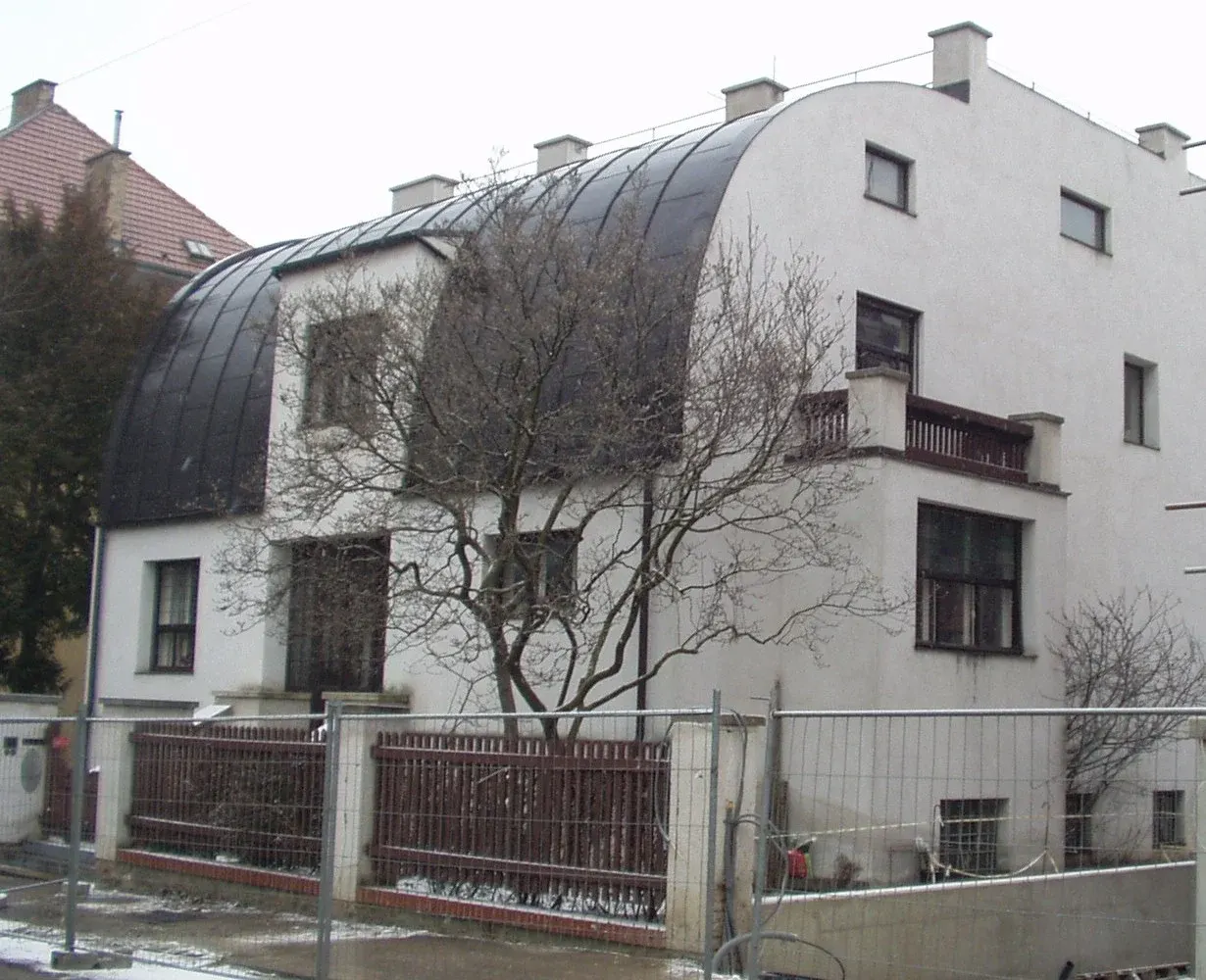
Adolf Loos, Steiner House (Vienna, completed around 1910), street-facing exterior, photographed in 2006 · Public Domain · Wikimedia Commons
An architectural study that features tattoos in its title argues that this essay's persuasiveness stemmed largely from logic borrowed from 19th-century criminal anthropology. According to that study, Le Corbusier, an architect active in France, championed Loos's work with particular enthusiasm in the 1920s, and that introduction shaped how the essay was read thereafter. The same study views this text as a crucial catalyst in shifting away from 19th-century architecture, which revived old styles, and moving toward modernism (DOI: 10.1017/s0066622x00003798).
One study suggests that the common understanding of Loos as someone who "resolutely opposed ornament on the grounds of utility" was solidified when artists leading new trends in post-WWI Europe accepted the essay without scrutinizing it (DOI: 10.2307/488400). Looking inside the interiors Loos decorated changes the picture slightly. Another study reads Loos as combining an emphasis on simplicity with a readiness to use expensive materials indoors, dressing the exterior visible from the street in a kind of mask (DOI: 10.55755/deparch.2022.6). Under this study's reading, the place where Loos's eraser landed was the surface, while the inside was different.
Objects stripped of ornament existed even before Loos. A study notes that 19th-century English designer Christopher Dresser was the first industrial designer to create unadorned objects under the influence of Japanese art (DOI: 10.5965/2175234612272020011). The same study views Art Deco and modernism as having initially clashed like conflicting cultures, only to blend together at a certain point, as recent research has pointed out.
In 1919, German architect Walter Gropius founded a school called the Bauhaus (DOI: 10.35483/acsa.intl.2016.12). The school opened in Weimar and relocated to Dessau six years later (Boundless, Art History ch. 29.02). A 2016 architectural education paper regards the school's core objective as the unification of art and technology, noting that this goal had not been fully achieved even by that time (DOI: 10.35483/acsa.intl.2016.12). Through the lens of that paper, the goal set by the Bauhaus remains a question still being worked out today.
"Form follows function" is known as a saying left by American architect Louis Sullivan (Boundless, Art History ch. 28.11). Functionalism is the modern architectural idea that a building's shape and layout should be derived from the work the building will do. The "function" here went beyond mere utility to encompass standards of beauty as well (Boundless, Art History ch. 28.11). For architects who championed function, beauty remained something to be reckoned with.
In 1912, the Shipping House (Scheepvaarthuis) was built in Amsterdam. A textbook cites this building, overseen by Dutch architect Johan van der Mey, as the starting point of the Amsterdam School (Boundless, Art History ch. 29.02). The architects in this group stacked bricks to sculpt rounded exteriors (Boundless, Art History ch. 29.02). Around the time Loos was simplifying exterior surfaces, Amsterdam's brick buildings were moving toward sculpting the exterior rather than stripping it away. The place targeted by the eraser in architecture was exterior ornament, but even within architecture of the same era, hands treating ornament were not all of one mind.
Art — An Eraser That Clears Away Recognizable Objects
Kandinsky was born in Russia, moved to Munich in 1896, and published Concerning the Spiritual in Art there in 1912 (DOI: 10.1080/00043249.1975.10793685). Some writings date this book to 1911 (DOI: 10.1177/0040571x10387346). With this book, Kandinsky became a leading advocate for abstraction before World War I. Abstract art is painting woven solely from colors, lines, and shapes, without recognizable figures depicting anything.
The reason Kandinsky erased recognizable objects lay outside the painting. He believed abstraction was suited to conveying his vision of an upcoming utopian era. Paintings that depicted objects as they were seemed identical to the material-centered values that dominated the era, and he considered objectless paintings the path to revealing spiritual values. At the same time, he worried that many people might not recognize such paintings. Therefore, one study suggests he had to find a way to make his meaning reach many people without depicting objects literally (DOI: 10.1080/00043249.1975.10793685).
The book's idea was to view painting as an expression of mood (DOI: 10.1353/jae.2005.0003). There are also studies that read the three essays Kandinsky wrote between 1911 and 1914 differently. While one art history account introduces Kandinsky as a necessary link toward the goal modernism would reach, this study reads those three essays as a stage where the painter himself staged his own position. That study suggests that the identity of the artist Kandinsky and the "historical necessity" built by these writings still support the legitimacy of modernist painting (DOI: 10.7202/1073076ar).
There is also a dispute over who first erased objects. Art historians have commonly picked Kandinsky, regarding a 1911 watercolor as the first abstract work. However, Swedish painter Hilma af Klint painted large, formless series of works five years earlier, starting in 1906. She kept these paintings secret and left instructions not to show them for twenty years after her death, so the paintings were revealed only decades later (DOI: 10.54664/aimf4981). The same study suggests that Kandinsky, Mondrian, and Malevich were each different, yet all were driven, to varying degrees, by thoughts on the spirit. It then asks whether af Klint's paintings belong to modernist abstraction or to a different branch of art containing spiritual teachings.
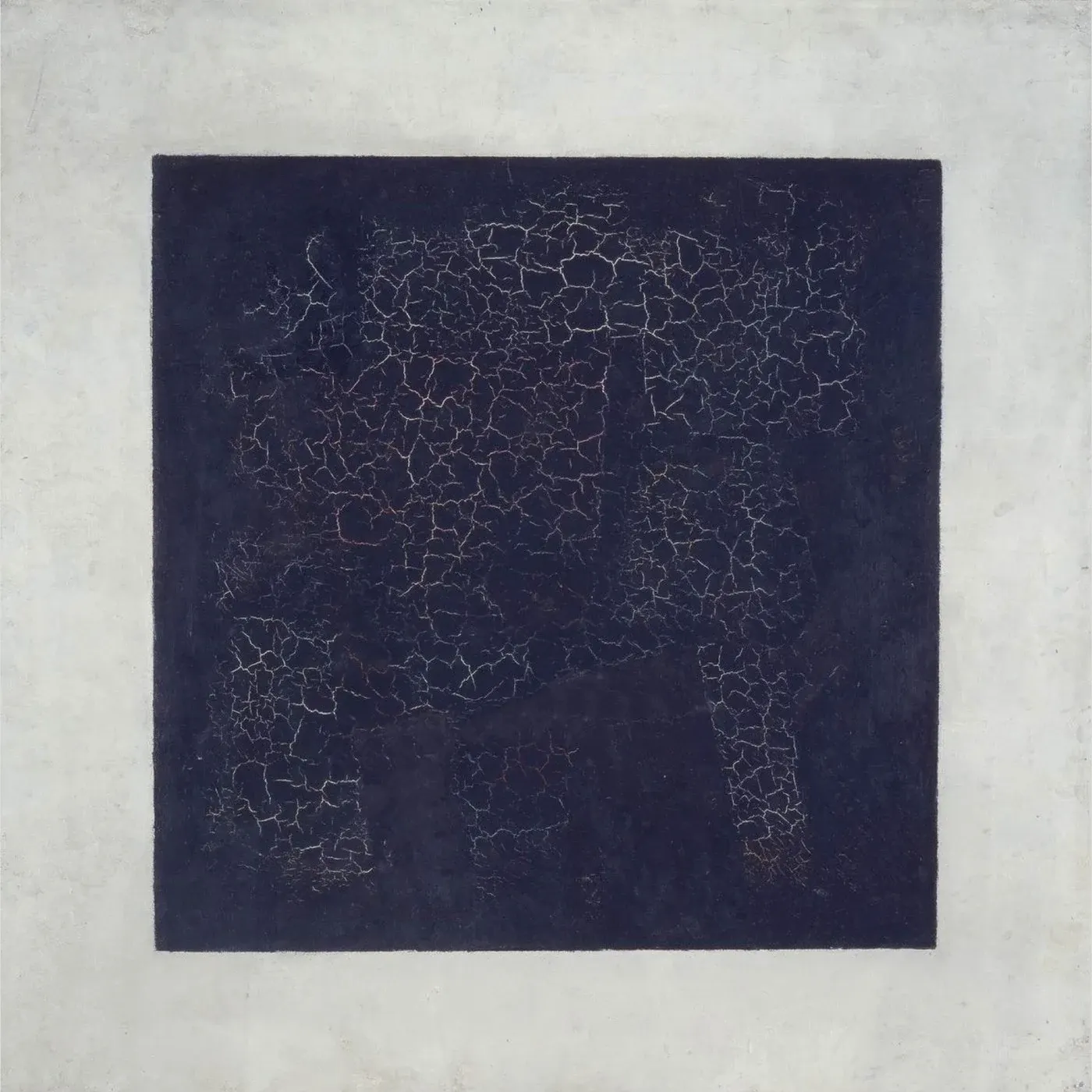
Kazimir Malevich, "Black Square" (1915) · Tretyakov Gallery, Moscow · Public Domain · Wikimedia Commons
Russian painter Kazimir Malevich hung a painting featuring a single black square at "The Last Futurist Exhibition 0.10". He hung this painting in the corner where religious icons were traditionally placed (DOI: 10.1080/02666286.2005.10462099). Suprematism is the name given by Russian painter Kazimir Malevich to abstract art woven from simple geometric shapes alone.
Looking at this painting today, the surface is cracked, and the color is no longer pure black, but a hue where black, brown, and white are mixed. One study suggests that this cracked surface reveals, contrary to Malevich's claim, that this square was not the first Suprematist painting, and reads the painting as an exploration of the material of paint rather than an illusion of a higher world. The same study suggests this reading can also explain why Malevich later returned to painting recognizable figures (DOI: 10.1080/02666286.2005.10462099). Conversely, another study reads this square as the face of God, and his painting as a path to seeking the ineffable absolute (DOI: 10.3390/rel12070542).
In Paris, Spanish-born painter Pablo Picasso and French painter Georges Braque took a different path. Cubism is a movement in painting where views of a single subject from multiple directions are drawn together on a single canvas. By the end of 1911, the two painters pulled the sense of depth in their paintings right to the picture plane, and starting in 1912, they cut and pasted paper and cloth (DOI: 10.4324/9780429498909-19). Because the two painters' works are still under copyright, they are not included in this article.
What the eraser touched in the paintings were recognizable objects, but not everyone erased them entirely. Kandinsky put the spirit in that space, Malevich placed a single square, and Picasso and Braque left the objects behind while gathering views from multiple directions onto a single canvas and cutting and pasting paper.
Music — An Eraser That Reached for the Tonic and the Beat
The French composer Claude Debussy's piano prelude "Voiles" was published as a score in 1910. One textbook groups Debussy with the French composer Maurice Ravel under "impressionist music" (Clark et al., Understanding Music ch. 7.01). Let us listen to the first eight measures of this piece.
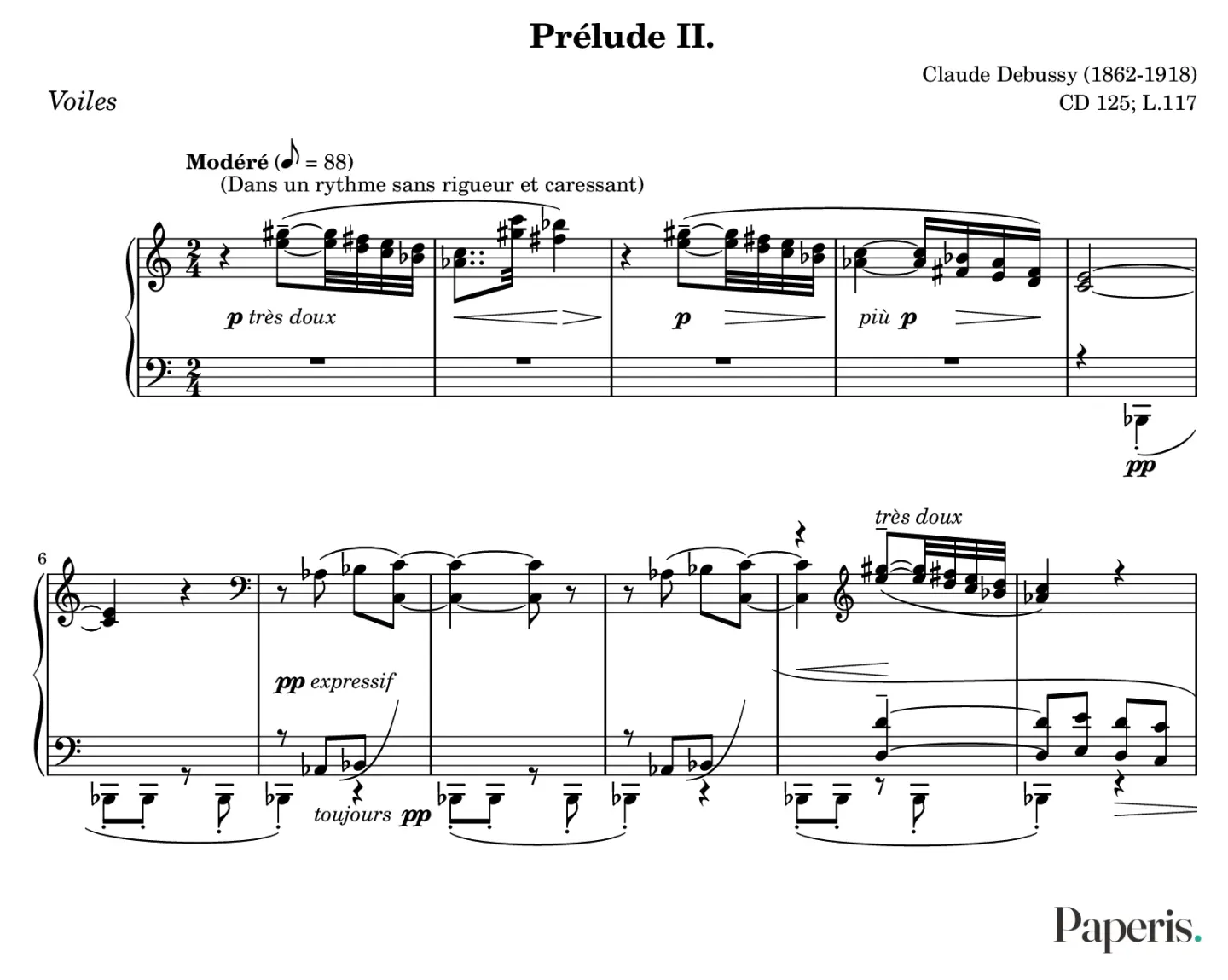
Debussy, Preludes, Book 1, No. 2, "Voiles" (1910), mm. 1–11 score · Score typeset by Mutopia Project (based on the 1910 Durand edition) · CC BY-SA 4.0
Clip: Debussy, Préludes Book 1 No. 2, "Voiles", bars 1–8 (synthesized piano; score input Mutopia Project after the 1910 Durand edition, CC BY-SA 4.0)
At first, a short melody made of two-note chords descends from above, and from measure 5 a very low A-sharp (B-flat) repeats. The notes used in these eight measures are only six: C, D, E, F-sharp, G-sharp, and A-sharp (B-flat). A semitone is one of the twelve steps into which Western music divides an octave, which is the distance from a key on the keyboard to the very next key. A whole tone is the distance of two semitones combined. The six notes are spaced a whole tone apart from one another.
A whole-tone scale is a scale made of six notes, each spaced a whole tone apart from the next. The first eight measures of "Voiles" are built using only these six notes.
In the three piano pieces, Opus 11, written in 1909 by the Vienna composer Arnold Schoenberg, the piece loses the central note to which it returns to rest. The tonic is the note from which a scale starts, and the central note where, when the piece clearly lands on it, you feel the most stable and restful. Tonal music is music in which a single tonic serves as the center, with the other notes organized in relation to that note.
Atonal music is music made without such a central note. One textbook cites Opus 11 as the first fully atonal work (Clark et al., Understanding Music ch. 7.02). What stood in the place where the central note was removed in Schoenberg's piece was not easily solved even in 1970. Schoenberg himself said that he followed the logic of chord construction without being conscious of it, and a 1970 article notes that analysts still find it difficult to unravel that logic and that the method used to construct the third piece of Opus 11 cannot even be properly taught (DOI: 10.1017/s0040298200046180).
Let us return to the Paris stage in 1913. The score of "The Rite of Performance" performed that day includes measures of five or seven beats, and passages where the meter changes from measure to measure are frequent (Clark et al., Understanding Music ch. 7.01). Whether it was this music or the dancing that shook the audience that day remains, as we saw earlier, a matter of debate. Whether this work is a clean break from the past or a large continuity with preceding works is also a question debated by scholars (DOI: 10.25071/ryr.v1i0.40328).
The eraser in music did not aim at just one place. In Schoenberg's Opus 11, the central note was removed, and in "The Rite of Spring", the meter that had stayed uniform from measure to measure was shaken. Debussy's "Voiles" built its first eight measures using only six notes, each spaced a whole tone apart. And seven years later, in 1920, Stravinsky brought old melodies believed to be by Pergolesi into the ballet "Pulcinella" (Clark et al., Understanding Music ch. 7.04). From the hands of the same composer, the act of stripping away and the act of calling back things of the past emerged together within the span of seven years.
Literature — The Eraser That Loosens the Thread of Narration
Mrs. Dalloway said she would buy the flowers herself.
What a lark! What a plunge! For so it had always seemed to her, when, with a little squeak of the hinges, which she could hear now, she had burst open the French windows and plunged at Bourton into the open air.
— Virginia Woolf, Mrs. Dalloway
Virginia Woolf's 1925 novel Mrs. Dalloway begins with a morning out to buy flowers. Yet within a few sentences, the story shifts within that same morning to Mrs. Dalloway—Clarissa—at eighteen opening a window at Bourton, and within that sentence the sound of the hinges is a sound "which she could hear now." Because the sentences follow the lady's head, the reader crosses along between the morning out to buy flowers and the window of age eighteen. Stream of consciousness is a narrative method that follows and writes down the thoughts and feelings arising in a character's head without breaking them.
Irish novelist James Joyce's Ulysses came out in 1922 and follows a character named Leopold Bloom through a day wandering around Dublin (Robinson, British Literature II ch. 3.01). Joyce compressed the ten years of the ancient Greek epic Odyssey into a single day in Ulysses (DOI: 10.5325/fscotfitzrevi.11.1.0080).
The two novels sharing that name do not move thoughts in the same way. One study comparing the two novels suggests that Joyce digs toward the unconsciousness spoken of by Freud, whereas Woolf follows the movement of thoughts shifting from the present to the past. The same study also points out the commonality that both novels stand upon the flow where thoughts, images, and emotions arise of their own accord, and hold everyday experiences with the characters' subjectivity (DOI: 10.23683/1995-0640-2019-4-62-71).
Another study views Joyce and American novelist William Faulkner as having used the stream of consciousness quite differently, drawing on British novelist Dorothy Richardson's remark, "All were writing in 'the new way,' at once, and differently" (DOI: 10.36941/jesr-2025-0018).
The year 1922 also saw the publication of Woolf's novel Jacob's Room. It is precisely the year Ulysses and Eliot's poem The Waste Land came out. One study suggests that perhaps due to being a work of that year and Woolf's first full-length fiction to break away from conventional narration, this novel is often read as an example of modernism, yet views some of its oddities as belonging to Woolf alone. The same study argues that rather than assuming Woolf was drawn to the new technique itself, one must understand the purpose she sought to achieve with this novel to untangle those oddities (DOI: 10.2307/2872966).
There is not just one direction for reading Woolf. For a long time, Woolf's novels have been read as literature that enters the mind, and recently, a reading method that puts forward an interest in objects and the external world has countered this. One study connects the two readings by paying attention to the frequent misreadings of Woolf's characters (DOI: 10.2979/jmodelite.34.2.1).
The Metamorphosis by Franz Kafka, a writer who wrote in German in Prague, came out in 1915. A comparative study places this novel and Mrs. Dalloway side by side, reading both novels as depicting identity as something achieved within the recognition of others (DOI: 10.67088/veethika/v16.i2.22). That study is a single comparative reading published in 2026.
Let us return to the opening where the morning out to buy flowers leaps in a few sentences to the window of age eighteen. One textbook lists breaking the continuity of a story as one of the techniques of modernist fiction (Robinson, British Literature II ch. 3.01). What filled the broken spaces differed by author, and researchers also look together at the commonalities standing upon the same flow.
Same Era, Different Clocks
We place the years of the works chosen for this article side by side. In painting, af Klint was from 1906, and Kandinsky’s watercolor was from 1911. Whether af Klint’s painting belongs in abstraction is itself a question (DOI: 10.54664/aimf4981). In architecture, Loos’s writing was from 1908 or 1912, and the Bauhaus was from 1919. In music, Schönberg’s Opus 11 was from 1909, and the novels Ulysses and Mrs. Dalloway were from 1922 and 1925. One textbook evaluates that stream-of-consciousness fiction, atonal music, and abstract art all had precedents in the 19th century (Boundless, Art History ch. 28.10). The differences in years are also differences among the works chosen for this article.
The places erased were different, too. Loos’s eraser reached the exterior of the building, Kandinsky’s eraser reached the objects inside the painting, and Schönberg’s eraser reached the central key of the piece. In fiction, the place was the continuity of the story connecting scenes, as pointed out by a textbook.
There are also traces of movement back and forth between fields. One textbook names the American writer Gertrude Stein as an author who applied the principles of Cubism to her writing (Boundless, Art History ch. 29.01). Woolf wrote about the impact of street music and opera on the community between 1905 and 1909. However, citing another researcher, a study notes that what the Woolfs listened to in turn on records between 1939 and 1940 was Beethoven's late string quartets, and that what Woolf enjoyed listening to was not the experimental composers of the "modern" era (DOI: 10.1353/nar.2005.0008). That Kandinsky’s painting theory can be read in comparison to music is a reading offered by a 2017 study (DOI: 10.25281/2072-3156-2017-14-1-54-60).
An article views that there was reciprocal influence between impressionism in painting and literature, and that modernism grew stream of consciousness out of that impressionism (DOI: 10.1002/9780470996331.ch22). Friedman views that Einstein’s theory of relativity made people rethink time and space, and that some of the art and philosophy of modernism had already begun expressing the same thoughts around that time (DOI: 10.1353/mod.2006.0059). Such resemblances are the views of the researchers who observed them.
There are also commonalities seen by critics who closely read forms after 1945 and grouped these works together. They are the idea that art stands on its own, a focus on form, detachment and irony, themes of myth, and an attitude of reflecting on the act of making itself (DOI: 10.1017/chol9780521563543.021). This list consists of commonalities seen through the eyes of those doing the grouping, and as seen earlier, the grouped artists themselves rarely used this name.
The eraser metaphor also reveals its limits here. Af Klint and Kandinsky added thoughts about the spirit to the places where objects were erased, the Amsterdam architects molded rounded exteriors with bricks, and Stravinsky pulled out old melodies again in 1920.
Under the single name of modernism, what the four fields pared down and what they added each differed, alongside traces of movement between fields and the commonalities later seen by critics.
Where to Look Next
The immediately preceding era is covered in "Romanticism — One Label, a Different Date on Every Drawer". You can listen to what follows right before the era covered in this piece.
In architecture, "Antoni Gaudí — Turning Hanging Strings Upside Down to Find Where Stone Can Stand" deals with a different path in Barcelona during the same period, while "Mies van der Rohe — Give the Weight to the Frame, Empty the Walls into Glass" explores the architecture behind the Bauhaus.
In painting, "Mondrian — Would You Notice If the Lines Moved a Little?" examines Mondrian's lines, and "Abstract Art and Children's Paintings — Between the Fridge Door and the Gallery Wall" covers how we view abstract art.
In music, "Debussy's Clair de lune — Asked to Pick a Color for a Sound, What Do We Follow?" explores another piece by Debussy, while "Gymnopédie No. 1 — Does Music Ease Anxiety, and Does the Pulse Follow?" looks at a French piano piece from around the same time. Kafka continues in "Character — A Man Who Worries About His Train Even on the Morning He Becomes a Vermin".
Source Papers
- "A Lasting Riot: Controversy and Stravinsky's Rite of Spring" (2014) — DOI: 10.25071/ryr.v1i0.40328 — A short piece noting that the premiere in Paris on May 29, 1913 is commonly recounted as ending in a disturbance, while scholars remain divided on the cause (choreography or music), the speed with which reactions changed, and whether it marked a break from or a continuation of the past (includes reviews of the premiere and research overviews, as well as a reflection on a 2012 Toronto performance). It concludes that while the shock has diminished, the vitality and controversy endure.
- "Kandinsky's Abstract Style: The Veiling of Apocalyptic Folk Imagery" (1975) — DOI: 10.1080/00043249.1975.10793685 — With his 1912 Munich publication Concerning the Spiritual in Art, Kandinsky became a leading advocate for abstraction before World War I; having moved to Munich in 1896, he envisioned an upcoming utopian era, equated representation with materialism, and worried that the public might not understand his work, compelling him to find a way to communicate broadly even without representation.
- "Adolf Loos and the Aphoristic Style: Rhetorical Practice in Early Twentieth-Century Design Criticism" (2010) — DOI: 10.5040/9781350096004.ch-006 — "Ornament and Crime" (1908) brought Loos notoriety as one of the most radical polemical essays in twentieth-century design criticism.
- "Art History (Boundless) — 29.01 European Art in the Early 20th Century" — Boundless, Art History ch. 29.01 — World War I lasted from 1914 to 1918, mobilizing over 60 million troops, and featured artists such as Gertrude Stein who employed cubist principles.
- "Art History (Boundless) — 28.10 The Rise of Modernism" — Boundless, Art History ch. 28.10 — A textbook evaluation suggesting that modernist innovations such as stream-of-consciousness fiction, atonal music, and abstract art had precedents in the nineteenth century.
- "Modernism in art, literature and political theory" (2003) — DOI: 10.1017/chol9780521563543.021 — A critical term of Anglo-American origin that emerged in the 1920s and spread during the two decades of formalist criticism following 1945, detailing the characteristics and exemplary writers identified by New Criticism, its appropriation by Western Marxists, and its recent expansion; it was rarely used by the figures themselves and remains essentially a contested concept.
- "Art History (Boundless) — 29.02 Europe from 1920-1945 CE" — Boundless, Art History ch. 29.02 — Tracing the roots of modernism to the 1880s, noting the Bauhaus in Weimar in 1919 and Dessau in 1925, and identifying the Scheepvaarthuis (1912) as the starting point of the Amsterdam School, with its rounded brick exterior.
- "Periodizing Modernism: Postcolonial Modernities and the Space/Time Borders of Modernist Studies" (2006) — DOI: 10.1353/mod.2006.0059 — Periodization harbors spatial assumptions that favor specific locations; Jameson viewed modernism as ending by the close of World War II, while the conventional dates of the 1890s to the 1940s prioritize English-language modernism even within Europe, and relativity theory systematized what parts of art and philosophy had already begun to articulate.
- "Chapter XIV: Modern Literature: General Modernism" (2025) — DOI: 10.1093/ywes/maaf057 — An annual review of research trends noting that modernist studies have spent decades seeking to broaden temporal horizons and reveal cross-era resonances.
- "Architecture, ornament and excrement: the Crossness and Abbey Mills pumping stations" (2007) — DOI: 10.1080/13602360701614631 — Designates "Ornament and Crime" (1908) as one of architectural modernism's most powerful early manifestos.
- "Decoration and Decorum, Adolf Loos's Critique of Kitsch" (1988) — DOI: 10.2307/488400 — Understands "Ornament and Crime" (1912) primarily as an anti-ornament argument driven by utility, which the post-World War I avant-garde accepted uncritically and placed in the canon of the modern movement.
- "Criminal Skins: Tattoos and Modern Architecture in the Work of Adolf Loos" (2005) — DOI: 10.1017/s0066622x00003798 — "Ornament and Crime" serves as a core canon linking unadorned architecture with modern culture, drawing its power from nineteenth-century criminal anthropology; Le Corbusier championed it enthusiastically in the 1920s to establish the mode of its reception, making it a key catalyst in the transition from nineteenth-century historicism to modernism.
- "Adolf Loos and Ornament" (2022) — DOI: 10.55755/deparch.2022.6 — While advocating for simplicity, Loos used expensive materials in interiors and supported the metaphor of the mask, simplifying only the exterior surface.
- "The Crisis of Ornament: Evaluation and Intercultural Divergences in the Visual Arts of the 19th and Early 20th Centuries" (2020) — DOI: 10.5965/2175234612272020011 — Christopher Dresser was the first industrial designer to create unadorned objects under the influence of Japanese art; the text discusses Loos's 1908 lecture, and the subsequent clash and later blending of Art Deco and modernism.
- "Bringing Bauhaus Back: Digital Architecture + Contemporary Craft" (2016) — DOI: 10.35483/acsa.intl.2016.12 — An architectural education paper noting that German architect Walter Gropius founded the Bauhaus in 1919, and that its core goal—the unification of art and technology—remains an unrealized concept.
- "Art History (Boundless) — 28.11 The Beginning of Modern Architecture" — Boundless, Art History ch. 28.11 — Louis Sullivan's dictum "form follows function," where "function" encompasses not only practical utility but aesthetic standards as well.
- "A theology of abstraction: Wassily Kandinsky's 'Concerning the Spiritual in Art'" (2011) — DOI: 10.1177/0040571x10387346 — Dates Concerning the Spiritual in Art to 1911 and examines Kandinsky's concept of the "spiritual" and its influences.
- "The Paradox of Kandinsky's Abstract Representation" (2005) — DOI: 10.1353/jae.2005.0003 — Concerning the Spiritual in Art instructs viewers to regard paintings not as representations of objects, but as expressions of moods.
- "Esoteric Painting by Hilma af Klint" (2022) — DOI: 10.54664/aimf4981 — While Kandinsky's 1911 watercolor is commonly cited as the first abstract painting, af Klint was painting non-figurative series starting in 1906, which came to light late due to a will stipulating they remain sealed for twenty years after her death; noting that Kandinsky, Mondrian, and Malevich were all drawn to spiritual ideas, the paper questions whether her work is modernist abstraction or spiritual and esoteric art.
- "Les écrits de Wassily Kandinsky ou le discours des fondements de la peinture abstraite" (2020) — DOI: 10.7202/1073076ar — Critiques art histories that view Kandinsky as an inevitable link toward the goals of modernism, analyzing three texts from 1911 to 1914 as the artist's self-presentation, and showing how that identity and historical inevitability continue to serve as grounds for the legitimacy of modernist painting.
- "Kazimir Malevich on vision and sensation" (2005) — DOI: 10.1080/02666286.2005.10462099 — Reveals that the cracked surface of Black Square mixes black, brown, and white, and that—contrary to Malevich's claims—it was not the first Suprematist painting; it was hung in the "0.10" exhibition in the corner reserved for religious icons, and is read here as an exploration of pigment rather than the spirit, which can also account for the return to figuration.
- "Kazimir Malevich's Negative Theology and Mystical Suprematism" (2021) — DOI: 10.3390/rel12070542 — An apophatic theological interpretation reading Black Square as the face of God, and Suprematism as a method for perceiving the unspeakable Absolute.
- "Collage" (2018) — DOI: 10.4324/9780429498909-19 — By late 1911, Picasso and Braque pulled the illusory depth of their paintings close to the surface, and beginning in 1912, they began pasting paper and cloth onto the canvas.
- "Understanding Music: Past and Present — 7.01 Introduction and Historical Context- 1900 to today" — Clark et al., Understanding Music ch. 7.01 — Groups Debussy and Ravel under impressionist music, and highlights the five- and seven-beat measures and frequent meter changes in The Rite of Spring.
- "Understanding Music: Past and Present — 7.02 Expressionism and Serialism" — Clark et al., Understanding Music ch. 7.02 — Designates Schoenberg's Opus 11 (1909, Three Piano Pieces) as the first completely atonal work.
- "Schoenberg and the 'Logic' of Atonality" (1970) — DOI: 10.1017/s0040298200046180 — Schoenberg spoke of an unconscious harmonic logic, yet analysts still find atonal logic difficult to untangle, and the texture of Opus 11, No. 3 cannot be taught effectively.
- "Understanding Music: Past and Present — 7.04 Neoclassicism" — Clark et al., Understanding Music ch. 7.04 — The 1920 ballet Pulcinella drew on older pieces believed to be by Pergolesi (though actually composed by a contemporary).
- "British Literature II — 3.01 Modernism and Postmodernism as Literary Movements" — Robinson, British Literature II ch. 3.01 — Defines the stream of consciousness and views the disruption of narrative continuity as one of the techniques of modernist fiction, citing Ulysses and Bloom's Dublin in 1922.
- "F. Scott Fitzgerald, Virginia Woolf, and the Watch for Spots of Time" (2013) — DOI: 10.5325/fscotfitzrevi.11.1.0080 — Joyce compressed the ten years of the Odyssey into a single day in Ulysses.
- "ПОТОК СОЗНАНИЯ В МОДЕРНИСТСКОМ ПОВЕСТВОВАНИИ" (2019) — DOI: 10.23683/1995-0640-2019-4-62-71 — Comparing Ulysses and Mrs. Dalloway: Joyce employs the Freudian unconscious, while Woolf tracks the movement of thought from the present to the past, with both novels relying on the natural flow of thoughts, images, and emotions as a common denominator for the subjective capture of everyday experience.
- "Many Streams: A Critical Review of Modernism's Divergent Modes of Consciousness" (2025) — DOI: 10.36941/jesr-2025-0018 — Discusses the various branches of the stream of consciousness employed by writers like Joyce and Faulkner, quoting Dorothy Richardson's remark: "They all were writing 'the new method', quite differently, at the same time."
- "Jacob's Room: Woolf's Satiric Elegy" (1981) — DOI: 10.2307/2872966 — Jacob's Room was published in 1922, the same year as Ulysses and The Waste Land, and while it is read as a model of modernism for being Woolf's first novel to break with conventional narrative, some of its traits are uniquely her own, which can only be understood by grasping Woolf's fundamental purpose.
- "Misperceiving Virginia Woolf" (2011) — DOI: 10.2979/jmodelite.34.2.1 — Connects the long-standing reading of Woolf as an "inward-facing" literature with the reading that prioritizes the material world through the device of characters' misperceptions.
- "The Paradox of Identity: Creation, Conformity, and Collapse in Modernist Fiction" (2026) — DOI: 10.67088/veethika/v16.i2.22 — A comparative reading of The Metamorphosis and Mrs. Dalloway portraying identity anew as a socially mediated process.
- "Transforming Musical Sounds into Words: Narrative Method in Virginia Woolf's The Waves" (2005) — DOI: 10.1353/nar.2005.0008 — Woolf's early musical essays (1905, 1906, 1909) address the impact of music on communities, introducing other scholarship which explains that what Woolf enjoyed listening to was not the "modern" experimental composers, and examining her attempts to use music as a model for the novel.
- "Wassily Kandinsky: the Experience of Reflections on the Art of Abstraction" (2017) — DOI: 10.25281/2072-3156-2017-14-1-54-60 — A reading exploring how Kandinsky's theories of abstraction and his judgments can be applied to other arts, particularly music.
- "Literary Impressionism" (2007) — DOI: 10.1002/9780470996331.ch22 — There was a two-way exchange between the impressionism of painting and of literature, and modernism cultivated the stream of consciousness out of impressionism.
Sources (37)
- A Lasting Riot: Controversy and Stravinsky's Rite of SpringDOI 10.25071/ryr.v1i0.40328
- Kandinsky's Abstract Style: The Veiling of Apocalyptic Folk ImageryDOI 10.1080/00043249.1975.10793685
- Adolf Loos and the Aphoristic Style: Rhetorical Practice in Early Twentieth-Century Design CriticismDOI 10.5040/9781350096004.ch-006
- Art History (Boundless) — 29.01 European Art in the Early 20th Century
- Art History (Boundless) — 28.10 The Rise of Modernism
- Modernism in art, literature and political theoryDOI 10.1017/chol9780521563543.021
- Art History (Boundless) — 29.02 Europe from 1920-1945 CE
- Periodizing Modernism: Postcolonial Modernities and the Space/Time Borders of Modernist StudiesDOI 10.1353/mod.2006.0059
- Chapter XIV: Modern Literature: General ModernismDOI 10.1093/ywes/maaf057
- Architecture, ornament and excrement: the Crossness and Abbey Mills pumping stationsDOI 10.1080/13602360701614631
- Decoration and Decorum, Adolf Loos's Critique of KitschDOI 10.2307/488400
- Criminal Skins: Tattoos and Modern Architecture in the Work of Adolf LoosDOI 10.1017/s0066622x00003798
- Adolf Loos and OrnamentDOI 10.55755/deparch.2022.6
- The Crisis of Ornament: Evaluation and Intercultural Divergences in the Visual Arts of the 19th and Early 20th CenturiesDOI 10.5965/2175234612272020011
- Bringing Bauhaus Back: Digital Architecture + Contemporary CraftDOI 10.35483/acsa.intl.2016.12
- Art History (Boundless) — 28.11 The Beginning of Modern Architecture
- A theology of abstraction: Wassily Kandinsky's 'Concerning the Spiritual in Art'DOI 10.1177/0040571x10387346
- The Paradox of Kandinsky's Abstract RepresentationDOI 10.1353/jae.2005.0003
- Esoteric Painting by Hilma af KlintDOI 10.54664/aimf4981
- Les écrits de Wassily Kandinsky ou le discours des fondements de la peinture abstraiteDOI 10.7202/1073076ar
- Kazimir Malevich on vision and sensationDOI 10.1080/02666286.2005.10462099
- Kazimir Malevich's Negative Theology and Mystical SuprematismDOI 10.3390/rel12070542
- CollageDOI 10.4324/9780429498909-19
- Understanding Music: Past and Present — 7.01 Introduction and Historical Context- 1900 to today
- Understanding Music: Past and Present — 7.02 Expressionism and Serialism
- Schoenberg and the 'Logic' of AtonalityDOI 10.1017/s0040298200046180
- Understanding Music: Past and Present — 7.04 Neoclassicism
- British Literature II — 3.01 Modernism and Postmodernism as Literary Movements
- F. Scott Fitzgerald, Virginia Woolf, and the Watch for Spots of TimeDOI 10.5325/fscotfitzrevi.11.1.0080
- ПОТОК СОЗНАНИЯ В МОДЕРНИСТСКОМ ПОВЕСТВОВАНИИDOI 10.23683/1995-0640-2019-4-62-71
- Many Streams: A Critical Review of Modernism's Divergent Modes of ConsciousnessDOI 10.36941/jesr-2025-0018
- Jacob's Room: Woolf's Satiric ElegyDOI 10.2307/2872966
- Misperceiving Virginia WoolfDOI 10.2979/jmodelite.34.2.1
- The Paradox of Identity: Creation, Conformity, and Collapse in Modernist FictionDOI 10.67088/veethika/v16.i2.22
- Transforming Musical Sounds into Words: Narrative Method in Virginia Woolf's The WavesDOI 10.1353/nar.2005.0008
- Wassily Kandinsky: the Experience of Reflections on the Art of AbstractionDOI 10.25281/2072-3156-2017-14-1-54-60
- Literary ImpressionismDOI 10.1002/9780470996331.ch22