
Paperis Articles
The Renaissance — One White Hind, Different Tracks in Every Forest
"Renaissance" (rebirth) is a name given in the nineteenth century. In Europe around 1400–1600, architecture put classical orders and domes forward, painting calculated space in Italy and oil paint in Flanders, music voices moving together, and literature the study of ancient texts and the sonnet. The wish to imitate antiquity shows in architecture, painting and literature but not, on this primer's evidence, in music — and timing and direction differed by field and region.
Your field's papers, as audio
Pick your fields and journals — Paperis summarizes the key papers and turns them into audio. Listen on your commute.
Start Paperis free →The Renaissance — One White Hind, Different Tracks in Every Forest
1436 in Florence, the Year the Dome Rose
The enormous dome atop Florence Cathedral was built from 1420 to 1436. The work was managed by the Opera del Duomo, the institution that built and cared for the cathedral, which had a character that was formally private yet public at the same time. The institution reported where public funds were used through ledgers, gathered consensus by involving citizens and local guilds, and kept in mind its social responsibility toward the workers building the dome (DOI: 10.1080/21552851.2019.1686036). The roof went up at the hands of an institution that reported public funds in ledgers.
In 1436, the year construction ended, the Italian scholar and theorist Leon Battista Alberti published On Painting, a book dealing with how to draw, in Italian, and attached to it a dedication letter to Filippo Brunelleschi, the Florentine architect who built that dome. The letter took up that dome and the new method by which it was raised. According to one study that closely reads this letter, Alberti believed that speaking of such unprecedented things required an equally new vocabulary, and called upon his contemporaries to polish the contemporary language rather than revive ancient Latin (DOI: 10.5070/c321008940). Right in the middle of an era remembered as one that revived the old, a theorist of that time was looking for new words to speak of new things.
This article looks at European architecture, art, music, and literature together from roughly 1400 to 1600. The starting point is the Italian cities, and northern Europe and England follow afterward at their own paces.
As a guide, we bring along a deer. Francesco Petrarca (Petrarch) was an Italian scholar and poet of the 14th century (Boundless, Art History ch. 19.01; Robinson & Getty, British Literature I ch. 2.26). In his poem, a white doe with golden horns appears, and around her neck is written, "Let no one touch me". In this article, that deer is the intention to emulate ancient Greece and Rome, the forests are the four fields, and the hunting seasons are the respective periods for each field. Whether that deer passed through every forest the same way must be examined separately for each forest. There are forests with deep footprints, and as evidence for this article, forests where the footprints are not easily seen. The meaning of the deer in the poem is separate; here, it is only borrowed as a guide.
The Name "Revival" Came Later
The Renaissance—a word meaning "revival"—is a retrospective label for an era and its art that began in Italy and spread across Europe from roughly 1400 to 1600. The practice of grouping this era and its style under this name began in the 19th century (Boundless, Art History ch. 19.01; Clark et al., Understanding Music ch. 3.01).
Jacob Burckhardt's 1860 book, The Civilization of the Renaissance in Italy, is often considered the work that first established the Renaissance as a period category. Yet this book was also the culmination of years of growing debate over this era and the concept of "revival" (DOI: 10.1017/9781846154751.008).
Burckhardt is counted among the founding fathers of modern cultural history. One study notes that his approach was not as radical as is often assumed, and that his tendency to view an era like a stopped painting drew significant criticism. The same study suggests that his deep anxiety about what modernization would bring explains both the conservative and innovative aspects of his approach (DOI: 10.5871/bacad/9780197267325.003.0003). While some of his claims have been discarded, research built upon his foundations has continued (DOI: 10.1017/s0018246x24000499). He portrayed the Renaissance as an inherently Italian phenomenon, and how to view the Renaissance in other countries remains a matter of contention today (DOI: 10.7256/2454-0609.2020.4.32637).
The word "revival" gives the impression that the preceding era was dead. Yet studies argue that there was a Renaissance in the Middle Ages as well. In his 1927 book The Renaissance of the Twelfth Century, the American medievalist Charles Homer Haskins described the intellectual revival of late-11th- and 12th-century Western Europe, followed by countless studies bearing the phrase "the 12th-century Renaissance." Debates over whether this term is appropriate have persisted, leading to alternative labels like renewal, revolution, or reform (DOI: 10.1017/9781846154751.008). Even where to attach the label "revival" remains a point of contention. Many studies also refer to the same period as the "early modern" (DOI: 10.1017/s0018246x24000499), a name that does not carry the meaning of being "born again."
Even while people argued over the labels afterward, the people of the era themselves saw that they differed from their medieval predecessors. Judging by surviving texts, the main reason they thought so was that they were deliberately imitating antiquity in art and architecture (Boundless, Art History ch. 19.01). The name came later, but the awareness of being different was there at the time.
So, what was reborn? The starting point was writing. Humanism is an intellectual movement that began by recovering, reading, interpreting, and imitating ancient Greek and Roman texts. Investigating ancient artifacts and ruins went hand in hand with this, and the movement soon became a cultural project touching nearly every facet of intellectual life in that era (DOI: 10.1017/ccol0521430380). Starting in literature, this movement spread beyond it to culture at large, reviving the artistic forms of ancient Greece and Rome (Boundless, Art History ch. 19.01). Its major spread outside Italy came after 1450 (Boundless, Art History ch. 20.01).
Architecture — A Dome Holding a Gothic Skeleton, and the Old Columns Behind It
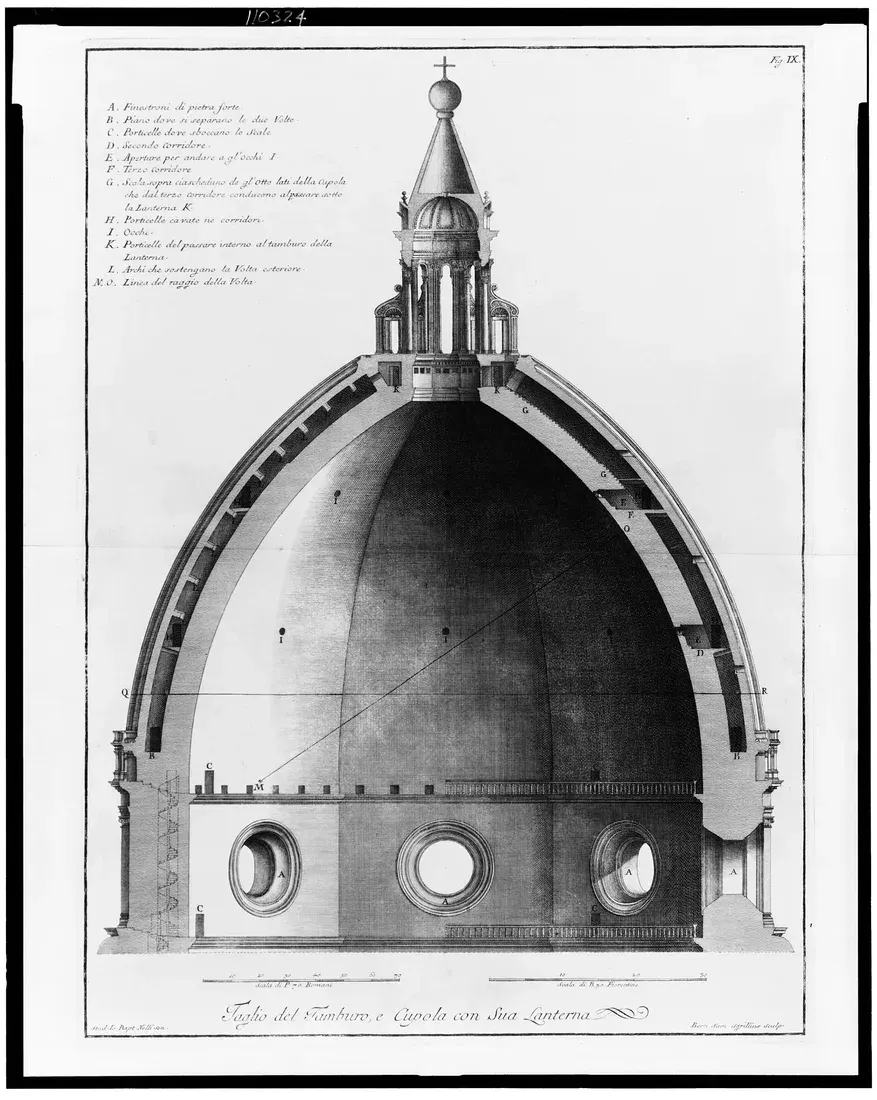
Bernardo Sansone Sgrilli, section of the dome of Florence Cathedral, engraving (1733) · Library of Congress · Public domain · Wikimedia Commons
We return to the roof from the beginning. Gothic is an architectural style that began in northern France in the mid-12th century, characterized by high stone ceilings and wide windows. The dome in Florence was influenced by ancient Roman domes like the Pantheon, but its pointed arches and skeleton were Gothic (Boundless, Art History ch. 19.02). One textbook notes that this dome is often called the first building of the Renaissance (Boundless, Art History ch. 19.02). From the roof dubbed the first building of the Renaissance, ancient Rome and the immediately preceding Gothic era were mixed into a single body.
The Palazzo Rucellai (1446–1451) in Florence, designed by Alberti, wrapped classical columns around all three of its front stories (Boundless, Art History ch. 19.02). The classical orders are a set of frameworks from ancient Greek and Roman buildings where columns and the parts resting upon them were assembled according to fixed proportions and decorations. By this time, buildings balanced their left and right sides and put classical orders front and center, deliberately reviving several elements of antiquity (Boundless, Art History ch. 19.02). In this forest, the footprints of the deer remained distinct in the shape of columns.
Alberti also wrote about architecture. One textbook lists his De re aedificatoria as the first architectural treatise of the Renaissance (Boundless, Art History ch. 19.02), and an introduction covering the history of architecture introduces him as the first person to write about architecture since Vitruvius in ancient Rome (DOI: 10.1201/9781003130000-4). The S-shaped scroll ornament that he placed on the facade of the Church of Santa Maria Novella in Florence was a new element with no ancient precedent, and it became a trend in churches across Italy (Boundless, Art History ch. 19.02). On the road of pursuing old parts, a part that never existed in antiquity had been born.
Alongside the revival came continuation. The money that sustained Florentine architecture came from trade profits, and most of the materials (stone and wood) and building practices were carried over directly from the previous era (DOI: 10.1201/9781003130000-4). In the 16th century, classical forms mixed with contemporary ones because the shape and use of buildings, as well as the layout of cities, differed from antiquity (Boundless, Art History ch. 19.02).
Even within Italy, there were multiple forests. In Venice, Gothic and Byzantine influences lingered far longer than in Florence or Rome (Boundless, Art History ch. 19.02). North of the Alps, the French king Francis I brought the architect Sebastiano Serlio from Italy (Boundless, Art History ch. 20.04). Yet one study concludes that French architectural theorists did not view antiquity as exclusive to Italy, but rather as the common past of contemporary culture as a whole, and forged their style by combining the heritage of antiquity with their own country's medieval tradition (DOI: 10.7256/2454-0609.2020.4.32637).
The windows of King's College Chapel in Cambridge, England, use low and wide arches that are pointed only at the top. This shape is called a Tudor arch (Boundless, Art History ch. 20.04). The Tudor style that used these arches is counted as the final development of medieval architecture continuing through the Tudor dynasty era (1485–1603) (Boundless, Art History ch. 20.04). Even after Florence raised classical columns, England continued to use styles descending from the Middle Ages throughout the Tudor dynasty.
Art — Space Calculated on Canvas, Light Built with Oil
In the early 15th century in Florence, Brunelleschi conducted experiments with a small hole and a drawing board in front of the Baptistery and the Palazzo Vecchio (DOI: 10.1484/m.techne.5.117720). Linear perspective is a method of drawing where receding parallel lines converge at a single point, creating depth on a flat surface through geometry. A vanishing point is the point in a drawing where receding parallel lines come together. Art historian Erwin Panofsky viewed Brunelleschi's experiment as the moment linear perspective was invented (DOI: 10.1484/m.techne.5.117720). Brunelleschi established the system of perspective, and 15th-century painters adopted it as a technique (Boundless, Art History ch. 19.04). Calculating space and putting it into a picture was what Italian painters of this era put forward.
However, because detailed records of exactly how Brunelleschi did this do not survive, historians guess at his technique. One study suggests that his experiment was revolutionary because it opened up a framework that allowed anyone to repeat and verify the same results (DOI: 10.4324/9781003466666-3).
Meanwhile, recent research in the history of perspective places the emergence of perspective deeper within the history of optics. The argument has also been made that optics developed by medieval Franciscan scholars—specifically, theories on how the eye sees—was knowledge that the artisans who created perspective could use. The introduction to the same book takes issue with the fact that the Panofsky-style definition of perspective, which views it merely as a step toward subsequent results, still haunts today's research on the history of perspective (DOI: 10.1484/m.techne.5.117720). In arguments that put optics first, perspective is a technique grown on the foundation of medieval learning.
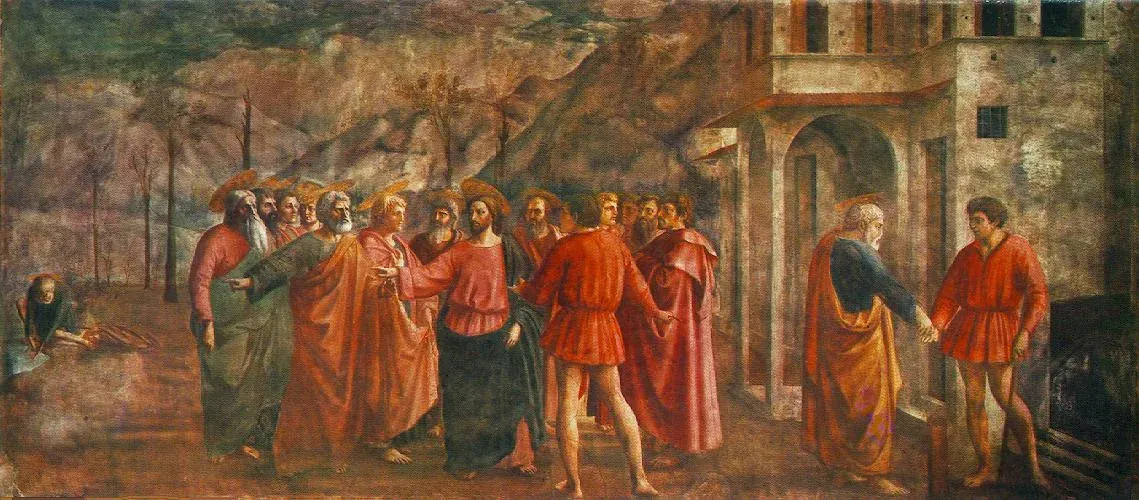
Masaccio, The Tribute Money (c. 1426–1427) · Brancacci Chapel, Santa Maria del Carmine, Florence · Public domain · Wikimedia Commons
Among the painters who adopted and used Brunelleschi's perspective, one textbook notes that Masaccio, active in Florence, was the first to use linear perspective techniques such as vanishing points in the frescoes of the Brancacci Chapel (Boundless, Art History ch. 19.04).
Around the same time, north of the Alps, an altarpiece made up of 26 panels was painted. It is the Ghent Altarpiece, painted by the Van Eyck brothers around 1432 (DOI: 10.1080/1051144x.2018.1532675; Boundless, Art History ch. 20.02). Oil painting is painting done with pigments mixed with oil. Jan van Eyck used a new technique for handling oil paints and transparent glazes (DOI: 10.1080/1051144x.2018.1532675). What Flemish painters put forward was this paint. They also experimented with oil paints earlier than Italian painters (Boundless, Art History ch. 20.02).
Tempera is paint made by mixing pigment with egg yolk. Italian painters traditionally used tempera (Boundless, Art History ch. 19.05). The Flemish painters who painted the Ghent Altarpiece relied on their region's Gothic past, dating to roughly the same period as Italy (Boundless, Art History ch. 20.02). During the same hunting season, the hunters of this forest chased different game.
In The Last Supper (1495–1498), painted on the dining hall wall of a Milanese monastery, Italian painter Leonardo da Vinci used tempera on a plaster ground instead of traditional mural painting on wet plaster, aiming for an effect like oil paint. The painting began to deteriorate almost immediately after completion (Boundless, Art History ch. 19.05).
Sfumato is a technique of painting without outlines, blending smoothly from light to dark like smoke. A scientific examination of Lady with an Ermine, dating from around 1489–1490, revealed that the areas transitioning from light to dark were created by overlapping thin glaze layers containing iron (DOI: 10.4000/11v45). The softness of this painting came from manual work building up thin layers one by one.
There is also the path by which the style moved from south to north. Albrecht Dürer, a painter and printmaker from Nuremberg, Germany, visited Italy in the late 15th and early 16th centuries, playing a part in bringing the Renaissance style north of the Alps (Boundless, Art History ch. 20.02). Unlike many Italian painters who turned to Greek and Roman subjects, northern painters developed landscape painting and genre painting depicting everyday life (Boundless, Art History ch. 20.01).
Music — Multiple Voices Together, Books Printed Part by Part
In 1501, Ottaviano Petrucci in Venice published the first book of sheet music printed with movable type (DOI: 10.1017/s0261127900000991). A voice is one of the melodic lines in a piece of music with several lines going together. Petrucci published many works as books for individual parts. Because there was a separate book for each voice, the singers held a book containing only their own part. Some precious books containing music for the Mass were produced in a choirbook layout dividing the parts across two facing pages, and scores aligning all the parts vertically on a single page were not printed until before the seventeenth century (DOI: 10.1353/sib.2007.0000). By the 1540s, printing technology had improved, and music printing established itself as a business centered in Venice (DOI: 10.1017/s0261127900000991).
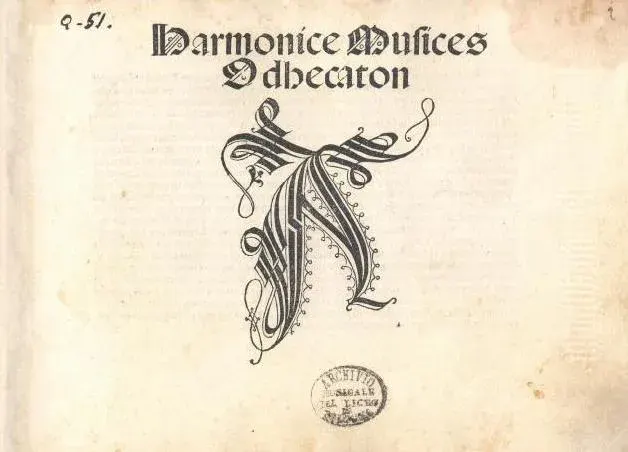
Ottaviano Petrucci, Harmonice Musices Odhecaton A (1501), title page · Museo internazionale e biblioteca della musica, Bologna · Public domain · Wikimedia Commons
What those books carried was the texture foregrounded by the music of this era. Polyphony is music in which several voices sing their own individual melodies at the same time. Medieval church polyphony was usually sung by just a few soloists. In the Renaissance church, entire male choirs divided up the voices (Clark et al., Understanding Music ch. 3.03).
Let us listen to the song "El Grillo" by Josquin des Prez. Originally from the region of modern-day Belgium, this composer worked in various Italian chapels and the Roman papal choir (Clark et al., Understanding Music ch. 3.03). This is a synthesized choral arrangement of the first twelve measures. Listen to how the four voices enter together from the first beat and move in nearly the same rhythm.
Clip: Josquin des Prez, "El Grillo," bars 1–12, four voices together (synthesized choir; score input Mutopia Project, public domain)
The four voices moved together like a single mass. The voices in polyphony sometimes weave across one another, but they also move together as in this passage.
In the church, whether the lyrics could be heard became a point of dispute. A Mass is a choral setting of the fixed prayers of the Catholic worship service. The Council of Catholic Church's Council of Trent took issue with excessive ornamentation in church music and the difficulty of understanding the Latin lyrics (Clark et al., Understanding Music ch. 3.03). The "Pope Marcellus Mass" by the Italian composer Giovanni Pierluigi da Palestrina is a work that embraced that recommendation, remaining polyphonic while making the words clearly audible (Clark et al., Understanding Music ch. 3.03).
Outside the church, the madrigal stood at the forefront. A madrigal is a song with several voices set to a short poem, sung by one person per voice. Beginning in Italy around 1520, this song delighted in translating the imagery of poetry into sound (Clark et al., Understanding Music ch. 3.02). This method, called word painting, depicts "ascending to heaven" with a rising melody and running with rapidly succeeding notes (Clark et al., Understanding Music ch. 3.06).
One study reads the madrigal as a genre that sought to imitate complex inner thoughts in sound, bringing various ways of painting emotion and desire through music into European music (DOI: 10.1525/california/9780520234932.001.0001).
This time, without the lyrics, let us listen simply to how the multiple voices pile up. This is a synthesized choral arrangement of the first eight measures of the five-voice madrigal "Solo e pensoso" by the Italian composer Luca Marenzio. The highest voice slowly ascends by half steps—one note per measure—while the other voices enter one by one after the first measure and move underneath.
Clip: Luca Marenzio, madrigal "Solo e pensoso," bars 1–8, the top voice rising by semitones (synthesized choir; score input Mutopia Project, CC BY-SA 3.0)
While the single top line climbed by half steps, the lower voices piled up one by one.
Literature — The Study of Reading Ancient Texts, and Poetry Written in One's Own Tongue
The hunt for literature began with scrolls. Petrarch, who poured himself into Greek and Roman scrolls, is called the "Father of Humanism" (Boundless, Art History ch. 19.01). Humanism encouraged both classical culture and writing composed in one's native tongue (Boundless, Art History ch. 19.04).
The sonnet is a short, fixed poetic form in Europe with a set number of lines and rhyme scheme. Petrarch's poetry collection the Canzoniere established the sonnet as the premier form for Renaissance love poetry and opened an international tradition of imitation that lasted until the mid-seventeenth century (DOI: 10.1002/9781118585184.ch18). The poem featuring the deer near the beginning is sonnet 190 of this collection. In this fourteen-line poem, the speaker sees a deer and drops everything to follow it, and words are inscribed on the deer's neck in diamonds and topazes. At the end, the speaker falls into the water and the deer vanishes.
" Nessun mi tocchi - al bel collo d’intorno scritto avea di diamanti et di topazi - : libera farmi al mio Cesare parve ".
"Let no one touch me — around her lovely neck was written in diamonds and topazes — : it pleased my Caesar to make me free."
— Francesco Petrarca, Canzoniere, Sonnet 190 (original · translated by Paperis)
The English poet and diplomat Thomas Wyatt (1503–1542) brought the sonnet into English while translating Petrarch's sonnets. His poems circulated in the court during his lifetime, and several first appeared in book form when they were included in Tottel's Miscellany in 1557, after his death (Robinson & Getty, British Literature I ch. 2.06). In Wyatt's "Whoso List to Hunt," the speaker is a hunter who has given up hunting the doe.
And graven with diamonds in letters plain There is written, her fair neck round about: Noli me tangere, for Caesar’s I am, And wild for to hold, though I seem tame.
— Thomas Wyatt, "Whoso List to Hunt"
Place the two poems side by side, and the doe, the words "Touch me not" inscribed with diamonds around its neck, and Caesar are in both. The deer in the two poems are separate from the guide deer of this article. Petrarch's Canzoniere made the sonnet the premier form of Renaissance love poetry, and the person who translated those sonnets and brought them into English was Wyatt in early sixteenth-century England (DOI: 10.1002/9781118585184.ch18; Robinson & Getty, British Literature I ch. 2.06).
The sonnet that crossed over to Britain grew independently there. One study suggests that the English sonnet tradition, stretching from Wyatt to the poet John Milton, stands out for extending into epic poetry and politics while fiercely expressing disillusionment with its own ambitions (DOI: 10.1002/9781118585184.ch18). During the reign of Queen Elizabeth I of England, the Petrarchan theme of loving a distant, powerful woman played out literally in the politics of the kingdom, and there is also an interpretation that the Queen herself recognized and used it (DOI: 10.1093/oso/9780192858368.001.0001). The sonnets of the English playwright and poet William Shakespeare (1564–1616) were published in 1609 (Robinson & Getty, British Literature I ch. 2.55). English humanism emphasized the education of courtiers and gentlemen while combining with Christianity, and literature written in English also grew, fueled by the study of the classics (Robinson & Getty, British Literature I ch. 2.01).
Same Name, Different Seasons
Even when given the same name, the timeframes differ. One art history textbook notes that the Renaissance began in the 14th century and remained the dominant style in Italy and most of Europe through the 16th century (Boundless, Art History ch. 19.01), whereas a music textbook dates the Renaissance in Western Europe from the late 1400s to the early 1600s (Clark et al., Understanding Music ch. 3.01).
The boundaries after the Renaissance are also drawn differently across fields. Mannerism is an artistic trend that emerged in 16th-century Italy after the High Renaissance, characterized by intentionally elongating or twisting the human body. In Italy, the Baroque is considered to have begun replacing Mannerism around 1580, but Mannerism in Northern Europe persisted into the early 17th century (Boundless, Art History ch. 19.05). One survey covering European music of this era groups the period from 1520 to 1640 together, while treating "Renaissance" and "Baroque" as separate concepts (DOI: 10.1515/9781846154645). The Italian composer Claudio Monteverdi is referred to as both a late Renaissance and an early Baroque composer (DOI: 10.1017/cbo9780511627279).
What crossed borders also varied by field. In art, Dürer played a part in carrying Italian styles northward, while in music, musicians from Flanders and the Low Countries often filled prominent musical posts in Italy (Clark et al., Understanding Music ch. 3.04). In art, what moved was a style; in music, what moved was people.
Later, the madrigal traveled north. Madrigals that spread outside Italy were mostly published in anthologies put together by editors, who translated texts and modified the music to suit northern audiences. This study reexamines the role played by Northern Europe in the history of the madrigal and its printing (DOI: 10.4324/9781315094687). In 1588, a collection of translated Italian madrigals appeared in London, followed by a madrigal boom in England that lasted for about thirty years (Clark et al., Understanding Music ch. 3.02).
In architecture, as we saw, even after Florence established the classical orders, Gothic influences lingered long in Venice, the medieval-derived Tudor style was used throughout the Tudor dynasty in England, and French theorists combined antiquity with their own Middle Ages. "Renaissance" is a single name attached to the back, but beneath that name, the four fields walked different paths in different seasons.
There were also similarities among the four fields. As we saw, contemporaries believed they were deliberately emulating antiquity in art and architecture, and humanism, which began in writing, spread into culture beyond texts to revive ancient artistic forms. A 2025 comparative study places Leonardo's Virgin of the Rocks side by side with Josquin's Ave Maria... virgo serena, arguing that painting techniques like sfumato and perspective and sonic techniques like polyphony converged on an ideal of "harmony within continuity" (DOI: 10.26650/cons2025-1686319). This is a comparison of a few selected pairs of works, and the researcher leaves extending this comparison to other eras and cultures as future work (DOI: 10.26650/cons2025-1686319). If we expand this resemblance into a single spirit uniformly pervading the entire era, we end up viewing an era like a paused painting—landing on the very criticism Burckhardt received.
The deer metaphor breaks down in three ways. First, not all hunters chased the same deer. The past that Flemish painters leaned on was the Gothic style of their own homeland. Second, the evidence in this article does not show what music revived from ancient Greece and Rome. What we saw in the music section was the texture of multiple voices and the printing that carried it. Third, hunting sounds like something done by a single person. Yet the dome was raised by the hands of an institution that reported public funds through ledgers, perspective grew upon medieval scholarship if the claims prioritizing optics are correct, and polyphony was sung together by multiple people dividing the voice parts.
Where to Read Next
The four arts of the immediately following era are covered in the same way in "Baroque — Four Clocks Running Under One Name".
How linear perspective calculated space within a picture is continued in "Perspective and Space — The One Footprint a Picture Is Calculated For", and whether painters actually used the perspective devices Dürer drew in his prints is explored in "Dürer — The Perspective Devices in His Prints: Did Painters Really Use Them?". One thing that happens in front of Leonardo's paintings is handled by "The Mona Lisa's Gaze — Eyes That Follow You Across the Gallery".
Why certain notes blend and others clash when multiple voices sound together can be seen in "Chords and Consonance — Teeth That Mesh, Teeth That Grind". How to read poems with rules of lines and sounds by ear, like the sonnet, is covered by "Rhythm in Poetry — Where the Breath Breaks on Its Own", and one common story tangled up with Shakespeare is handled by "Shakespeare — Was He the Man Who Knew the Most Words?".
Source Papers
- "The construction of Brunelleschi’s dome in Florence in the fifteenth century: between accountability and technologies of government" (2019) — DOI: 10.1080/21552851.2019.1686036 — Accounting and accountability practices of the Opera del Duomo—a "quasi-public" (formally private) institution entrusted with the dome construction from 1420 to 1436: public fund reporting, checks and balances, consensus-building through the participation of citizens and local trade guilds, and social responsibility toward workers.
- "“Equally unknown and unimaginable among the ancients”: Brunelleschi’s Dome and Alberti’s Lingua Toscana" (2011) — DOI: 10.5070/c321008940 — Reading Alberti’s Italian treatise On Painting (1436) and his dedicated letter to Brunelleschi within the context of language debates, suggesting that to speak of unprecedented painting, perspective, and domes required a new language, leading writers to establish a modern vernacular rather than restore ancient Latin.
- "The Renaissance of the Twelfth Century Before Haskins" (2006) — DOI: 10.1017/9781846154751.008 — Haskins’s The Renaissance of the Twelfth Century (1927) and its terminology debates (renewal, revolution, reform); Burckhardt’s 1860 book was also the culmination of a long-running discussion on the concept of the Renaissance.
- "‘A Centaur at the Edge of the Forest’: Jacob Burckhardt as Cultural Historian" (2022) — DOI: 10.5871/bacad/9780197267325.003.0003 — Burckhardt is counted as the father of modern cultural history, but he was not as radical as often thought, his static views have been widely criticized, and his anxieties about modernization explain both his conservatism and his innovativeness.
- "Renaissance Self-Fashioning after 44 Years: Hybridity, Conversos, Individuation, and littérature totale" (2024) — DOI: 10.1017/s0018246x24000499 — While parts of Burckhardt’s arguments have been discarded, research has continued upon his foundation, representing the trajectory of "early modern" identity studies.
- "“National” and “international” in the architecture of French Renaissance" (2020) — DOI: 10.7256/2454-0609.2020.4.32637 — Burckhardt depicted the Renaissance as a uniquely Italian phenomenon, whereas French theorists viewed antiquity as a shared past and synthesized it with their domestic medieval traditions.
- "The Cambridge Companion to Renaissance Humanism" (1996) — DOI: 10.1017/ccol0521430380 — Humanism began with the recovery, interpretation, and imitation of ancient Greek and Roman writings and the study of ancient artifacts, eventually becoming a cultural project touching nearly all of Renaissance intellectual life.
- "The Renaissance, 1350–1600" (2021) — DOI: 10.1201/9781003130000-4 — Florence’s construction was funded by trading profits, while most materials and practices were carried over from earlier eras; a sidebar in the chapter introduction presents Alberti as the first person to write about architecture since Vitruvius.
- "Introduction" (2019) — DOI: 10.1484/m.techne.5.117720 — Panofsky viewed Brunelleschi’s experiments in front of the Baptistery and the Palazzo Vecchio as the invention of linear perspective; recent scholarship in the history of perspective places its emergence deeper within the history of optics (arguing that medieval Franciscan optics constituted knowledge accessible to artisans), yet Panofsky's definition persists in research today.
- "Florence, 1425" (2024) — DOI: 10.4324/9781003466666-3 — Because detailed information on how Brunelleschi drew spatial recession is lacking, historians surmise his techniques, but the revolutionary nature of the experiment lies in opening up a repeatable structure where anyone could verify the same results.
- "Jan Van Eyck and the Ghent Altarpiece" (2018) — DOI: 10.1080/1051144x.2018.1532675 — The Van Eyck brothers' Ghent Altarpiece comprises 26 panels and employs new techniques handling oil paint and transparent glazes.
- "The Lady with an Ermine – Portrait of Cecilia Gallerani: Research into Leonardo da Vinci’s painting materials and techniques" (2024) — DOI: 10.4000/11v45 — Material analysis of the work from around 1489–1490 shows that tonal transitions were created via sfumato using thin layers of iron-based glaze.
- "Music-printing in late sixteenth- and early seventeenth-century Florence: Giorgio Marescotti, Cristofano Marescotti and Zanobi Pignoni" (1990) — DOI: 10.1017/s0261127900000991 — The first music printed with movable type was produced by Petrucci in 1501, and music printing became commercially established centered on Venice by the 1540s.
- "Bibliographical Aspects of Italian Printed Music of the Sixteenth and Seventeenth Centuries" (2003) — DOI: 10.1353/sib.2007.0000 — Petrucci (Venice, 1501) issued many works as separate books of individual voice parts, while certain precious books (especially settings of the Mass) were printed in choirbook layout; full-score printing did not exist before the 17th century.
- "European Music, 1520-1640" (2006) — DOI: 10.1515/9781846154645 — An introductory survey treating the 16th and early 17th centuries as the so-called "golden age of polyphony," discussing the concepts of the "Renaissance" and the "Baroque" separately.
- "Modal SubjectivitiesSelf-Fashioning in the Italian Madrigal" (2004) — DOI: 10.1525/california/9780520234932.001.0001 — An interpretation of the madrigal as a genre that attempted to imitate complex inner emotions through sound, introducing new ways of depicting feelings and desires into European music.
- "Editing Music in Early Modern Germany" (2017) — DOI: 10.4324/9781315094687 — Outside Italy, madrigals circulated primarily through anthologies compiled by editors, who translated texts and modified compositions to suit northern audiences, prompting a reassessment of northern Europe's importance in the history of the madrigal and its printing.
- "Monteverdi" (1994) — DOI: 10.1017/cbo9780511627279 — (Book introduction) Monteverdi was a composer of late Renaissance and early Baroque Italy.
- "Petrarchism and Its Counterdiscourses" (2018) — DOI: 10.1002/9781118585184.ch18 — The Canzoniere established the sonnet as the premier form of Renaissance love poetry and initiated an international tradition of imitation lasting until the mid-17th century, with the English branch—from Wyatt to Milton—notable for its expansion into epic and politics and for its disillusionment.
- "Petrarchan Love and the English Renaissance" (2022) — DOI: 10.1093/oso/9780192858368.001.0001 — Petrarchan love poetry in England from the early 16th century to 1621; during the Elizabethan reign, the theme of love for a distant, powerful woman played out literally in politics, and the queen recognized and utilized this dynamic.
- "Painting and Music: Renaissance Expressions of Harmony" (2025) — DOI: 10.26650/cons2025-1686319 — Comparing Leonardo’s Virgin of the Rocks with Josquin’s Ave Maria... virgo serena, interpreting sfumato, perspective, polyphony, and rhythmic structures as converging into "harmony within continuity."
- "Art History (Boundless) — 19.01 The Italian Renaissance" — Boundless, Art History ch. 19.01 — The term "Renaissance" was coined in the 19th century; contemporaries' self-awareness of imitating antiquity, the origins and spread of humanism, Petrarch, studia humanitatis, and the Renaissance period (14th–16th centuries).
- "Art History (Boundless) — 19.02 Renaissance Architecture" — Boundless, Art History ch. 19.02 — The structure of the Florence Cathedral dome (Gothic arches and ribs, influence of ancient Roman domes, red bricks), the conscious revival of symmetry and the classical orders, the column arrangement by story in the Palazzo Ruccelai, Alberti’s On Architecture, the S-shaped scrolls of Santa Maria Novella, the fusion of forms in the 16th century, and the persistence of Venetian Gothic.
- "Art History (Boundless) — 19.04 Renaissance Painting" — Boundless, Art History ch. 19.04 — Perspective was systematized by Brunelleschi and adopted by early 15th-century painters; Masaccio’s Brancacci frescoes (textbook descriptions citing them as the first use of linear perspective with vanishing points, etc.) and their related influences; humanism also encouraged writing in the vernacular.
- "Art History (Boundless) — 19.05 The High Renaissance" — Boundless, Art History ch. 19.05 — Italian painters' traditional tempera, the materials and damage of The Last Supper (1495–1498), and the displacement of the Renaissance by the Baroque in Italy beginning around 1580 (with Northern Mannerism lasting into the early 17th century).
- "Art History (Boundless) — 20.01 The Northern Renaissance" — Boundless, Art History ch. 20.01 — Humanism spread outside Italy after 1450, and Northern painters developed landscape and genre painting.
- "Art History (Boundless) — 20.02 Painting in the Northern Renaissance" — Boundless, Art History ch. 20.02 — The Flemish school emerged around the same time as the Italian but was influenced by its regional Gothic past, experimented with oil painting earlier than Italy, produced the Ghent Altarpiece around 1432, and Dürer played a role in introducing the Renaissance style north of the Alps.
- "Art History (Boundless) — 20.04 Architecture of the Northern Renaissance" — Boundless, Art History ch. 20.04 — Francis I brought Serlio; the Tudor style (1485–1603) represents the final development of medieval architecture, and while the Elizabethan style replaced it in fashionable homes, it persisted within English taste.
- "Understanding Music: Past and Present — 3.01 Introduction and Historical Context" — Clark et al., Understanding Music ch. 3.01 — The Renaissance means "rebirth," and the Western European Renaissance spans the late 1400s to the early 1600s.
- "Understanding Music: Past and Present — 3.02 Music of the Renaissance" — Clark et al., Understanding Music ch. 3.02 — The definition and beginning of the madrigal (Italy around 1520), the London translated anthologies of 1588, and the approximately 30-year English madrigal boom.
- "Understanding Music: Past and Present — 3.03 Worship Music" — Clark et al., Understanding Music ch. 3.03 — Josquin’s origins and career, the entire choir dividing up parts to sing (medieval church polyphony was usually performed by soloists), critiques of music at the Council of Trent, and Palestrina’s Pope Marcellus Mass.
- "Understanding Music: Past and Present — 3.04 Secular Music" — Clark et al., Understanding Music ch. 3.04 — Flanders and the Low Countries supplied musicians for major musical posts in Italy.
- "Understanding Music: Past and Present — 3.06 Glossary" — Clark et al., Understanding Music ch. 3.06 — Definition and examples of word painting.
- "British Literature I — 2.01 Introduction" — Robinson & Getty, British Literature I ch. 2.01 — English humanism emphasized the education of courtiers and gentlemen while combining with Christianity, and classical studies stimulated vernacular literature.
- "British Literature I — 2.06 Thomas Wyatt" — Robinson & Getty, British Literature I ch. 2.06 — Wyatt (1503–1542) introduced the sonnet into English through translations of Petrarch sonnets, and his poems circulated in court before several were printed for the first time in Tottel's Miscellany in 1557.
- "British Literature I — 2.26 Edmund Spenser" — Robinson & Getty, British Literature I ch. 2.26 — Petrarch’s birth and death dates (1304–1374).
- "British Literature I — 2.55 William Shakespeare" — Robinson & Getty, British Literature I ch. 2.55 — Shakespeare (1564–1616), sonnets published in 1609.
Sources (37)
- The construction of Brunelleschi’s dome in Florence in the fifteenth century: between accountability and technologies of governmentDOI 10.1080/21552851.2019.1686036
- Equally unknown and unimaginable among the ancientsDOI 10.5070/c321008940
- The Renaissance of the Twelfth Century Before HaskinsDOI 10.1017/9781846154751.008
- ‘A Centaur at the Edge of the Forest’: Jacob Burckhardt as Cultural HistorianDOI 10.5871/bacad/9780197267325.003.0003
- Renaissance Self-Fashioning after 44 Years: Hybridity, Conversos, Individuation, and littérature totaleDOI 10.1017/s0018246x24000499
- NationalDOI 10.7256/2454-0609.2020.4.32637
- The Cambridge Companion to Renaissance HumanismDOI 10.1017/ccol0521430380
- The Renaissance, 1350–1600DOI 10.1201/9781003130000-4
- IntroductionDOI 10.1484/m.techne.5.117720
- Florence, 1425DOI 10.4324/9781003466666-3
- Jan Van Eyck and the Ghent AltarpieceDOI 10.1080/1051144x.2018.1532675
- The Lady with an Ermine – Portrait of Cecilia Gallerani: Research into Leonardo da Vinci’s painting materials and techniquesDOI 10.4000/11v45
- Music-printing in late sixteenth- and early seventeenth-century Florence: Giorgio Marescotti, Cristofano Marescotti and Zanobi PignoniDOI 10.1017/s0261127900000991
- Bibliographical Aspects of Italian Printed Music of the Sixteenth and Seventeenth CenturiesDOI 10.1353/sib.2007.0000
- European Music, 1520-1640DOI 10.1515/9781846154645
- Modal SubjectivitiesSelf-Fashioning in the Italian MadrigalDOI 10.1525/california/9780520234932.001.0001
- Editing Music in Early Modern GermanyDOI 10.4324/9781315094687
- MonteverdiDOI 10.1017/cbo9780511627279
- Petrarchism and Its CounterdiscoursesDOI 10.1002/9781118585184.ch18
- Petrarchan Love and the English RenaissanceDOI 10.1093/oso/9780192858368.001.0001
- Painting and Music: Renaissance Expressions of HarmonyDOI 10.26650/cons2025-1686319
- Art History (Boundless) — 19.01 The Italian Renaissance
- Art History (Boundless) — 19.02 Renaissance Architecture
- Art History (Boundless) — 19.04 Renaissance Painting
- Art History (Boundless) — 19.05 The High Renaissance
- Art History (Boundless) — 20.01 The Northern Renaissance
- Art History (Boundless) — 20.02 Painting in the Northern Renaissance
- Art History (Boundless) — 20.04 Architecture of the Northern Renaissance
- Understanding Music: Past and Present — 3.01 Introduction and Historical Context
- Understanding Music: Past and Present — 3.02 Music of the Renaissance
- Understanding Music: Past and Present — 3.03 Worship Music
- Understanding Music: Past and Present — 3.04 Secular Music
- Understanding Music: Past and Present — 3.06 Glossary
- British Literature I — 2.01 Introduction
- British Literature I — 2.06 Thomas Wyatt
- British Literature I — 2.26 Edmund Spenser
- British Literature I — 2.55 William Shakespeare