Paperis Articles
Baroque — Four Clocks Running Under One Name
What architecture, painting, music and literature in Europe each brought to the fore from roughly 1600 to 1750, and the single name later generations gave them
Your field's papers, as audio
Pick your fields and journals — Paperis summarizes the key papers and turns them into audio. Listen on your commute.
Start Paperis free →Baroque — Four Clocks Running Under One Name
Around 1650, a Chapel in Rome
On a street corner in Rome stands the church of Santa Maria della Vittoria. The rear and right side are wedged between neighboring buildings, and the left flank visible from the street is a bare wall with only a single window. Seen from the outside, it is uncommonly plain for a Roman church of the early seventeenth century (DOI: 10.1353/com.2015.0019).
Step inside, stand before the chapel at the end of the left transept, and the story changes. The marble sculpture created for this Cornaro Chapel by the Italian sculptor and architect Gian Lorenzo Bernini between 1647 and 1652 occupies the altar space. The central figure is the Spanish mystic, Saint Teresa of Ávila (DOI: 10.1353/com.2015.0019). Teresa confessed in her writings about her spiritual ecstasy that the body takes part in it too, and quite substantially at that, which is why this sculpture is often called the most sensual of Bernini's works. Yet one study notes that this chapel is constructed like a theatrical performance, complete with onlookers and witnesses. Read that way, the saint loses her consciousness not because her senses overflow, but because her senses vanish, according to that study (DOI: 10.5456/issn.2050-3679/2015w08).
Around the same time, the English poet Richard Crashaw also wrote poems about the same saint (DOI: 10.1353/sel.2019.0006). A carved sculpture in stone and a poem written in English thus sought to capture the very same moment of a saint's ecstasy.
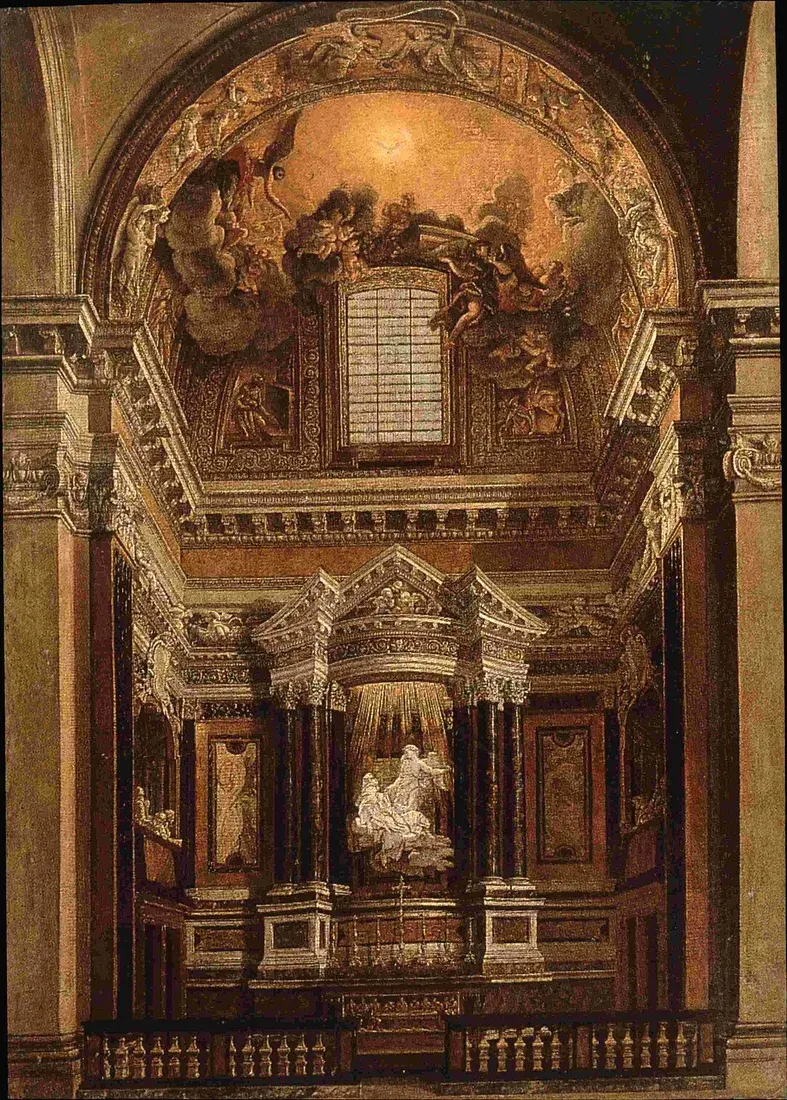
Anonymous, The Cornaro Chapel in Santa Maria della Vittoria (c. 1650) · Archive of the Academy of Sciences, Turin · Public domain · Wikimedia Commons
This article looks at the architecture, art, music, and literature of Europe from roughly 1600 to around 1750 all in one place. It does not cover the art of Latin America or Asia from the same period. This span of a little over 150 years is commonly bound together by a single name. It is the name found in the title of this article. It is helpful to picture four clocks hanging side by side on a wall. There is a single label, but when the hands began to turn and when they stopped differs for each clock. After looking at the four fields in turn, we will place the four clocks side by side at the end.
A Name Tag Attached Late
The word "Baroque" first appeared in music criticism in 1730s France. Several writers used the term for the music of French composer Jean-Philippe Rameau, complaining that it was overly ornate, bizarre, and filled with too many grating sounds (DOI: 10.1007/978-1-349-11303-3_1). Today's meaning is different. The Baroque is a name that points to European art from roughly 1600 to around 1750, or the artistic style that stood out during that time. From an insult to the name of an era, the word has passed through several layers.
In 1768, the thinker Jean-Jacques Rousseau even included a definition of the word in his music dictionary published in Paris. He described Baroque music as a style where harmony is cluttered, keys shift constantly, grating sounds abound, melodies are harsh and unnatural, the notes are hard to catch, and the flow is forced (DOI: 10.1007/978-1-349-11303-3_1). In music criticism, the word was an insult from the start.
The word itself existed earlier, and its root is unclear. Some books point to the Portuguese word barroco, which referred to pearls of irregular shape (DOI: 10.1007/978-1-349-11303-3_1), while others note that the Spanish word barrueco, which points to the same pearl, is the conventional explanation, adding that the theories chosen for its root keep growing. The meanings carried by those theories mostly disparaged things that strayed from classical reason and restraint, such as distortion, bizarreness, excessive ornament, and bad taste (DOI: 10.1017/9789048551118.002). One music textbook introduces the pearl theory together with a view that sees the Italian word barocco, once used by medieval philosophers to denote something that deviates from schematic logic, as a more fundamental root (Clark et al., Understanding Music ch. 4.01).
It became the name of an era much later. There is an explanation that art criticism first used the word as a name for the period from 1600 to around 1750 in the early 19th century, with music history following behind (DOI: 10.1007/978-1-349-11303-3_1). Now it is used to denote a period as well as a style, and is even applied to colors, clothing, and ice cream (DOI: 10.1017/9789048551118.002).
One music textbook records it differently. In the art world, the word pointed to the bizarre until 1888, the year Heinrich Wölfflin used it as the name of a style for the first time (Clark et al., Understanding Music ch. 4.01). The points in time chosen by the two explanations differ. Wölfflin, one of the founders of modern art history, was also among the first to argue that the Baroque should not be lumped together with bad taste or decay. In his 1888 book Renaissance and Baroque, he proposed viewing the Baroque not as the tail end of the Renaissance, but as a style to be studied on its own terms. His explanation was that the Baroque did not come with theory and rules the way the Renaissance did, and so it failed to gain a name during its own time. Before "Baroque" took hold, words like "the new style," "capricious," and "bizarre" filled that empty space (DOI: 10.1353/boc.2013.0003). In his 1915 book, Wölfflin compared paintings of the Renaissance and the Baroque through five pairs of opposing concepts, such as "the linear and the painterly" (DOI: 10.1111/jaac.12160).
To use a clock as an analogy, the name tag was written on the wall by later generations after the clock had already run its course, and that writing was for a time an insult.
Architecture — Curved Walls, Decorated Plazas
Bernini’s hand also reached beyond the chapel to open spaces in the city. The square in front of Saint Peter’s Basilica in the Vatican is his design. Colonnades with rows of pillars on both sides of the plaza curve around in a circle, and an obelisk, a stone pillar from Egypt, stands right in the middle, embraced by the two colonnades (Boundless, Art History ch. 21.02). Anyone who walks in finds themselves standing inside a wide courtyard surrounded by pillars even before reaching the doors of the basilica. One textbook notes in praise that this square serves as a model of a Baroque theatrical stage (Boundless, Art History ch. 21.02). Here, even the open space in front of the building belonged to the design.
At San Carlo alle Quattro Fontane, a church in the same city of Rome, the walls do not stay still. They bulge outward and then grow hollow inward in a repeating rhythm. This is because the floor plan was woven by overlapping an ellipse and a cross. The designer was the Italian architect Francesco Borromini, Bernini’s rival (Boundless, Art History ch. 21.02). A comparative study points out that while Renaissance architecture expressed reason and order through symmetry, balance, and classical geometry, Baroque architecture put emotion and grandeur first through movement and theatrical effects. The two buildings that study sets against each other are the Florence Cathedral and this very San Carlo (DOI: 10.11648/j.ijaaa.20251103.13).
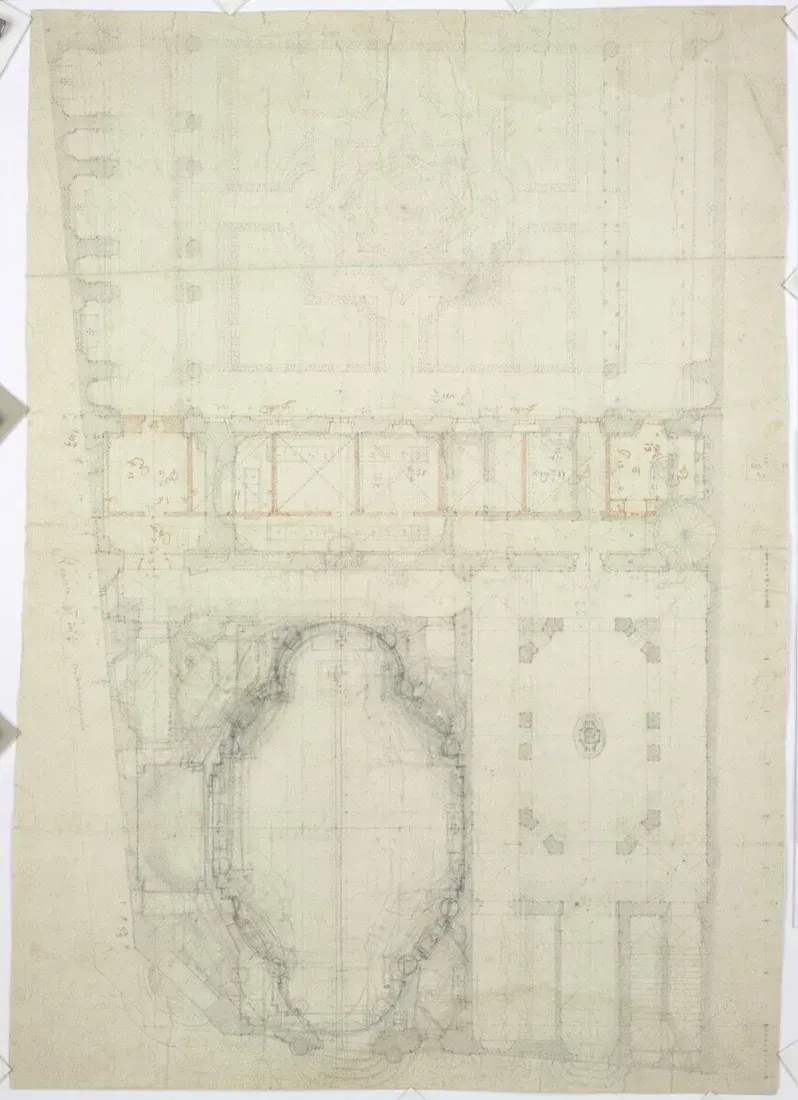
Francesco Borromini, plan drawing for San Carlo alle Quattro Fontane (1634–1638) · Albertina, Vienna · Public domain · Wikimedia Commons
The two rivals did not produce a single answer. Bernini’s Sant'Andrea al Quirinale and Borromini’s San Carlo became opposing models, and architects in northern Italy, France, England, the German-speaking lands, and Bohemia took up the two in different ways (DOI: 10.6093/2532-2699/13685). Even in the same city and the same generation, Baroque architecture did not take just one form.
The circumstances of the church are often cited as the background for why Roman churches put so much effort into this. The Counter-Reformation was a movement in the mid-sixteenth century where the Catholic Church sought to mend itself and reaffirm its faith in opposition to the Protestant Reformation. It is also called the "Catholic Reform" (DOI: 10.1080/10286632.2010.544727). One textbook sets its period from 1545, when the Catholic Church's council began meeting in Trent, northern Italy, to 1648, when the Thirty Years' War ended (Boundless, Art History ch. 21.01). The architecture chapter of the same textbook records that Baroque architecture was "at least initially" directly connected to this movement, and also notes that it was frequently used to project the triumphs of the Catholic Church and absolute monarchies (Boundless, Art History ch. 21.02).
The story of the royal court continues in Paris. When the French king Louis XIV repeatedly requested work from Bernini, Bernini traveled to Paris in 1665, stayed for several months, and produced a design proposal for the east facade of the Louvre Palace. That proposal was ultimately not adopted (Boundless, Art History ch. 21.03). An analysis suggests that Louis XIV’s Palace of Versailles started out as a theatrical type of architecture that dressed up royal power like a myth, and then shifted toward private living quarters in the decades leading up to the revolution through Rococo (DOI: 10.51461/issn.2309-3072/78.2241). What stands out newly in architecture are curved walls and plazas designed to include the open ground in front of the building. The patrons of those projects were both the church in Rome and the king in Paris.
Art — Light Gathered in a Few Places Within the Dark
In the paintings of Italian artist Michelangelo Merisi da Caravaggio, the background sinks into darkness while figures emerge with only parts of their bodies catching the light (Boundless, Art History ch. 21.04). The technique underlying this is older. Chiaroscuro is a technique that uses strong contrasts between light and dark to render forms and illumination. It was already widely used during the Renaissance (Boundless, Art History ch. 21.01). Caravaggio pushed that contrast to its limit, surrendering most of the picture plane to darkness. Tenebrism is an extreme form of chiaroscuro in which dramatic light is gathered in a few spots within the darkness, pushing light and dark to extremes. Caravaggio's paintings are cited as the prime example of this (Boundless, Art History ch. 21.04).
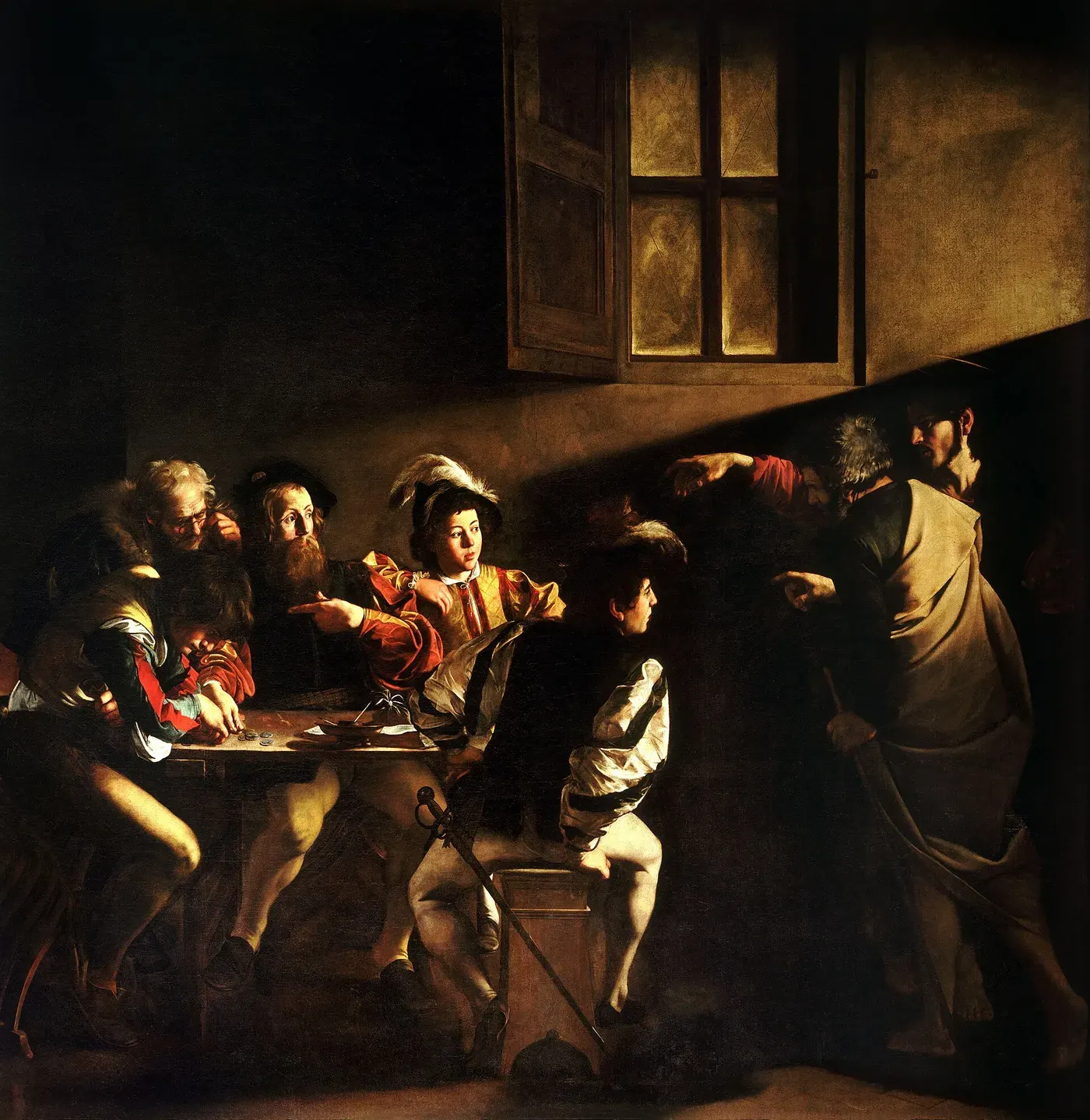
Caravaggio, The Calling of Saint Matthew (1599–1600) · Contarelli Chapel, San Luigi dei Francesi, Rome · Public domain · Wikimedia Commons
Many painters followed this approach, and they are called the "Caravaggisti" (Boundless, Art History ch. 21.04). Dutch painters from Utrecht who had visited Italy also joined that group, and one textbook notes that Rembrandt's chiaroscuro likely came through these Dutch followers (Boundless, Art History ch. 21.05). Light in the dark traveled from Rome northward.
The church also wanted something from painting. In northern Europe, Protestant reformers smashed church sculptures and paintings, calling them idols, while the Catholic Church reasserted the value of images (DOI: 10.1111/1467-8365.12305). The final session of the Council of Trent in 1563 ruled that images inside churches were permitted to be used to teach believers and reinforce their faith. Guidelines also followed: avoiding nudity, steering clear of ambiguous meanings, and painting biblical stories simply as they were handed down (DOI: 10.1353/cat.2005.0082). The idea that paintings should even sway the emotions of believers was what the Counter-Reformation expected of art (DOI: 10.1080/10286632.2010.544727).
However, it is difficult to explain strong chiaroscuro by this single decision alone. Some research suggests that chiaroscuro as a device to stir emotion had already begun with Leonardo da Vinci in Milan at the end of the 15th century, more than half a century before the council (DOI: 10.3390/arts13020068). Other research notes that it remains an open question how much the council's decisions were actually accepted in European society and how much they influenced the flourishing of 17th-century religious art (DOI: 10.31802/pwg.2023.10.2.003).
Turning our gaze to sculpture, the chapel from the beginning appears again. When this chapel, commissioned in 1647 by the Venetian cardinal Federico Cornaro, was unveiled in the summer of 1652, Roman public opinion praised this arrangement—which wove sculpture, painting, and architecture together like a theater—with the same high regard as the patron. The sculpture of Teresa is placed at the very center of that arrangement (DOI: 10.1353/com.2015.0019). Weaving sculpture into oneness with architecture was not uncommon in sculpture of this period (Boundless, Art History ch. 21.03). Photographs that isolate just the sculpture fail to reveal that weaving.
Around the same time, in the Dutch Republic to the north, the number of painters grew and the art market expanded rapidly. A network study that connected painters by shared subjects concludes that what a painter painted depended less on friendships with other painters or the neighborhood they lived in than on market forces, personal skill and ambition, and selling strategies (DOI: 10.51750/emlc11334). Dutch paintings of this period belong to the Baroque chronologically and often display its features, but one textbook writes that most of them lack idealization or grandiosity (Boundless, Art History ch. 21.05). In art, what came to the fore was the light gathered in a few spots within the darkness, which Caravaggio had pushed to the limit; and in the north during the same period, paintings that received that light while scaling back embellishments grew alongside the market.
Music — The Low Line That Sustains to the End
Around 1600 in Italy, a stage emerged where an entire drama was driven by song. At its starting point lay a single mistaken assumption. That assumption was that ancient Greek tragedies were sung from start to finish, and thus moved their audiences. Today, we understand that the sections sung in ancient drama were limited to the chorus. Those who held this assumption were the Florentine Camerata, a circle of scholars and nobles in Florence (Clark et al., Understanding Music ch. 4.03). Opera is a drama in which actors sing even their lines and perform on stage to the accompaniment of instruments.
If you open the accompaniment section in the score of this new stage, you will not find much written. At the very bottom lies a single line of low notes, with numbers attached beneath those notes. These numbers are markings that indicate what chords to build above those low notes (Clark et al., Understanding Music ch. 4.03). Basso continuo is an accompaniment where the performer looks at a single line of low notes written in the score and the numbers beneath them, filling in chords from the beginning of the piece to the end to support a song or melodic instrument. The family of instruments responsible for this accompaniment included instruments such as the harpsichord, lute, and cello (Clark et al., Understanding Music ch. 4.02). Because the chords were not fully written out as notes, even with the same score, the way performers built the chords could vary (Clark et al., Understanding Music ch. 4.03). In passages sung as if speaking, the tempo also rested with the singer. Such passages were taken at a flexible tempo and performed to a simple accompaniment, which was usually handled by the basso continuo (Clark et al., Understanding Music ch. 4.08). Textbooks note that as the singer slowed or pushed the tempo following the lyrics and emotions, the accompaniment followed behind (Clark et al., Understanding Music ch. 4.03). Basso continuo was used not only in opera but also in concertos and chamber music (Clark et al., Understanding Music ch. 4.02), and one textbook names it as a defining characteristic of Baroque music (Clark et al., Understanding Music ch. 4.03).
Starting around 1600, pieces written specifically for instruments also increased dramatically (Clark et al., Understanding Music ch. 4.04).
The tail end of this era is crowned by two composers born in German lands in the same year, 1685 (Clark et al., Understanding Music ch. 4.05). Johann Sebastian Bach wrote extensively for the Lutheran Church (Clark et al., Understanding Music ch. 4.01), and under a prince who loved instrumental music, he poured out keyboard works and concertos (Clark et al., Understanding Music ch. 4.06). Before listening to one of his keyboard pieces, we establish three terms. A voice is a single line of melody among several lines moving together in music. A single soprano line and a single bass line in a choir each constitute one voice. Counterpoint is a compositional technique of weaving multiple independent voice lines to sound simultaneously while interlocking them so they harmonize with one another. A fugue is a contrapuntal piece constructed by having multiple voices take up and enter in turn with a single short melody. Below is the sound of the first six measures of the first fugue from Bach's The Well-Tempered Clavier, rendered with a synthesized piano. You can count the spots where the voices enter one by one.
Clip: Bach, Well-Tempered Clavier I, Fugue in C, BWV 846, bars 1–6, voices entering one by one (synthesized piano; score input Mutopia Project, public domain)
The upper voice enters on the third beat of the second measure, the lower voice in the fourth measure, and the lowest voice on the third beat of the fifth measure, interlocking four lines of melody. Each line walks its own path.
George Frideric Handel moved from staging Italian operas in London to English oratorios. This followed a wave of popularity for new operas sung in English in London in 1728 (Clark et al., Understanding Music ch. 4.05). An oratorio is a large-scale vocal work that tells a story, such as one from the Bible, through soloists, chorus, and orchestra, but is presented like a concert without stage acting or costumes. Below is a synthesized orchestral and choral sound of the first eight measures of the "Hallelujah" chorus from his 1741 oratorio Messiah. The lyrics are not audible.
Clip: Handel, Messiah, HWV 56, “Hallelujah” chorus, bars 1–8 (synthesized orchestra and choir; score input Mutopia Project, public domain)
The first three measures sound with orchestra alone, and in the fourth measure, all four choral voices enter at once to repeat a short phrase in harmony. In the fugue, the voices entered separately one by one; here, they entered together. Because both clips are a solo keyboard piece and a synthesized chorus, basso continuo is not included. What arose anew in music is opera, a drama driven by song, and basso continuo, the low line that sustains it from beneath to the very end.
Literature — Words That Stitch Together What Lies Far Apart
In seventeenth-century England, writers commonly grouped as "the Metaphysical poets"—such as John Donne and Richard Crashaw, who wrote a poem on Teresa at the start—were active. A conceit is a figure of speech that forces together two widely separated subjects to startle the listener. These poets were known for their skill in using striking conceits to place seemingly incompatible domains of meaning side by side, making them strike the senses sharply. Crashaw was counted among the wittiest poets even by those who belittled him (DOI: 10.1353/elh.2004.0030). Donne's poetry brings the soul and the body, the holy and the fleshly, into the same space (DOI: 10.55804/jtsu-2960-9461-2023-10).
Around the same time in Spain, there were two sharp rivals: the poet Luis de Góngora and the poet and writer Francisco de Quevedo. Quevedo was a nobleman famous for his biting satire, and Góngora stood out at the top of his list of rivals. The two men are called representatives of different currents. Culteranismo is a current in seventeenth-century Spanish poetry that piles up rhetorical expression and ornamentation to excess. Góngora is considered its master. Conceptismo is a current in seventeenth-century Spanish literature that puts conceits—that is, the pairing of clever ideas and wordplay—first. Quevedo takes that side (DOI: 10.1017/9781800106468.007).
There is also the view that sees the two currents as springing from a single root. A 1987 paper notes that it is now widely accepted in criticism to view conceptismo as the foundation of almost all Spanish Baroque literature and culteranismo as a branch within it. According to that paper, what the Baroque prized above all was the sharpness of wit (DOI: 10.5209/rev_rfrm.1987.n5.13933).
On the stage, Life Is a Dream by the Spanish playwright Pedro Calderón de la Barca represents this period. The protagonist Segismundo is locked away and raised from birth because of a prophecy that he will become a tyrant. Brought to court briefly, he is told that the experience was a dream, and begins to ask what is real and what is an illusion (DOI: 10.57067/kr.spl.vol.1.i04/950). In Act 2, Scene 19, Segismundo, left alone on stage, says that both the rich and the poor dream of what they are, and concludes with these lines:
¿Qué es la vida? — Un frenesí. ¿Qué es la vida? — Una ilusión, Una sombra, una ficción, Y el mayor bien es pequeño: Que toda la vida es sueño, Y los sueños sueño son.
What is life? A frenzy. What is life? An illusion, a shadow, a fiction, and the greatest good is small: for all of life is a dream, and dreams are only dreams.
— Pedro Calderón de la Barca, Life Is a Dream, Act 2, Scene 19 (original · translated by Paperis)
The six lines ask the same question twice, building the answer by changing it to a frenzy, an illusion, a shadow, and a fiction. One study reads that while this play depicts life as fleeting and uncertain like a dream, it asserts that even in a world where reality seems uncertain, a person bears ethical responsibility for their actions (DOI: 10.57067/kr.spl.vol.1.i04/950). With seventy editions known by 1800, this play was the most printed dramatic work of its era. The German thinker Walter Benjamin, who delved deeply into Baroque tragedy, saw this play as the consummate form of Baroque tragedy. On the other side, the French Enlightenment thinker Voltaire disparaged Calderón's entire output as a "dung heap" of barbarism and nonsense; and while he did not single out this play, those who followed him chose and targeted it directly. Life Is a Dream has thus been cited simultaneously as the peak of Baroque theater and as containing all the faults of the Baroque (DOI: 10.1017/9781800103597.005). In literature, the skill that brought poets renown was the metaphor stitching together things far apart, and upon the stage, the boundary between dream and waking was shaken.
Same Era, Different Clocks
The dates textbooks give differ from field to field. Architecture is seen as starting in Rome in the late 16th century (Boundless, Art History ch. 21.02), while the style as a whole is viewed as beginning around 1600 in Rome and spreading to most of Europe (Boundless, Art History ch. 21.01). The peak of Roman painting is placed from 1623 to 1667 (Boundless, Art History ch. 21.04). In music, the division of roughly 1600 to 1750 is widely used (Clark et al., Understanding Music ch. 4.01), and the term "Baroque" was first applied to music at its tail end in the 1730s (DOI: 10.1007/978-1-349-11303-3_1). From 1648, which one textbook sets as the end of the Counter-Reformation, to around 1750, when the musical Baroque ends, is a little over 100 years.
Even within the same field, the hands of the clock diverge. Louis XIV's France pushed a classical style through the royal art academy (Boundless, Art History ch. 21.04), whereas Dutch painting pared down the grandiosity.
Periodization is the work of taking history as it flows continuously, cutting it into several pieces from behind, and giving each piece a name. The years 1600 and 1750 are conventional boundaries drawn in that way, and the four fields did not all chime or stop together in any single year.
As for the clock of literature, people even dispute whether to use this name at all. In Anglophone academia, "Baroque" is a term that easily connects with music, art, and architecture, but less so with literature—especially writing in English—and "English Baroque" has long been an unfamiliar concept in the tradition of English literary history (DOI: 10.1017/9789048551118.002). Scholars have also clashed over whether to view Góngora as a Baroque poet or as a poet standing between that period and the one before it (DOI: 10.1017/9781846155888.001). One world literature textbook opens a chapter collecting the literature of this time under the name "the Age of Reason," and calls 1660 to 1800 "the long eighteenth century." It adds that the same period can also be called the Age of Enlightenment or the Neoclassical Age (Turlington et al., Compact Anthology of World Literature 4–6 ch. 1.01). Thus, writing from the overlapping stretch between 1660 and around 1750 is grouped as Baroque in some books and as the Age of Reason in others. The hands of the four clocks did not turn at the same time.
Then what is it that binds the four fields together? There are those who speak of resemblance. One art textbook lists the production of dramatic effects through exaggerated movement as a characteristic of the Baroque style, and notes that it spans not only painting and architecture but also literature and music (Boundless, Art History ch. 21.01). A 1971 study states that it is an intellectual history study dealing with "the spirit of an age," and argues that there is a concept of "expression" common to the various arts of the Baroque era, which connects to the medicine and philosophy of the time. This argument was made by citing period texts rather than analyzing artworks (DOI: 10.2307/2737918). One paper comparing several poems by Donne to Baroque paintings and sculpture suggests that painters, sculptors, and poets created works embodying the same values even while separated from one another (DOI: 10.55804/jtsu-2960-9461-2023-10).
There are also those who argue that people are divided even on what to tie them together with. The concept of the Baroque has a reputation for being notoriously difficult to define or, conversely, too easy, and scholars are split between those who view it as a period of history and those who view it as a stylistic habit that recurs across eras (DOI: 10.1017/9789048551118.002). The Spanish historian José Antonio Maravall grouped them not by style, but by social fabric, viewing culture—including theater—as a conservative response that propped up power in a 17th-century society plunged into crisis (DOI: 10.1353/boc.2013.0003). There are also scholars who have regarded the Baroque as inseparable from the Counter-Reformation (DOI: 10.1017/9789048551118.002). Facts that do not entirely fit into that framework have also appeared in this article. Bach wrote music for the Lutheran Church, and most Dutch painting, while frequently displaying Baroque characteristics, lacked idealization and grandeur.
Although the name Baroque is singular, the span and meaning that name covers in the four fields are not the same. Resemblance is what a single textbook and a few studies claim. The dates recorded by textbooks mostly overlap around the neighborhood of 1600, and what diverges greatly across fields is what that period is called—in other words, the name. That Teresa from the opening appeared together in Bernini's stone and Crashaw's poem is a fact of two arts sharing the same subject. Whether the two were born of a single spirit remains a matter of dispute.
Where to Read Further
How light in the dark was used in the north continues in "Rembrandt's Night Watch — A Map of Paint, Drawn Inside a Glass Room" and "Rembrandt — Did Eyes That Look Misaligned See a Flatter World?". The different light of the Netherlands during the same period is covered by "Vermeer — The Question in a Bead of Light" and "Girl with a Pearl Earring — Light Built in Layers, a Name Not Asked". How light and shadow are read by the eye leads into "Light and Shadow — One Apple, and an Eye That Guesses First".
Two composers from the tail end of this era meet separately in "Bach — Music Written by Mathematics, or Music That Mathematics Can Measure?" and "Handel — As His Sight Failed, What Did the Records Keep?". How chords and major and minor keys sound to the ear are addressed in "Chords and Consonance — Teeth That Mesh, Teeth That Grind" and "Major and Minor — When the Third Drops a Half Step".
Metaphor itself, the foundation of the conceit, continues in "Figures and Images — The Old Vow, Firm and Shining Like a Flower of Gold". Writing used on the English stage a generation before Calderón is covered by "Shakespeare — Was He the Man Who Knew the Most Words?" and "Hamlet — Is That the Question, or Is Here the Point?".
Source Papers
- "The Sculptural Iconography of Feminine Jouissance: Lacan's Reading of Bernini's Saint Teresa in Ecstasy" (2015) — DOI: 10.1353/com.2015.0019 — Santa Maria della Vittoria stands tucked into a street corner with a plain left flank featuring just a single window, making it look modest from the outside. The chapel commissioned by Cardinal Cornaro in 1647 honored the Spanish mystic Teresa of Ávila, and when it was unveiled in 1652, Roman public opinion praised its composition, which wove together sculpture, painting, and architecture like a theatrical performance (from the introduction of a paper discussing Lacan's reading of Teresa).
- "Alienata da' sensi: reframing Bernini's S. Teresa" (2015) — DOI: 10.5456/issn.2050-3679/2015w08 — Suggests that while Bernini's Teresa in the Cornaro Chapel (1647–52) is read as a deeply sensual work and Teresa herself wrote that the body plays a part in the rapture, when viewed in the context of a "performance" staged with spectators and witnesses, the saint's swoon is closer to an absence of the senses than an overflow of them.
- "Reading Rapture: Richard Crashaw's Saint Teresa" (2019) — DOI: 10.1353/sel.2019.0006 — Compares Richard Crashaw's poems on Saint Teresa, written around the same time as Bernini's sculpture, with Lacan's reading, suggesting that the history of reading rapture is far from over.
- "Music and Society in the Late Baroque Era" (1993) — DOI: 10.1007/978-1-349-11303-3_1 — From the early nineteenth century onward, art criticism and subsequently music history used the name for the period around 1600–1750. The term was first applied to music in the 1730s as a derogatory label in criticisms of Rameau, and the word itself is thought to derive from the Portuguese barroco (misshapen pearl), as defined in Rousseau's 1768 dictionary.
- "The Labyrinthine Baroque" (2020) — DOI: 10.1017/9789048551118.002 — The Baroque is notoriously difficult or too easy to define, encompassing two meanings: a period and a style. In Anglo-American academia, it connects less with literature, "English Baroque" remains an unfamiliar concept, its origin is unclear (with the Spanish word barrueco as the conventional explanation), and theories are split between a historical period versus a recurring style, with some scholars considering it inseparable from the Counter-Reformation.
- "Con-textos de José Antonio Maravall y su Estructura Histórica del Barroco" (2013) — DOI: 10.1353/boc.2013.0003 — Maravall read the Baroque as a conservative response and cultural structure that propped up power in a society in crisis. Wölfflin viewed the Baroque in 1888 not as a decline but as an independent style, explaining that it lacked theoretical rules and thus failed to gain a name in its own time.
- "Two-Dimensional Versus Three-Dimensional Pictorial Organization: Symposium The 100th Anniversary of Wölfflin's Principles of Art History" (2015) — DOI: 10.1111/jaac.12160 — Re-examines the five pairs of concepts in Wölfflin's Principles of Art History (1915) (such as the linear and the painterly) as tools for describing pictorial composition.
- "Art History (Boundless) — 21.01 The Baroque Period" — Boundless, Art History ch. 21.01 — The Baroque was a style that began in Rome around 1600 and spread to most of Europe, featuring exaggerated movement and dramatic effects as characteristics spanning multiple arts. Chiaroscuro was a technique widely used during the Renaissance, and the period aligns with the Counter-Reformation and the Council of Trent in northern Italy.
- "Art History (Boundless) — 21.02 Architecture of the Baroque Period" — Boundless, Art History ch. 21.02 — Beginning in late sixteenth-century Rome, linked directly at least at first to the Counter-Reformation, and expressing the triumph of the church and absolute monarchy, featuring Saint Peter's Square (Bernini) and the convex and concave walls of San Carlo (Borromini), with the Counter-Reformation spanning 1545–1648.
- "Art History (Boundless) — 21.03 Sculpture of the Baroque Period" — Boundless, Art History ch. 21.03 — Baroque sculpture frequently drew on elements outside the sculpture itself (such as integration with architecture), and notes Bernini's 1665 stay in Paris and the rejection of his east front design for the Louvre.
- "Art History (Boundless) — 21.04 Painting of the Baroque Period" — Boundless, Art History ch. 21.04 — Caravaggio's tenebrism (dark backgrounds, figures lit only in part) and the Caravaggisti. The Roman High Baroque lasted from 1623 to 1667, and Louis XIV's Academy pushed a classical style.
- "Art History (Boundless) — 21.05 The Dutch Painters" — Boundless, Art History ch. 21.05 — The Utrecht Caravaggisti; Rembrandt's use of light and shadow likely derived from them. Dutch Golden Age painting falls within the Baroque period and often displays its features, yet much of it is less idealized and ornate.
- "Arches, Columns, and Domes: Architectural Evolution from the Renaissance to the Baroque Era" (2025) — DOI: 10.11648/j.ijaaa.20251103.13 — Contrasts Renaissance symmetry, balance, and classical geometry with Baroque movement, theatricality, and emotion, comparing Florence Cathedral to San Carlo.
- "Lessons of Scale. Transformations of the Giant Order from Michelangelo to Piranesi, II, From Baroque Rome to Europe and Back Again" (2026) — DOI: 10.6093/2532-2699/13685 — Bernini's Sant'Andrea al Quirinale and Borromini's San Carlo became contrasting models that spread differently into northern Italy, France, England, the German-speaking lands, and Bohemia.
- "The cultural policy of the Counter-Reformation: the case of St. Peter's" (2011) — DOI: 10.1080/10286632.2010.544727 — The Counter-Reformation (Catholic Reform) mobilized art for the church's mission; Trent ruled that art could instruct believers, and images had to strengthen faith and stir emotion.
- "Versailles: The phenomenology of architectural form" (2023) — DOI: 10.51461/issn.2309-3072/78.2241 — Versailles evolved from the mythologized theatricality of absolute monarchy through the Rococo toward private dwellings in the decades before the revolution.
- "Introduction: Art and Religious Reform in Early Modern Europe" (2017) — DOI: 10.1111/1467-8365.12305 — Protestant iconoclasm versus the Catholic reaffirmation of visual expression, with Protestantism prioritizing hearing over seeing.
- "Tacito Predicatore: The Annunciation Chapel at the Madonna dei Monti in Rome" (2004) — DOI: 10.1353/cat.2005.0082 — The image decrees of the final session of the Council of Trent in 1563: meant for instructing believers and strengthening faith, avoiding nudity, shunning ambiguity, and keeping biblical stories simple.
- "From Leonardo to Caravaggio: Affective Darkness, the Franciscan Experience and Its Lombard Origins" (2024) — DOI: 10.3390/arts13020068 — Shifts the origin of light and shadow as a tool of emotion, arguing it began not after Trent, but with Leonardo in Milan in the late fifteenth and early sixteenth centuries.
- "The Theology of the Cathedral Icon as a Response to the Challenges of the Reformation" (2023) — DOI: 10.31802/pwg.2023.10.2.003 — How thoroughly the decrees of Trent were applied and accepted across European society and how much they influenced the flowering of seventeenth-century religious art remain open questions.
- "A Network of Iconography: Tracing the Evolution of Iconography in History Paintings in the Dutch Golden Age" (2021) — DOI: 10.51750/emlc11334 — Network analysis shows that seventeenth-century Dutch painters' choices of subjects had little to do with social ties or places of residence, being driven instead by market forces and the painters' own skills, ambitions, and marketing strategies.
- "Understanding Music: Past and Present — 4.01 Introduction and Historical Context" — Clark et al., Understanding Music ch. 4.01 — The Baroque era spanned roughly 1600–1750, and Bach wrote extensively for the Lutheran church. Introduces the medieval philosopher's Italian word barocco as the ultimate root of the term alongside the Portuguese and Spanish pearl theories, noting that in art history it meant the bizarre until 1888, when Wölfflin used it as a style name.
- "Understanding Music: Past and Present — 4.02 Music in the Baroque Period" — Clark et al., Understanding Music ch. 4.02 — Basso continuo instrument groups (lute, viola da gamba, cello, harpsichord) were used in opera, concerto, and chamber music.
- "Understanding Music: Past and Present — 4.03 Birth of Opera" — Clark et al., Understanding Music ch. 4.03 — The birth of opera around 1600, the Florentine Camerata's guesswork regarding ancient drama (today we believe only the chorus was sung), and numbers below bass notes indicating chords to leave significant discretion to performers, with accompaniments following singers' tempos in recitative—a decisive feature of Baroque music.
- "Understanding Music: Past and Present — 4.08 Key Terms and Individuals" — Clark et al., Understanding Music ch. 4.08 — Recitative has speech-like melodies sung at a free tempo to simple accompaniment, usually provided by basso continuo. Basso continuo is an accompaniment that fills in chords throughout a piece.
- "Understanding Music: Past and Present — 4.04 New Music for Instruments" — Clark et al., Understanding Music ch. 4.04 — Instrumental-only music grew from around 1600 onward, and orchestras were born out of court spectacles and opera accompaniments.
- "Understanding Music: Past and Present — 4.05 Music of George Frideric Handel (1685-1759)" — Clark et al., Understanding Music ch. 4.05 — Handel, born in the same year as Bach, staged Italian operas in London but shifted to English oratorios after the English ballad opera of 1728.
- "Understanding Music: Past and Present — 4.06 Music of Johann Sebastian Bach (1685-1750)" — Clark et al., Understanding Music ch. 4.06 — The prince of Köthen (1717–1723) wanted instrumental music, leading Bach to write many keyboard pieces, concertos, and suites.
- "Francisco de Quevedo, La vida del Buscón" (2022) — DOI: 10.1017/9781800106468.007 — Quevedo's (1580–1645) chief rival was Góngora; Góngora was a master of culteranismo, while Quevedo was aligned with conceptismo.
- "La poesía burlesca áurea, ejercicio de lectura conceptista y apostillas al romance "Boda de negros" de Quevedo" (1987) — DOI: 10.5209/rev_rfrm.1987.n5.13933 — It is widely accepted in criticism that conceptismo forms the basis of nearly all Spanish Baroque literature, with culteranismo being a branch within it, and that the Baroque prized the sharpness of wit above all.
- "Sacred Subjects and the Aversive Metaphysical Conceit: Crashaw, Serrano, Ofili" (2004) — DOI: 10.1353/elh.2004.0030 — The Metaphysical poets were known for striking conceits and the skill of bringing together disparate realms of meaning, with Crashaw counted among the most witty of them.
- "Dualistic Origins of Baroque Aesthetics in John Donne's Poetry" (2023) — DOI: 10.55804/jtsu-2960-9461-2023-10 — A paper comparing several of Donne's poems with Baroque art. Soul and body, the sacred and the secular clash, and the author suggests that Metaphysical poetry and Baroque art held the same values even independently of one another.
- "Between Illusion and Truth: Philosophical Reflections in Life Is a Dream" (2026) — DOI: 10.57067/kr.spl.vol.1.i04/950 — Segismundo, raised in confinement due to a prophecy that he would become a tyrant, is brought to court and told it is all a dream, prompting him to question truth and illusion. While depicting life as fleeting like a dream, the play maintains that ethical responsibility for one's actions remains.
- "La vida es sueño" (2021) — DOI: 10.1017/9781800103597.005 — The era's most printed play, with seventy known editions by 1800; Benjamin viewed it as the culmination of the Baroque Trauerspiel, whereas Voltaire dismissed Calderón's work as a "dung heap," reflecting how it has been classed simultaneously as the pinnacle of Baroque theater and the sum of all its flaws.
- "Introduction: Con pretensión de Fénix" (2007) — DOI: 10.1017/9781846155888.001 — The concept of the Baroque has long been a disputed subject, with scholars clashing over whether to view Góngora as a Baroque writer or as a transitional poet leaning toward mannerism.
- "Compact Anthology of World Literature 4, 5 and 6 — 1.01 Age of Reason" — Turlington et al., Compact Anthology of World Literature 4–6 ch. 1.01 — Refers to the period from 1660 to 1800 as "the long eighteenth century" and "the Age of Reason," while also listing the names the Enlightenment and the neoclassical era.
- "Comparative Aspects of the Theory of Expression in the Baroque Age" (1971) — DOI: 10.2307/2737918 — States that it deals with the "zeitgeist" in intellectual history, arguing through contemporary primary source citations rather than artwork analysis that a shared concept of expression existed across the various Baroque arts, rooted in contemporary medicine and philosophy.
Sources (37)
- The Sculptural Iconography of Feminine Jouissance: Lacan's Reading of Bernini's Saint Teresa in EcstasyDOI 10.1353/com.2015.0019
- Alienata da' sensi: reframing Bernini's S. TeresaDOI 10.5456/issn.2050-3679/2015w08
- Reading Rapture: Richard Crashaw's Saint TeresaDOI 10.1353/sel.2019.0006
- Music and Society in the Late Baroque EraDOI 10.1007/978-1-349-11303-3_1
- The Labyrinthine BaroqueDOI 10.1017/9789048551118.002
- Con-textos de José Antonio Maravall y su Estructura Histórica del BarrocoDOI 10.1353/boc.2013.0003
- Two-Dimensional Versus Three-Dimensional Pictorial Organization: Symposium The 100th Anniversary of Wölfflin's Principles of Art HistoryDOI 10.1111/jaac.12160
- Art History (Boundless) — 21.01 The Baroque Period
- Art History (Boundless) — 21.02 Architecture of the Baroque Period
- Art History (Boundless) — 21.03 Sculpture of the Baroque Period
- Art History (Boundless) — 21.04 Painting of the Baroque Period
- Art History (Boundless) — 21.05 The Dutch Painters
- Arches, Columns, and Domes: Architectural Evolution from the Renaissance to the Baroque EraDOI 10.11648/j.ijaaa.20251103.13
- Lessons of Scale. Transformations of the Giant Order from Michelangelo to Piranesi, II, From Baroque Rome to Europe and Back AgainDOI 10.6093/2532-2699/13685
- The cultural policy of the Counter-Reformation: the case of St. Peter'sDOI 10.1080/10286632.2010.544727
- Versailles: The phenomenology of architectural formDOI 10.51461/issn.2309-3072/78.2241
- Introduction: Art and Religious Reform in Early Modern EuropeDOI 10.1111/1467-8365.12305
- Tacito Predicatore: The Annunciation Chapel at the Madonna dei Monti in RomeDOI 10.1353/cat.2005.0082
- From Leonardo to Caravaggio: Affective Darkness, the Franciscan Experience and Its Lombard OriginsDOI 10.3390/arts13020068
- The Theology of the Cathedral Icon as a Response to the Challenges of the ReformationDOI 10.31802/pwg.2023.10.2.003
- A Network of Iconography: Tracing the Evolution of Iconography in History Paintings in the Dutch Golden AgeDOI 10.51750/emlc11334
- Understanding Music: Past and Present — 4.01 Introduction and Historical Context
- Understanding Music: Past and Present — 4.02 Music in the Baroque Period
- Understanding Music: Past and Present — 4.03 Birth of Opera
- Understanding Music: Past and Present — 4.08 Key Terms and Individuals
- Understanding Music: Past and Present — 4.04 New Music for Instruments
- Understanding Music: Past and Present — 4.05 Music of George Frideric Handel (1685-1759)
- Understanding Music: Past and Present — 4.06 Music of Johann Sebastian Bach (1685-1750)
- Francisco de Quevedo, La vida del BuscónDOI 10.1017/9781800106468.007
- La poesía burlesca áurea, ejercicio de lectura conceptista y apostillas al romance \DOI 10.5209/rev_rfrm.1987.n5.13933
- Sacred Subjects and the Aversive Metaphysical Conceit: Crashaw, Serrano, OfiliDOI 10.1353/elh.2004.0030
- Dualistic Origins of Baroque Aesthetics in John Donne's PoetryDOI 10.55804/jtsu-2960-9461-2023-10
- Between Illusion and Truth: Philosophical Reflections in Life Is a DreamDOI 10.57067/kr.spl.vol.1.i04/950
- La vida es sueñoDOI 10.1017/9781800103597.005
- Introduction: Con pretensión de FénixDOI 10.1017/9781846155888.001
- Compact Anthology of World Literature 4, 5 and 6 — 1.01 Age of Reason
- Comparative Aspects of the Theory of Expression in the Baroque AgeDOI 10.2307/2737918