Paperis Articles
Gothic — Four Building Sites, Each Taking Down Its Scaffolding on a Different Day
European architecture, art, music and literature from the mid-twelfth to the late fourteenth century, in one piece
Your field's papers, as audio
Pick your fields and journals — Paperis summarizes the key papers and turns them into audio. Listen on your commute.
Start Paperis free →Gothic — Four Building Sites, Each Taking Down Its Scaffolding on a Different Day
June 1144, A Consecration Outside the Walls of Paris
A consecration ceremony dedicating the newly built eastern end of the Abbey Church of Saint-Denis to God was held on June 11, 1144, with the King of France in attendance (Boundless, Art History ch. 18.02). The abbey stood just outside the city walls of Paris, and its abbot was Abbot Suger (DOI: 10.1017/9789048532162.001). Abbot Suger was the patron of the reconstruction rather than its architect, and the names of the two master masons who actually cut and stacked the stones have not survived (Boundless, Art History ch. 18.02).
There is no single consensus on why Abbot Suger tore down the old church. One researcher suggests that Abbot Suger planned the rebuilding because the growing number of pilgrims made the old structure hard to accommodate. The same researcher notes that the abbey Suger inherited had lost its reputation and fallen into decay, and that building a church worthy of both the abbey's fame and its political weight regarding the monarchy was part of that reform (DOI: 10.1017/9789048532162.001).
In The Age of Cathedrals, the historian Georges Duby argued that while economic and social conditions were right, the real cause was theology, interpreting that Abbot Suger's belief that God is light transformed the building (DOI: 10.1017/cbo9780511498169.005). The pilgrim angle is one researcher's estimate, the political side is the context noted by the same researcher, and the theological side is one historian's interpretation.
Today, Abbot Suger is counted as the person who unlocked the architectural changes that filled later medieval buildings with light (DOI: 10.1017/9789048532162.001). Gothic is an architectural style that began in northern France in the mid-12th century, characterized by churches built with tall stone vaults and wide windows. This article looks together at European architecture, art, music, and literature from roughly the mid-12th century through the end of the 14th century.
As our guide, we take a single construction site. Construction on Cologne Cathedral in Germany began in 1248, and after halts and resumptions, it finally finished in 1880 (Boundless, Art History ch. 18.02). Cologne's construction spanned multiple generations. In this article, the four arts are four construction sites, each starting on a different day and seeing its scaffolding removed on a different day. The sign "Gothic" hangs in front of the architectural construction site, and art textbooks hang this same sign on paintings and sculptures from the same period (Boundless, Art History ch. 18.03). Different names hang in front of the construction sites of music and literature.
The Signboard Called "Gothic"
This style, which we call Gothic today, was called the "French style" before that name came into widespread use (Boundless, Art History ch. 18.02).
The name for the period before the Gothic was also coined later. Romanesque is the name given to the architecture built with thick walls and semicircular arches in Europe from the late 10th century to around the 13th century, along with the art of that period. This name was created by 19th-century art historians, and when it began and ended varies by region (Boundless, Art History ch. 17.01). In some places, the Romanesque and Gothic overlap for a time.
The dividing lines for the broader umbrella of the "Middle Ages" also vary from book to book. One music textbook sets the Middle Ages from 450 to 1450 (Clark et al., Understanding Music ch. 2.01), while an English literature textbook sets the English Middle Ages from the departure of the Roman army in 410 to the end of the Wars of the Roses in 1485 (Robinson & Getty, British Literature I ch. 1.01).
The Renaissance that follows is no different. An art textbook records that the Renaissance began in Italy in the 14th century (Boundless, Art History ch. 18.06), whereas a music textbook dates it from around the 15th century (Clark et al., Understanding Music ch. 2.01). This article's placement of the Gothic in the 12th to 14th centuries is likewise a conventional division.
Architecture — Work That Lessens the Wall
When you put a semicircle arch over a door, the width of the door determines the height of the arch. If the width is wide, it gets high; if narrow, it gets low. The pointed arch is an arch where two curves rising from both sides meet sharply at the top. Because you can change the degree of pointedness, you can evenly match the ceiling heights of bays with different widths (DOI: 10.5040/9781474207768.047).
The rib vault is a ceiling woven by crossing stone ribs like a skeleton across a vaulted stone ceiling. Both pointed arches and rib vaults existed before Gothic. Both were used in late Romanesque France and England (DOI: 10.5040/9781474207768.047), and there are cases of pointed arches going back further to pre-Islamic architecture in the Near East and preceding Islamic architecture (Boundless, Art History ch. 18.01).
Then what was new at the east end of Saint-Denis? One textbook picks this place as where several elements, including pointed arches and rib vaults, were first used together inside a single building (Boundless, Art History ch. 18.02). One architectural survey book considers that Romanesque attempts to weave arches into a single system were first fully achieved at Suger's Saint-Denis. The same book explains that whereas Romanesque built by adding parts one by one, Gothic architects generally conceived the whole first and then divided and redivided it (DOI: 10.5040/9781474207768.047). The explanation is that the order of assembly changed rather than the parts.
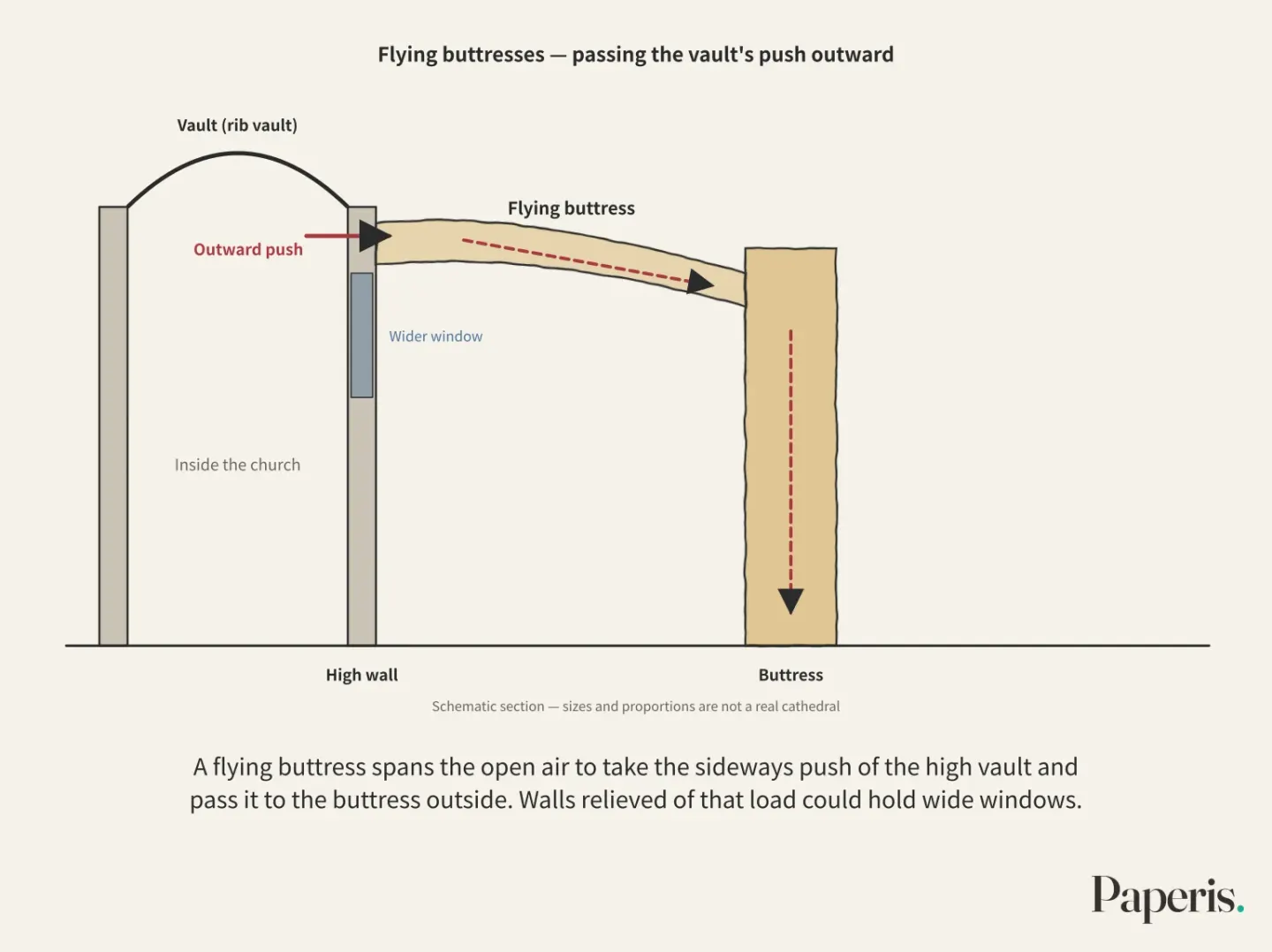
If you make the wall thin, who takes the sideways pushing force of the high ceiling? The buttress is a stone wall or pier supporting from the outside so that an arch or wall does not push outward. The flying buttress is a stone arch spanning across the air from a separate buttress set outside to the high wall of the cathedral, taking the sideways pushing force of the ceiling against the wall and passing it to the buttress. One overview text picks out three technologies together: pointed arches, rib vaults, and flying buttresses. These three made taller buildings, thinner walls, and wider stained-glass windows possible (DOI: 10.5281/zenodo.21176794).
Opening up the wall and putting glass in its place is commonly understood as the core of Gothic architecture (DOI: 10.1017/9789048532162.001). Iron was also among the materials holding that space together. While restoring Notre-Dame de Paris, which caught fire in 2019, researchers removed and examined 12 iron cramps that bound stone to stone. Radiocarbon dating on six of them showed that Notre-Dame was the first Gothic cathedral known to have used iron on a massive scale across the entire building as a material to bind stones together (DOI: 10.1371/journal.pone.0280945). In the mid-12th century, the masons of that construction site bound stone with iron as they stacked it.
Across the sea, we look up at the ceiling of Lincoln Cathedral in England. English Gothic lasted roughly from 1180 to 1520, and English cathedrals tended to emphasize the length of the building over its height (Boundless, Art History ch. 18.02). One researcher considers that several rib weaves on the ceiling and walls of Lincoln were unprecedented and became the basic vocabulary of later English Gothic as a whole. While reading this geometry against the cosmology that Lincoln Bishop Robert Grosseteste (in office 1235–53) wrote with light and geometry, that researcher also notes that there is no evidence Grosseteste instructed masons directly (DOI: 10.4324/9781315096261-6).
South of the Alps, Florence Cathedral, begun in 1296, has neither French-style stained-glass windows nor an emphasis soaring upward (Boundless, Art History ch. 18.06). Even under the same sign, construction schedules and blueprints varied from site to site, and what to pile high varied too.
Art — Pictures Raised on Windows and Walls
At Chartres Cathedral in France, medieval glass survives in about 173 out of 186 window locations. No other Gothic building retains this much, so researchers use Chartres as a baseline when trying to understand medieval windows (DOI: 10.1057/9780230615441_6). Stained glass is a window whose pictures are built by piecing together colored glass shards. At Chartres, the themes are grouped so that the north windows of the cathedral body deal with Christ and the south windows with the Virgin Mary, among other subjects. That researcher sees in this grouping traces of clerics coordinating the themes (DOI: 10.1057/9780230615441_6).
Among those windows is a farmer driving a horse to plow a field. According to research to date, windows of this scene are known in the entire medieval Western Europe from only two 13th-century windows: those at Chartres and Tours Cathedrals. The possibility that a peasant donated this window has also been raised, and the horse in the picture is read as a sign of wealth and prestige (DOI: 10.4000/books.pufr.14949). Rare though they were, the glass of these two cathedrals included the likenesses of people working in the fields of that era right alongside biblical stories.
Interpretations are divided on how to read this colored light. One textbook explains that to Abbot Suger, stained glass was a tool for teaching theology, and light was a sign that God was present there (Boundless, Art History ch. 18.01). The researcher mentioned earlier, who brought up the stories of pilgrims, considers that an obsession with form and structure has obscured the materials that made up the cathedral (DOI: 10.1017/9789048532162.001).
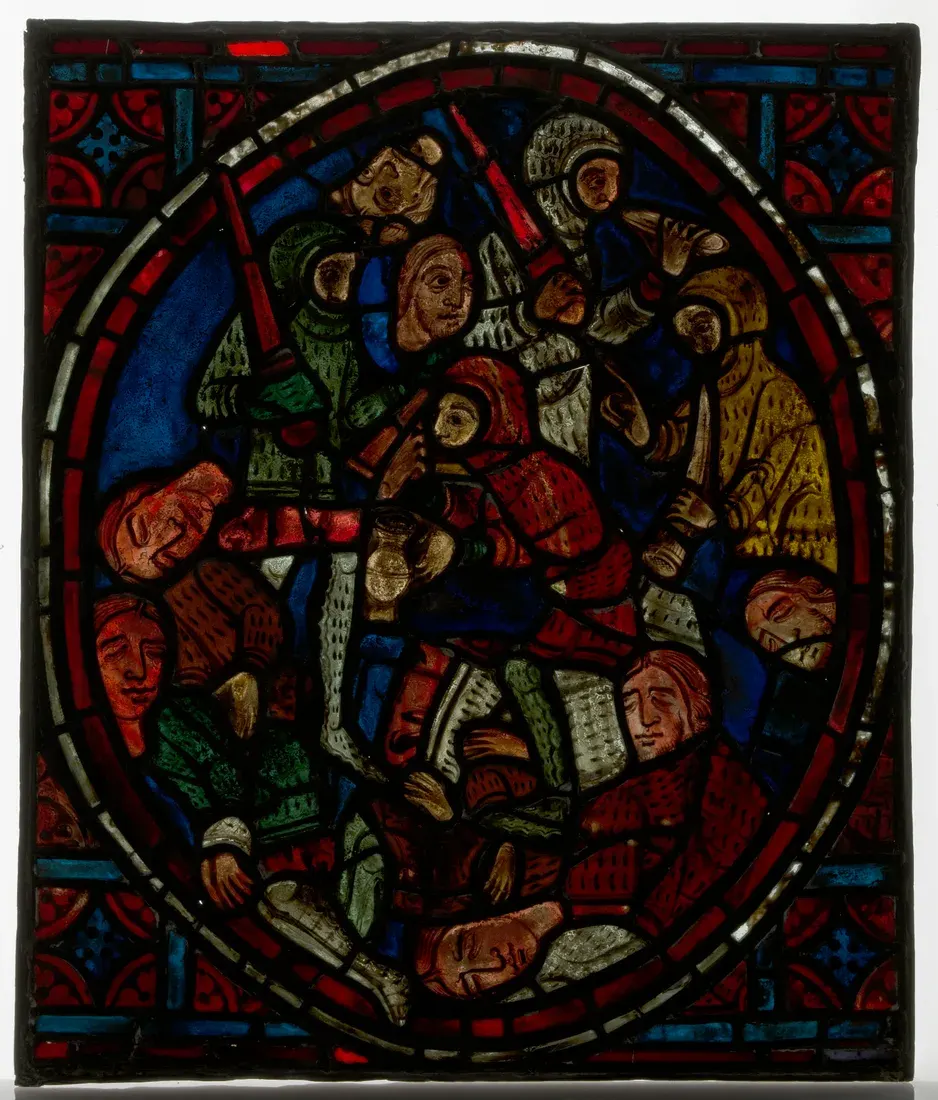
Stained glass panel, France, c. 1270 · The Metropolitan Museum of Art, New York · Public domain (CC0) — not the Chartres glass
South of the Alps, the stage for pictures was walls rather than windows. Fresco is a mural technique painted on wet plaster before it dries, letting the wall hold the color as it sets. The Italian painter Giotto di Bondone painted an angel announcing the child to the Virgin Mary on the arch near the altar of the Arena Chapel in Padua around 1303–1305. The figure of God was painted on a wooden panel fitted into the wall, while the remaining figures were painted in fresco (DOI: 10.1484/j.ikon.4.2017007).
In "The Lamentation" from the same chapel, the dead Christ is a volumetric body lying down to appear shortened in the foreground. Figures surround him from all sides, and several touch his body. One researcher views this painting as a rewriting of Byzantine lamentation scenes that had just entered Italian painting around that time (DOI: 10.4324/9781315244471-4). Another researcher claims that the small rooms inside the walls painted by Giotto were drawn using perspective rules that gather receding lines to a single point, going so far as to argue that such perspective was not a Renaissance invention. This is the claim of a geometric analysis paper (DOI: 10.1007/978-3-0346-0518-2_2).
These murals by Giotto receive two names together within a single art textbook. While introducing Giotto in a chapter covering Gothic painting (Boundless, Art History ch. 18.04), the textbook also calls Italian art and architecture from 1200 to 1400 "Proto-Renaissance" in another chapter (Boundless, Art History ch. 18.06). In front of Italy's painting construction sites, the sign for the next construction was hung early alongside it.
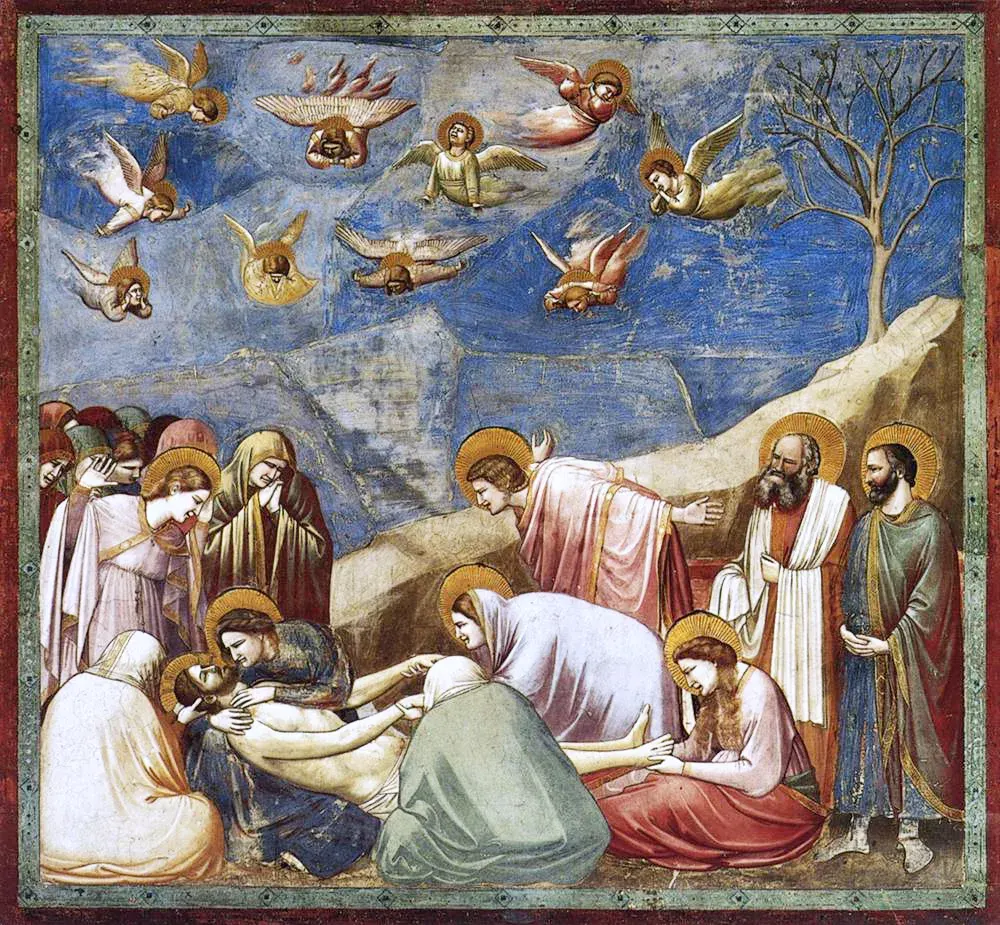
Giotto di Bondone, The Lamentation (c. 1304–1306) · Arena (Scrovegni) Chapel, Padua · Public domain · Wikimedia Commons
Music — Construction That Adds Lines to a One-Line Song
Worship inside a cathedral was accompanied by song. Chant is worship music sung in a single, unaccompanied melody line. The new construction undertaken by the music of this era was, at first in certain sections of the service, the act of placing another line atop that single line (Clark et al., Understanding Music ch. 2.03).
A voice is one of the melody lines in a music piece with multiple lines going together. Polyphony is music in which multiple voices each sing their own melody at the same time. If only a single chant line is sung, there is one voice, and if even one other line is added, it becomes polyphony.
Organum is polyphonic worship music in which another voice was added to a chant melody. Created in Paris from the late 12th century through the 13th century, organum is the first name attached to polyphonic worship music (Clark et al., Understanding Music ch. 2.03).
To hear how adding another line to a single line sounds to the ear, we listen through two short snippets. The two snippets are examples created by Paperis to show the principle, and are not medieval pieces. First, a single melody line goes up and down alone.

Clip: our own example (not a medieval piece) — a single melodic line (synthesized choir)
This time, a second voice has been added beneath the same melody. The second line moves following the upper line in the exact same shape, at a position a perfect fifth lower than the upper line. A perfect fifth is a pitch difference spanning five letter names and separated by seven semitones, like G and the C below it. Listen by comparing what differs from when there was a single line. This example only shows the principle of adding a second line of the same shape to a single line, and does not mean that organum in Paris actually sounded like this.
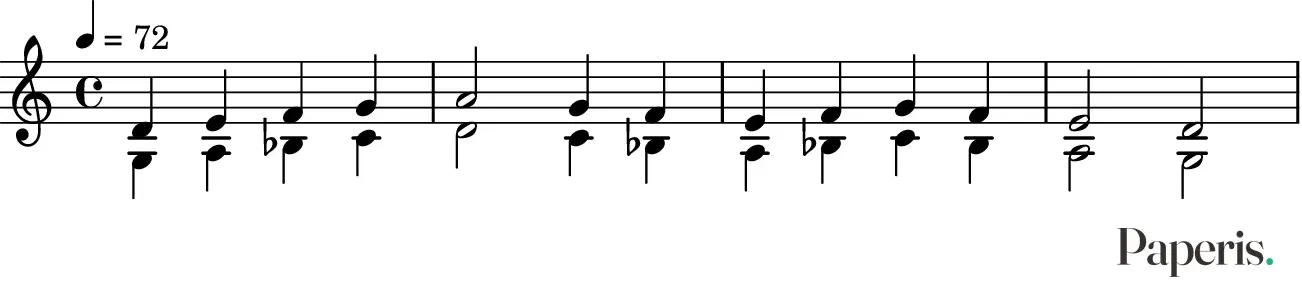
Clip: our own example (not a medieval piece) — the same melody with a second voice a perfect fifth below (synthesized choir)
One theorist who stacked lines compared that work to building a house. Johannes de Grocheio, a theorist who wrote down the genres of polyphonic music sung in Paris around 1275, compared the voice usually placed at the very bottom to the foundation of a house. All the other voices are built upon it, and that voice governs them, he stated. In most polyphonic songs called motets in medieval France, the voice serving as the foundation was a melody borrowed from chant (DOI: 10.1215/00222909-10232105). The new construction rose up upon the old chant without tearing it down.
Written records of Western music that can be read today date from around 800 (Clark et al., Understanding Music ch. 2.01). In the 14th century, composers and theorists created symbols representing ratios of beat and length, making it possible to accurately write down much broader rhythmic relationships (DOI: 10.1093/oso/9780198162308.001.0001).
Around 1330, the music theorist Jacques of Liège set out in a thick theoretical treatise to expose the errors of the "Ars nova" composers. He appears to have been the first person to use this name (DOI: 10.1017/9781805437840.005). Ars nova is a Latin term meaning "new art," and is the name used for music in 14th-century France that employed new notation and more complex rhythms. Jacques favored the music before it, calling it "Ars antiqua," meaning the old art. He compared the new music's loose treatment of clashing notes to a donkey wearing human clothes, and scolded it above all for accepting "imperfect" duple meter units (DOI: 10.1017/9781805437840.005).
One book considers that 14th-century new notation responded to more complex rhythms while further spurring that complexity. The French musicians Philippe de Vitry and Guillaume de Machaut, who stood at the center of this, simultaneously held administrative work for the royal court or nobility and church offices (DOI: 10.1017/9781316584781.006). Machaut lived from around 1300 to 1377, and was renowned as both a composer and a poet. Machaut's music left behind traces of the old art even while embracing the new (DOI: 10.1017/9781805437840.005). In music, the name "new art" appears in the writings of a contemporary, and according to one researcher, the person who first used that name appears to have been on the side criticizing that music.
Literature — Beside Latin, in the People's Words
In the 12th century, in Occitania in southern France, poet-singers called troubadours appeared, marking the beginning of a tradition of songs composed in the local language. Those songs, while singing of nightingales and love, repeatedly questioned the very act of singing (DOI: 10.1353/nlh.2015.0038). The vernacular is the local language used in place of Latin, representing the early face of modern tongues like French or Italian. Around this time, courtly songs and poems were increasingly written in regional tongues rather than Latin (Clark et al., Understanding Music ch. 2.01).
Nel mezzo del cammin di nostra vita mi ritrovai per una selva oscura, ché la diritta via era smarrita.
In the middle of the journey of our life I found myself within a dark wood, for the straight way had been lost.
— Dante Alighieri, the Divine Comedy, Inferno, Canto 1 (original · translated by Paperis)
The Italian poet Dante Alighieri's the Divine Comedy begins as the speaker finds himself entering a dark wood in the middle of the journey of his life. In his youthful work Vita Nuova, Dante wrote that composing rhymed poetry in the vernacular was equivalent to composing metrical poetry in Latin. One researcher suggests that this judgment was not obvious in Dante's time, yet it reveals the poetic design of the entire Divine Comedy (DOI: 10.1353/mdi.2016.0006).
Dante wrote a treatise called De Vulgari Eloquentia around 1302–05, and in Canto 6 of Purgatorio from the Divine Comedy, he crafted a scene where the ancient poet Virgil, who wrote the Latin epic the Aeneid, embraces the 13th-century troubadour Sordello upon realizing they share the same hometown of Mantua. The same researcher reads in this embrace both the future of Italian literature that Dante foresaw and his desire for reconciliation between the divided and warring cities of northern Italy (DOI: 10.1353/mdi.2016.0006). A Latin poet and a vernacular poet meet in a single scene.
Whan that Aprille with his shoures sote The droghte of Marche hath perced to the rote, And bathed every veyne in swich licour, Of which vertu engendred is the flour;
— Geoffrey Chaucer, The Canterbury Tales, General Prologue
The English poet Geoffrey Chaucer's The Canterbury Tales begins with spring, as the April rain soaks the drought of March down to the roots. Chaucer wrote in Middle English, an older form of today's English, and passed away in 1400 (Robinson & Getty, British Literature I ch. 1.01). It was only around 1362, some 40 years earlier, that the language of the courts officially returned to English by law (Robinson & Getty, British Literature I ch. 1.01).
From the troubadours of 12th-century southern France, to Dante writing De Vulgari Eloquentia in the early 14th century, to Chaucer who died in 1400, the project of writing in the vernacular proceeded at different times in different places.
Same Era, Different Clocks
Let us think of a single city called Paris. One music textbook notes that as organum emerged in Paris from the late 12th through the 13th centuries, the increasing complexity of music seemed to run parallel to the increasing complexity of architecture (Clark et al., Understanding Music ch. 2.03). That textbook does not point to a specific building. Earlier in the same Paris of the mid-12th century, the construction site of Notre-Dame bound its stones with iron clamps (DOI: 10.1371/journal.pone.0280945). The theorist Grocheio around 1275 compared the voice part usually placed at the very bottom to the foundation of a house (DOI: 10.1215/00222909-10232105). Running parallel is an observation from that textbook, and the house metaphor is the words of a theorist.
There are also interpretations that attempt to bundle architecture and the thought of its era into a single framework. In his 1951 book Gothic Architecture and Scholasticism, art historian Erwin Panofsky compared the order-making method of Gothic architecture to the order-making thought of scholasticism. Scholasticism is a medieval academic discipline that wove classical philosophy together with Catholic theology (DOI: 10.4324/9781315096261-6). This comparison by Panofsky continues to spark debate within and outside art history even today (DOI: 10.1086/707699). One architectural survey regards Gothic architecture as impossible to understand without Christian thought, explaining that the idea of finding divine order in numbers aimed at the complete harmony of music and the complete beauty of sight together (DOI: 10.5040/9781474207768.047). Both are interpretations.
Mismatches exist with equal weight. First is the name. Architecture was initially called the "French Style" and later widely called "Gothic" (Boundless, Art History ch. 18.02), and art textbooks treat the stained-glass windows and mural paintings of the same period as media of the Gothic era (Boundless, Art History ch. 18.03). In music, a book by a theorist around 1330 features the "new art" and the "old art" (DOI: 10.1017/9781805437840.005).
Music textbooks and English literature textbooks bundle this period into the "Middle Ages" (Clark et al., Understanding Music ch. 2.01; brit-lit-1/1-01-introduction-to-the-middle-ages), and music further divides the inside of that period into the times of the "old art" and the "new art" (DOI: 10.1017/9781805437840.005). "Gothic" is a sign hanging at the front door of architecture and art, while a different name hangs in front of the construction sites of music and literature.
Next is the construction schedule. Following the consecration of Saint-Denis, English Gothic continued from roughly 1180 (Boundless, Art History ch. 18.02), and Florence went ahead with its cathedral, whose construction began in 1296, without the vertical emphasis of the French style (Boundless, Art History ch. 18.06). Even though it is the same architectural style, there is a gap of several decades just between France and England.
On the side of song, the troubadours of southern France opened up vernacular song in the 12th century (DOI: 10.1353/nlh.2015.0038), polyphonic music in Paris began from the late 12th century (Clark et al., Understanding Music ch. 2.03), and Ars nova arrived in the 14th century. Dante’s De Vulgari Eloquentia is from the early 14th century (DOI: 10.1353/mdi.2016.0006), and English returned to the English law courts in 1362 (Robinson & Getty, British Literature I ch. 1.01). Gothic painting continued to grow in Catalonia across the 14th and 15th centuries while blending influences from Italy, France, and Flanders (DOI: 10.17323/3034-2031-2025-5-101-126).
Even within a single field, the period signs do not line up sharply. Looking at motets surviving in manuscripts from around 1250 to around 1430, the way voice parts were laid out on the page did not change chronologically. An analysis shows that there was no layout used exclusively in a single period, and exceptions were found in only two quires of a single manuscript (DOI: 10.1484/j.jaf.5.103802). Resemblances remain as the city of Paris and the interpretations of a few scholars, whereas mismatches remain as different names and schedules at every construction site.
Where to Look Next
How the next signpost, which appeared early in Italian painting, continues is explored in "The Renaissance — One White Hind, Different Tracks in Every Forest". The article that views the four arts of the 17th century in the same way is "Baroque — Four Clocks Running Under One Name".
When two sounding notes fit together and when they clash is covered in "Chords and Consonance — Teeth That Mesh, Teeth That Grind". How a single stained-glass window changes the light inside a room can be explored further in "Light — How One Window and One Curtain Change a Room".
Source Papers
- "A New Material Interpretation of Twelfth-Century Architecture — Introduction" (2024) — DOI: 10.1017/9789048532162.001 — Saint-Denis sits just outside the walls of Paris, and Abbot Suger (1081–1151) is credited with changing later medieval buildings by filling them with light; he likely planned the reconstruction to accommodate growing numbers of pilgrims, and the church matched his political ambition to restore a monastery that had lost its reputation and weight with the monarchy. Although opening walls to bring in glass is understood as the core of Gothic architecture, the author argues that a focus on form and structure has overshadowed materials.
- "The Essay as Philosophical Form" (2003) — DOI: 10.1017/cbo9780511498169.005 — Introducing Georges Duby's The Age of Cathedrals: economic and social conditions were right, but the real cause was theology, interpreted as Abbot Suger's belief that "God is light" transforming architecture (which the essay's author uses as an argument that new art forms are not merely the result of technology).
- "France, 1135–1450" (2018) — DOI: 10.5040/9781474207768.047 — Semicircular arches have their width determine their height, whereas pointed arches can be adjusted to achieve a uniform height; pointed arches and rib vaults were already used in late Romanesque France and England, but binding arches into a single system was first fully accomplished at Saint-Denis. Romanesque built by adding and interlocking, whereas Gothic divided the whole, and Gothic architecture cannot be understood without Christian thought—the order of numbers aimed at musical and visual beauty alike, according to this survey.
- "Gothic Cathedrals and Scholasticism" (2026) — DOI: 10.5281/zenodo.21176794 — Pointed arches, rib vaults, and flying buttresses are three techniques that offered a solution enabling taller buildings, thinner walls, and larger stained-glass windows (self-published overview — low grade, attributed in the text to "an overview").
- "Notre-Dame de Paris: The first iron lady? Archaeometallurgical study and dating of the Parisian cathedral iron reinforcements" (2023) — DOI: 10.1371/journal.pone.0280945 — Following the 2019 fire, 12 iron staple samples and 6 radiocarbon dates show that Notre-Dame is the earliest known Gothic cathedral to use iron extensively as a material to bind stone throughout the entire building, representing an innovation on mid-twelfth-century construction sites.
- "The Architecture of Lincoln Cathedral and the Cosmologies of Bishop Grosseteste" (2017) — DOI: 10.4324/9781315096261-6 — The unprecedented vaulting and elevation forms of Lincoln Cathedral became the basic vocabulary of English Gothic, and a researcher proposes reading its geometry against the light cosmology of Robert Grosseteste (Bishop of Lincoln, 1235–53), while noting that no direct instructions to masons survive; Scholasticism was a synthesis of classical philosophy and Catholic theology.
- "Charlemagne as Saint? Relics and the Choice of Window Subjects at Chartres Cathedral" (2008) — DOI: 10.1057/9780230615441_6 — Chartres preserves medieval glass in about 173 of its 186 window locations, making it the benchmark for medieval glass studies; clergy coordination is visible in thematic groupings such as Christ on the north and the Virgin on the south.
- "La représentation du cheval de labour dans deux vitraux du XIIIe siècle: Des cathédrales de Chartres et de Tours" (2017) — DOI: 10.4000/books.pufr.14949 — Medieval Western European windows depicting a farmer plowing with a horse are found only in these two thirteenth-century windows at Chartres and Tours, pointing to likely peasant patronage, with horses serving as symbols of wealth and prestige.
- "Giotto's Annunciation to the Virgin in Arena Chapel in Padua between East and West" (2017) — DOI: 10.1484/j.ikon.4.2017007 — The Annunciation on the altar-side arch of the Arena Chapel around 1303–1305 features God painted on a wooden panel inserted into the wall, with the rest executed in fresco.
- "Bodies of Self-Transcendence: The Spirit of Affect in Giotto and Piero" (2017) — DOI: 10.4324/9781315244471-4 — Giotto's Lamentation is a reworking of a Byzantine mourning scene recently introduced to Italy, featuring a voluminous Christ lying foreshortened and figures surrounding him on all sides.
- "Giotto and Renaissance Perspective" (2010) — DOI: 10.1007/978-3-0346-0518-2_2 — A geometric analysis showing that the small rooms (coretti) on the walls of the Arena Chapel were drawn using rules of perspective construction, with the author arguing that central perspective was not an invention of the Renaissance.
- "Upper-Voice Structures and Compositional Process in the Ars nova Motet" (2023) — DOI: 10.1215/00222909-10232105 — Discussing Parisian polyphony around 1275, Johannes de Grocheio likened the tenor (usually the lowest voice) to the foundation of a house, and with few exceptions, the tenors of medieval French motets were borrowed from chant.
- "Mensuration and Proportion Signs: Origins and Evolution" (1993) — DOI: 10.1093/oso/9780198162308.001.0001 — Fourteenth-century composers and theorists created meter and proportion signs to precisely notate broad rhythmic relationships, leading right to the threshold of modern notation.
- "Sounding Numbers, Fickle Anagrams, Chameleonic Alphabets and Carved Vowels" (2025) — DOI: 10.1017/9781805437840.005 — Guillaume de Machaut (c. 1300–1377) was both a composer and a poet, evidently the first to use the term "Ars nova," which Jacques of Liège around 1330 criticized by defending Ars antiqua and attacking dissonances and "imperfect" duple time units; Machaut embraced the new while leaving traces of older techniques.
- "Scribes, Scholars, and Secretaries in Fourteenth-Century France" (2023) — DOI: 10.1017/9781316584781.006 — Fourteenth-century changes in Ars nova notation responded to and spurred rhythmic complexity, and Philippe de Vitry and Machaut held both royal or noble administrative posts and church offices.
- "Unwriting Medieval Song" (2015) — DOI: 10.1353/nlh.2015.0038 — The vernacular song tradition began with twelfth-century Occitan troubadours, and those songs are filled with ambiguity and self-consciousness about the very act of singing.
- "Virgil and Sordello's Embrace in Dante's Commedia: Latin Poeta Meets Vernacular Dicitore" (2016) — DOI: 10.1353/mdi.2016.0006 — The judgment in Vita Nuova that "vernacular verse is equal to Latin verse" was not self-evident at the time, yet it reveals the poetic project of the entire Divine Comedy; the embrace between Virgil and Sordello (a thirteenth-century troubadour from Mantua) in Purgatorio canto 6 embodies the future of Italian literature and hopes for political reconciliation, and De vulgari eloquentia dates to around 1302–1305.
- "Panofsky on Architecture: Iconology and the Interpretation of Built Form, 1915–1956, Part I" (2020) — DOI: 10.1086/707699 — Erwin Panofsky's Gothic Architecture and Scholasticism (1951) compared the architectural order system to the intellectual order system and still generates considerable debate inside and outside art history.
- "GOTHIC PAINTING OF THE CATALAN LANDS OF THE XIV–XV CENTURIES: THE PROBLEM OF STYLE DEVELOPMENT" (2025) — DOI: 10.17323/3034-2031-2025-5-101-126 — Catalan Gothic painting developed in the fourteenth and fifteenth centuries by mixing local traditions with influences from the Italian Trecento, French and Flemish court painting, and International Gothic (overview).
- "The Layout of the Early Motet" (2015) — DOI: 10.1484/j.jaf.5.103802 — Manuscript motet layouts from 1250 to 1430 are not chronological, and there are no separate sections for Notre-Dame, Ars antiqua, and Ars nova arrangements, with only the 7th and 8th fascicles of the Montpellier (Mo) manuscript providing an exception where repertory layers and layouts overlap.
- "Art History (Boundless) — 18.02 Gothic Architecture" — Boundless, Art History ch. 18.02 — The eastern end of Saint-Denis was consecrated on June 11, 1144, with the king in attendance; Abbot Suger was the patron and the master mason anonymous. Originally called the "French style," multiple elements were used together for the first time in a single building, according to this textbook. Cologne Cathedral ran from 1248 to 1880 (including interruptions), and English Gothic spans c. 1180–1520 with an emphasis on length.
- "Art History (Boundless) — 18.01 Introduction to Gothic Art" — Boundless, Art History ch. 18.01 — Pointed arches had precedents in pre-Islamic Near Eastern and Islamic architecture, and to Abbot Suger, stained glass was a tool for theological education, while light represented the presence of God, according to the textbook.
- "Art History (Boundless) — 18.06 Italy in the Gothic Period" — Boundless, Art History ch. 18.06 — The Renaissance began in fourteenth-century Italy, and Italian art and architecture from 1200 to 1400 is termed Proto-Renaissance, with Florence Cathedral begun in 1296 lacking French-style stained glass and vertical emphasis.
- "Art History (Boundless) — 18.03 Gothic Sculpture" — Boundless, Art History ch. 18.03 — Groups sculpture, panel painting, stained glass, fresco, and illuminated manuscripts together as media of Gothic art.
- "Art History (Boundless) — 18.04 Gothic Painting" — Boundless, Art History ch. 18.04 — Covers Giotto in the chapter on Gothic painting.
- "Art History (Boundless) — 17.01 The Romanesque Period" — Boundless, Art History ch. 17.01 — Romanesque spans the late tenth century to the thirteenth century (varying by region) and is a term coined by nineteenth-century art historians, characterized by thick walls and semicircular arches.
- "Understanding Music: Past and Present — 2.01 Introduction and Historical Context" — Clark et al., Understanding Music ch. 2.01 — The medieval period spans 450–1450, the Renaissance around the fifteenth century, decipherable notation dates from around 800, and the vernacular refers to regional languages used in place of Latin, seeing increased use in court songs and poetry.
- "Understanding Music: Past and Present — 2.03 Music for Medieval Christian Worship" — Clark et al., Understanding Music ch. 2.03 — Chant is unaccompanied monophonic worship music, polyphonic worship music was initially for specific passages of the liturgy, organum is the earliest name for Parisian polyphonic worship music of the late twelfth and thirteenth centuries, and the textbook observes that musical complexity appears to run parallel to architectural complexity.
- "British Literature I — 1.01 Introduction to the Middle Ages" — Robinson & Getty, British Literature I ch. 1.01 — English medieval literature spans 410–1485, English returned to the courts in 1362, Chaucer wrote in Middle English, and he died in 1400.
Sources (29)
- A New Material Interpretation of Twelfth-Century Architecture — IntroductionDOI 10.1017/9789048532162.001
- The Essay as Philosophical FormDOI 10.1017/cbo9780511498169.005
- France, 1135–1450DOI 10.5040/9781474207768.047
- Gothic Cathedrals and ScholasticismDOI 10.5281/zenodo.21176794
- Notre-Dame de Paris: The first iron lady? Archaeometallurgical study and dating of the Parisian cathedral iron reinforcementsDOI 10.1371/journal.pone.0280945
- The Architecture of Lincoln Cathedral and the Cosmologies of Bishop GrossetesteDOI 10.4324/9781315096261-6
- Charlemagne as Saint? Relics and the Choice of Window Subjects at Chartres CathedralDOI 10.1057/9780230615441_6
- La représentation du cheval de labour dans deux vitraux du XIIIe siècle: Des cathédrales de Chartres et de ToursDOI 10.4000/books.pufr.14949
- Giotto's Annunciation to the Virgin in Arena Chapel in Padua between East and WestDOI 10.1484/j.ikon.4.2017007
- Bodies of Self-Transcendence: The Spirit of Affect in Giotto and PieroDOI 10.4324/9781315244471-4
- Giotto and Renaissance PerspectiveDOI 10.1007/978-3-0346-0518-2_2
- Upper-Voice Structures and Compositional Process in the Ars nova MotetDOI 10.1215/00222909-10232105
- Mensuration and Proportion Signs: Origins and EvolutionDOI 10.1093/oso/9780198162308.001.0001
- Sounding Numbers, Fickle Anagrams, Chameleonic Alphabets and Carved VowelsDOI 10.1017/9781805437840.005
- Scribes, Scholars, and Secretaries in Fourteenth-Century FranceDOI 10.1017/9781316584781.006
- Unwriting Medieval SongDOI 10.1353/nlh.2015.0038
- Virgil and Sordello's Embrace in Dante's Commedia: Latin Poeta Meets Vernacular DicitoreDOI 10.1353/mdi.2016.0006
- Panofsky on Architecture: Iconology and the Interpretation of Built Form, 1915–1956, Part IDOI 10.1086/707699
- GOTHIC PAINTING OF THE CATALAN LANDS OF THE XIV–XV CENTURIES: THE PROBLEM OF STYLE DEVELOPMENTDOI 10.17323/3034-2031-2025-5-101-126
- The Layout of the Early MotetDOI 10.1484/j.jaf.5.103802
- Art History (Boundless) — 18.02 Gothic Architecture
- Art History (Boundless) — 18.01 Introduction to Gothic Art
- Art History (Boundless) — 18.06 Italy in the Gothic Period
- Art History (Boundless) — 18.03 Gothic Sculpture
- Art History (Boundless) — 18.04 Gothic Painting
- Art History (Boundless) — 17.01 The Romanesque Period
- Understanding Music: Past and Present — 2.01 Introduction and Historical Context
- Understanding Music: Past and Present — 2.03 Music for Medieval Christian Worship
- British Literature I — 1.01 Introduction to the Middle Ages