Paperis Articles
Jeong Seon — Did the Mountains and Rivers Really Look Like That?
The true-view landscape paintings of Jeong Seon, a painter of late Joseon Korea, are known as pictures of real scenery, and one geography paper describes them as rendered close to how the land looked. One study that compared angles of view sees Jeong Seon's compositions as far wider than the human field of vision and reads that as the trace of painting from memory, while a study that rebuilt old terrain in virtual space analyzed the fish-eye-like curvature and panoramic composition he used again and again. A study that compared the paintings with site photographs found that ten Han River paintings line up with a single vantage point. Scholars still dispute what the name 'true view' means, and researchers use these paintings to look for vanished sandbars and ponds.
Your field's papers, as audio
Pick your fields and journals — Paperis summarizes the key papers and turns them into audio. Listen on your commute.
Start Paperis free →Jeong Seon — Did the Mountains and Rivers Really Look Like That?
The Painter Who Painted Inwangsan and the Han River
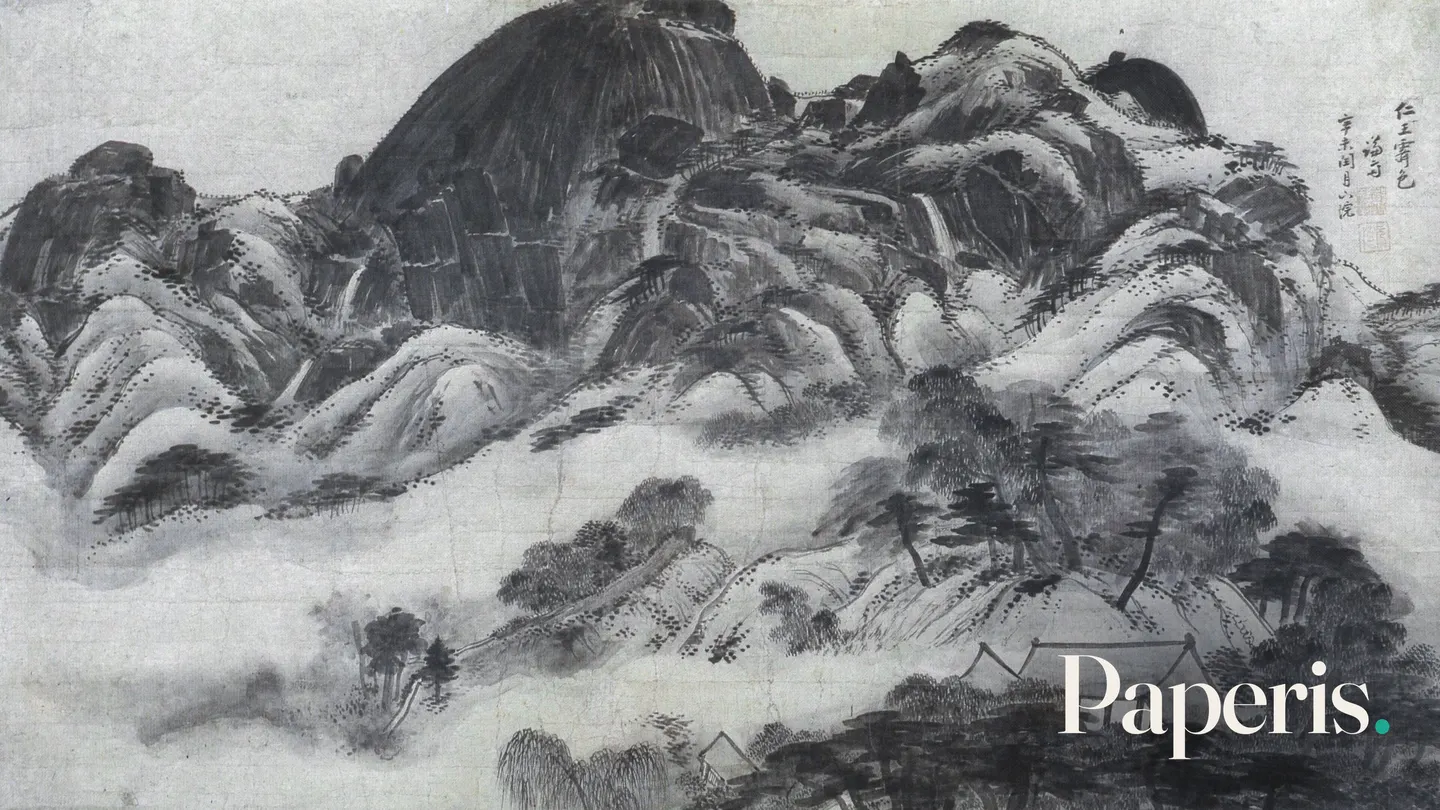
In the 18th century, a painter named Jeong Seon (1676–1759) lived in Hanyang, the capital of Joseon Korea. Joseon was a dynasty that ruled the Korean peninsula from 1392 to 1910, and Jeong Seon was active in its later period. He traveled to Geumgangsan in 1711 and created an album of paintings, and this album is the earliest among Jeong Seon's currently known paintings of Geumgangsan (DOI: 10.30527/klcc..66.201706.007). Most of the paintings depicting Hanyang captured Seochon, the neighborhood below Inwangsan and Baegaksan (KCI ART001742447). Around 1740, he worked as the magistrate—meaning the local head official—of Yangcheon, a county along the Han River, where he toured the Han River and left the painting album Gyeonggyo Myeongseungcheop which wove together poems and paintings (KCI ART003128740). This article looks at the late Joseon painter Jeong Seon and asks how closely his paintings actually resembled the real scenery.
Jingyeong sansuhwa is a term referring to landscape paintings depicting famous real scenery of the land of Joseon, painted centered around Jeong Seon in 18th-century Joseon. Sansuhwa are East Asian paintings depicting nature centered on mountains and water. There is one more similar term. Silgyeong sansuhwa is a term broadly referring to landscape paintings that depict specific places that actually exist. This side had a tradition dating back to the Goryeo dynasty, much earlier than Jeong Seon, and Joseon's actual scenery was also captured in 16th-century gyehoedo (paintings commemorating gatherings of officials) or the 17th-century paintings of artists Han Si-gak and Jo Se-gol (KCI ART001475833).
An art education paper points out that people's understanding of jingyeong sansuhwa tends to linger around "silgyeong sansuhwa painted in the late Joseon period," and that while school art classes frequently treat jingyeong sansuhwa as an example representing the unique color of Joseon painting, they often provide superficial information (DOI: 10.35657/jae.2009.25..005). A geography paper dealing with the terrain of the Danyang region goes a step further, defining late Joseon landscape paintings as a painting style that depicts real topographical scenery close to reality, whether called silgyeong or jingyeong (DOI: 10.25202/JAKG.12.1.7). There is also an assessment that while jingyeong sansuhwa has established itself among the public as a proud national culture, it has remained at the center of debate in academia (DOI: 10.37981/hjhrisu.2024.12.71.205).
So do they really resemble the actual scenery? Researchers have stood at the sites holding the paintings, compared them with photographs, and reconstructed old topographies inside computers. This article follows those results, looks at the debates among scholars surrounding the name "jingyeong", and goes all the way to what researchers seeking out lost ancient riverside areas through paintings that do not resemble reality must be careful about.
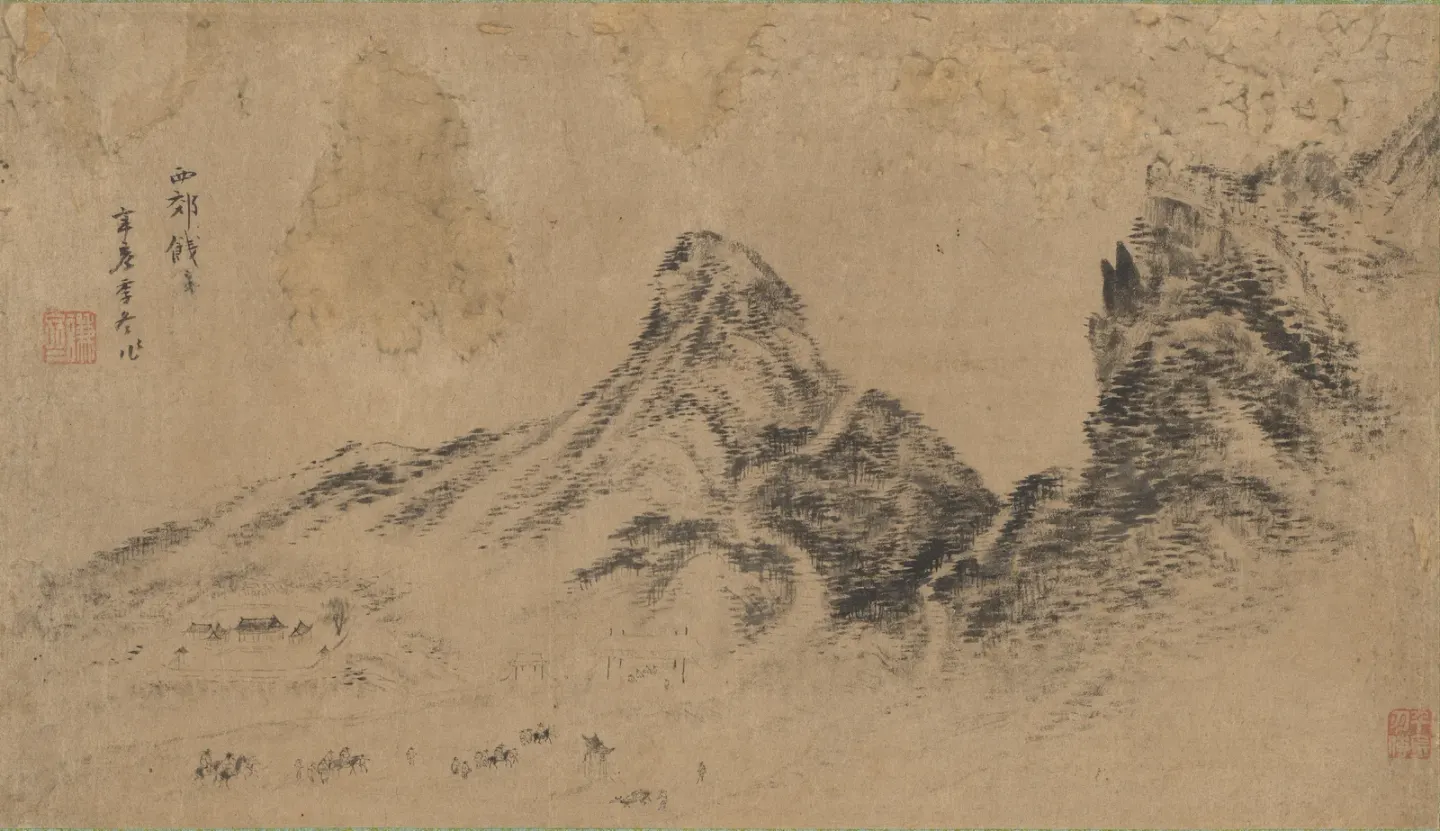
Jeong Seon, Gyeongseong Seogyodo (1731) · National Museum of Korea · public domain · Wikimedia Commons — one example of Jeong Seon painting a real place; not a work compared in the studies discussed here
Comparing the Width of Paintings Through Angle of View
Let us take a true-view painting by Jeong Seon, go to that exact spot, and hold up a camera. According to a 2009 art history study comparing late Joseon real-scenery paintings by viewpoint and angle of view, Jeong’s scenes usually do not fit entirely within the frame of a standard lens (DOI: 10.23158/jkaa.2009.v3_06). Angle of view refers to how wide an angle a scene captures horizontally and vertically, and in a camera, the lens determines that width.
This study divides viewpoints into three types: a viewpoint looking down from a high place, a viewpoint combining views from multiple locations, and a viewpoint where the viewing position moves along the screen. Multiple viewpoints refer to a perspective that joins views from several different positions into a single screen. Based on these viewpoints and angles of view, the researcher believes it is possible to gauge whether or not a painting was sketched on location (DOI: 10.23158/jkaa.2009.v3_06). Life drawing is the act of drawing a subject while looking at it directly in front of one's eyes.
The study suggests that late Joseon real-scenery paintings followed two distinct paths. One path closely resembled the actual scenery, while the other did not resemble it very much. The paintings that did not resemble the scenery were drawn from memory after visiting famous sites, significantly altering the scenes, and the study explains that paintings bearing geographic names were no different. Such paintings were primarily produced by Jeong Seon—whom the study classifies as a literati painter—and the painters who followed him, as well as Lee In-sang, Heo Pil, and Yoon Je-hong, preceding the period of paintings drawn to resemble reality based on on-site sketches. The side that drew things to closely resemble reality includes Kim Hong-do, painters who followed him, and literati painters Sim Sa-jeong and Kang Se-hwang (DOI: 10.23158/jkaa.2009.v3_06).
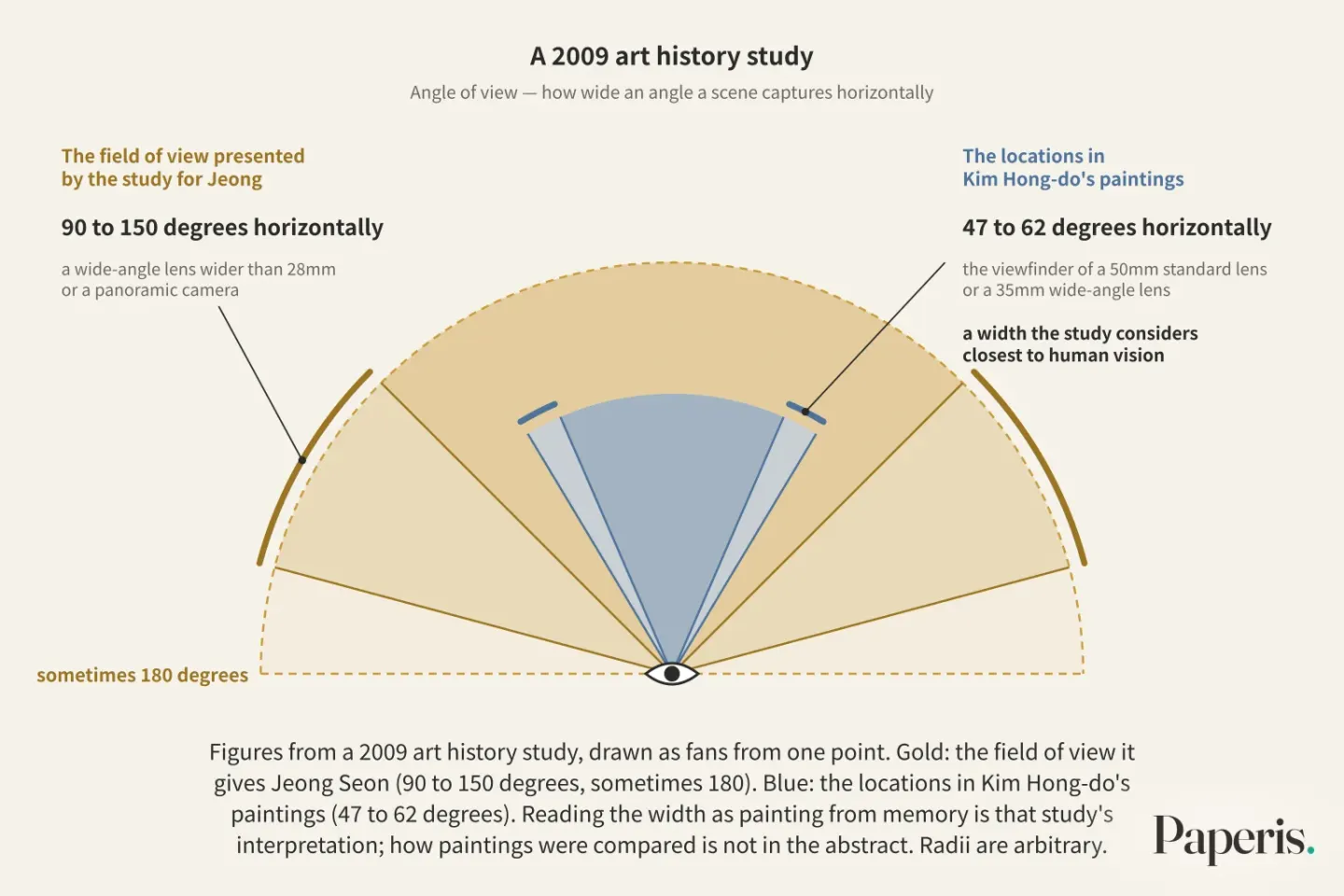
The study concludes that because Jeong Seon painted relying on memory, his true-view scenes cannot be captured by a camera equipped with a 28–50mm lens, requiring instead a wide-angle lens wider than 28mm or a panoramic camera. The field of view presented by the study for Jeong is generally 90 to 150 degrees horizontally, and sometimes 180 degrees. On the other hand, the locations in Kim Hong-do's paintings measured 47 to 62 degrees horizontally, fitting within the viewfinder of a 50mm standard lens or a 35mm wide-angle lens, a width the study considers closest to human vision (DOI: 10.23158/jkaa.2009.v3_06). Kim Hong-do (1745–1806?) (DOI: 10.52557/tpsh.2023.127.313) was a professional painter belonging to the Dohwaseo, the government office in charge of painting affairs, namely a hwawon (DOI: 10.23158/jkaa.2009.v3_06). According to this study, a single painting by Jeong Seon contains a landscape far wider than the expanse a person sees without turning their head. The abstract does not state how many paintings were compared or how the comparison was made.
The study also explains the foundation behind this. Painting from memory, Jeong Seon painted ideal landscapes set against the backdrop of Joseon’s land, grounded in Neo-Confucianism, the state ideology of Joseon. The researcher points together to records stating that Jeong painted according to the principles of the I Ching (Book of Changes), as well as his closeness to the literati of the Western faction (Seoin) and Noron lineages holding power at the time. The Kim Hong-do side captured actual scenes vividly with perspectives similar to 17th-century European landscape paintings and landscape photography, depicting everyday scenes alongside scenic spots, and the researcher traces the basis of this change to a culture moving away from Neo-Confucianism in the late 18th century (DOI: 10.23158/jkaa.2009.v3_06). In this contrast, the narrative concerning Kim Hong-do will be continued in the article covering Kim Hong-do.
This abstract treats the width of the screen and the explanation that it was "drawn from memory" as a single continuous flow. The abstract does not provide a method to separately distinguish whether a wide screen is a trace of memory or an intentionally constructed composition, and asking to divide the two is the question of this article.
There are other studies that have approached wide screens through different methods. Regarding “Nokuntan”, which depicts the Namhangang River area within the Gyeonggyo Myeongseung-cheop (Album of Scenic Spots on the Capital's Border), researchers have been divided on what was painted and from where. This is because it is unclear whether the buildings in the painting even survive today, and the rocks that served as primary landmarks for comparison are no longer visible after the water levels changed following the construction of Paldang Dam. A 2024 study reconstructed the old terrain in a virtual space and estimated the viewpoint from which the painting was made using image similarity evaluation utilized in computer graphics. It also analyzed the fisheye-like distortion and panoramic screen composition that Jeong Seon repeatedly used in the Gyeonggyo Myeongseung-cheop and other landscape paintings (KCI ART003128740). The abstract does not specify angle figures nor the results of the analysis.
The directions of the two studies overlap in that Jeong Seon's compositions are depicted as wide or curved. The angle-of-view study reads that width as a trace painted from memory, whereas the virtual reality study treats it as a compositional method repeatedly employed by Jeong Seon. Limited to folding fan paintings, there is also research arguing that Jeong Seon used the surface of the fan as a medium to broaden the viewer's field of vision and allow them to re-examine the landscape (DOI: 10.18707/jacs.2025.8.32.219). The materials collected in this article do not provide a basis for extending this interpretation to paintings outside of fans.
Where They Painted Alike, Where They Painted Differently
South of the Han River in Yangcheon, there is a small mountain called Gungsan. A 2009 study in landscape architecture selected ten paintings where poems and images form a pair in the Gyeonggyo Myeongseungcheop, comparing the paintings with photographs of the actual scenery to identify the spots from which they were painted and the subjects depicted. The ten pieces were various views of the Han River area as seen from a single point on Gungsan. The research team concludes that Jeong Seon's paintings can serve as material that allows us to encounter the old scenery of the Han River area in the 18th century realistically, or at least in a similar appearance (KCI ART001427688). This means that even among Jeong Seon's works, there are paintings whose painted locations can be pinpointed in the field.
Research comparing Seochon paintings with actual scenery goes a step further. Researchers believe that comparing paintings and actual scenery reveals, within the structure of the scenery, the painter's intentions and perspective, a faithful expression of reality, and the way the scenery was borrowed to express ideas. After tracking down locations based on reliable scenery in the paintings, they propose that the site where Jeong Seon's <Pilun Sanghwa> was painted may be near Sesimdae at the foot of Inwangsan rather than near Pilundae. They view <Jang'an Yeonwu> as a 1753 work based on the three doors of Yuksangmyo in the painting (KCI ART001742447). The task of matching paintings against the field is even used to re-establish locations and dates.
Some studies read elements painted differently from the field as intentional alterations. A 2023 study that newly discovered, introduced, and analyzed a folding screen painting created by Jeong Seon after touring Cheongdam Valley in Samgaksan in 1756 suggests that this painting was created while recalling the time he met his pupil Kim Hui-seong and Hong Sang-han, who had ordered the painting, upon just arriving at Cheongdam on a day of autumn rain. The researchers point out features of the villa's garden that Jeong Seon painted differently from the field. He altered and exaggerated the rock blocking the mouth where water escapes, drew the forest densely to obscure the villa, newly painted objects that were not there so that specific landscape features could serve their function, and tilted two trees to close off the garden like a gate. The researchers interpret this through pungsu, meaning the traditional geography ideas of evaluating earth energies, as a strategy to turn a villa with insufficient land into an auspicious site, viewing it as an ideal garden that was difficult to achieve in reality but possible through painting (DOI: 10.22755/kjchs.2022.56.1.172). What was judged to be different compared to the field is not in the abstract. Regarding the same painting, both "recollection" and "intentional alteration" coexist within a single study.
There is also research that compared 18th-century paintings of Cheongganjeong Pavilion on the Gangwon-do coast, whose painters were not identified, with poetry collections, old maps, geographies, and remaining foundation stones. In some paintings, foundation stones drawn long like pillars were actual structures meant to prevent erosion by waves, confirming that what was once considered a misplaced spot by the painter actually captured the real appearance. Paintings that had been read as sunrises or daytime turned out to be night seas with a rising moon. The researchers conclude that Cheongganjeong paintings go beyond simply reflecting real scenery, being the product of a more complex process of borrowing from poetry, altering, and weaving (DOI: 10.14769/jkaahe.2024.08.48.7). This implies that a single painting can mix spots that faithfully capture reality with spots borrowed from text.
It is also possible that paintings did not go straight from the field to the silk or paper. A study covering real-scenery paintings of the Gangwon region from the 18th and 19th centuries views tour experiences as having been turned into picture models and accumulated, with some painters of this period utilizing those picture models or collaborating with other painters to create paintings for urbanites to appreciate. Lineages are confirmed in the repetition and variation of specific scenes, and in Jeong Seon's case, it is believed that a patron's commission and whether they accompanied him acted decisively in scene composition and painting titles (DOI: 10.21208/kla.2025.12.56.637). A study comparing Jeong Seon's masterpiece <Geumgang Jeondo> with a painting by the Yuan dynasty painter Zhao Mengfu also considers that both paintings were based on recognizable actual mountains and rivers, yet transformed real scenery into a single icon through brush and ink and spatial composition (KCI ART003360633).
Even people of the same era held divided opinions on this issue. Kang Se-hwang, a literati painter who toured Geumgangsan in 1788, criticized Jeong Seon's Geumgangsan paintings, which brandished the brush arbitrarily, as not being "true-view" paintings. Even that same Kang Se-hwang captured scenery using Western painting techniques such as perspective, an extremely high bird's-eye viewpoint, and chiaroscuro in his “Songdo Gihaengchop” drawn while traveling through Gaeseong in 1757, yet his 1789 <Pigeumjeongdo>—when compared with satellite photos, maps, and paintings of the same place by other artists—had little deep connection to the actual landscape. The researcher suggests that he moved toward the old literati painting style of revealing nature's dynamic force through the endless flow of mountain ranges at that time (DOI: 10.14380/AHF.2017.45.129). This means a single painter oscillated between painting alike and painting differently throughout his life.
Evaluations by people who saw Jeong Seon's Geumgangsan paintings for the first time also remain. The first album from 1711 consisted of paintings depicting Geumgangsan's scenery delicately. The album from his second trip in 1712 does not survive today, but a 2020 study reconstructed its contents through the records of literati who saw the paintings. According to those records, Jeong Seon showed off bold and fast brushstrokes at this time, and these paintings earned the designation "Haegak Jeonsin," meaning they revealed the spirit of Geumgangsan through painting. Jeonsin is a term from old painting criticism meaning to convey not just the external appearance of a subject, but even its spirit. Yi Ha-gon, renowned for his connoisseurship at the time, evaluated these paintings as combining the drawing of Geumgangsan's external appearance alike with jeonsin (DOI: 10.22835/ahvc.2020..25.004). To viewers of that era, likeness was one axis of evaluation, but not the only one.
Researchers place different weights on Jeong Seon's goal. A 2025 study that re-examined the trend of 17th-century real-scenery paintings considers that the 1682 “Gungun Gugokdo” depicted mountains and rivers as if reflected in a mirror, yielding extremely high documentary value, and views such explorations through the 17th century as a factor that led the true-view landscape painting of the early 18th century. Furthermore, it interprets the ultimate goal of Jeong Seon's paintings not as accurate depiction, but as vividly expressing the emotional resonance stirred by nature's harmony (DOI: 10.22835/ahvc.2025..35.004). There is also research stating that what more directly influenced Jeong Seon's true-view landscape painting were the real-scenery paintings of 17th-century painters Han Si-gak and Jo Se-geol, and that these paintings depicted the actual scenery of Joseon much more realistically and concretely than 16th-century paintings (KCI ART001475833). Research also notes that Jeong Seon used techniques originating from Western painting from his thirties until the end of his life, fusing perspective and linear perspective into traditional techniques. The researcher writes that these techniques blend well with traditional techniques, making the influence of Western painting difficult to recognize at a glance (DOI: 10.31065/ahak.281.281.201403.003). Meanwhile, painting-angle research views viewpoints similar to 17th-century European landscape painting as a characteristic on Kim Hong-do's side while placing Jeong Seon on the opposite side (DOI: 10.23158/jkaa.2009.v3_06). There is no research gathered in this article that contrasts these two studies to obscure what Jeong Seon's wide screen was. Outside of folding fan paintings, there are no words to confirm that a widely spread-out screen was Jeong Seon's choice. Jeong Seon did not leave behind his own thoughts on painting in writing (DOI: 10.22835/ahvc.2012..11.008), and it is difficult to find grounds that he himself discussed or argued for "true-view" (KCI ART002030815).
For every aspect in which Jeong Seon's paintings differ from the field, researchers put forward different explanations such as memory, compositional choices, the meaning of pungsu, and the borrowing of poetry, while Jeong Seon himself left no reason behind. A single unalike element does not have a single fixed cause.
The Dispute Over the Name "Jingyeong"
There is an old dispute surrounding the term "Jingyeong landscape painting." According to a 2024 paper that summarizes the flow of academic theories, the Jingyeong-era theory advocated by Choi Wan-soo and others views the late Joseon Dynasty as the cultural peak that revealed Joseon's unique colors like Jingyeong landscape painting, and explains its foundation through Joseon Neo-Confucianism, Joseon Sinocentrism, and the sense of autonomy derived from them. It is also the achievement of the Korean academic community trying to overcome colonial historiography after liberation (DOI: 10.37981/hjhrisu.2024.12.71.205). Joseon Sinocentrism is the idea that after the fall of the Ming Dynasty, Joseon became the true successor of Chinese civilization (KCI ART001680630).
Counterarguments emerged immediately from the art history community. The criticism is that the conviction to establish an independent national culture took precedence over academic objectivity, and that it failed to properly capture the diverse cultural realities of the late Joseon period (DOI: 10.37981/hjhrisu.2024.12.71.205). Citing records that Jeong Seon worked at the Dohwaseo (Royal Bureau of Painting) and painted commercially upon commission, a paper published in The Journal of Korean History views it as difficult to see him as a literati painter, criticizes that there is no clear evidence for the claim that Jeong Seon was influenced by Sinocentric succession consciousness, and criticizes the periodization calling Jeong's era the "Jingyeong Era" as extremely subjective and arbitrary (KCI ART001680630). There are also studies that read the accounts of Jeong Seon working at the Dohwaseo differently. A 2014 study views Jeong Seon as having handled painting-related work such as illustrations and maps of Western books in his capacity as an astronomy professor at Gwansanggam, the nation's astronomy office, which is why he was perceived by high-ranking figures like a painter from the Dohwaseo (DOI: 10.31065/ahak.281.281.201403.003). A 2019 study views Jeong Seon as a painter from the Yangban (aristocratic) class. His friend and poet Lee Byeong-yeon mediated painting commissions and sold paintings on his behalf via envoys heading to China, and Jeong Seon avoided the stigma of trading in paintings by receiving rewards not in cash, but in gifts like fish and silk (DOI: 10.22835/ahvc.2019..23.001). Hwakhak studies also classify Jeong Seon as a literati painter (DOI: 10.23158/jkaa.2009.v3_06). Whether Jeong Seon should be viewed as a literati painter is divided even within the evidence gathered in this article.
This dispute directly touches upon the question of this article, "Are They Similar?" There is a philosophy paper pointing out that, under the influence of Choi Wan-soo and others, Jeong Seon's paintings have been called Jingyeong landscape paintings, and landscape paintings prior to that have been defined as gwan-nyeom (idealistic) landscape paintings (KCI ART000977801). Gwan-nyeom landscape painting is paired with Jingyeong landscape painting, a term that has been used to refer to landscape paintings that imitate the ideal landscapes passed down by old paintings and painting manuals rather than actual locations. This paper points out that the "jing (真)" in Jingyeong contains too strong a value judgment, and by that logic, landscape paintings that are not Jingyeong would become fake landscape paintings. It also views the definition that Jeong Seon's paintings captured both actual scenery and spirit as ambiguous. The point is that it is easy to slip away toward the spirit side if a counterargument arises that it is not actual scenery, and toward the actual scenery side if a counterargument arises that the spirit is strong (KCI ART000977801). The point is that the question "Are They Similar?" is difficult to get an answer to in front of such definitions.
There are also studies that read "Jingyeong" differently. A 2008 study views that late Joseon literati regarded landscape paintings of ideal true appearances as Jingyeong, and rather than treating landscape paintings imitating old paintings and actual scenery landscape paintings as opposing each other, they painted and enjoyed both as landscape paintings detached from the secular world (DOI: 10.31065/ahak.257.257.200803.006). Considering that late Joseon literati treated both landscape imitating old paintings ("old Jingyeong") and actual scenery landscape ("actual Jingyeong") as Jingyeong, the study views Jingyeong landscape painting as having attempted to directly realize contemporary actual scenery by learning the meaning and method of old paintings. It also argues that the history of late Joseon landscape painting must be re-established free from modern ideologies such as nationalism and modernism. According to this distinction, landscape imitating old paintings and landscape depicting actual scenery are both included in Jingyeong, and "jing" does not necessarily mean "identical to reality." This is the reading this article drew from the distinction in the 2008 study. A 2017 study points out that scholars hold differing views on why paintings after Jeong Seon are specifically called Jingyeong landscape paintings separately, and that the term itself was created by later generations (DOI: 10.30527/klcc..66.201706.007).
There are also studies suggesting that our field of vision should be broadened outside of Joseon. A 2012 paper views that Jingyeong landscapes are deeply connected to the spread of landscape travelogues and colored maps, have a certain connection to the envoy paths to China, and are partially related to the impact of publishing and Western painting, so they should not be viewed solely from the perspective of a single country (DOI: 10.17963/ccek.2012..38.309). In that flow, Chinese landscape print collections were presented as direct comparison targets for understanding Jeong Seon's Geumgangsan mountain paintings, gaining considerable agreement in the academic community, but a 2025 study questions anew that the traces of prints remaining in Jeong Seon's paintings are limited, so their importance may have been exaggerated (DOI: 10.22835/ahvc.2025..35.004). Disputes also continue over the source of influence.
There are also conclusions on the opposite side. A 2009 art education paper concludes that Jeong Seon's Jingyeong landscape paintings have re-proved to be a period achievement that broke free from the influence of Chinese painting styles while combining the originality and artistry of our painting (DOI: 10.35657/jae.2009.25..005). According to the 2024 academic theory summary, Jingyeong landscape painting research since the 2000s has been divided into research of a similar grain to the Jingyeong-era theory and research criticizing it. While viewing the academic limitations of the Jingyeong-era theory as clear, the academic theory summary finds its significance in having created an occasion for academic debate and caused research to branch out in various directions (DOI: 10.37981/hjhrisu.2024.12.71.205). The evidence gathered in this article leans toward the side criticizing the Jingyeong-era theory. Since writings from the side advocating the Jingyeong-era theory are not on this list, that theory entered this article only through the abstracts of researchers who criticized or summarized it.
Studies Visiting Old Riverbanks with Paintings
The Han River in Seoul has long embankments built, straight water channels, and deepened water through two large-scale development projects in the latter half of the 20th century. Landscape architecture research in 2026 views that as a result, the river became like a giant concrete artificial waterway, making the natural ecosystem disappear and homogenizing the riverside scenery (KCI ART003311722). What researchers chose as material to show the vanished riverbanks are Jeong Seon’s paintings.
This study analyzed 25 paintings by Jeong Seon capturing the 18th-century Han River by marking elements with the help of descriptions from existing artwork commentaries, dividing them into observed elements and natural and artificial riverside elements. It also estimated changes in the flat terrain by plotting the locations of the 25 paintings on maps before and after the Han River development. As a result, it views that it confirmed riverside features different from today, such as small landforms like sandbars and cliffs, clan villages and pavilions on the riverside, and flatboats, cargo transport, and fishing. There were also few limitations. The trees in the paintings are drawn with light greenish ink, making it impossible to tell what kind of trees they are. The study places significance on them as basic materials for understanding the prototype of landscapes lost through old paintings (KCI ART003311722). What this study read from the paintings is topography, buildings, and people's activities, and what it failed to read is the types of trees.
There are also studies searching for vanished gardens. A 2009 study selected 8 paintings containing houses and gardens from among Jeong Seon’s works, read literature and paintings together, and found three rectangular ponds built with long stone blocks by drawing in valley water from five paintings of <Chungpunggyedo>, judging them as a rare case in Joseon Dynasty noble-family gardens. The researcher places significance on confirming through paintings the appearance of late Joseon Dynasty noble-family houses and gardens that have now disappeared (KCI ART001427684). The method of this study was literature survey and painting reading, and the step of comparing it with on-site materials outside the paintings is not in the abstract.
A 2011 study covering Ssangdojeongji, a government office pond in Seongju, Gyeongsangbuk-do, compared them with more diverse materials. It analyzed literature and old maps, investigated the site, and interviewed local historians to compare the actual scenery on site and in the paintings, aiming to confirm the location of the pond and provide basic data for restoration. Considering this site as a place where the location of traditional garden ruins can be identified relatively accurately, the researcher anticipates original form restoration through excavation. However, the study left as unsolved tasks the diagram of dynamics depicted in the painting—in other words, the part where the principles of the I Ching are unraveled into paintings—and the connection between Yun Seon-do and Jeong Seon, who are viewed as the creators of the pond (KCI ART001645913). While the layer of symbols in the painting and the connection between Yun Seon-do and Jeong Seon remained unsolved, the location of the pond was confirmed alongside materials outside the painting.
We must also ask when the scenes in the paintings belong to. A 2021 Korean literature study, under the premise that five paintings from <Gyeonggyo Myeongseungcheop>, ranging from <Nokuntan> to <Miho>, capture the actual scenery of the early to mid-18th century, identified the owners of the villas in the paintings by comparing them with literature from that time. However, the results gave birth to a new problem. Analysis suggesting this painting album was drawn around 1740 was mainstream, but by that time, Nokuntan’s pavilion Ganghanjeong had already collapsed, and Miho’s pavilion Mongojeong was also a time when it was losing its name. Deeming that if it captures the Han River’s top scenic spots, the timing must be earlier to be persuasive, the researcher leaves the problem open (DOI: 10.17260/jklc.2021.58..127). What the researcher shakes is the production year of around 1740. The researcher places the scene in the painting to the early to mid-18th century and doubts the production timing. The possibility that the scene in the painting and the production timing may differ is a question this paper adds.
Studies that use paintings like photographs make an even greater assumption. A 2013 study in a science education academic journal viewed that a camera obscura—an optical device that projects outside scenery onto a small hole in a dark box—was introduced to Joseon in the late 1700s, causing painters of that era to draw objects as precisely as photographs, and regarded Kim Hong-do’s 1796 painting of Danyang Dodam Sambong as a photograph taken in that era. As its basis, it cited the fact that the locations of sandbars around Dodam Sambong were identical when comparing the 1959 photograph and the painting. As a result of comparing the painting’s outlines with those of the 1959 photograph and current photographs, it viewed that the middle peak among the three peaks was eroded the most by the water current, and in scaled model experiments as well, the middle peak received the most impact from the water current (DOI: 10.15737/ssj.7.2.201306.63). The same abstract reads the difference in the middle peak together as evidence of erosion and indirect evidence that Kim Hong-do drew it as real. How it filtered out the possibility that the difference came from the artist redrawing it is not in the abstract. Art history abstracts dealing with the claim that the camera obscura was introduced to Joseon and used by painters are also absent from the evidence this article gathered. Disputes surrounding the camera obscura were covered in "Vermeer — The Question in a Bead of Light", and research attempting to read old skies using the colors of paintings was covered in "Turner — Did the Hazy Skies Hold the Air?".
The weight of studies finding old topography through paintings is determined by what the study compared it against, and which layer of the painting it trusted.
Using Unlike Paintings as Records
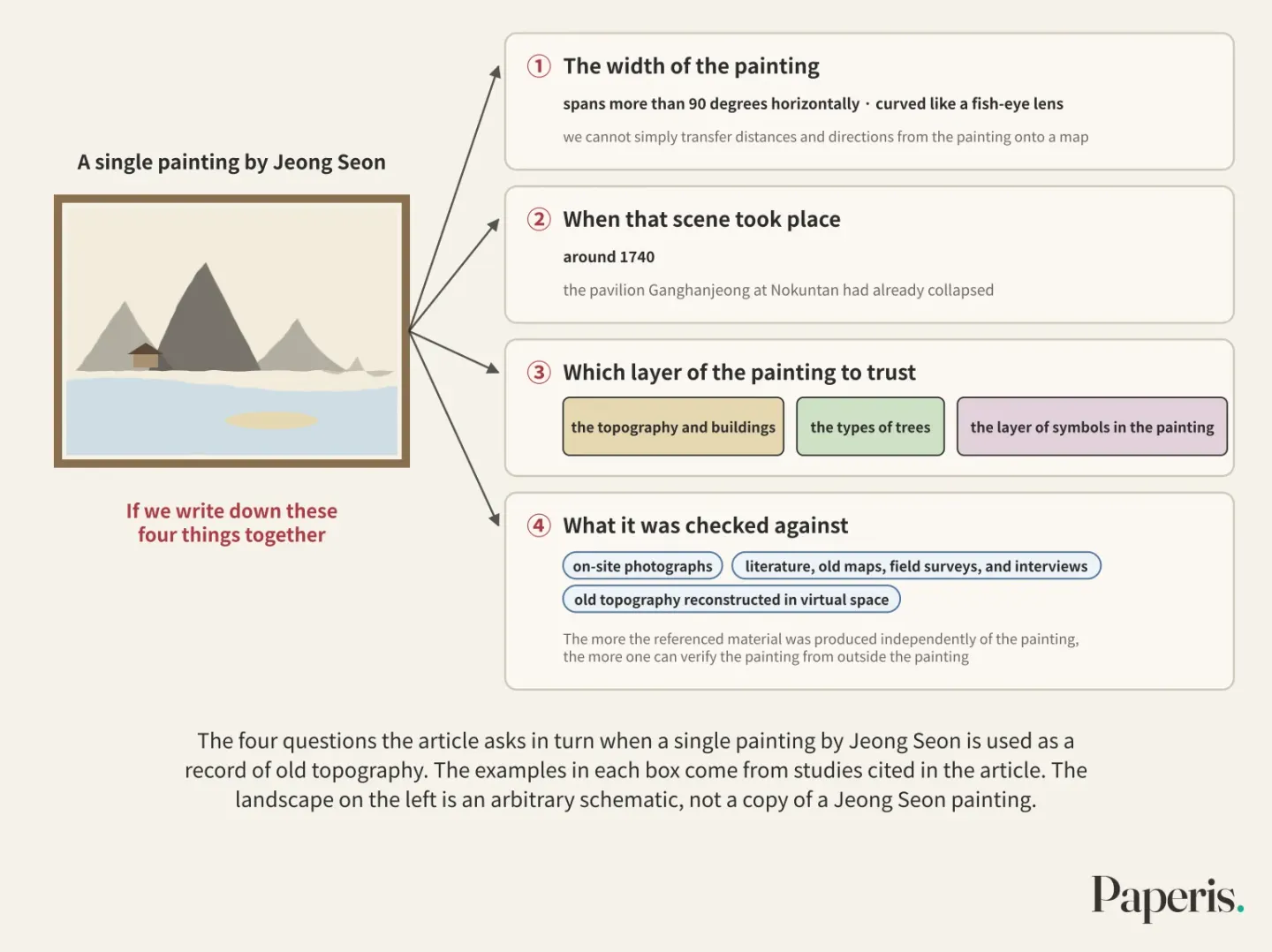
Let us suppose we are trying to locate a vanished sandbar of the Han River using a single painting by Jeong Seon. First, we must ask about the width of the painting. As one study suggests, if the painting spans more than 90 degrees horizontally (DOI: 10.23158/jkaa.2009.v3_06), and as another study analyzes, if it is curved like a fish-eye lens (KCI ART003128740), we cannot simply transfer distances and directions from the painting onto a map.
Next is the question of when that scene took place. Around 1740, when Gyeonggyo Myeongseung-cheop is said to have been painted, the pavilion Ganghanjeong at Nokuntan had already collapsed, and the Mongojeong pavilion captured in the painting was also losing its name. Therefore, the question arose that if the work depicts the greatest scenic spot on the Han River, its production date must be earlier (DOI: 10.17260/jklc.2021.58..127). Then comes the question of which layer of the painting to trust. Han River research read the topography and buildings but could not read the types of trees (KCI ART003311722), while research on the Cheongdam painting read the part where rocks and trees were switched as a matter of pungsu (DOI: 10.22755/kjchs.2022.56.1.172). Lastly is what it was checked against. Research on Gungsan checked it against on-site photographs (KCI ART001427688), research on Ssangdojeong-ji checked it against literature, old maps, field surveys, and interviews (KCI ART001645913), and research on “Nokuntan” checked it against old topography reconstructed in virtual space (KCI ART003128740). The more the referenced material was produced independently of the painting, the more one can verify the painting from outside the painting. Old maps were not always separate from paintings either. In old maps from the late 18th century onward, there are not a few instances cited as being influenced by Jeong Seon's painting style (KCI ART002400368).
If we write down these four things together, Jeong Seon's paintings can become clues to the vanished riverside. There are paintings that align perfectly from a single spot, like the ten scenes of Gungsan (KCI ART001427688). Researchers have read from Jeong Seon's paintings the now-vanished sandbars and ferries of the Han River (KCI ART003311722), as well as the ponds and gardens of vanished houses (KCI ART001427684). Separately from Jeong Seon's paintings, even in 18th-century paintings of Cheongganjeong by anonymous artists, there are cases where spots that seemed like mistakes were actually real structures (DOI: 10.14769/jkaahe.2024.08.48.7).
Open questions still remain. Whether Jeong Seon painted from memory, or intentionally expanded and altered the view, cannot be confirmed by Jeong Seon's own words. The study presenting Jeong Seon's screen width in angle-of-view figures is only one among the pieces of evidence gathered in this article, and explaining that width as the result of painting from memory is that study's interpretation. There is also research that treats Jeong Seon's broadly expanded or curved screen as a repeatedly used compositional method. Whether to read the "true" (jin) in "True-view Landscape Painting" (jingyeong) as actual or as an idealized true appearance also differs among scholars.
Jeong Seon's paintings can serve as a window to look into the old rivers and mountains, but some windows are broadly expanded or curved, and all of them are windows that have passed once through the painter's eye and brush. Whether that window was curved by memory or by intent remains open, and to use a painting as a record, one must write down the shape of the window together.
Source Papers
- "Painting from Actual Scenery and Painting from Memory: Viewpoint and Angle of View in Landscape Paintings of the Late Joseon Dynasty" (2009) — DOI: 10.23158/jkaa.2009.v3_06 — Two branches of late Joseon landscape painting from actual scenery: Jeong Seon's angle of view of 90–150 and 180 degrees (under 28mm and panoramic) vs. Kim Hong-do's 47–62 degrees (35mm and 50mm); an explanation stream that it is broad because it was painted from memory; categorization of Jeong Seon as a literati painter; authors' interpretations: Neo-Confucian ideals, the Book of Changes, Noron faction / post-Neo-Confucianism.
- "Analysis of <Nokuntan> in Jeong Seon's “Gyeonggyo-myeongseung-cheop” Using Virtual Reality Analysis Tools" (2024) — KCI ART003128740 — Reconstructing terrain lost to the Paldang Dam water level changes in virtual space, estimating observation points via image similarity, and analyzing fisheye lens distortion and panoramic composition.
- "A Study on the Viewpoint and Target Landscape of Ten Poetry-Painting Scenes in Gyeomjae Jeong Seon's "Gyeonggyo-myeongseung-cheop"" (2009) — KCI ART001427688 — Confirming through photographic comparison that the ten scenes are views from a single spot on Yangcheon Gusan, serving as material showing the old Han River area in a "realistic or at least closely similar" appearance.
- "Revisiting the Scenic Spots of Seochon and True-View Landscape Painting in the Late Joseon Dynasty" (2013) — KCI ART001742447 — Comparing Seochon paintings with actual scenery, suggesting the location of <Pilun-sanghwa> is near Seseimdae, and dating <Jangan-yeonwu> to 1753.
- "The Reality and Intent of Gyeomjae Jeong Seon's Cheongdamdo (Clear Pool)" (2023) — DOI: 10.22755/kjchs.2022.56.1.172 — Excavation of the 1756 Cheongdam folding screen, painted from recollection, interpreting a garden drawn differently from the site as a geomantic talisman (bibo).
- "New Perspectives on the Gangwon-do Eight Scenic Spots Archives and 18th-Century True-View Landscape Painting: Focusing on a Critical Review of Cheongganjeong Historical Materials" (2024) — DOI: 10.14769/jkaahe.2024.08.48.7 — Column-like tall pillar bases (jangchoseok) representing actual structures, a painting read as a sunrise actually depicting a moonrise, and the borrowing, adaptation, and editing of poetic lines.
- "Multilayered Mobility of Late Joseon True-View Landscape Paintings of the Gangwon Region as Seen Through Inscriptions and Iconography" (2025) — DOI: 10.21208/kla.2025.12.56.637 — Accumulation and utilization of painting manuals and sketches (hwabon and hwago), repetition and variation of iconography, and patronage orders and accompaniment being decisive for Jeong Seon's scene composition.
- "Visual Reconstruction of Real Topography: A Study on Zhao Mengfu's "Autumn Colors on the Qiao and Hua Mountains" and Jeong Seon's "Inwangjesaekdo" from an Iconological Perspective" (2026) — KCI ART003360633 — Iconifying identifiable real mountains and rivers through brush-and-ink and composition.
- "The “Pigeumjeong-do” of 1789: Kang Se-hwang's Exploration and Conclusion Regarding True-View Landscape Painting" (2017) — DOI: 10.14380/AHF.2017.45.129 — Kang Se-hwang's critique of Jeong Seon's paintings of Mount Kumgang, Western painting techniques in “Songdo-gihaeng-cheop”, and <Pigeumjeong-do> having little relation to the actual landscape.
- "Haeak Jeonsin: Reconsidering the Creation of Jeong Seon's 1712 Paintings of Mount Kumgang" (2020) — DOI: 10.22835/ahvc.2020..25.004 — Delicate depiction in 1711, hwiwae-beop (sweeping brush technique) in 1712, and Yi Ha-gon's critiques on hyeongsa (resembling form) and jeonsin (transmitting spirit).
- "From Print to Landscape: The Transition of 17th-Century True-View Landscape Painting and Jeong Seon's Mount Kumgang Paintings" (2025) — DOI: 10.22835/ahvc.2025..35.004 — Doubts on the overestimation of landscape print theory, high documentary value of “Gugun-gugok-do”, the goal of Jeong Seon's painting being the expression of emotion rather than accurate depiction (authors' conclusion), and 17th-century explorations driving true-view landscape painting.
- "Gyeomjae Jeong Seon's True-View Landscape Painting and Western Painting Techniques" (2014) — DOI: 10.31065/ahak.281.281.201403.003 — Jeong Seon's use of techniques derived from Western painting since his thirties, fusing perspective and projection drawing with tradition.
- "Jeong Seon's “Sinmyonyeon-pungak-do-cheop”: The 1711 Trip to Mount Kumgang and the Formation of True-View Landscape Painting" (2012) — DOI: 10.22835/ahvc.2012..11.008 — Formation of painting style during the 1711 trip, with Jeong Seon leaving behind no painting theory.
- "An Analysis of Ideational Image (Uisang) and Iconographic Nature Appearing in Gyeomjae's "Geumgangjeondo"" (2014) — KCI ART002030815 — Lack of basis for Jeong Seon himself discussing "true views" (jingyeong), and criticism of nationalist interpretations from the 1970s and 1980s.
- "True-View Landscape Painting of the Early and Middle Joseon Dynasty: Focusing on Actual Surviving Works and Their Sites" (2010) — KCI ART001475833 — Pre-Jeong Seon true-view tradition, with the more realistic true views of Han Si-gak and Jo Se-gol in the 17th century.
- "Geomorphological Interpretation of the Danyang Eight Scenic Spots and Surrounding National Geoparks Depicted in True-View Landscape Paintings" (2023) — DOI: 10.25202/JAKG.12.1.7 — Defining late Joseon landscape paintings as a style portraying actual terrain close to reality, and interpreting Danyang topography.
- "A Consideration on the Interpretation of True-View Landscape Painting" (2009) — DOI: 10.35657/jae.2009.25..005 — Superficiality of public understanding, concluding with the originality and artistry of Jeong Seon's true views.
- "Clashes and Divergences of Theories Regarding True-View Landscape Painting in the Late Joseon Dynasty" (2024) — DOI: 10.37981/hjhrisu.2024.12.71.205 — The "True-View Era" theory (Choi Wan-soo, etc.) and counterarguments, two branches since the 2000s, and historiographical significance.
- "Gyeomjae Jeong Seon (1676–1759) and His True-View Landscape Painting: How to View Them" (2012) — KCI ART001680630 — Records of Dohwaseo (Royal Bureau of Painting) employment and commercial production, absence of evidence for claims of a Sinocentric succession consciousness, and arbitrary division of the "True-View Era".
- "A Reconsideration of the Friendship Between Jeong Seon and Yi Byeong-yeon" (2019) — DOI: 10.22835/ahvc.2019..23.001 — Yi Byeong-yeon as friend and order broker, selling paintings via envoy letters.
- "The Kim Chang-hyeop School and True-View Landscape Painting" (2005) — KCI ART000977801 — Evaluation of the value of "truth" (jin), ambiguity of the dual regulation of actual scenery and spirit, and definition as idealist landscape painting.
- "Jeong Seon's 'Imitating Antiquity and Consulting the Present' (Banggo-chamgeum) — Complementarity Between Late Joseon Banggo Landscape Painting and True-View Landscape Painting" (2008) — DOI: 10.31065/ahak.257.257.200803.006 — True view = ideal true appearance, complementarity of banggo (imitating ancient styles) and true scenery, and critique of modern ideology.
- "Jeong Seon's Mount Kumgang Paintings and Painting-Like Poetry — Reconsidering the Meaning of True-View Landscape Painting" (2017) — DOI: 10.30527/klcc..66.201706.007 — Arbitrariness of terminology, a term created in later generations.
- "A Polemic Against the Emptiness of True-View Landscape Painting Research" (2012) — DOI: 10.17963/ccek.2012..38.309 — Critique of single-country perspectives, and connections to travel accounts of mountains, colored maps, envoy journeys, and Western painting.
- "Interpretation of Han River Riparian Scenery Expressed in Gyeomjae Jeong Seon's True-View Landscape Painting" (2026) — KCI ART003311722 — 25 paintings, commentaries, maps before and after development, sandbars, cliffs, and ferries, with limitations in identifying vegetation species.
- "Traditional Gardens Expressed in Gyeomjae's True-View Landscape Painting" (2009) — KCI ART001427684 — Identification of demolished yangban houses and gardens, such as the three square ponds in <Cheongpunggye-do>.
- "A Study on the Location and Characteristics of the Ssangdo-jeongji Depicted in Gyeomjae Jeong Seon's Paintings" (2011) — KCI ART001645913 — Literature, old maps, field surveys, interviews, foundational data for restoration, with mechanical diagrams remaining unresolved.
- "The Appearance of the Late Joseon Han River Depicted in Jeong Seon's “Gyeonggyo-myeongseung-cheop”: From Nokuntan to Miho" (2021) — DOI: 10.17260/jklc.2021.58..127 — Nokuntan = Daetan-byeolsseo, Ganghan-jeong already collapsed, Mongojeong losing fame → questions regarding the circa 1740 production date theory.
- "Research Feasibility of Tracking Weathering and Erosion Using True-View Landscape Painting" (2013) — DOI: 10.15737/ssj.7.2.201306.63 — Treating Kim Hong-do's 1796 painting of Dodam Sambong as a photograph, comparing outlines to show maximum erosion of the central peak (Science Education Academic Journal).
- "Jeong Seon's Fan Paintings: Renewal of Poetic Intent (siui) and Actual Scenery (silgyeong)" (2025) — DOI: 10.18707/jacs.2025.8.32.219 — Utilizing fan paintings as a medium to expand the viewer's field of vision and re-examine the landscape.
- "A Study on the Life and Paintings of Chowon Kim Seok-sin" (2023) — DOI: 10.52557/tpsh.2023.127.313 — Source for the birth and death dates of Kim Hong-do (1745–1806?).
Sources (20)
- Painting from Actual Scenery and Painting from Memory: Viewpoint and Angle of View in Landscape Paintings of the Late Joseon DynastyDOI 10.23158/jkaa.2009.v3_06
- 겸재 정선(謙齋 鄭敾) 〈청담도(淸潭圖)〉의 실재(實在)와 작의(作意)DOI 10.22755/kjchs.2022.56.1.172
- 관동팔경 아카이브와 18세기 실경산수의 새로운 시각: 청간정 사료의 비판적 검토를 중심으로DOI 10.14769/jkaahe.2024.08.48.7
- 화제와 도상으로 본 조선 후기 강원지역 실경산수화의 다층적 이동성DOI 10.21208/kla.2025.12.56.637
- 1789년의 〈피금정도〉: 강세황의 실경산수화에 관한 모색과 귀결DOI 10.14380/ahf.2017.45.129
- 해악전신: 정선의 1712년 금강산도 제작에 관한 재고DOI 10.22835/ahvc.2020..25.004
- 판화에서 산수로: 17세기 실경산수화의 전환과 정선의 금강산도DOI 10.22835/ahvc.2025..35.004
- 謙齋 鄭敾의 眞景山水畵와 西洋畵法DOI 10.31065/ahak.281.281.201403.003
- 정선의 《신묘년풍악도첩》: 1711년 금강산 여행과 진경산수화의 형성DOI 10.22835/ahvc.2012..11.008
- 실경 산수화에 나타난 단양팔경과 주변 국가지질공원에 대한 지형학적 해석DOI 10.25202/jakg.12.1.7
- 진경산수화의 해석에 대한 고찰DOI 10.35657/jae.2009.25..005
- 조선후기 진경산수화 관련 학설의 충돌과 분기DOI 10.37981/hjhrisu.2024.12.71.205
- 정선과 이병연의 우정에 대한 재고DOI 10.22835/ahvc.2019..23.001
- 鄭敾의 '倣古參今' — 조선후기 倣古산수화와 實景산수화의 相補性DOI 10.31065/ahak.257.257.200803.006
- 정선의 금강산 그림과 그림 같은 시 — 진경산수화 의미 재고DOI 10.30527/klcc..66.201706.007
- 眞景山水 연구의 虛에 대한 辨證DOI 10.17963/ccek.2012..38.309
- 鄭敾의 《京郊名勝帖》에 그려진 조선 후기 漢江의 모습: 綠雲灘에서 渼湖까지DOI 10.17260/jklc.2021.58..127
- 진경산수화를 이용한 풍화 침식 추척 연구 가능성DOI 10.15737/ssj.7.2.201306.63
- 정선의 선면화: 시의(詩意)와 실경(實景)의 쇄신DOI 10.18707/jacs.2025.8.32.219
- 초원 김석신의 생애와 회화 연구DOI 10.52557/tpsh.2023.127.313