Paperis Articles
Turner — Did the Hazy Skies Hold the Air?
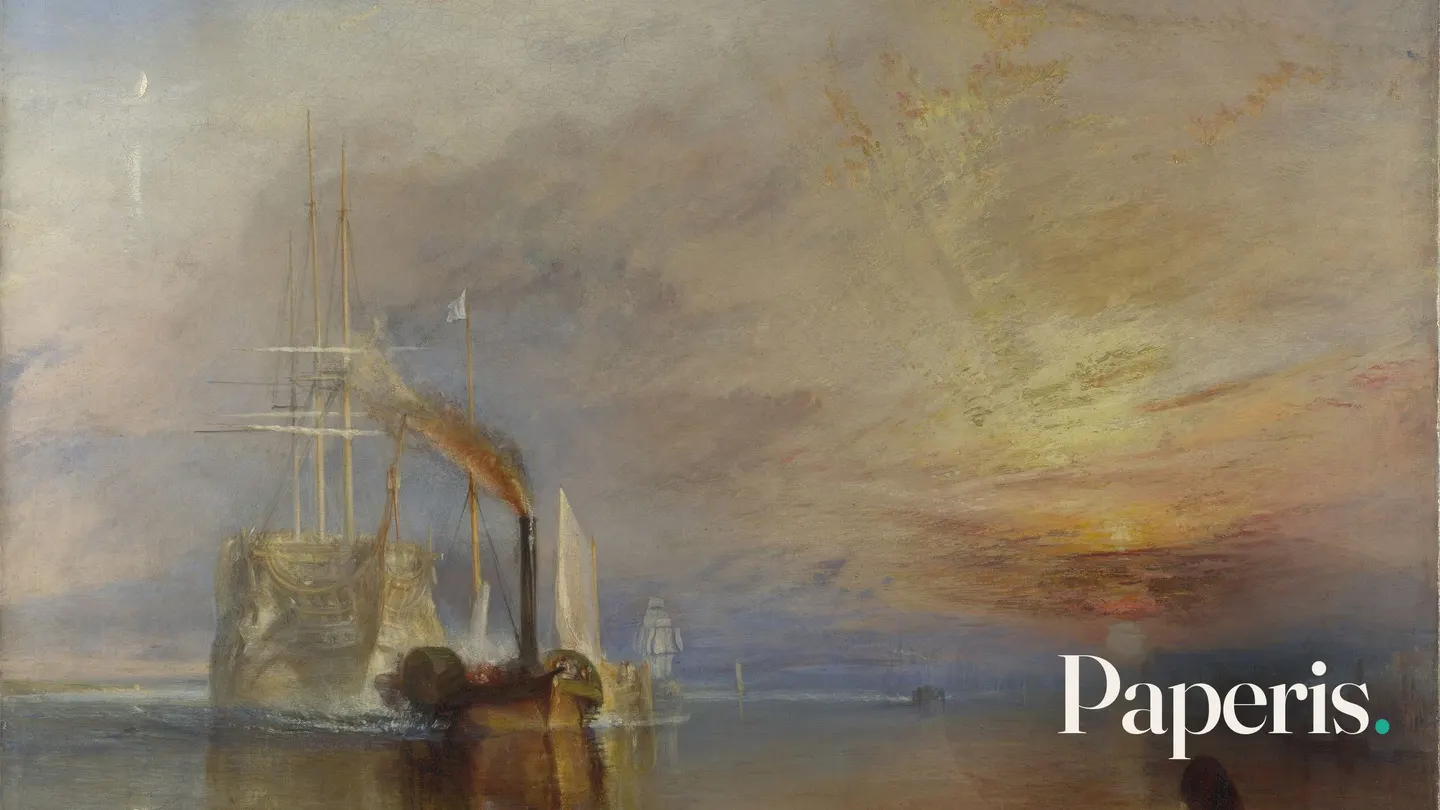
In Turner's The Fighting Temeraire the sunset blazes red; in Rain, Steam and Speed the sky is hazy. One team of atmospheric scientists compared the redness of hundreds of painted sunsets, by artists the summaries do not name, with records of volcanic eruptions; a 2023 study compared the haziness of paintings by Turner, Monet and others with 19th-century air pollution. What did they measure, and how much of saying the paintings 'captured' changes in the light is interpretation?
Your field's papers, as audio
Pick your fields and journals — Paperis summarizes the key papers and turns them into audio. Listen on your commute.
Start Paperis free →Turner — Did the Hazy Skies Hold the Air?
Around 1840 London, the Red and Hazy Skies in Paintings
The British painter Joseph Mallord William Turner (1775–1851) was based in London and painted many seascapes and skies. In his 1839 work The Fighting Temeraire, a sunset burns across the river as a retired warship is towed by a steam tug. In his 1844 work Rain, Steam and Speed, a train crossing a bridge dissolves into rain and mist, its form blurred. Both paintings are in the collection of the National Gallery, London. When standing before these paintings, one question arises: Was that red and hazy sky a painterly habit, or was the sky of that era really like that?
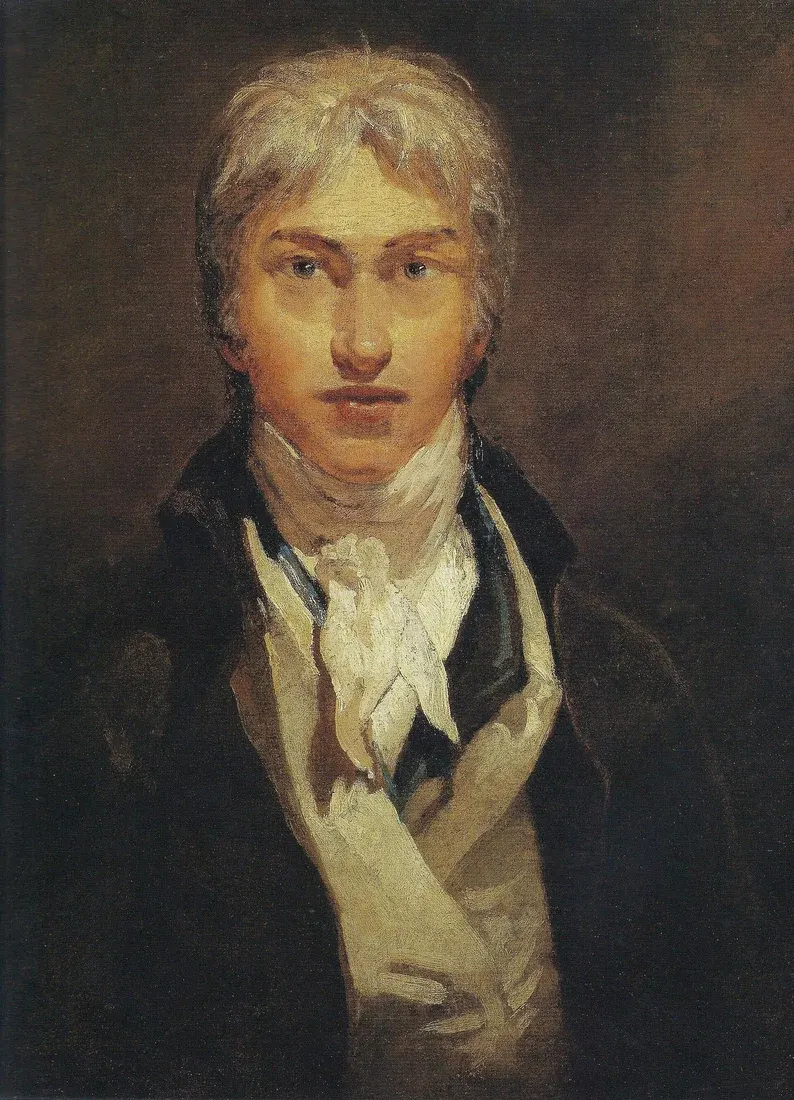
J. M. W. Turner, Self-Portrait (c. 1799) · Tate, London · public domain · Wikimedia Commons
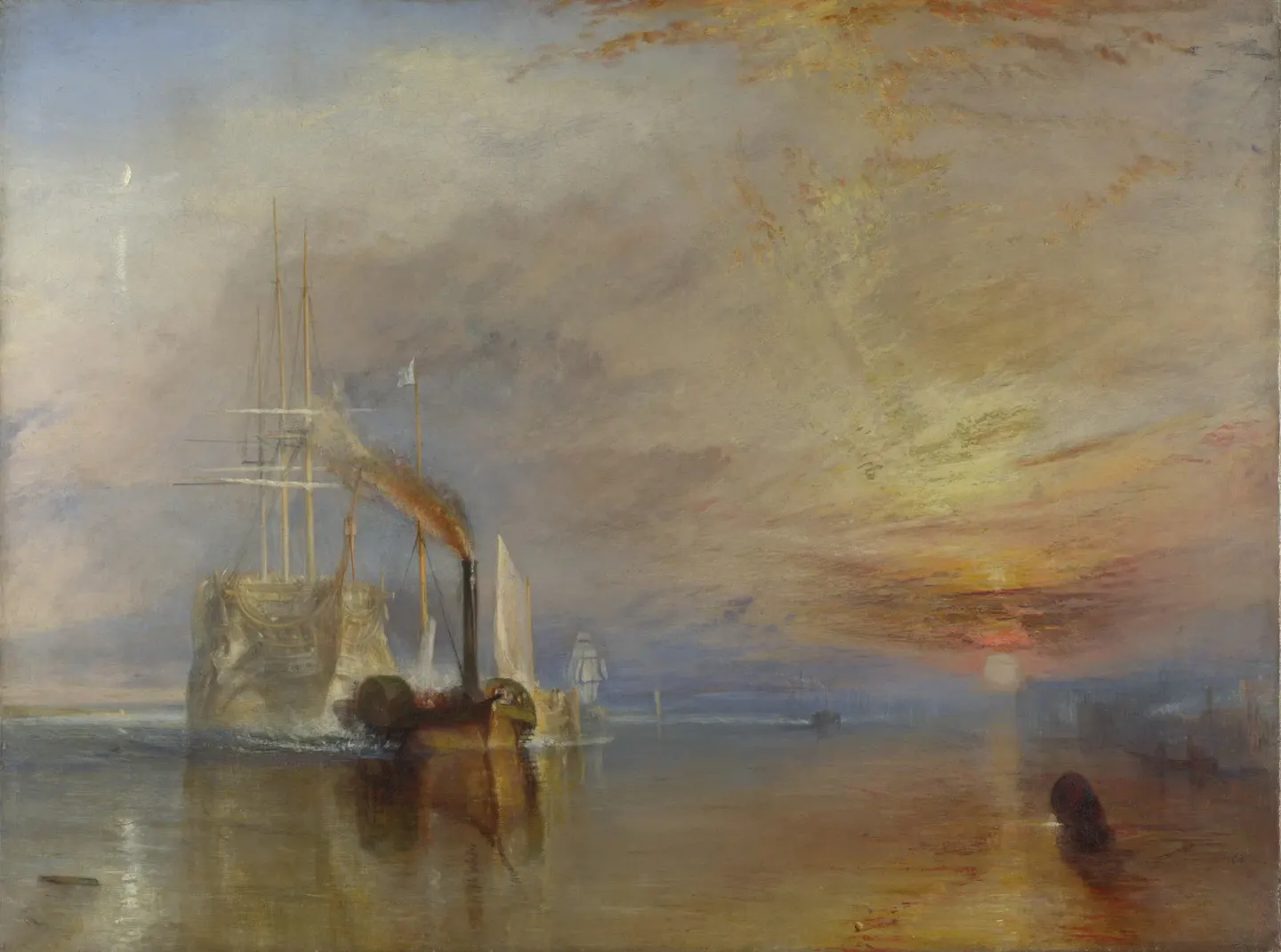
J. M. W. Turner, The Fighting Temeraire (1839) · The National Gallery, London · public domain · Wikimedia Commons
Studies that have tried to solve this question with numbers fall into two branches. One branch measured the redness. An atmospheric science team measured how red the sky was in hundreds of sunset paintings spanning hundreds of years and compared it against records of volcanic eruptions, though the published summary does not disclose who painted those paintings. The other branch measured the haze. A 2023 study named Turner and the French painter Claude Monet, measuring the contrast between light and dark and the intensity of light in their paintings to compare them against 19th-century urban air pollution records. The side bearing Turner's name is the haze, and Turner's share in the redness side is unknown. This article will follow these two branches in turn, without transferring the results of one side to the other.
Particles in the Sky That Paint the Sunset
On August 27, 1883, the Krakatoa volcano erupted. This was roughly 30 years after Turner passed away. Thousands of people lost their lives, and huge ocean waves and atmospheric disturbances were captured all over the globe. Billions of tons of volcanic ash soared into the sky, and various colourful sunsets appeared in its wake. This was the result of particles floating in the sky scattering sunlight (DOI: 10.19195/0301-7966.58.1).
Aerosols are tiny particles or water droplets floating in the air. Volcanic ash, dust blown from deserts, and chimney smoke all fall into this category. To understand why sunsets are red, we must first look at this: when the sun sinks close to the horizon, sunlight passes obliquely through a much longer layer of air to reach our eyes than when it beats down from overhead. Along that long path, blue light is scattered in all directions and lost, leaving relatively more red light behind. When there are more particles in the sky here, the way light is scattered changes, and the colour of the sunset changes too. The colour of a sunset shifts depending on what is floating in the sky at that moment.
The sunsets after Krakatoa were seen in most parts of the world. A report titled "The Eruption of Krakatoa and Subsequent Phenomena" published in 1888 by the Royal Society, a scientific body in the UK, has a separate section collecting the strange evening glows seen in various places around the world in 1883–84. Several poets, including the British poet Alfred Tennyson, also captured these sunsets in their poetry (DOI: 10.19195/0301-7966.58.1). An observational record by scientists and a poem by a poet remain side by side regarding the same sky.
However, there were almost no machines that recorded that redness in numbers. The period from 1500 to 1900 is an era with almost no records of the atmosphere measured by machines (DOI: 10.5194/acp-7-4027-2007). The red sunset after a large eruption is a trace left by particles floating in the sky, but the period for which the ledger measuring those traces was empty was long.
Measuring Red Light in Hundreds of Sunsets
Can an empty ledger be filled with paintings? An atmospheric science study published in 2007 started from this question. A proxy is a clue that lets us estimate past values we could not measure directly, using other records that moved together with those values. The research team gathered hundreds of sunset paintings by renowned artists between 1500 and 1900, examined whether the paintings could serve as a proxy for the sky following major volcanic eruptions, and reported that the paintings do provide such information (DOI: 10.5194/acp-7-4027-2007).
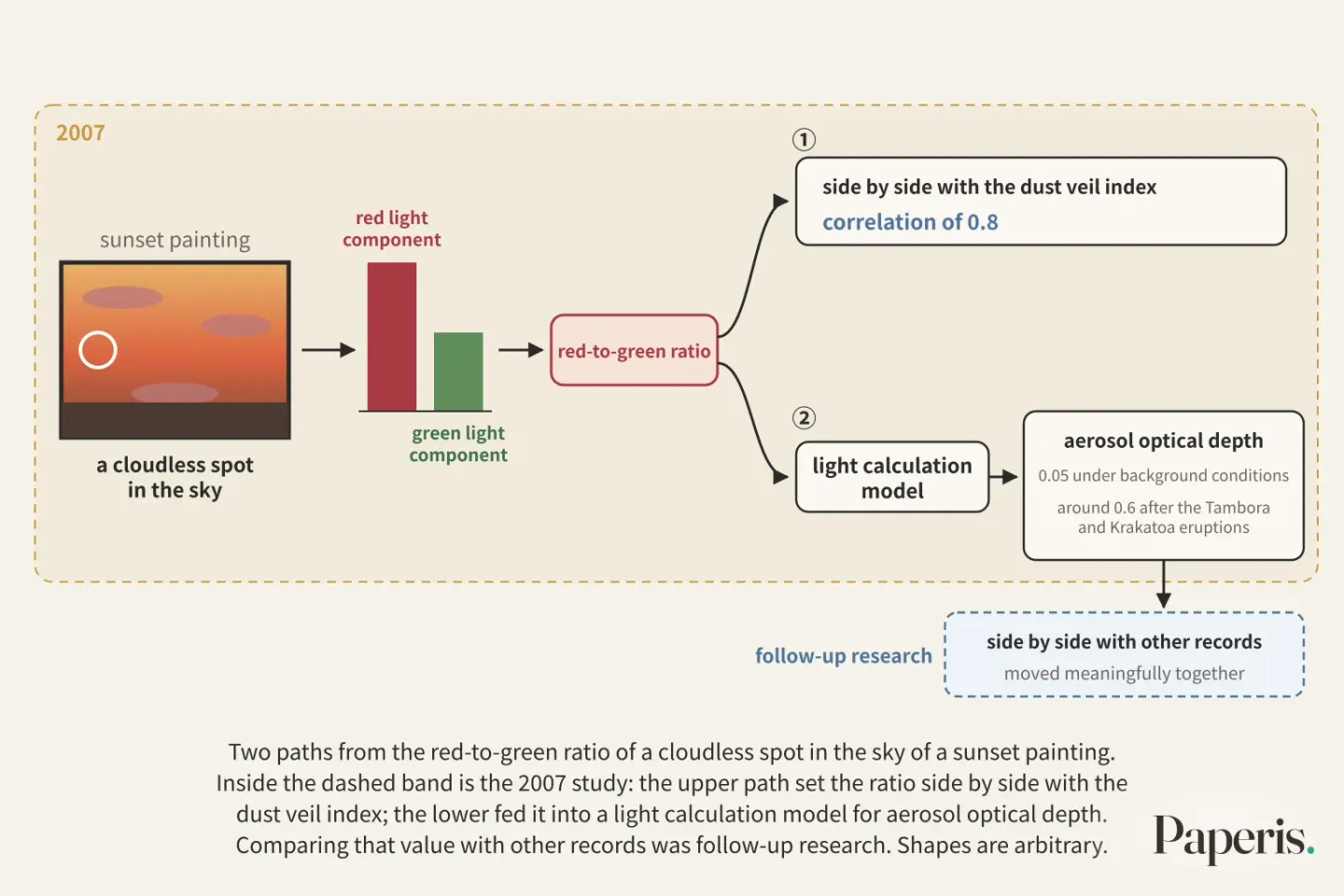
What the researchers measured in the paintings was a single colour. The red-to-green ratio is the value obtained by dividing the red light component by the green light component at a single spot in the sky within a painting, and it increases the redder the sunset is. The dust veil index is an existing index that rates how dense the dust veil cast over the sky by a volcanic eruption was for each eruption. The researchers compared the red-to-green ratio of the paintings with this index. The correlation coefficient between the two was 0.8, which was a statistically meaningful level (DOI: 10.5194/acp-7-4027-2007). This means that the paintings from periods when the dust veil was denser showed a clearer tendency for sunsets to be painted redder.
The research team went a step further. Aerosol optical depth is a value representing how much aerosols in the sky block and scatter sunlight with a single number, and the closer it is to 0, the clearer the sky. The researchers plugged the red-to-green ratio of the paintings into a model that calculates the process of light scattering and diminishing as it passes through air and particles, thereby inversely calculating this value for the mid-latitude sky of the Northern Hemisphere. The values calculated from the paintings were roughly 0.05 under background conditions with almost no volcanic dust, and around 0.6 after the Tambora and Krakatoa eruptions (DOI: 10.5194/acp-7-4027-2007).
Follow-up research in the same study lineage reconfirmed two things (DOI: 10.5194/acp-14-2987-2014). First, while the previous analysis measured colours from painting photographs uploaded on the internet, comparing them with images obtained by applying precise colour measurement procedures to the paintings showed that internet photos also provided accurate information. Second, the aerosol optical depth calculated from the paintings moved meaningfully together not only with the dust veil index but also with mutually independent records such as stratospheric aerosol observation data and volcanic trace indices left in ice cores extracted from glaciers. The redness of the sunsets in the paintings pointed in the same direction as multiple other lines of records.
Tracing a single painting makes this method tangible. Suppose there is a sunset painting created within a few years after a major eruption. First, pick a cloudless spot in the sky, measure the shares of red and green light from the colour of that spot, and produce the red-to-green ratio. Gathering this value across hundreds of paintings and placing it side by side with the dust veil index is the comparison with a correlation of 0.8. Putting the same value into the light calculation model yields an estimate of the aerosol optical depth of the sky for that year, and follow-up research placed this estimate side by side with other records. The value of a single point is an estimate filtered through an artist's hand, and what the research relies on is the trend drawn by the values of hundreds of points.
Where does Turner fit in here? The published paper abstract does not disclose how many paintings by which artist were included in the sample of hundreds. The 1815 Tambora eruption occurred around the time Turner was forty years old, and the Krakatoa eruption took place after he passed away. Whether Turner's sunsets were included in the values after Tambora cannot be known from the abstract alone. What the studies that measured redness showed is the trend in which hundreds of sunsets moved together, and evidence that a single sunset by Turner recorded Tambora is not contained within it.
Placing a Painter Under a Dusty Sky
With old paintings alone, there is no way to know whether a painter truly saw and painted the sky on that day. Subsequent researchers designed a direct experiment to support the previous results (DOI: 10.5194/acp-14-2987-2014).
It was a time when dust from the Sahara Desert was passing over the sky of the Greek island of Hydra. A painter skilled in handling colour painted the sunset during the passage of the dust and the sunset that followed, in that order. At the same location, an observation instrument was placed to measure sunlight and find the aerosol optical thickness of the sky. The researchers measured the red-green ratio from the painter's paintings and put it into the previous calculation model to find the aerosol optical thickness. That value matched the value measured on the spot by the observation instrument during the stage when the dust was clearing (DOI: 10.5194/acp-14-2987-2014). While the dust was clearing, the redness chosen by the brush met the machine's numbers through calculation.
Sahara dust is mineral particles from a desert, so it differs from particles originating from volcanoes. The researchers tested this difference separately, and the difference in the red-green ratio between typical volcanic aerosols and Hydra's mineral aerosols was small, ranging from −2.6% to +1.6%. Even when measuring different parts of a cloudless sky in paintings after a large eruption, different picture compositions per painting did not change the results (DOI: 10.5194/acp-14-2987-2014).
The scope of this experiment is also clear. There is one painter, one dust event, and what matched the machine is the stage where the dust is clearing. And this experiment involves a single modern painter participating in the experiment and painting the sky right in front of their eyes. Whether painters hundreds of years ago transferred the sky with the same attitude is not a question this experiment answers. That a trained eye and brush can be consistent enough to turn the turbidity of the sky into numbers, this experiment showed at least once.
The Sky in a Year Without Volcanoes, and Chimneys
What would the sky be like in a year when volcanoes are quiet? Subsequent researchers divided the period from 1500 to 2000 into 50-year blocks, separating out the year of an eruption and the 3 years following it as "volcanic years". The aerosol optical depth calculated from the pictures of the remaining "non-volcanic years" rose from around 0.15 in the mid-19th century to around 0.20 by the end of the 20th century. The researchers presented this as additional evidence that the sky became hazy over decades during the industrialization period (DOI: 10.5194/acp-14-2987-2014). Because this value was calculated for each 50-year block using the remaining years after excluding volcanic years, its baseline differs from the "background condition" value of 0.05 from the earlier study. The two numbers are not directly compared. So far, this is the redness side of the story, and Turner's name does not appear in the summaries of these studies.
Turner's name appears on the haziness side. A study published in the Proceedings of the National Academy of Sciences (PNAS) in 2023 measured the same era with a different yardstick (DOI: 10.1073/pnas.2219118120). As the Industrial Revolution progressed in the 19th century, human-emitted aerosols increased to unprecedented levels, and this was especially true in Western European cities. Contrast is the difference between the bright parts and the dark parts within a single scene. In the thickened air, the light environment of cities had reduced contrast and increased light intensity. When contrast is reduced, a scene looks hazy and blurred.
Impressionism is an art movement that arose in France in the late 19th century, aiming to capture with rapid brushstrokes the fleeting impression given by outdoor light and colour. The painters this study focused on are Turner and Claude Monet (1840–1926), a French painter who represents Impressionism, and the statistical analysis also included works by other painters. According to a commentary accompanying this study, what was analysed was a selection of works among the two painters' paintings (DOI: 10.1073/pnas.2300462120). The researchers reported that the shift over the course of the 19th century in paintings by Turner and Monet drawn in London and Paris—moving from clear-cut shapes toward impression-focused expression—accurately reflects the physical changes in the light environment of those regions (DOI: 10.1073/pnas.2219118120).
The basis for this was pollutant gases. The change in sulfur dioxide emissions in those regions, which increased alongside industrialization, was a statistically very significant factor explaining the trends in contrast and light intensity in the works of Turner, Monet, and other painters. This remained true even after controlling for the passage of time and the subjects of the paintings (DOI: 10.1073/pnas.2219118120). Artistic style can change over the years, and haziness can also vary depending on whether one paints a misty river or a clear field. The core evidence of this study is that sulfur dioxide remained a significant factor even after controlling for these two things. "Very significant" means that the relationship is difficult to dismiss as a coincidence, and the summary does not state how much of the trend is explained by sulfur dioxide.
The researchers concluded that industrialization changed the environment in which Turner and Monet painted, and that their paintings captured changes in the light environment associated with an increasingly polluted atmosphere (DOI: 10.1073/pnas.2219118120). This conclusion was reached by naming the two painters. However, because the statistical results for sulfur dioxide are reported together for the works of Turner, Monet, and other painters, the summary does not reveal what share of that belongs to Turner's paintings. And what this study measured was contrast and light intensity, not the redness of a sunset. The interpretation of looking for changes in Monet's later paintings in the painter's eyes was covered in "Monet's Japanese Footbridge — The Same Bridge, Different Colours".
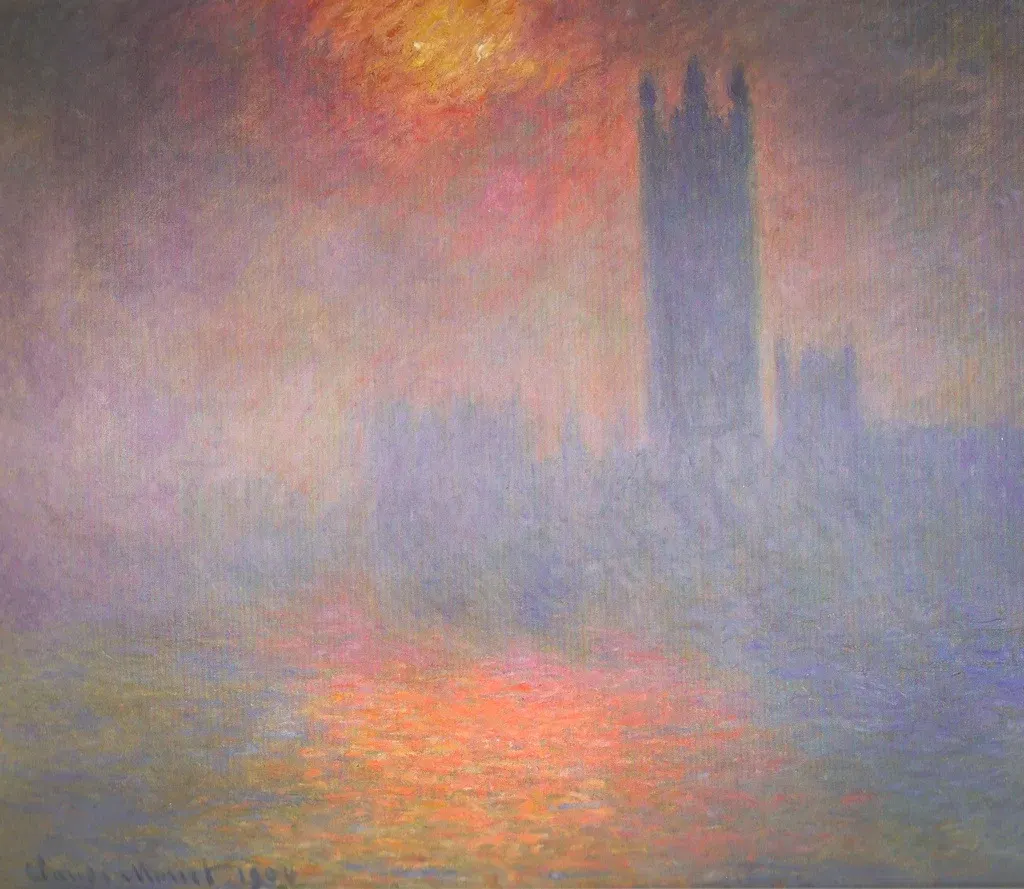
Claude Monet, London, Houses of Parliament. Sunlight through the Fog (1904) · Musée d'Orsay, Paris · public domain · Wikimedia Commons — the summaries do not say whether this painting was in the 2023 study's sample
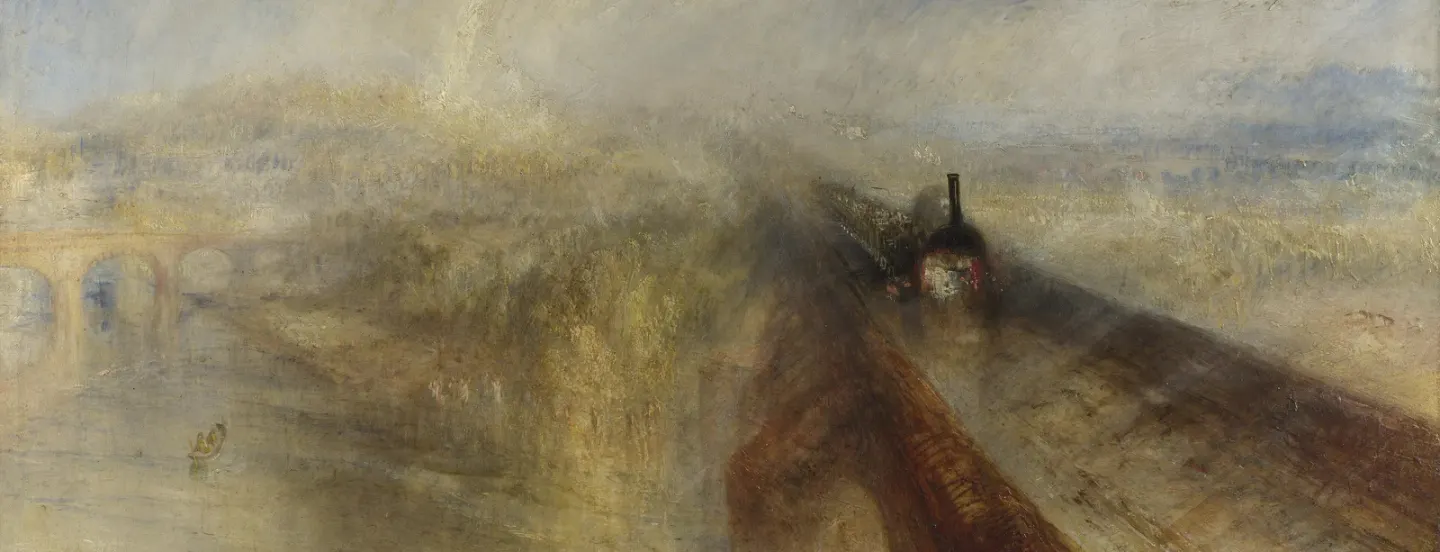
J. M. W. Turner, Rain, Steam and Speed (1844), detail · The National Gallery, London · public domain · Wikimedia Commons — the summaries do not say whether this painting was in the 2023 study's sample
Whose Is the Word "Record"?
The effect of clouds on red-to-green ratios has not yet been fully sorted out. The volcanic sunset research team wrote themselves that studies are still needed to closely examine, one by one, the uncertainties that could interfere with this method, including clouds. They also wrote that they were proposing their conclusion "provisionally." The conclusion was that the red-to-green ratio of masters could serve as an independent proxy regardless of artistic school, and the basis they cited for this was the large number of paintings analyzed (DOI: 10.5194/acp-14-2987-2014). The power of this method comes from the weight of hundreds of paintings rather than the accuracy of a single painting.
A commentary was published in the same journal in 2023. A commentary is an evaluation article written by another researcher after reading the study, and it does not contain new measurement results. The commentary evaluated that this study convincingly showed that the two painters faithfully painted the impact of pollution on urban air, and gave the two painters' paintings the name "polluted realism." The same commentary noted that such paintings are usually finished in the studio some time later rather than on-site, and argued on that basis that this name summarizes their paintings well (DOI: 10.1073/pnas.2300462120). The commentator read the studio finish as evidence supporting "polluted realism." The same fact can be questioned differently. The skies in Turner's and Monet's paintings may not be an on-the-spot transcription of the sky at a specific date and time. Studies measuring how that difference affects the measurements are not among the evidence gathered in this article.
Questions remain that cannot find answers in the abstract. Whether centuries-old paint retains its original colours, whether there is a bias created by selecting only paintings by famous painters, and how paintings where the painter intentionally painted sunsets redder were filtered out—the paper abstracts covered here do not tell us how they handled these questions. Neither research directly refuting this method nor independent replications of the same method by other research teams are present within the evidence gathered in this article. Therefore, most of the limitations visible now are ones the research team wrote themselves, and how large those limitations are cannot be judged from these pieces of evidence.
What remains is the weight of words. What the measurements showed is the fact that the redness of many paintings moved together with records of volcanic eruptions, and that the contrast and light intensity of paintings by painters including Turner and Monet moved together with records of pollution emissions. The statements that the flow of paintings "accurately transcribed" changes in the light environment and that the paintings "captured" those changes are the research team's conclusions, and the statement that the two painters "faithfully painted" the impact of pollution is the commentator's evaluation. Both are interpretations laid on top of measurements. No measurement measured what the painter intended to record.
So What Did We Learn
We stand before “The Fighting Temeraire” once again. There is no basis in these studies to say that this single piece recorded the sky of a certain day in 1839. What the basis speaks of is groups of paintings. Hundreds of sunsets by anonymous painters grew red alongside the records of major eruptions, one skilled painter rendered a clearing dusty sky to match the instruments, and the paintings of Turner, Monet, and other painters lost contrast alongside urban sulfur dioxide emissions.
What these bases say about Turner leans toward the blurry. In 2023, researchers concluded that the paintings of Turner and Monet captured changes in the light environment associated with an atmosphere that became increasingly polluted during the Industrial Revolution. What the researchers measured was contrast and light intensity, not redness, and these bases do not tell us whether the red sunset of “The Fighting Temeraire” moved alongside volcanic eruptions. The volcanic sunset researchers tentatively proposed that collecting and measuring many sunset paintings can serve as a proxy indicator for reading traces of past skies, and uncertainties like clouds and questions of the sample remain open.
Source Papers
- "Atmospheric effects of volcanic eruptions as seen by famous artists and depicted in their paintings" (2007) — DOI: 10.5194/acp-7-4027-2007 — The red-to-green ratios of hundreds of sunset paintings by famous artists from 1500 to 1900 correlate at 0.8 with dust veil indices; radiative transfer models estimate Northern Hemisphere mid-latitude aerosol optical depths from 0.05 (background conditions) to roughly 0.6 (after Tambora and Krakatoa), covering the era before instrumental observations.
- "Further evidence of important environmental information content in red-to-green ratios as depicted in paintings by great masters" (2014) — DOI: 10.5194/acp-14-2987-2014 — Internet images match precision color-measured photographs; painting-based optical depths correlate with stratospheric data, dust veil indices, and ice core indicators; non-volcanic years shift from 0.15 (mid-19th century) to roughly 0.20 (late 20th century); in the Hydra Saharan dust experiment, the painter's values match the declining-phase observations; volcanic versus mineral aerosol differences range from −2.6 to +1.6%; uncertainties like clouds require further study, and conclusions are tentative.
- "Paintings by Turner and Monet depict trends in 19th century air pollution" (2023) — DOI: 10.1073/pnas.2219118120 — The shift of Turner and Monet's paintings from figurative to impressionistic in 19th-century London and Paris reflects changes in the light environment; local sulfur dioxide emissions are a statistically highly significant explanatory variable for trends in contrast and light intensity in works by Turner, Monet, and other painters (even after controlling for time trends and subject matter); authors' conclusion: industrialization changed the two painters' environments, and the paintings captured changes in the light environment of polluted atmospheres.
- "Polluted realism in the art of Turner and Monet" (2023, commentary) — DOI: 10.1073/pnas.2300462120 — A PNAS commentary on the above study, evaluating that the two painters truthfully depicted the effects of pollution and coining the term "polluted realism", citing the point that paintings were generally completed in the studio some time later.
- "“The wrathful sunset glared…”: The Krakatoa Sunsets in Victorian Science and Art" (2020) — DOI: 10.19195/0301-7966.58.1 — The August 27, 1883 Krakatoa eruption, multicolored sunsets created by billions of tons of volcanic ash and aerosol scattering, analysis of the Royal Society's 1888 report on worldwide evening glow records and responses by poets such as Tennyson.
Sources (5)
- Atmospheric effects of volcanic eruptions as seen by famous artists and depicted in their paintingsDOI 10.5194/acp-7-4027-2007
- Further evidence of important environmental information content in red-to-green ratios as depicted in paintings by great mastersDOI 10.5194/acp-14-2987-2014
- Paintings by Turner and Monet depict trends in 19th century air pollutionDOI 10.1073/pnas.2219118120
- Polluted realism in the art of Turner and MonetDOI 10.1073/pnas.2300462120
- The wrathful sunset glared…DOI 10.19195/0301-7966.58.1