Paperis Articles
Rembrandt — Did Eyes That Look Misaligned See a Flatter World?
A stereoblindness hypothesis born from the art-class habit of closing one eye, the seemingly misaligned gaze in his self-portraits, stereo tests on groups of artists, and the limits of reading a painting as a medical record
Your field's papers, as audio
Pick your fields and journals — Paperis summarizes the key papers and turns them into audio. Listen on your commute.
Start Paperis free →Rembrandt — Did Eyes That Look Misaligned See a Flatter World?
The Painter in Front of a Mirror
The 17th-century Dutch painter Rembrandt van Rijn painted his own face throughout his life until he passed away in 1669. The self-portraits he left behind number around 90 (PMID 31232803). Rembrandt's self-portraits have served as material for doctors, and doctors have searched these faces for traces of illness (PMID 23674298).
This article follows one question among them. In a few of Rembrandt's self-portraits, the two eyes appear to look at slightly different places. If so, were Rembrandt's eyes actually misaligned? And did such eyes make him see the world flat, helping him paint on a flat canvas? The question of whether a painting style can be intentionally created by a painter or influenced by vision is also a question taken as a starting point by a review covering the eye diseases of famous painters (PMID 35087973).
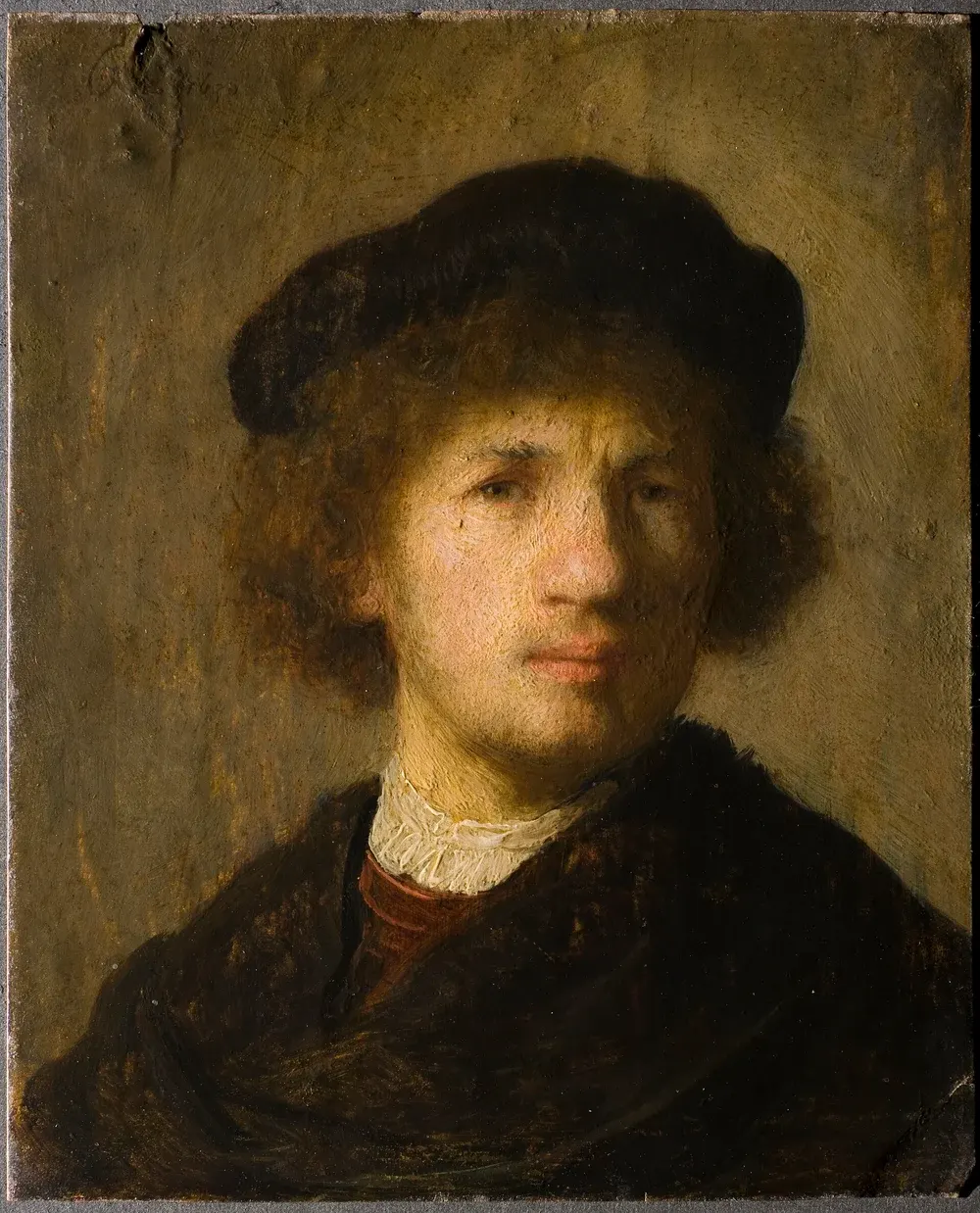
Rembrandt van Rijn, Self-Portrait (c. 1630, oil on copper) · Nationalmuseum, Stockholm · public domain · Wikimedia Commons — our own choice of example; the abstract does not say whether it was among the ten works the 2013 study examined
Hypothesis — Is an Eye That Sees Flat at an Advantage?
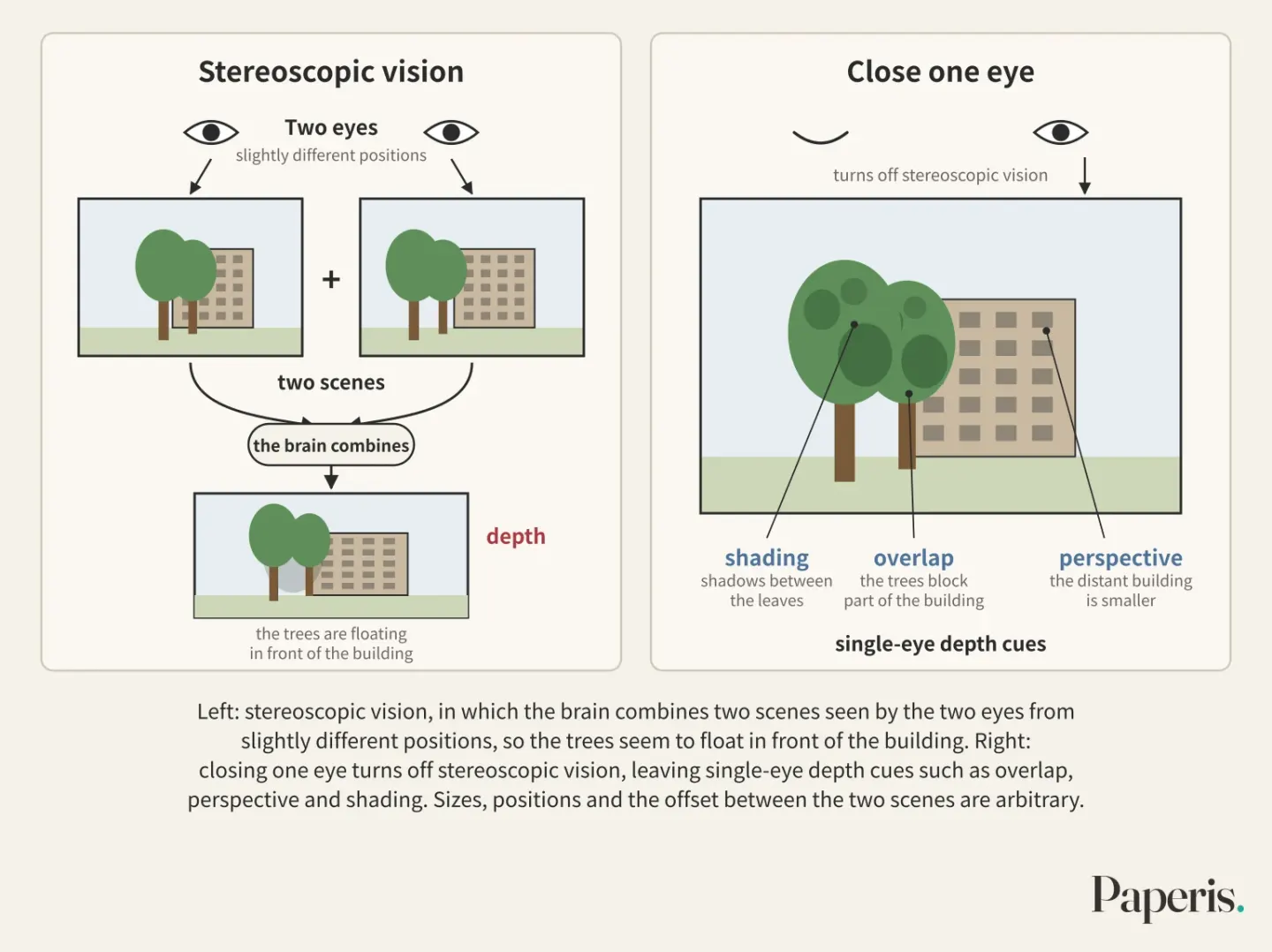
Two eyes are situated a few centimeters apart on the face, viewing the same scene from slightly different positions. Stereoscopic vision is the process by which the brain combines the differences between two scenes viewed by two slightly different positions of the eyes to perceive depth. When watching a 3D movie, the feeling of objects jumping out of the screen is precisely the result of using this power.
This power works properly when both eyes accurately look at the same place together. People whose eye directions do not align well rarely have good stereoscopic vision (DOI: 10.1167/4.8.458). Strabismus is a condition in which the two eyes are not adjusted to look at the same place together, with one eye facing a different direction. Among them, exotropia is a case where one eye turns outward, toward the ear, among strabismus types.
Stereoblindness is a state in which the power to perceive depth through the differences between the two eyes is absent or very weak. Even so, a stereoblind person does not see the world as entirely flat. This is because there are separate clues that can be used with just one eye. Depth cues are clues that the eye and brain use to gauge what is closer and what is farther. Perspective where things become smaller as they get farther away, overlap where a front object hides a back object, and shading created by light and shadow are depth cues that can be used with a single eye (DOI: 10.1177/0956797610397958). The way perspective creates depth on a flat surface was covered in "Perspective and Space — The One Footprint a Picture Is Calculated For".
Here, an old custom of art classes appears. When learning to draw, one is often told to close one eye. Closing one eye turns off stereoscopic vision and makes single-eye depth cues like perspective, overlap, and shading more prominent (DOI: 10.1177/0956797610397958). What an artist has to do is transfer a world deep in three directions onto a canvas with only two directions. If so, wouldn't someone who already sees the world flat be at an advantage in this transfer? A 2004 report by American neuroscientists Margaret Livingstone and Bevil Conway is cited as the source of this hypothesis by a 2011 report (DOI: 10.1177/0956797610397958).
If you try this custom directly, you get a sense of what the hypothesis expects. Suppose you sit by a window and look at the trees outside and the building beyond them. When you keep both eyes open, the feeling that the trees are floating in front of the building is distinct. When you close one eye, that floating feeling decreases, and what remains are facts such as that the trees block part of the building, that the distant building is smaller, and shadows between the leaves. These are all depth cues that can be transferred to paper with a pencil. The hypothesis considers that for a stereoblind person, this single-eyed scene would always be the default. However, whether such a person actually draws better is not told by this scene and is a question that must be tested separately.
An abstract titled "Was Rembrandt Stereoblind?" published in the 2004 journal Journal of Vision expands on this idea. Whether this abstract is the same document as Livingstone and Conway's work cannot be known with the materials we have. The logic of the abstract starts from closing one eye in art class. Since the technique of seeing the world flat is taught in class, someone who already sees the world flat might have an advantage in drawing (DOI: 10.1167/4.8.458). A conference abstract is a step lower in evidence than a peer-reviewed paper. According to the abstract, the researchers looked at frontal photographs of famous painters. By comparing the relative positions of light reflections mirrored in the two pupils, eye alignment can be roughly gauged. However, this is only under the condition that the person in the photo is not looking at a close object and the lighting is not close by. The researchers noted that they saw signs in photos of various painters such as Andrew Wyeth, Edward Hopper, Marc Chagall, and Pablo Picasso that their eye alignment was poor, so they could be stereoblind (DOI: 10.1167/4.8.458).
Rembrandt appears in a single sentence at the very end of this abstract. In the immediately preceding sentence, the authors themselves wrote that diagnosing stereoblindness from paintings is less reliable than doing so from photographs. Then, they added that it is worth noting that in a surprisingly large number of Rembrandt's self-portraits, the eyeballs appear to protrude forward (DOI: 10.1167/4.8.458). The word used by the abstract is exophthalmus, which is not about the direction of the two eyes, that is, their alignment.
To sum up, this hypothesis is connected by three rings. If eye alignment is poor, stereoscopic vision is weak; if stereoscopic vision is weak, the world looks flat; and if it looks flat, drawing might be easier. To put Rembrandt on this hypothesis, one must first examine the front ring, that is, "Were Rembrandt's Eyes Misaligned?", and the authors of the 2004 abstract themselves wrote that painting evidence is less reliable than photographs. However, what that abstract pointed out in the self-portraits was not the direction of the eyes, but the protruding appearance of the eyeballs. Measuring eye alignment from paintings is a "prior claim" re-examined by a 2013 study (PMID 23892492).
Testing a Group of Painters
A short report published in the journal Psychological Science in 2011 tested the rear end of the hypothesis on living people. The hypothesis put forward by the researchers is that "weaker stereoscopic vision can be an advantage for someone trying to transfer a three-dimensional world onto a two-dimensional plane" (DOI: 10.1177/0956797610397958). The title of the paper tells the result plainly: that stereoscopic vision was lower among art students and established painters.
This report is an original paper in which the researchers directly tested the hypothesis. However, since the only data we have is its first paragraph, it does not state how many people were measured with what tests, or how much difference there was from non-painters. Therefore, this article does not copy the numerical values of that study.
What this result tells us must be sorted by the subjects. What this study measured is the stereoscopic vision of art students and painter groups alive today. The result stated in the title, that "stereoscopic vision was lower among art students and painters," does not mean that any single person in that group is stereoblind, and furthermore, it says nothing about the eyes of Rembrandt, a person from 400 years ago. The stereoscopic vision tests of art students and painter groups test only the rear end of the hypothesis—that is, the relationship between stereoscopic vision and drawing—and do not reach the front end, which is whether Rembrandt's eyes were misaligned.
There is also a story viewed from the opposite direction regarding the relationship between stereoscopic vision and painting. An article discussing portraits viewed with both eyes points out that portraits are generally monocular pictures drawn from a single viewpoint, yet we look at them with both eyes. When viewed with both eyes, information that the canvas is flat comes in, and the sense of depth created by monocular depth cues in the painting is actually reduced (PMID 37091739). When the two articles are placed side by side, the habit of closing one eye on the drawing side and the fact that two eyes on the viewing side reveal the flatness of the canvas can be read as the same principle viewed from both sides. This principle explains the tricks of drawing, but it does not serve as evidence that a specific painter was stereoblind.
Reading Self-Portrait Gazes Anew
In 2013, a research team took a fresh look at Rembrandt's self-portraits. This study did not deal with stereoscopic vision, but in this article's hypothesis, it addressed the question that corresponds to the frontmost link. What they tried to reexamine was the previous claim that Rembrandt had a large exotropia based on measurements of how centered the painted irises were (PMID 23892492).
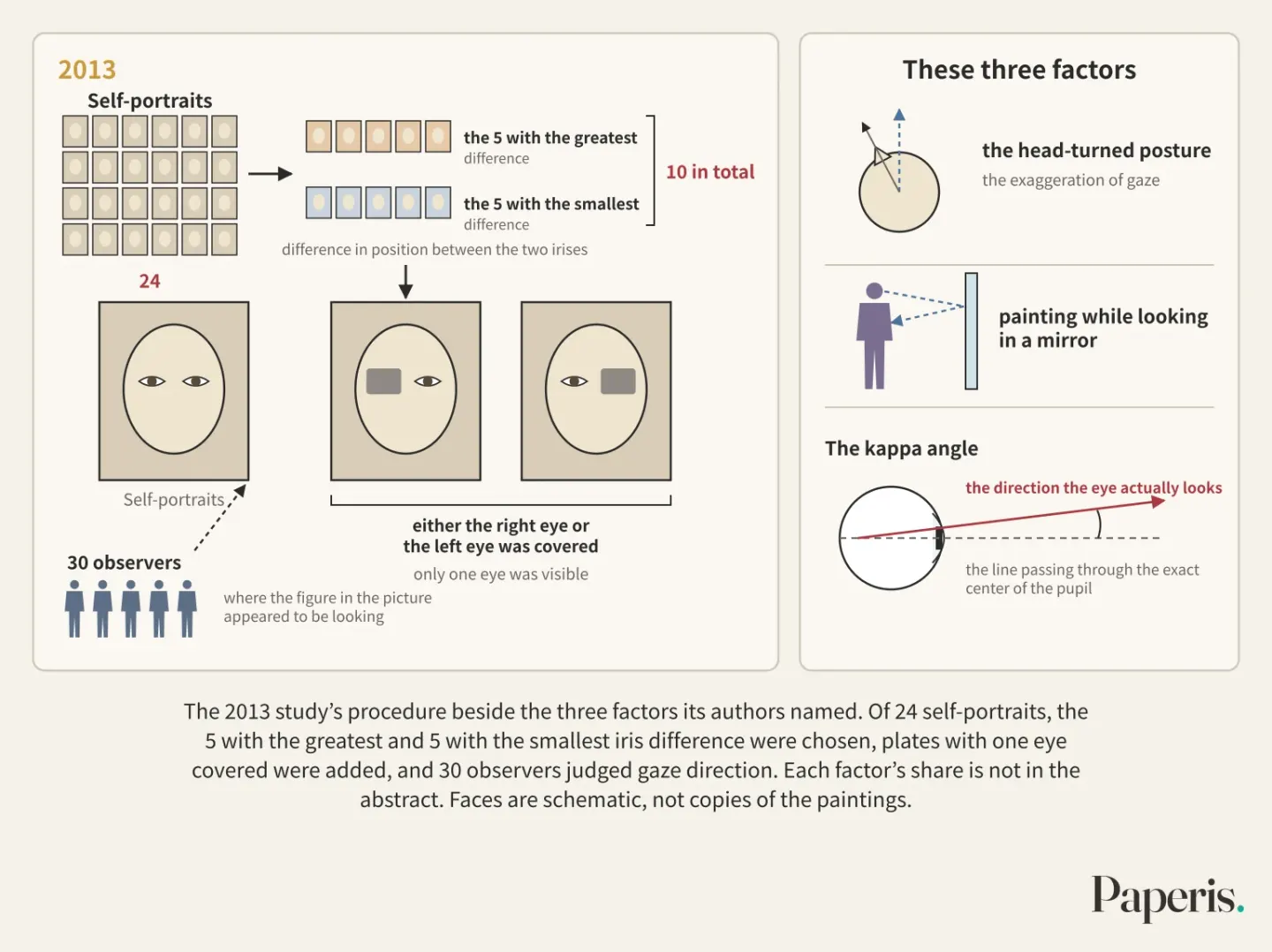
The method was as follows. Among the self-portraits painted by Rembrandt, there are 24 where the eyes are drawn in enough detail to feel the direction of the gaze. The research team selected 10 in total from among them: the 5 with the greatest difference in position between the two irises and the 5 with the smallest difference. They also made separate plates for each painting where either the right eye or the left eye was covered, preparing pictures where only one eye was visible. 30 observers looked at each picture and judged where the figure in the picture appeared to be looking within the plane of the face (PMID 23892492). If the previous claim measured the geometric position of the irises, what this study measured is how a gaze is read by human eyes.
The first line of the results is in the same direction as the previous claim. In the observers' judgments, the gazes of the two eyes were statistically significantly diverged outward. However, part of that divergence was the share of the eye “considered unlikely to be strabismic”. That eye also appeared biased outward from the center. The research team noted that the share by which the “eye pointed out as strabismic” diverged further can be explained by the exaggeration of gaze caused by the head-turned posture, the circumstances of painting while looking in a mirror, and the kappa angle (PMID 23892492). The kappa angle is a small angle difference that naturally exists between the line passing through the exact center of the pupil and the direction the eye actually looks. Even if the eyes are straight, the pupil can look slightly displaced because of this difference. How much each of these three factors operated is not stated in the abstract.
The research team pointed out two more things. Self-portraits where Rembrandt looks strabismic were only in those painted during the first few years of his career as a painter. And even in portraits of other people painted by Rembrandt and his disciples, there were many cases where people who likely were not strabismic similarly appeared strabismic (PMID 23892492).
The conclusion is cautious. The reason some of Rembrandt's self-portraits make him look strabismic can be explained by multiple factors without concluding that he actually had strabismus, the research team wrote (PMID 23892492). And they added that Rembrandt and his disciples may have painted this appearance as a painterly style. As we see it, the two observations in the previous paragraph—namely, that it appears only in the early few years and that it appears in portraits of others as well—do not conflict with that possibility. This conclusion is not “Rembrandt did not have strabismus”. It means the strabismus-like impression of some self-portraits can be explained without assuming strabismus.
To the same question, an analysis from 2020 hung a more advanced answer in its title. By examining eye dominance—the tendency of each person to use one eye more predominantly—using geometry, the title suggests that Rembrandt and Leonardo da Vinci ultimately had straight eyes (PMID 31774472). However, the abstract consists of just a single sentence: “the theoretical question of whether the eyes of the two painters were straight is examined through illustrations and images”. What was measured and how is not in the abstract, so how much weight this analysis holds cannot be judged in this article.
Leonardo, Whose Eye Position Was Measured
A 2019 paper stated it would present evidence that Leonardo da Vinci had strabismus (PMID 30347053). According to this paper, clues for guessing strabismus from the positions of drawn eyes have been used for several famous painters (PMID 30347053). If the 2013 study from the previous section gathered observers' judgments, this paper measured the positions of drawn eyes with geometry. This paper selected six images considered to be of Leonardo's likeness, namely two sculptures, two oil paintings, and two drawings. It then fitted circles and ellipses to the pupils, irises, and eyelid gaps to measure their relative positions. The premise is that in exotropia, the pupil appears pushed outward within the eyelid gap (PMID 30347053).
The results were values deviated outward in 5 out of the 6 points. The "David" sculpture was −13.2°, "Salvator Mundi" was −8.6°, and the late-life self-portrait was −8.3°. Only one, the "Vitruvian Man", was in the opposite direction at +5.9°. The paper considered these values to be consistent with exotropia (PMID 30347053). Two premises underlie this. They are that these images are Leonardo's face, and that the artist transferred the direction of the eyes as they were in real life. The 2013 study that reassessed Rembrandt's self-portraits showed that this second premise can shake in the paintings of Rembrandt and his pupils. Whether that is the case in Leonardo's images is not in these abstracts.
The conclusion of this paper connects the rear end of the hypothesis in one bound. The author suggests, upon gathering the evidence, that Leonardo had intermittent exotropia and thus could switch to monocular vision. They wrote that this would "probably" explain his exceptional skill in depicting the stereoscopic effect of faces and objects, and the depth of mountains receding far away (PMID 30347053). "Probably" is the author's own word. This sentence is a hypothesis crossing over twice: from the position of the drawn eyes to the painter's eyes, and then again to the painter's skill.
The same "monocular vision" plays a different role in another writing. The 17th-century Italian painter Giovanni Francesco Barbieri (1591–1666) was called "Il Guercino", meaning "the squinter". A writing covering him notes that one might guess a person with strabismus mainly uses only one eye, so their paintings would be close to two-dimensional, but the actual paintings rendered light and shadow in great detail to create a stereoscopic effect. And it estimated that he studied light and shadow deeply with one eye to compensate for his weak eye (PMID 30626256). This writing is an article that selected and interpreted literature, and is not a study that examined Guercino's eyes.
When you place the two writings side by side, one thing becomes visible. Vision seen with one eye appears as the reason for rendering stereoscopic effects well in the Leonardo paper, and as a weakness that had to be overcome in the writing covering Guercino. The two writings are looking at the same result of paintings bringing stereoscopic effects to life well. The premises are also different. The Leonardo paper sees that he could switch to monocular vision because he had intermittent exotropia, whereas the Guercino writing sees that he mainly used one eye because of a weak eye. The weight is also different. The former is a paper that measured 6 images, while the latter is an interpretive writing that selected and read literature. From our perspective, if monocular vision serves both as the reason for skill and as a weakness to be compensated for, it is difficult to explain the painter's skill with that alone. A study that measured this directly is not in the evidence this article gathered.
What It Means to Diagnose a Painting
Skin and eye diseases, hypothyroidism, temporal arteritis (inflammation of the arteries on the side of the head), and psychiatric and psychological traits have long been subjects of debate regarding Rembrandt's self-portraits. A 2007 article summarizing the physicians who diagnosed Rembrandt notes that when searching for traces of disease, even a small bump on the canvas can be treated as a symptom, and papers produced in this manner have spawned numerous diagnostic hypotheses (PMID 23674298).
Retroactive diagnosis is the task of estimating a disease name not by directly examining a person who has passed away, but solely through surviving records such as letters, biographies, and artworks. The debate surrounding Rembrandt's eyes is one branch of this. Another example of retroactive diagnosis that explains paintings through eye conditions was covered in "El Greco — Were His Elongated Saints the Fault of Astigmatism?".
Even studies that used Rembrandt's paintings as diagnostic data arrive at conflicting conclusions. A 2016 study reviewed literature to select 17 relevant pieces of data and measured the ratios between facial reference points in self-portraits from various ages using graphic software. The research team considered the problems raised in the literature regarding the area around Rembrandt's eyes and his visual acuity to be incorrect, or explained by changes in painting style or normal aging. They also stated that because certain problems did not reappear in subsequent paintings, they are difficult to view as diseases. The research team's conclusion is that they "believe" all physical changes visible in the self-portraits are natural aging or changes in painting style, and not symptoms of disease (PMID 26125286).
Conversely, a 2024 preprint measured contrast, color, and image complexity across Rembrandt's self-portraits and portraits in general to trace changes in his painting style. This is research at a stage that has not yet undergone peer review. This study considered it unlikely that Rembrandt suffered from depression, age-related cognitive decline, or neurodegenerative diseases. However, it noted that Rembrandt's "late style," as described by art historians, is also consistent with macular degeneration, a disease in which the center of the retina wears down (DOI: 10.20944/preprints202406.1621.v1). Compared to the 2016 study—which viewed the issues raised regarding visual acuity as changes in painting style or normal aging—this preprint read the late style described by art historians as aligning with eye disease as well. The two studies use different samples and different measurements. "Consistent" means there is no contradiction, not a diagnosis.
The very premise that a self-portrait is a record of a face is subject to testing. In 2019, two plastic surgeons and a physician who paints portraits independently examined 25 of Rembrandt's self-portraits and evaluated, in a prescribed manner, whether 25 features of aging were present. The rate of agreement between the evaluations was 0.87 (PMID 31232803). Pointing out that features of aging in the self-portraits appeared to accumulate year by year, the research team concluded that Rembrandt honestly painted the aging of his own face until 1660. They noted that after that, he appeared to try to draw features of aging less (PMID 31232803). By this research team's judgment, even within the same painter's self-portraits, the degree to which they can be read as a "record" differs by period. Furthermore, this evaluation concerns features of aging such as wrinkles and sagging, not the direction of the two eyes.
When placing the evidence surrounding Rembrandt side by side with the photographic evidence cited by the abstract of "Was Rembrandt Stereoblind?", the differences become apparent. For photographs, the conditions for verification are fixed. By checking whether the photographed person was looking at a close object and whether the lighting was nearby, one can roughly gauge alignment using the light reflection points on the two eyes (DOI: 10.1167/4.8.458). For self-portraits, there are many more things to consider. Whether the painter drew while looking in a mirror or with their head turned can alter the gaze within the picture, and the fact that he and his apprentices drew other people's faces similarly leaves open the possibility of a painting style (PMID 23892492). Regarding aging, one research team judged that Rembrandt painted honestly until 1660 and appeared to draw less of it thereafter (PMID 31232803). The authors of the abstract merely wrote that diagnoses from paintings are less reliable than those from photographs, and while the abstract does not give the reasons, this list concretely shows what those reasons are.
Because the gaze in Rembrandt's self-portraits can be a result produced jointly by the mirror, the head turn, and the painting style in addition to the painter's eyes, it is difficult to isolate the share of the painter's eyes from among them using the painting alone. The list of factors given by a 2013 study illustrates that difficulty.
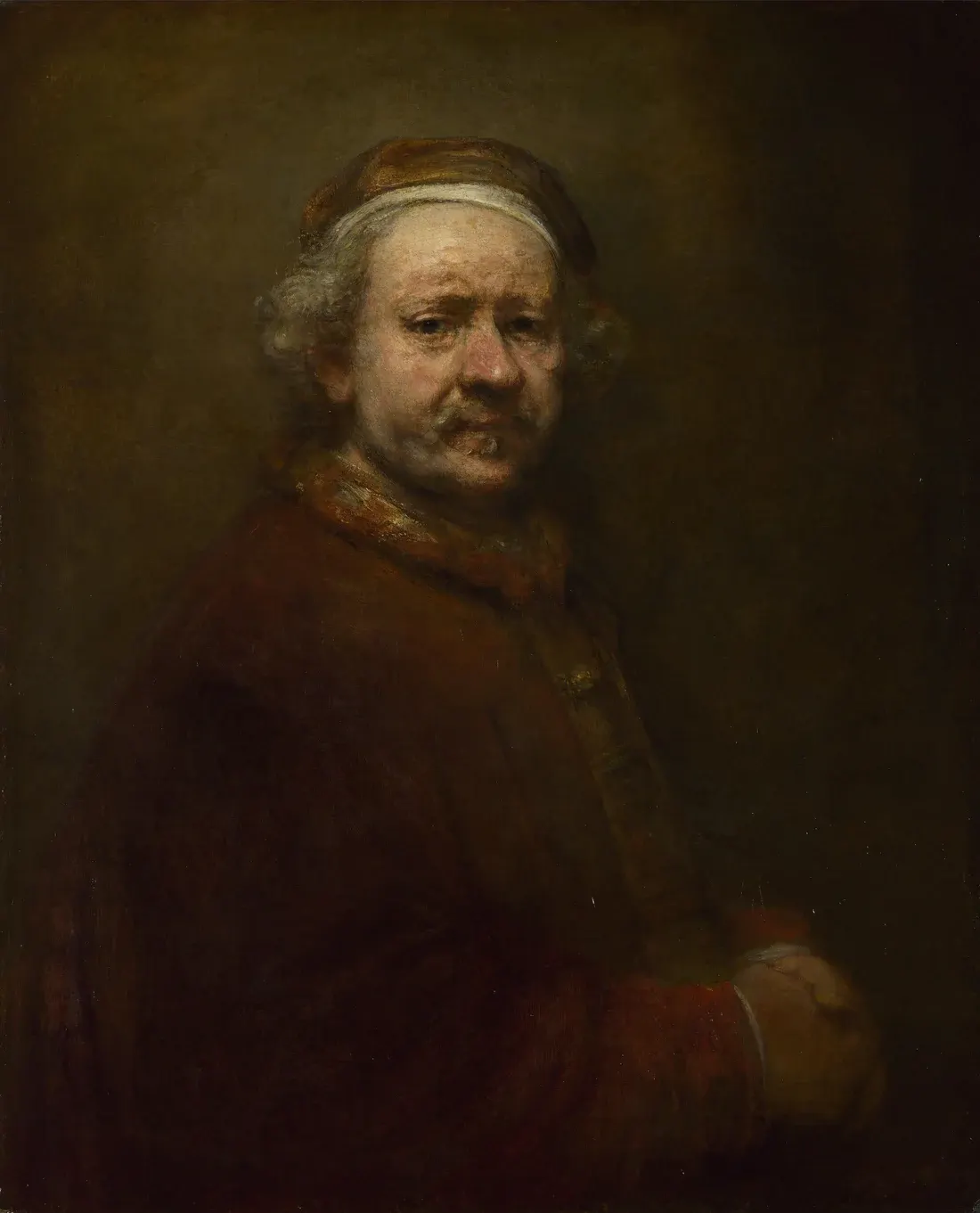
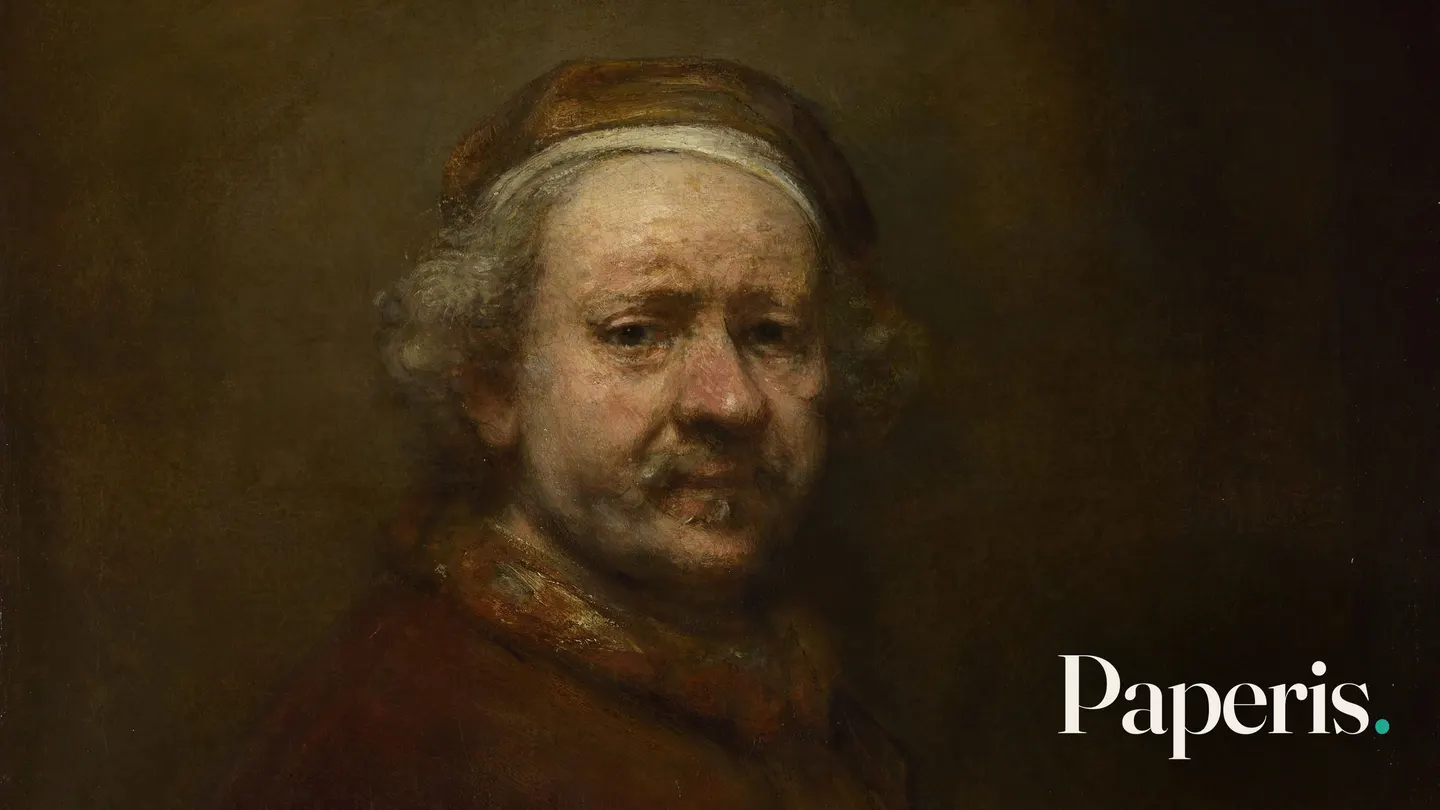
Rembrandt van Rijn, Self-Portrait at the Age of 63 (1669) · The National Gallery, London · public domain · Wikimedia Commons
So What Did We Learn?
Whether Rembrandt had stereoblindness cannot be determined today. The hypothesis consists of three links, and the weight of the evidence differs for each link.
In the first link, "Were Rembrandt's Eyes Misaligned?", the evidence held by this article leans toward being cautious about using paintings as evidence. However, the original claim regarding strabismus—namely, the earlier work that measured iris positions to argue for a large exotropia—is not present in the evidence gathered by this article, and is known only through the fact that a 2013 study re-examined it (PMID 23892492). Even the 2004 conference abstract containing this hypothesis noted that diagnosis from paintings is less reliable than diagnosis from photographs (DOI: 10.1167/4.8.458). In the 2013 study, observers saw a divergence of the gaze, but the researchers noted that part of it belonged to the eye that would not be strabismic, and the rest could be explained by head turning, the mirror, and the kappa angle. That impression was present only in the early years and appeared also in portraits of others painted by Rembrandt and his students (PMID 23892492). That does not prove that Rembrandt had straight eyes, either. A 2020 analysis with that as its title did not disclose its evidence in the abstract (PMID 31774472).
The third link, "Is Weak Stereovision Advantageous for Drawing?", was tested on living people, and the title of a 2011 report states that stereovision was lower among art students and painters. Our materials do not include the sample or the figures (DOI: 10.1177/0956797610397958). This result is about today's group of art students and painters, just as the title says. The mere fact that many people in the group have weak stereovision does not establish it as an advantage for drawing. It cannot be directly transferred to Rembrandt alone.
There are three takeaways from this question. The eyes drawn in a painting are not the same as the painter's eyes. The tendency of a group of painters does not speak for the eyes of a single painter. And monocular vision has been described in different texts as both a reason for skill and a weakness to be made up for regarding the same sense of depth, so the evidence gathered by this article is insufficient to establish it as the secret of talent.
Source Papers
- "Was Rembrandt Stereoblind?" (2004) — DOI: 10.1167/4.8.458 — Conference abstract. Hypothesis that seeing poor eye alignment in frontal photos of painters implies stereo-blindness could be an advantage for drawing in 2D. Mentions Rembrandt's self-portraits in a single sentence, with the caveat that diagnoses from paintings are less reliable than from photos.
- "Stereopsis and Artistic Talent: Poor Stereopsis Among Art Students and Established Artists" (2011) — DOI: 10.1177/0956797610397958 — Short report. Testing the hypothesis among art students and painters that weak stereopsis is an advantage for drawing, based on the convention that closing one eye turns off stereoscopic vision and reveals monocular depth cues (our data lacks result figures).
- "Was Rembrandt strabismic?" (2013) — PMID 23892492 — 10 self-portraits and 30 observers. Outward drift was present, but some share of the eyes could be normal, and the rest can be explained by head turning, mirrors, and the kappa angle. Only in the early years, and also in portraits of others. Can be explained without concluding it was strabismus, and could be a matter of style.
- "A Geometric Analysis of Eye Dominance Suggesting That Rembrandt and Leonardo da Vinci Had Straight Eyes After All." (2020) — PMID 31774472 — Theoretically examines whether the eyes of both painters were straight using diagrams and images (one-sentence abstract).
- "Evidence That Leonardo da Vinci Had Strabismus." (2019) — PMID 30347053 — Fits circles and ellipses to 6 images considered to be Leonardo, obtains values consistent with exotropia, and suggests that intermittent exotropia "may" explain his representation of depth.
- "Lights and darks of a picture. The life of Giovanni Francesco Barbieri, "il Guercino" - the squinter." (2019) — PMID 30626256 — Literature-based interpretation. Presumes that a strabismic painter studied light and shade with one eye to compensate for his weakness.
- "Binocular portraiture." (2023) — PMID 37091739 — Portraits are usually painted from a single viewpoint, but viewing them with both eyes weakens the information about the flatness of the canvas that serves as a monocular depth cue.
- "Rembrandt's doctors." (2007) — PMID 23674298 — Organizes diagnostic hypotheses surrounding Rembrandt's self-portraits (skin, eyes, thyroid, Horton's disease, psychiatric traits) and warns that a small bump on the canvas can become a symptom.
- "Rembrandt's Ocular Pathologies." (2016) — PMID 26125286 — Literature review and proportion measurements, with the authors concluding that the changes in his self-portraits are all due to natural aging or changes in artistic style.
- "Self Images: An Empirical Enquiry into Rembrandt's Self-portraits and Portraits" (2024) — DOI: 10.20944/preprints202406.1621.v1 — Preprint. Measures contrast, color, and fractal dimension, considering the likelihood of depression or neurodegeneration to be low, and noting that his late style is consistent with macular degeneration.
- "Rembrandt's Aging Face in Plastic Surgical Perspective." (2019) — PMID 31232803 — 25 self-portraits, 25 aging features, and 3 evaluators. Concludes that he drew aging honestly up until 1660.
- "The influence of ophthalmological diseases on the vision quality of famous painters." (2021) — PMID 35087973 — Review. Surveys eye diseases of famous painters from the question of whether style can be intentional or influenced by vision.
Sources (12)
- Was Rembrandt Stereoblind?DOI 10.1167/4.8.458
- Stereopsis and Artistic Talent: Poor Stereopsis Among Art Students and Established ArtistsDOI 10.1177/0956797610397958
- Was Rembrandt strabismic?PMID 23892492
- A Geometric Analysis of Eye Dominance Suggesting That Rembrandt and Leonardo da Vinci Had Straight Eyes After AllPMID 31774472
- Evidence That Leonardo da Vinci Had StrabismusPMID 30347053
- Lights and darks of a picture. The life of Giovanni Francesco BarbieriPMID 30626256
- Binocular portraiturePMID 37091739
- Rembrandt's doctorsPMID 23674298
- Rembrandt's Ocular PathologiesPMID 26125286
- Self Images: An Empirical Enquiry into Rembrandt's Self-portraits and PortraitsDOI 10.20944/preprints202406.1621.v1
- Rembrandt's Aging Face in Plastic Surgical PerspectivePMID 31232803
- The influence of ophthalmological diseases on the vision quality of famous paintersPMID 35087973