Paperis Articles
Vermeer — The Question in a Bead of Light
Highlights broken into dots and seemingly exact perspective led to the claim that Vermeer used a camera obscura. Researchers tested it by showing how dim a period lens would make the image, reenacting the process in a studio, unfolding painted rooms into floor plans, and comparing the town view with old maps. What each test said, and what it did not.
Your field's papers, as audio
Pick your fields and journals — Paperis summarizes the key papers and turns them into audio. Listen on your commute.
Start Paperis free →Vermeer — The Question in a Bead of Light
Small Rooms in Delft
In the 1660s in the Dutch city of Delft, the painter Johannes Vermeer (1632–1675) repeatedly painted interiors by windows. Light enters mostly from a left-hand window, and one or two people read letters, pour milk, or play instruments. Only about thirty-odd of his paintings survive today, and most are scenes of these small rooms. In front of those paintings, 20th-century art historians repeated the same question: did Vermeer paint by looking at an image projected onto a wall by a lens?
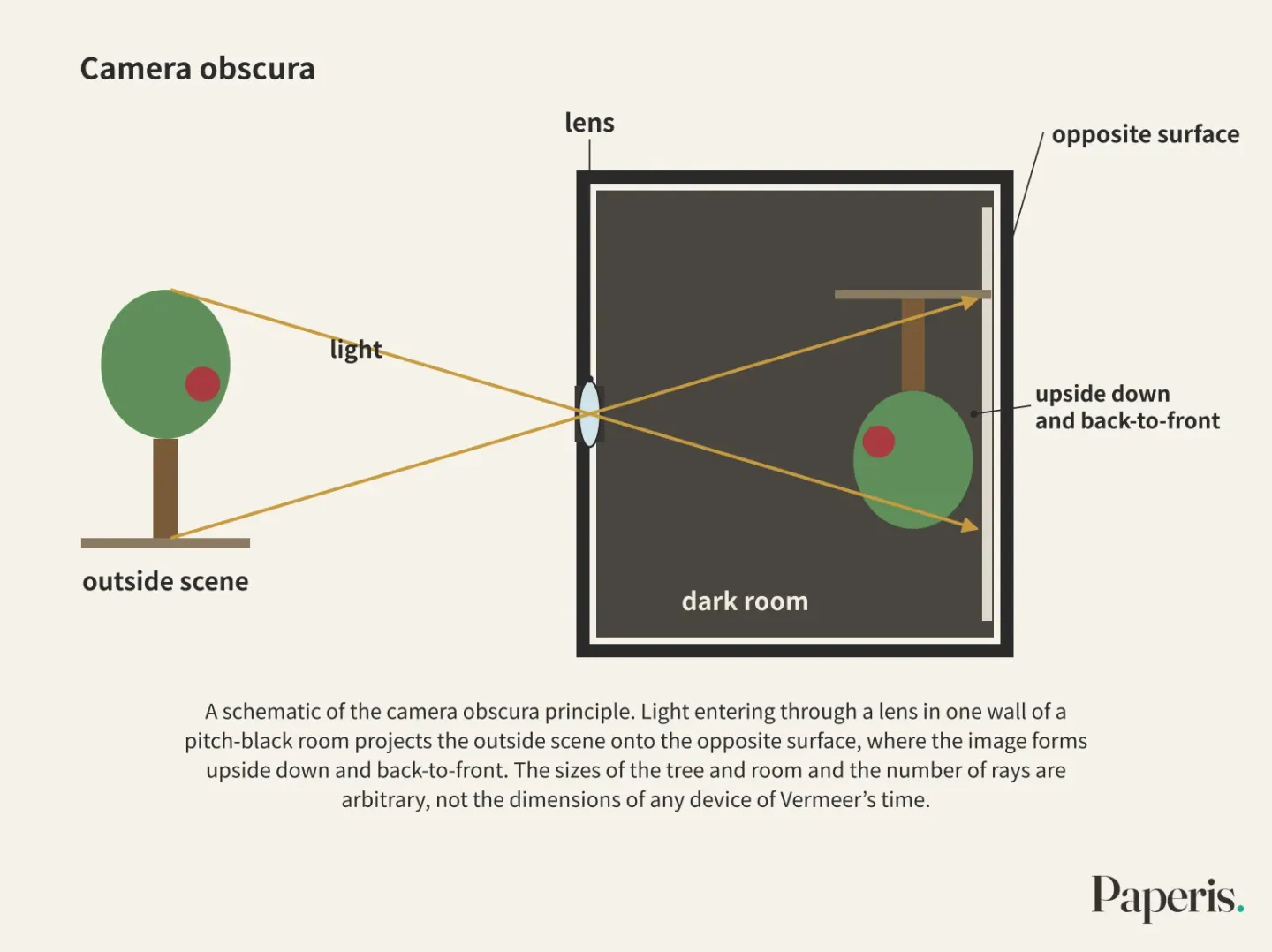
The tool pointed to by that question is the camera obscura. The name means "dark room" in Latin, and a camera obscura is a device that lets light into a pitch-black room or box through a small hole or lens pierced in one wall, projecting the outside scene upside down and back-to-front onto the opposite surface. The story that Vermeer used this device, which corresponds to the ancestor of the camera, as a drawing aid began with a hint dropped in the late 1920s and grew over more than 30 years into sentences close to certainty (DOI: 10.1080/00043079.1964.10788766).
The occasion for historians' attention to gather around this question again was two books from 2001. The painter David Hockney argued in Secret Knowledge that painters had used projected images since the 15th century, and Philip Steadman published Vermeer's Camera that same year. A 2008 journal special issue introduction evaluated that Steadman's book presented "strong evidence that Vermeer used a camera obscura," noting that the two books revived historians' interest in the camera obscura, projected images, and the possibility that painters used them (DOI: 10.1163/157338208x285017). "Strong evidence" is the evaluation of those who compiled the special issue.
This article does not judge "did Vermeer copy." It follows what gave birth to that claim, by what methods researchers tested that claim, and how far each test spoke.
Traces the Claim Leant On — Distortion and Light Grains
The first clue was a photograph. In the late 1920s, the writer Wilenski placed much more weight on the mirror than on the camera obscura, yet pointed out features in Vermeer's paintings that can be seen in photographs, such as the effect where objects in the foreground appear distorted and enlarged. He wrote that it would “perhaps be one of the ironies of art history” that a composition achieved by a great painter through all manner of skill could now be accidentally snapped by a child with a Kodak camera (DOI: 10.1080/00043079.1964.10788766). Effects visible in photographs became the first clue.
In 1946, art historian Hyatt Mayor organized the evidence leaning toward the idea that Vermeer used mechanical aids. The traces he raised are three: the way nearby objects are distorted in size, color tones mixed “as perfectly as the ground glass of a camera”, and the observation that highlights on foreground objects are “scattered in dots like blurred drops of light floating on ground glass” (DOI: 10.1080/00043079.1964.10788766). Ground glass is a glass plate with one side ground frosted so that it can receive an image. Mayor's metaphor points to what a person looking at an image formed by a lens on that plate sees.
Here, highlights are spots where light bounces off a smooth surface like a mirror, forming the brightest point on an object. In several of Vermeer's paintings, the sparkles on bread crusts or chair decorations are actually dotted as multiple small spots of paint. The term Mayor used is “halation”, and exactly what kind of optical phenomenon that halation is, and whether the dots in the painting truly came from a lens, are not settled by his metaphor alone.
In the 1950s, art historian Lawrence Gowing wrote after several pages of analysis that “the technical aspect is clear. It is highly probable that Vermeer used a camera obscura”. Gowing also guessed where he obtained his knowledge of lenses. Citing the fact that Antonie van Leeuwenhoek, a fellow citizen of Delft renowned for designing, grinding, and using lenses, was recorded as the executor of Vermeer's estate, he suggested his assistance as a possibility (DOI: 10.1080/00043079.1964.10788766). That he was the executor is a matter of record, while that they handled lenses together is Gowing's speculation.
In 1964, art historian Charles Seymour studied the image formed by a camera obscura and compared it with the characteristics of two small panel paintings in the National Gallery of Art in Washington, “Girl with a Flute” and “Girl with a Red Hat”. He concluded that Vermeer used the device, while at the same time calling his own work “preliminary” and stating that it was worth further study (DOI: 10.1080/00043079.1971.10790546). What initially propped up this claim were visual impressions, circumstantial evidence, and a single experiment that he himself called preliminary.
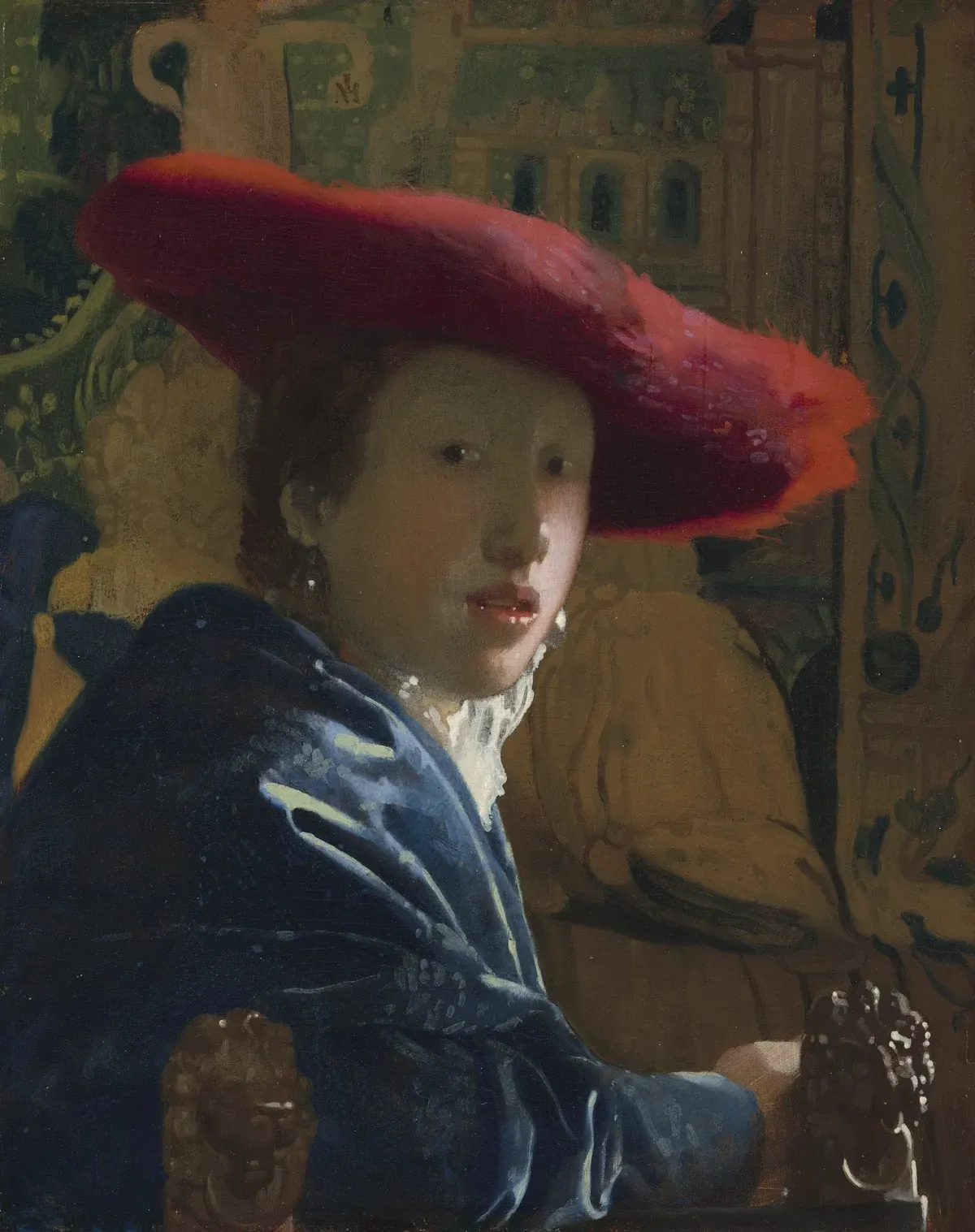
Johannes Vermeer, Girl with a Red Hat (c. 1669) · National Gallery of Art, Washington · public domain (CC0) · Wikimedia Commons
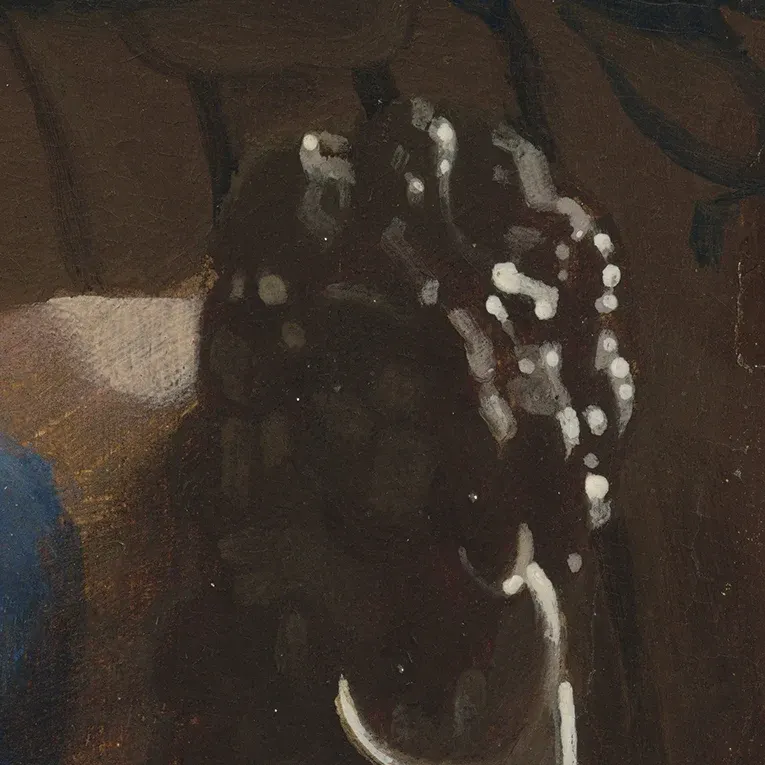
Detail of the same painting — dots of light on the chair finial (our own observation; it does not mean Mayor cited this painting)
The Impression That the Perspective Is Accurate
If light particles are the impression of the eye, the second piece of evidence was something that could be measured. The point that the linear perspective in Vermeer's paintings is noticeably accurate led to the claim that "he used a room-sized camera obscura" (DOI: 10.2307/1576575).
Linear perspective is a method that creates depth on a flat surface using geometry by drawing receding parallel lines so that they converge on a single point. The name of that point is the vanishing point, and the vanishing point is the point in a painting where receding parallel lines come together. You can find this point by extending the seam lines of floor tiles outside the painting with a ruler. Stedman's theory also leans on this accuracy, namely that he obtained geometrically accurate perspective with a camera obscura (DOI: 10.4310/iccm.2014.v2.n1.a6). How a painting calculates perspective was covered in "Perspective and Space — The One Footprint a Picture Is Calculated For".
A 2010 study measured this accuracy directly. The author drew analysis drawings and floor plans of 13 genre paintings by Vermeer with accurately drawn perspective, and compared them based on the dimensions of the tiles in the paintings. This is a method of unfolding the paintings into rooms viewed from above. As a result, the author reported that the scenes contained in the paintings all fit as if cropped from within a circle of the same size (DOI: 10.2190/em.28.1.f). The image projected by a lens forms within a round circle, and the author used that very circle as a yardstick. The author concluded that the projected image is a fine resource for achieving consistency of perspective within the picture plane, and that Vermeer utilized that resource to explore a spatial representation unprecedented in his time. That they fit into a circle of the same size is a measurement, and that that circle came from a lens and that Vermeer pioneered a new spatial representation are the author's interpretations.
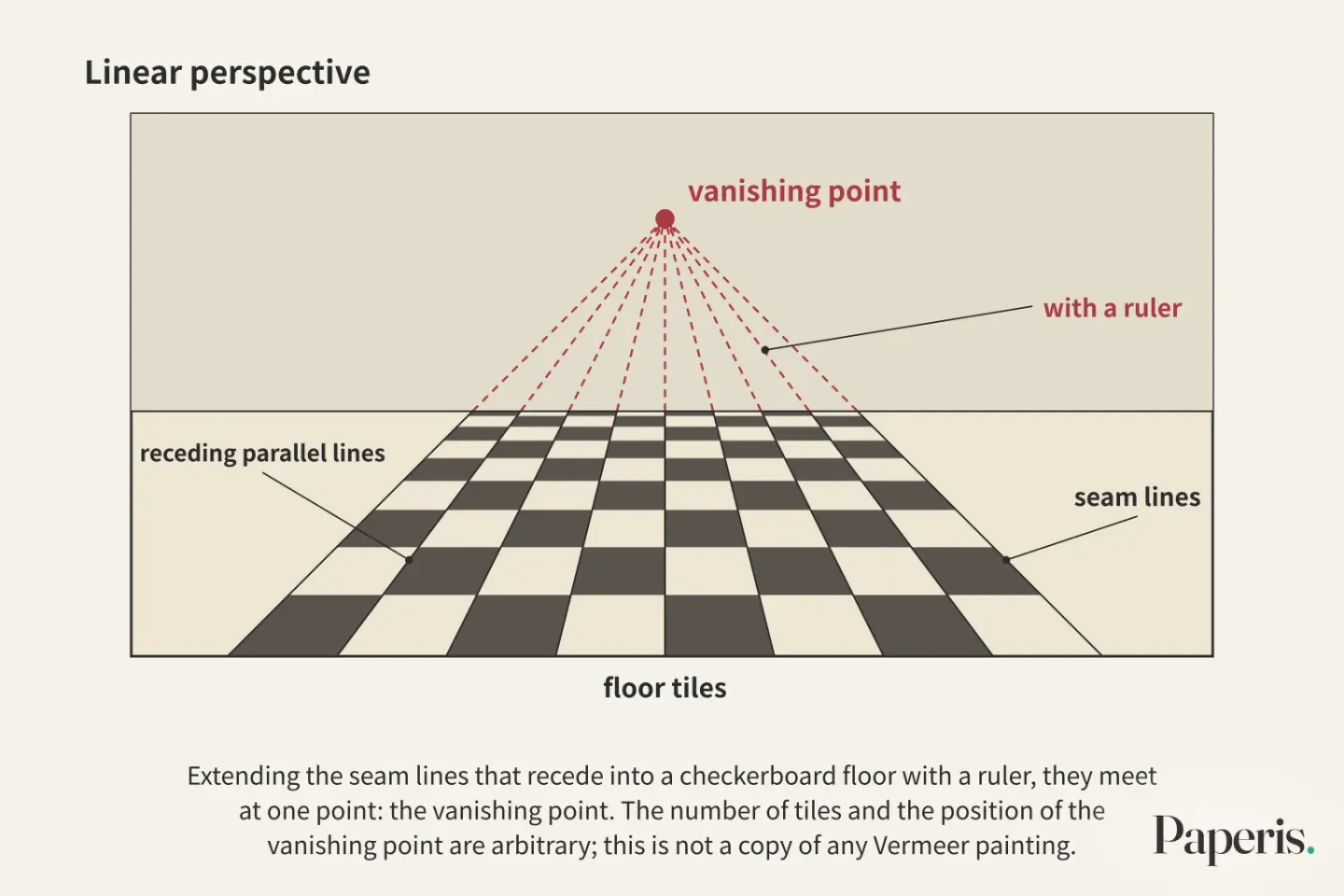
What Can Be Done with the Devices of That Era
If the accurate perspective matches the lens, the next question is whether that work could actually be done with the lenses of that era. A 1998 paper examined this question as a matter of practicality. In the 17th century, the easiest convex lenses to obtain were eyeglass lenses, measuring around 4 cm in diameter. The author showed that if such a lens is used in a room-sized camera obscura, the image of an indoor scene is too dim to be examined properly. The problem of the image being flipped upside down and left to right, along with the issue of the depth in focus, also makes the image harder to handle (DOI: 10.2307/1576575).
The issue of depth in focus comes from defocus blur. Defocus blur is a phenomenon where, when a lens focuses at one distance, the image of something closer or farther blurs. For example, with an arrangement invented for this article, focusing on a chair at the front of the room blurs a map on the back wall, and focusing on the map blurs the chair. In a room-sized device, the entire room becomes a box, and the painter views the image formed on a screen inside that dark room. What the 1998 paper examined was the darkness, the inversion, and this focus problem of that image.
The author's conclusion is that Vermeer could not have traced indoor scenes directly at painting size from the screen of a camera obscura, and the other half of the same conclusion is that a small camera obscura could have stimulated his composition and perspective handling. However, the author added that the final painting must have been painted in an upright state and under bright light (DOI: 10.2307/1576575). This paper did not erase the device. It erased one method of tracing directly at painting size from the screen.
There is an old counterargument to the problem of the inverted image. Meyer cited as a historically possible method the fact that the image could be righted by using a second lens or by setting a mirror at a 45-degree angle inside the device (DOI: 10.1080/00043079.1964.10788766). This counterargument resolves the inversion, but does not address darkness, which is the problem raised first by the 1998 paper.
Trying It Again in the Studio
A studio experiment published in 2013 asked the question from another direction. When a lens image forms upside down and reversed left to right on a screen or a wall, how could a painter of that era have used this compressed and flattened image for painting? The experiment approached this problem using the painter's eye and experience, while using only the primitive technology and unrefined materials of that era. The experimenter stated that the materials used were all from that period (DOI: 10.1163/22134913-00002006).
What the experiment produced is a simple tracing method. The image formed by the lens is traced onto the canvas as a single-color image with its orientation corrected, and this method can be used at each stage of the painting's progress. The image traced onto the ground layer serves as the foundation for the underpainting, and the image traced onto the upper layers transfers highlights and optical effects that are not visible to the naked eye (DOI: 10.1163/22134913-00002006). The underpainting is a layer of paint laid down in place before applying the final colors. How the paint layers in Vermeer's paintings are stacked was covered in "Girl with a Pearl Earring — Light Built in Layers, a Name Not Asked".
According to this method, the painter can work while facing the actual scene in a bright studio while applying colors (DOI: 10.1163/22134913-00002006).
The experiment report noted that the results match the visual evidence seen in Vermeer's painting methods and the results of recent scientific investigations of his paintings. These results suggest possible causes for several unusual qualities of Vermeer's paintings. These include strong light and dark contrast in the underpainting with no traces of preliminary sketching, uniform materials in the ground layer, and the feel of uneven focus (DOI: 10.1163/22134913-00002006). This is a single studio experiment report, and it merely showed that this method was "possible" and "fits," not that any record of Vermeer actually doing this has been found. The report itself also used the phrase "possible cause."
Remeasuring the Rooms and Streets in Paintings
Research measuring accuracy has emerged from other questions as well. A 2014 study computer-analyzed the geometry of Vermeer’s masterpiece "The Art of Painting". It stated two purposes: to reveal Vermeer’s hidden compositional rules, and to find arguments to counter Steadman’s theory that geometrically accurate perspective was obtained using a camera obscura (DOI: 10.4310/iccm.2014.v2.n1.a6). The researchers analytically reconstructed the perspective of the painting, explained under what assumptions the objects in the painting could be reconstructed, and reported that there are geometric flaws in the perspective. They also wrote directly why they revealed those flaws. The goal was not to nitpick, but to show that for Vermeer, compositional rules and artistic intuition were far above the task of copying a camera obscura image. The geometric flaws are measurements taken from a single point in "The Art of Painting", and that intuition came first is the interpretation of the researchers.
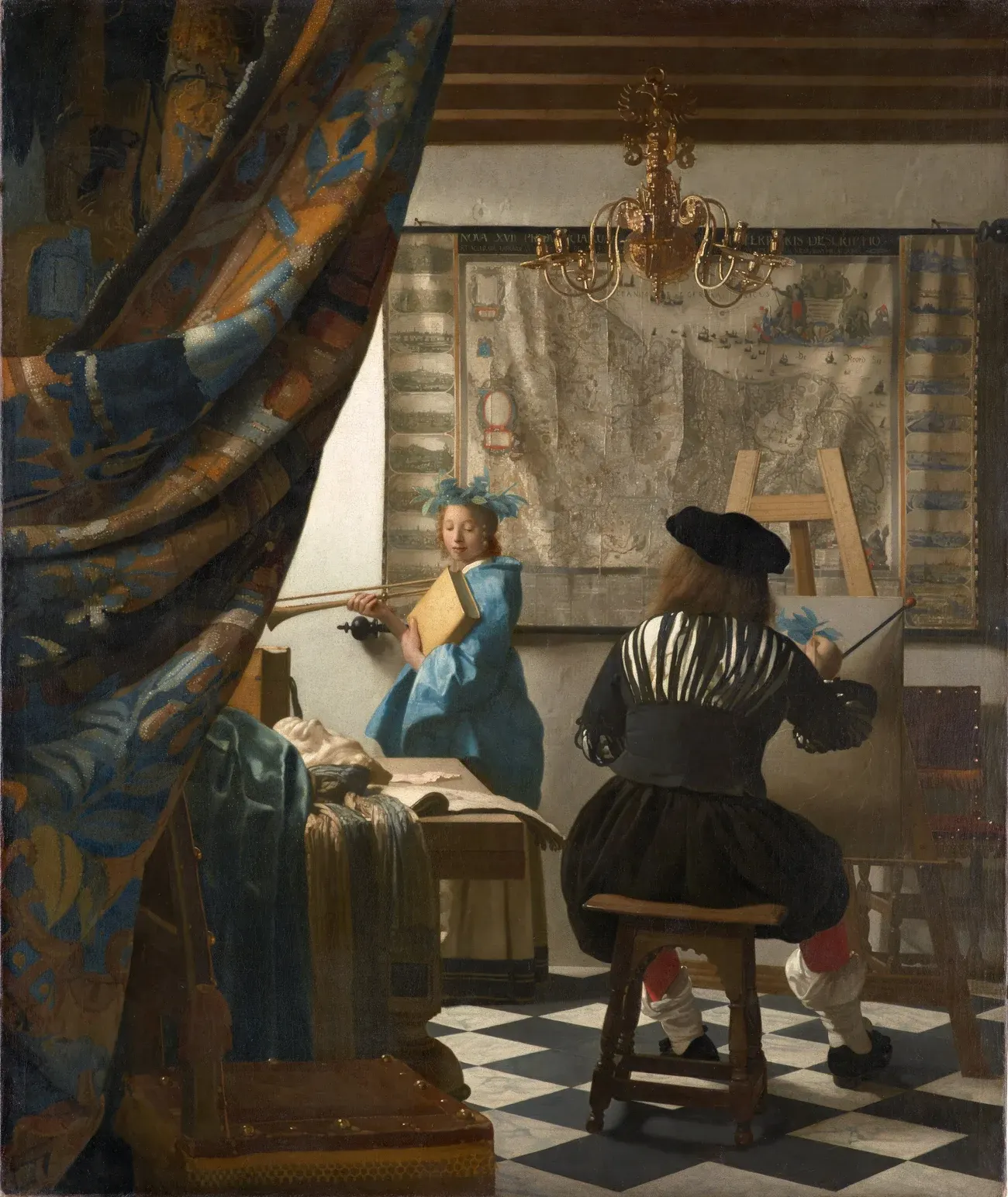
Johannes Vermeer, The Art of Painting (c. 1666–1668) · Kunsthistorisches Museum, Vienna · public domain · Wikimedia Commons (Google Arts & Culture)
There is also research comparing paintings and reality in landscapes. A 1982 study compared "View of Delft" with old maps and urban landscape paintings, examining in detail the relationship between the scene in the painting and the actual location. Although much of the painting was very accurate, this comparison suggests that Vermeer altered the composition in several places to enhance the impression of the scene. Some of those modifications are revealed in X-rays and infrared photography. This study concluded that these compositional modifications are important when evaluating the camera obscura hypothesis (DOI: 10.2307/1483203). X-rays and infrared photography are methods of shining a light to see the layers beneath the outer paint.
Accuracy and modification exist together in a single painting. When compared against maps and landscape paintings, many parts are very accurate, but the interpretation of this study is that there were several compositional modifications made to enhance the impression of the scene. This study concluded that those modifications are important when assessing the hypothesis, and which side those modifications support does not appear in the abstract.
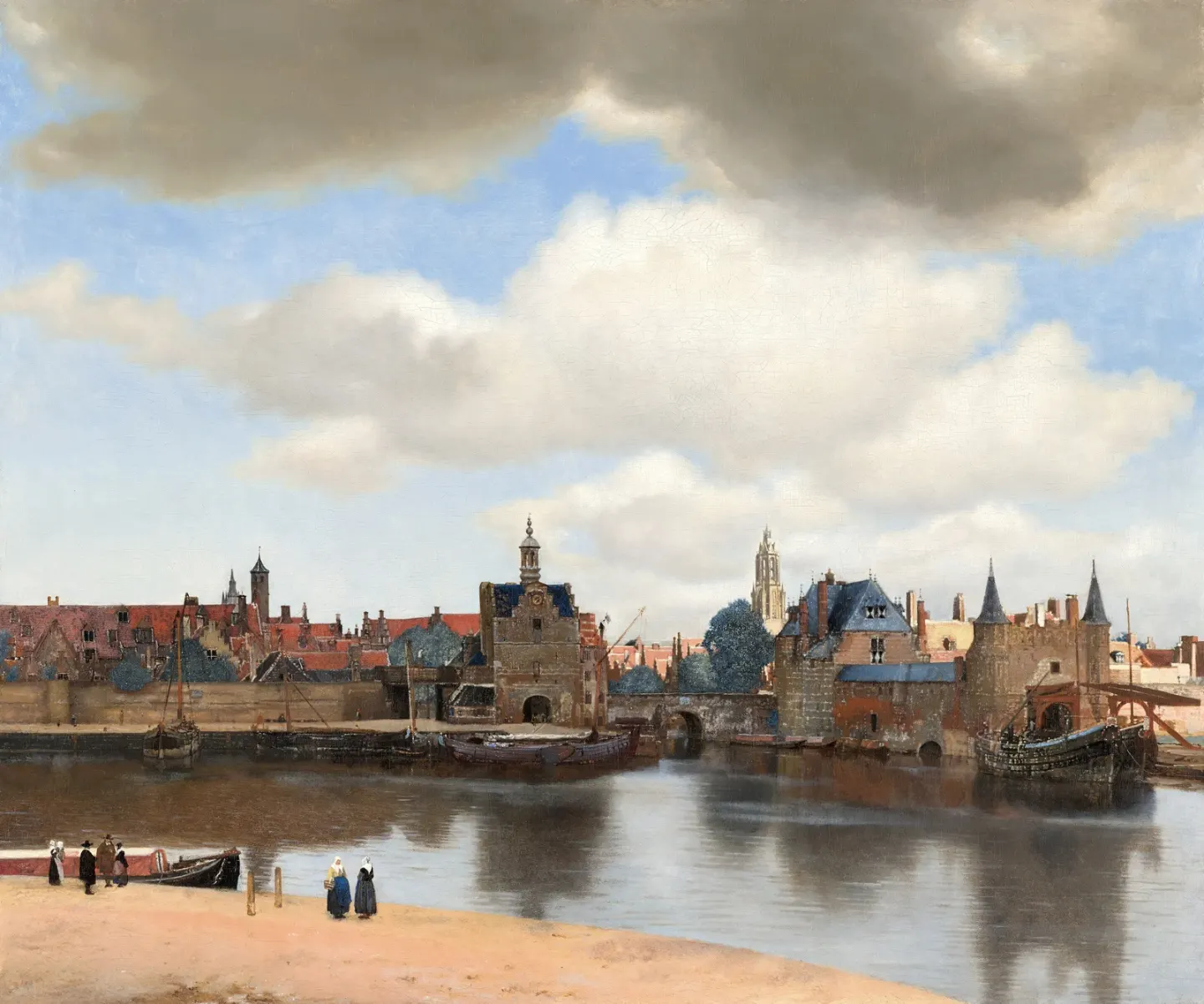
Johannes Vermeer, View of Delft (c. 1660–1661) · Mauritshuis, The Hague · public domain · Wikimedia Commons
There is also debate surrounding allegory and arrangement. Critics of the suggestion that Vermeer made extensive use of a camera obscura while painting interiors argued that this could not be the case, pointing out that his compositions, unlike "taken snapshots," were extremely delicately weighed and balanced, his subjects came from traditional motifs of Dutch genre painting, and his paintings were filled with complex allegories and symbols. A 2005 paper agreed that all three of these features characterize Vermeer’s paintings, but argued that the painter created those very features with a camera. The argument is that he arranged a scene by placing real furniture and props with extreme care in an actual room of his mother-in-law's house, and then transferred the optical image of that scene (DOI: 10.1163/1573382054088123).
This paper places the arranged scene and the lens within a single process. The composition is that allegory and balance emerged at the stage of placing props, and the optical image of that scene was then transferred. Whether allegory and arrangement are incompatible with the extensive use of cameras is itself at the center of the dispute.
Still Debated
"There is not yet agreement on this problem." This conclusion, drawn by Heinrich Schwarz in an article published in Pantheon, was conveyed at the starting point of a comparative study from 1971. According to that study's summary, Vermeer's paintings baffled critics for more than a century after their rediscovery because of formal elements almost never seen in other painters, and to some, those elements looked like optical phenomena painted onto the canvas. Vermeer's meticulous biographer P. T. A. Swillens, with a lifetime of investigation, learned almost nothing about whether the artist used such a device (DOI: 10.1080/00043079.1971.10790546).
Within the evidence gathered in this article, later research has built up evidence, but sentences stating a consensus are not to be seen. What each study tested and the scope of what it stated differ. Observations about light particles and tones give the impression of resembling a lens's image. A 2010 study measured that 13 scenes fit into a circle of a single size, and the author interpreted that Vermeer explored new spatial expression by utilizing projected images as a resource. Studio experiments go so far as to say that a method of projecting and transferring images to paint them in bright places was possible and matched the characteristics of the paintings. A 1998 paper concluded that one could not trace directly onto a room-sized device's screen at the painting's actual size, while leaving open the possibility that a smaller device stimulated the composition. A 2014 study found geometric flaws in "The Art of Painting", countering Steadman's theory that accurate perspective was obtained with a camera. The abstract of a study on "View of Delft" merely noted that compositional revisions are important when examining hypotheses. Among these pieces of evidence, none argue that Vermeer did not use a device, and no direct records emerge showing that he owned or used one. Even the single record cited by Mayor was a tradition passed down to the 18th-century 's Gravesande—namely, the story that several earlier Dutch painters studied the effects of the camera obscura and imitated them in their paintings (DOI: 10.1080/00043079.1964.10788766).
The reason a definitive conclusion is not reached lies in the type of evidence. Light particles and tones are impressions of the eye, so as the 1971 study's summary puts it, "to some" they looked like optical phenomena painted onto the canvas. Measurements of tiles and circles also only go as far as saying they match a lens, without directly showing that that perspective came from a lens. Devices and experiments only say what is possible and what cannot be done by that method, but they cannot say what Vermeer actually did. What can fill that empty space is records, and those records are empty.
Therefore, the open question is narrower and more specific than "did he use it or not." If he used it, what size of device was it—room-sized, or a small box for capturing composition. How were the images brought onto the canvas—did he trace them, project and transfer them, or reference them only to frame the composition. And within a single painting, to what extent. The 1998 paper and the 2013 experiment offered different answers to these questions as possibilities. Hockney's broader claim, that painters have used projected images since the 15th century, is a separate debate that goes beyond Vermeer alone.
So What Did We Learn?
Standing before "Girl with a Red Hat," we apply the tests of this article one by one. This small panel painting is one of two that Seymour compared while studying the characteristics of the camera obscura image. The light dots scattered over the chair decoration look just like what Mayor described, as this article saw it, with highlights on objects in the front scattering into dots. Up to this point, this is where the argument leans on evidence. The conclusion of the 1998 paper concerns the method of tracing indoor scenes at painting size using a room-sized apparatus, and the abstract does not state how that conclusion applies to this small figure painting. The possibility that a small device stimulated the composition remains open, as that paper left it. When we apply the method of the 2013 experiment, one more possibility arises: tracing the image and then building up colors in a bright space. Yet that possibility stops at "it fits."
What the studies have shown is the boundary of what was possible if Vermeer used a camera, and what could not be done by that method. Within that boundary, to whom the judgment of organizing the scene is attributed is written in the two papers. The 2005 paper arguing for use presupposed a painter who arranged actual furniture and props with extreme care, and the 2014 study countering Steadman's theory interpreted that rules of composition and artistic intuition came far above tracing images for Vermeer. Both papers pointing in different directions attribute the judgment of organizing the scene to the painter.
What this question leaves behind is one way of looking at paintings. It is an eye that examines what a single dot of light, a single tile seam, and a single spot misaligned with the map each testify to, and what they fail to testify to.
Source Papers
- "Dark Chamber and Light-Filled Room: Vermeer and the Camera Obscura" (1964) — DOI: 10.1080/00043079.1964.10788766 — 1964 Art Bulletin paper (title and quotes match the paper introduced as Seymour's in the 1971 comparative study — author estimated). Wilenski's (late 1920s) mirror and foreground enlargement distortion, Meyer's (1946) evidence (size distortion, ground-glass-like tones, highlights scattered like drops of light), counterargument that the image could be righted with a mirror or a second lens, Gowing's "likely used", record of Leeuwenhoek as estate executor.
- "Vermeer's Use of the Camera Obscura — A Comparative Study" (1971) — DOI: 10.1080/00043079.1971.10790546 — Seymour compared two Washington-held works with camera images and concluded they were used, though calling it "preliminary". Schwartz's "no consensus yet".
- "Kepler, Optical Imagery, and the Camera Obscura: Introduction" (2008) — DOI: 10.1163/157338208x285017 — Introduction to a journal special issue. Summarized that Hockney and Steadman's 2001 book sparked historians' interest in the camera obscura and projected images, evaluating Steadman's book as "strong evidence".
- "Camera Obscura's Role in Johannes Vermeer's Painting Space" (2010) — DOI: 10.2190/em.28.1.f — Analysis drawings, floor plans, and tile dimension comparisons of 13 genre paintings with accurate perspective, with the scenes fitting inside circular image frames of the same size. Concluded that projected images are an excellent resource for perspective consistency.
- "Vermeer and the Camera Obscura: Some Practical Considerations" (1998) — DOI: 10.2307/1576575 — With a spectacle lens of around 4 cm in diameter, the image of a room-sized apparatus is too dark, plus there are issues with inversion, left-right reversal, and depth of focus. It could not be traced directly on the canvas at painting size; a small device may have inspired composition and perspective, with the final painting done in a bright space right-side up.
- "From Perception to Paint: the Practical Use of the Camera Obscura in the Time of Vermeer" (2013) — DOI: 10.1163/22134913-00002006 — Report on studio experiments using contemporary materials. Capturing and transferring a correctly oriented monochrome image to use for underpainting and highlights, then coloring in a bright space, with results matching visual evidence and scientific examinations, and a "probable cause" for unusual properties.
- "The hidden geometry in Vermeer's "The Art of Painting"" (2014) — DOI: 10.4310/iccm.2014.v2.n1.a6 — Interpretive reconstruction of the perspective in "The Art of Painting", countering Steadman's theory with geometric flaws, interpreting that compositional rules and intuition superseded tracing.
- ""Vermeer's View of Delft" and His Vision of Reality" (1982) — DOI: 10.2307/1483203 — Compared with old maps and landscapes, many parts are accurate, but there are compositional modifications that heighten the impression, and some are visible in X-rays and infrared. Important for reviewing the camera hypothesis (the abstract does not mention direction).
- "Allegory, Realism, and Vermeer's Use of the Camera Obscura" (2005) — DOI: 10.1163/1573382054088123 — The basis for criticizing widespread use (balanced composition, traditional motifs, allegory) is the argument that it was created by transferring the optical image of a scene with props arranged in his mother-in-law's room.
Sources (9)
- Dark Chamber and Light-Filled Room: Vermeer and the Camera ObscuraDOI 10.1080/00043079.1964.10788766
- Vermeer's Use of the Camera Obscura — A Comparative StudyDOI 10.1080/00043079.1971.10790546
- Kepler, Optical Imagery, and the Camera Obscura: IntroductionDOI 10.1163/157338208x285017
- Camera Obscura's Role in Johannes Vermeer's Painting SpaceDOI 10.2190/em.28.1.f
- Vermeer and the Camera Obscura: Some Practical ConsiderationsDOI 10.2307/1576575
- From Perception to Paint: the Practical Use of the Camera Obscura in the Time of VermeerDOI 10.1163/22134913-00002006
- The hidden geometry in Vermeer's \DOI 10.4310/iccm.2014.v2.n1.a6
- Vermeer's View of Delft\DOI 10.2307/1483203
- Allegory, Realism, and Vermeer's Use of the Camera ObscuraDOI 10.1163/1573382054088123