Paperis Articles
El Greco — Were His Elongated Saints the Fault of Astigmatism?
For more than a century, El Greco's elongated saints have been dogged by the conjecture that the painter was astigmatic. That explanation was a retrospective diagnosis read backward from the paintings, and several sources judge it unfounded. The counterargument—an eye that stretches the world also stretches the canvas—became a tool for experimental psychology, and then drew the objection that it has a gap of its own. And there are art historians who read the elongation as an element of Mannerism in his works, early-20th-century scholars who read his painting as an embodiment of mysticism, and one scholar who reads his deformed bodies as a sense of ascent toward heaven.
Your field's papers, as audio
Pick your fields and journals — Paperis summarizes the key papers and turns them into audio. Listen on your commute.
Start Paperis free →El Greco — Were His Elongated Saints the Fault of Astigmatism?
The Elongated Saints of Toledo
At the end of the 16th century, a painter from the Greek island of Crete settled in the central Spanish city of Toledo. His real name was Doménikos Theotokópoulos, and the name we know him by is El Greco. He was born in Crete around 1541 and started out as a painter of icons, meaning Eastern Orthodox sacred paintings. In 1567 or 1568 he crossed to Venice, using Renaissance masters like Titian and Tintoretto as models to forge his own paintings anew, and in 1570 he moved to Rome. In 1577 he went to Spain and soon reached Toledo, settled there completely in 1583, and passed away in 1614 (DOI: 10.1093/obo/9780195399301-0199).
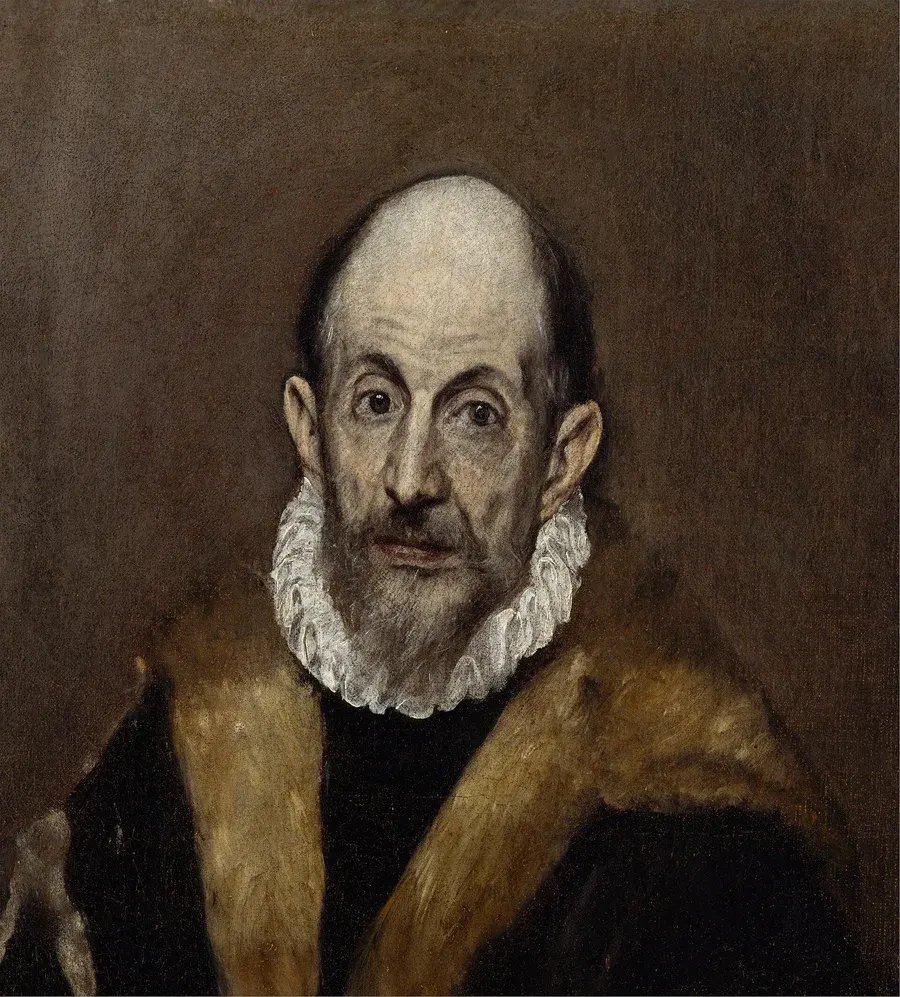
El Greco, Portrait of an Old Man (c. 1595–1600) · The Metropolitan Museum of Art, New York · sometimes thought to be a self-portrait, though this is not settled · public domain · Wikimedia Commons
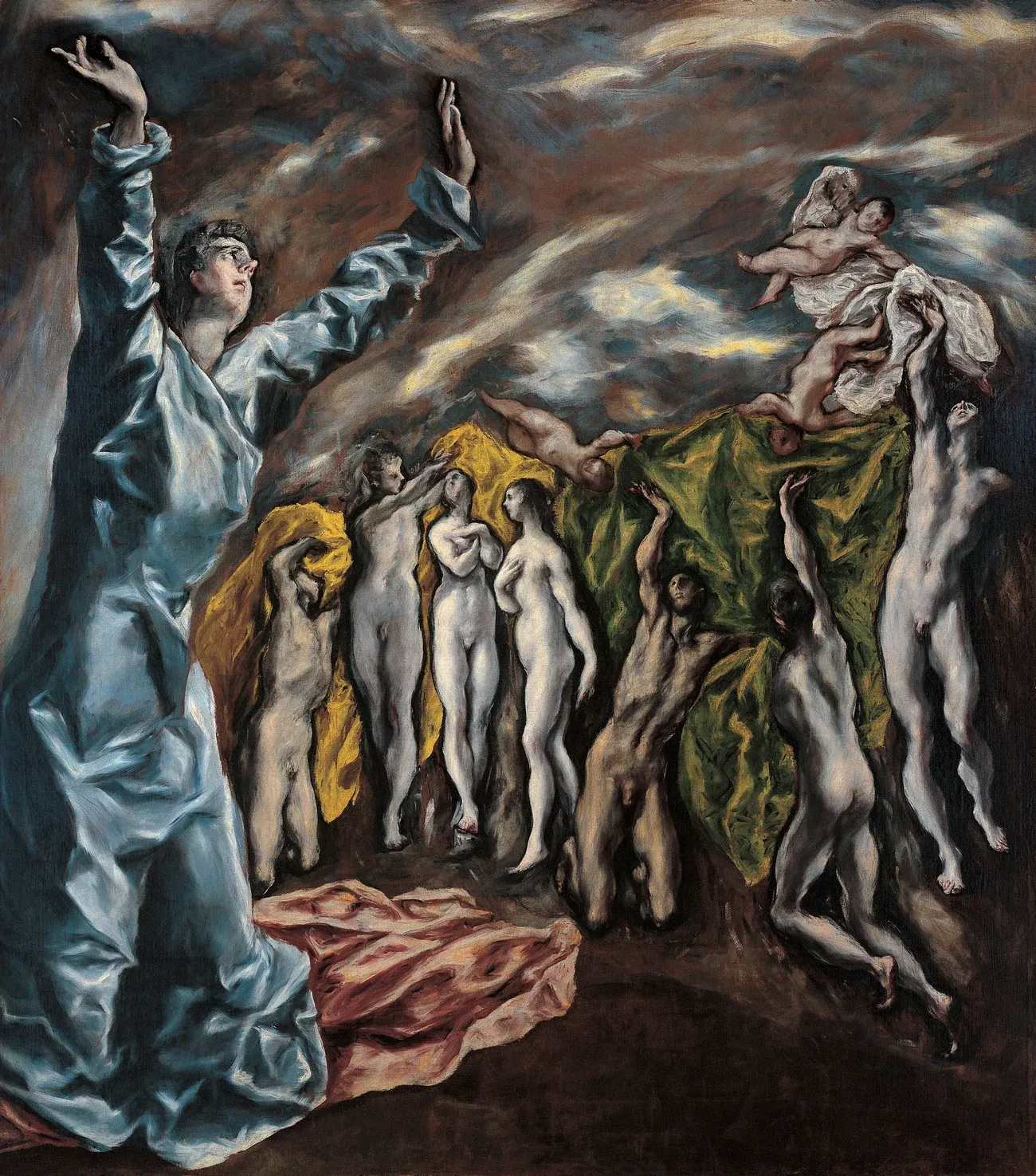
El Greco, The Opening of the Fifth Seal (c. 1608–1614) · The Metropolitan Museum of Art, New York · public domain · Wikimedia Commons
When you stand before his late-period paintings, the first thing that catches your eye is the proportions of the figures. The bodies of the saints and angels are unusually elongated. Debates over how to explain this elongation have continued for over a century (DOI: 10.13128/ijae-20921). A widely spread explanation is that there was something wrong with the painter's eyes, astigmatism among them (PMID 24422249). This guess that the elongation reflects perception stretched by astigmatism is over a century old (PMID 24577418). Astigmatism is an eye condition where the cornea or lens of the eye bends light differently depending on the direction, so that lines in one direction look sharp while lines in another direction look blurry. The astigmatism hypothesis assumes that he saw the world looking stretched in one direction, and painted it just as he saw it.
This article follows a single question all the way through. Did that elongation come from the painter's eyes, or from his way of drawing, namely his artistic style? We will look in turn at doctors' diagnoses, psychologists' arguments and experiments, the counterarguments reassessing those arguments, and art historians' interpretations.
Diagnoses Worked Backwards from Works
The discussed illnesses were several. To explain El Greco's elongated figures, multiple scholars tried to pinpoint eye diseases, especially astigmatism, and reasons ranging from mental illness, addiction to hashish (a drug made from cannabis), to Marfan syndrome (a genetic disorder in which limbs become elongated) were proposed (DOI: 10.13128/ijae-20921). There was also an assertion that he used madmen as models, and an art history literature review classifies this along with the astigmatism theory as ``baseless theories'' (DOI: 10.1093/obo/9780195399301-0199). An ophthalmology review article placed the question of whether the figures' oblique elongation was due to astigmatism alongside a list of famous painters' eye conditions (PMID 8510952). Listed side by side are questions of whether the eye conditions acquired in old age by Leonardo da Vinci, Rembrandt, Michelangelo, and Monet influenced their late-period works; whether the English painter Constable had color vision deficiency; whether the Impressionists' painterly style was due to myopia and cataracts in their representative painters; and whether Van Gogh's yellow paintings were due to the ocular side effects of the heart medication digitalis (PMID 8510952). The questions surrounding El Greco are a branch of long-standing inquiries trying to read the painter's eyes from famous paintings. A chapter in an art history research book summarizes this current in a single sentence: the Cretan painter was diagnosed as having psychiatric and visual defects because of his works (DOI: 10.1163/9781848881112_018).
These diagnoses share a common structure. Retroactive diagnosis is the task of estimating a disease name using only surviving records such as letters, biographies, and works, without directly examining a deceased person. The diagnoses that emerged regarding El Greco started from his works (DOI: 10.1163/9781848881112_018). It is a sequence of spotting an eye disease from the characteristics of a painting, and then explaining the painting back through that disease. The same chapter notes that these diagnoses were persuasively refuted on the grounds that they lack scientific value, biographical evidence, and support from the works themselves, and have now become part of the myth surrounding the painter (DOI: 10.1163/9781848881112_018). These retroactive diagnoses are assumptions worked backwards from paintings.
The reason why such assumptions are dangerous is also found in the literature. While it is common for abnormalities in the visual pathway to change the world a painter renders, controversies continue regarding old painters whose visual functions are not well preserved in historical records (PMID 12637042). A 2015 ophthalmology lecture states more directly that because painters have the freedom to paint as they wish, diagnosing eye diseases from works is dangerous (PMID 26563659). When reading an eye disease from a place where only a single painting remains, it is difficult to distinguish what the painter deliberately chose from what the eyes forced upon them. Doctors and art historians have been divided over the same paintings for over a century. Art historians did not accept medical theories, and many physicians tried to find diseases beneath that elongation (DOI: 10.13128/ijae-20921).
The Canvas Seen Through the Same Eyes
Besides the lack of diagnostic records, the astigmatism hypothesis faces one more longstanding objection. Before we even examine the evidence, the logic within the hypothesis collapses on itself. An article in an ophthalmology journal summarizes this "logical objection" as follows: if El Greco saw things stretched out due to astigmatism, not only his subjects but his canvas would have appeared stretched out in the exact same way, and therefore he would not have needed to stretch his paintings to match what he saw (PMID 24577418).
We can follow this logic into a scene in front of an easel. Suppose, as the hypothesis claims, the painter's eyes make everything stretch in one direction. A model stands in front of him, and the painter looks at the model. To his eyes, the model looks elongated. Now he turns his eyes to the canvas. Because it is the same pair of eyes, the canvas and the lines drawn on it look elongated in the exact same way. When the painter draws the model's proportions so they look normal, that drawing looks just as elongated to his eyes as the model does. Since the two things he sees match up, he stops his brush there. According to this counter-argument, to us looking at that canvas with normal eyes, the figure should appear in normal proportions.
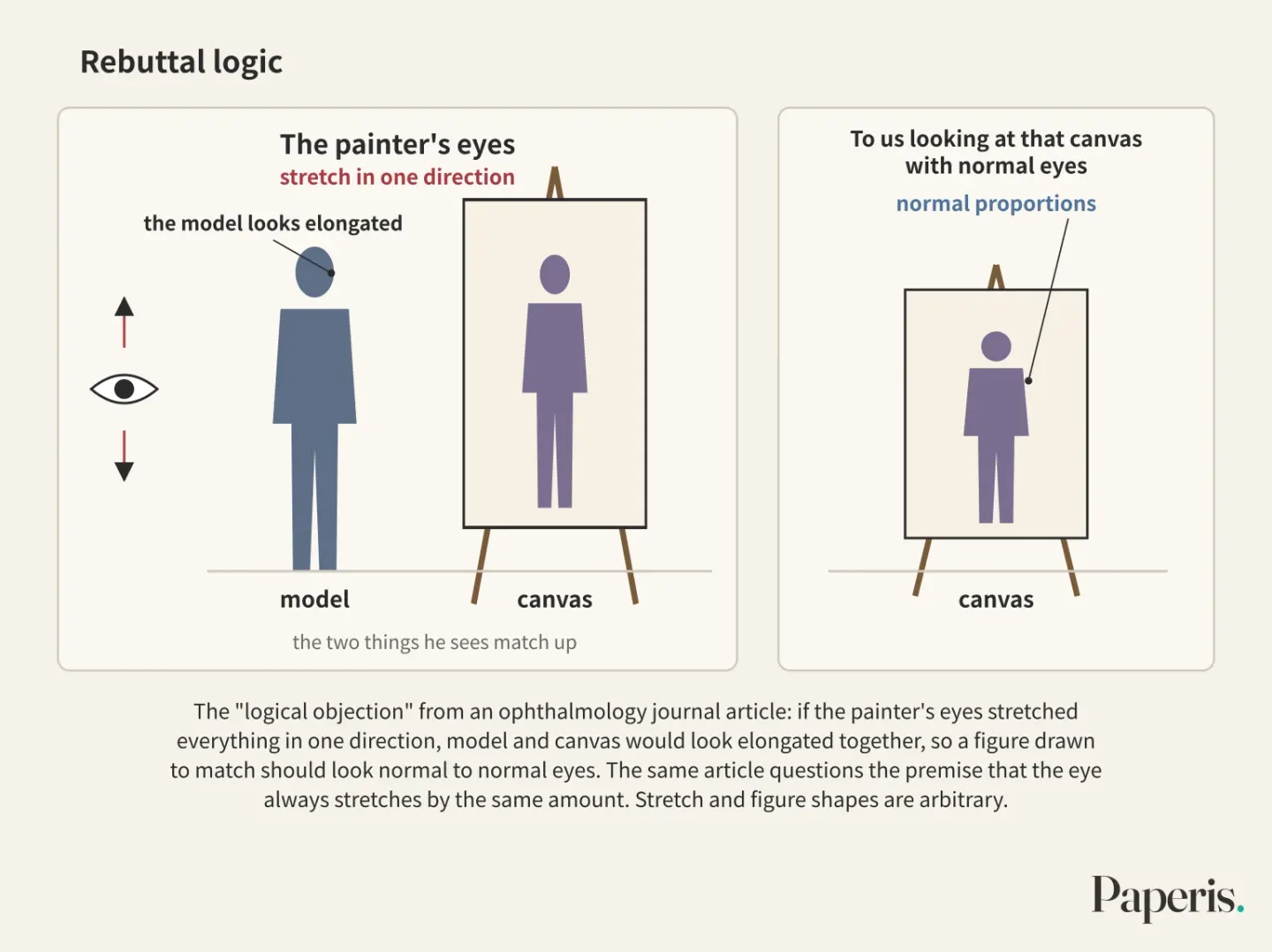
If the eyes stretch everything equally, a painting adjusted and drawn with those eyes must come out in normal proportions. According to this logic, the elongation in the paintings cannot come from the stretching of the eyes alone. The article in the ophthalmology journal assesses this objection as important because it warns us against the false conclusion of treating the artist's work as a literal copy of his perception (PMID 24577418). A short note on psychology starts from the same point. El Greco's elongated forms are often blamed on astigmatism, but that explanation is wrong, and the reason why it is wrong leaves a deep lesson for perceptual psychology (PMID 24422249).
There is a name attached to that lesson. Used in a psychological sense, the El Greco error is a reasoning fallacy that explains distortions appearing in a painting or measurement by saying "it looked that way to that person's eyes," while missing the fact that the same eyes saw the canvas or ruler used for comparison as distorted in the same way. This name entered psychological research as a term referring to a reasoning fallacy in art history (DOI: 10.1177/0956797613485092; DOI: 10.1167/13.9.780).
Arguments Went to the Lab
This logic stepped outside the painting to become an experimental tool. In the background was a trend in psychology around 2013. The top-down effect is the claim that mental states like mood, knowledge, and physical abilities alter the very way objects look. A psychology research team wrote that studies reporting this effect were pouring in like a rising tide, and asked whether it was truly a change in what is seen, or a change in judgment, memory, or response habits (DOI: 10.1177/0956797613485092).
The method the team used was the El Greco fallacy. The same study came out as a journal article and a conference abstract (2013 Vision Sciences Society), with the experimental details in the conference abstract. Two sets among the five experiments went like this (DOI: 10.1167/13.9.780). There was a previous result showing that when people held a long rod horizontally in front of their bodies, they adjusted a gap width they thought they could fit through to be narrower when using a tape measure. The research team replicated this result. Then they changed the matching tool from a tape measure to another gap. If holding the rod genuinely made the gap look narrower, the gap being used for matching should also look equally narrow, so the two distortions should cancel each other out. The setup is the same as the painter in front of the easel. Yet the effect of adjusting it narrower still appeared. If what happened was a change in visual appearance, this result could not occur. The abstract does not conceal which of the candidates the team initially listed—judgment, memory, or response habits—remains.
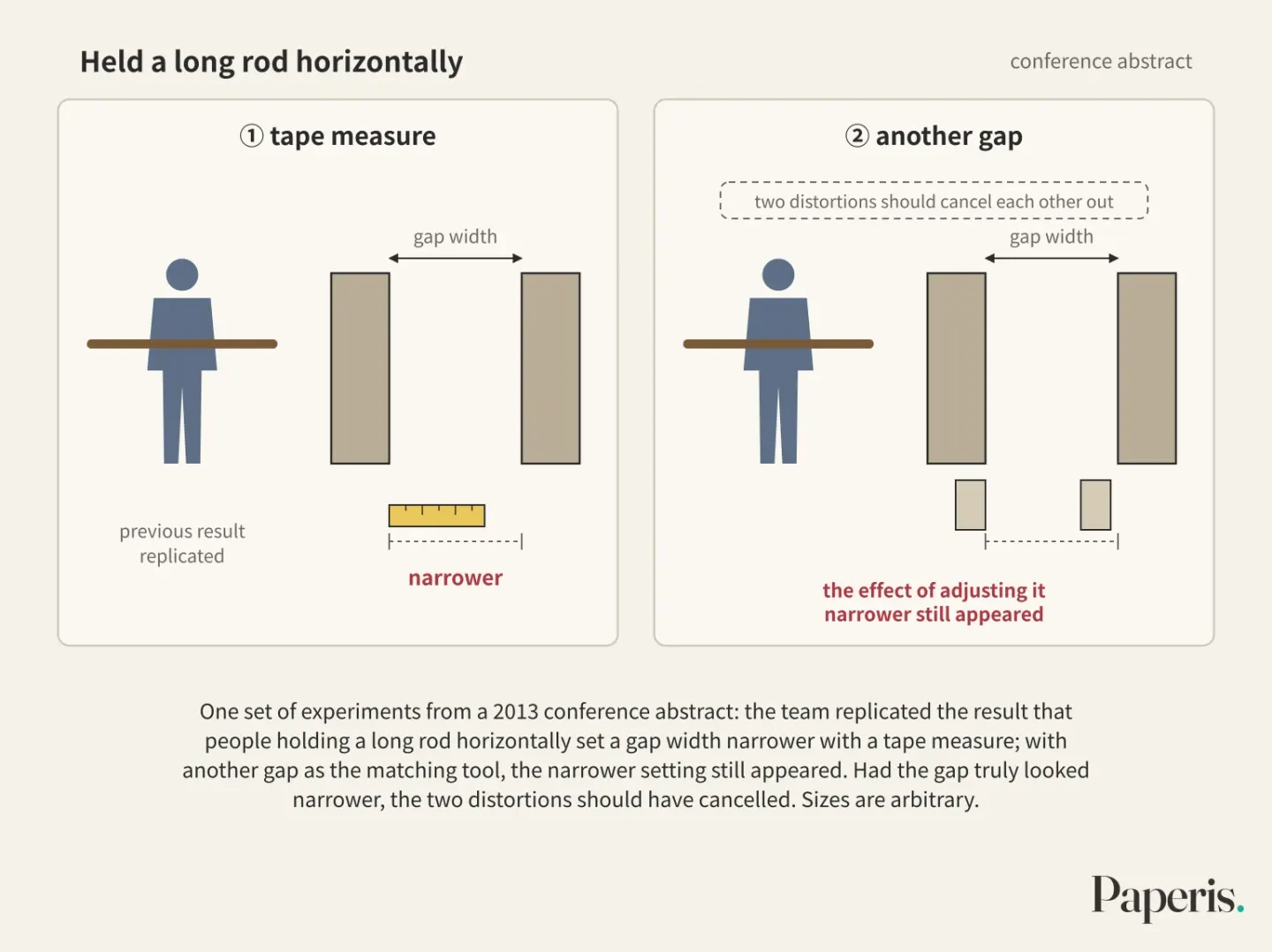
The second set had the same structure. There was a result that recalling an unethical action caused people to rate stimuli as darker on a scale of 1 to 7, and the team replicated it. Then, instead of numbers, they used a scale made of seven gray squares. If it really looked darker, the gray squares should have also looked darker together, but the effect of rating it darker remained (DOI: 10.1167/13.9.780). The research team's conclusion is that while these effects are real, they cannot be effects of perception. That is because if they were perceptual effects, the tool used to measure them should have also looked distorted by the same amount, canceling out the effect (DOI: 10.1167/13.9.780). The main paper published in the journal showed through this method that several top-down effects cannot be true perceptual effects, noted that the same error might be mixed into other top-down effects, and stated that this has implications for the debate over whether perception and cognition are connected (DOI: 10.1177/0956797613485092).
The research team's premise was that if the measuring tool undergoes the same distortion as what is being measured, the two distortions will cancel each other out. This logic, which came from El Greco's canvas, was used in psychology as a tool to test the claim of "seeing." There are also counterarguments to this application. One example is an academic commentary arguing that mental states genuinely alter perception, based on studies that measured pupil size (DOI: 10.1017/s0140525x15002654). These experiments tested whether mental states change what things look like, not El Greco's eyes.
The Objection That the Rebuttal Also Has Flaps
The logic in front of the easel has one hidden assumption. It is the assumption that the eye always stretches everything in the same direction and by the same amount. That very article in the ophthalmology journal that summarized the "Logical Rebuttal" earlier takes issue with this assumption. Analyzing the effect of astigmatism on the image formed on the retina, the author concludes that the rebuttal propagates yet another error by viewing astigmatism as a constantly uniform source of perceptual error (PMID 24577418). The title captures that claim directly. It is "The "El Greco Fallacy" Fallacy".
The name "El Greco Fallacy" is used in two senses. This ophthalmology journal article applies the name "El Greco Fallacy" to the conjecture itself that El Greco's elongation reflects a perception stretched by astigmatism (PMID 24577418). In psychology, the same name points to the flaw in the inference that "because the eye saw crookedly, the result is also crooked" (DOI: 10.1177/0956797613485092). The same name is calling different things. A short note from the psychology side points out that as the details and historical origins of this lesson were passed down repeatedly, an incomplete and even inaccurate understanding spread, and records that are actual are richer and more subtle than recent explanations (PMID 24422249). What was corrected and how is not mentioned in the abstract of that note.
What the counterargument shakes is the certainty that "the astigmatism hypothesis was ended by a single piece of logic." If astigmatism does not create the exact same error every time, it is difficult to say that the scene where both the canvas and the model are stretched by the same amount holds true either. However, this counterargument merely takes issue with the premise of the rebuttal logic, and does not say that El Greco had astigmatism. As we saw earlier, the same article evaluated that rebuttal logic as important (PMID 24577418). Evidence that he had astigmatism is not in that abstract, and the limitations of retrospective diagnosis seen in the previous section remain as they are.
There is also a definitive assertion on the opposite end. The ophthalmology lecture from earlier cuts it short by saying "El Greco did not have astigmatism" (PMID 26563659). The same lecture also states that Monet was not nearsighted and Turner did not have cataracts (PMID 26563659). It is a sentence applying the lecturer's judgment that reading eye diseases from artworks is dangerous to El Greco as well.
The range supported by the evidence is as follows. There is no record anywhere in the evidence gathered by this article that there was astigmatism in his eyes. The astigmatism explanation has received evaluations in multiple literatures that it is wrong and groundless. One short note calls the explanation attributing the elongation to astigmatism "wrong" (PMID 24422249), an art history literature review calls the theory that he suffered from astigmatism a "groundless theory" (DOI: 10.1093/obo/9780195399301-0199), and a research book chapter writes that visual and mental defect diagnoses received because of works were "persuasively rebutted" (DOI: 10.1163/9781848881112_018). However, a flap was pointed out in the single rebuttal logic that "if the eye stretches, the canvas also stretches" (PMID 24577418). And the lecture's assertion that "he did not have astigmatism" exceeds the range supported by records. This is because the absence of records does not serve as proof that he did not have astigmatism.
The Side That Reads Elongation as a Stylistic Choice
While the eye-based explanation lacked records, art historians found answers elsewhere. Without accepting medical theories, they see Mannerist elements in El Greco’s work, with elongation being one of them (DOI: 10.13128/ijae-20921). Mannerism is an art movement that emerged in 16th-century Italy after the High Renaissance, a style in which the human body was often deliberately elongated or twisted. How his training under Titian and Tintoretto, whom he took as models in Venice, connects to this elongation does not appear in the evidence gathered by this article.
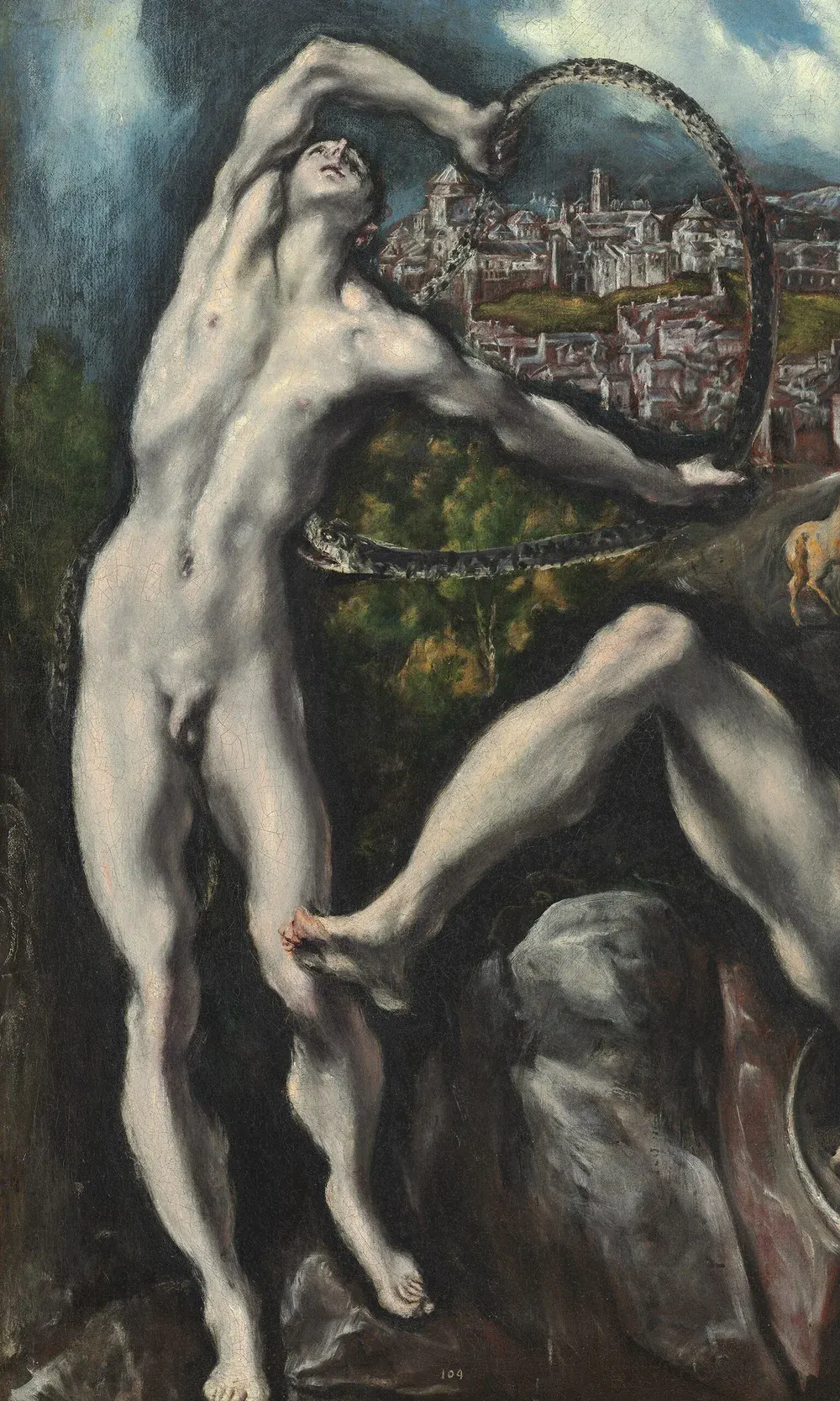
El Greco, Laocoön (c. 1610–1614), detail · National Gallery of Art, Washington · public domain (CC0) · Wikimedia Commons
His paintings received mixed evaluations even in his own time. Contemporaries acknowledged his talent yet frequently rebuked his novel attempts in painting, and several religious works were criticized for violating the strict standards of decorum established after the Council of Trent. Writers from the 17th and 18th centuries dismissed his late painting style, notable for its prominent brushwork, as excessive (DOI: 10.1093/obo/9780195399301-0199). The Council of Trent is a church council held by the Catholic Church in the mid-16th century. Whether the criticized novel attempt was elongation is not stated by this review.
Later interpretations shifted with each era. 19th-century Romantic writers portrayed him as a rebellious genius, early 20th-century scholars in Castile, Spain, saw his paintings as embodying the mysticism of mystics such as Teresa of Ávila and John of the Cross, and others put him forward as a pioneer of modern art. This image of the "mystic painter" persisted for decades, and it was during that time that the astigmatism theory and the madman model theory emerged (DOI: 10.1093/obo/9780195399301-0199). The common notion connecting madness and creativity is handled separately in "Genius and Madness — The Thin Sheet Between Them".
What changed that image of the painter was the painter’s own writings. According to the same literature review, the publication of writings he authored revealed that he was an intellectual well-versed in Italian art theory, causing academic views to shift significantly in the 1980s. How he applied this humanistic erudition to religious and secular paintings has not yet been fully explored, is the conclusion of the review (DOI: 10.1093/obo/9780195399301-0199). The evidence that those writings explain elongation is not in the materials gathered by this article.
A chapter from an art history research book moves in a different direction. The author acknowledges that the pathological diagnosis was refuted, yet considers that the claim itself—that his paintings depict things difficult for ordinary eyes and minds to conjure—does not vanish with that refutation. Drawing upon historically more robust interpretations, the author views El Greco's humanistic representation of nature, Neoplatonic spirituality, and ecstatic mysticism as a combination of facts and symbols expressive to the point of being near-abnormal, and reads how the twisted and lifeless bodies in his late paintings create a sense of ascending to heaven against gravity along with garments and the sky (DOI: 10.1163/9781848881112_018). The author calls this the "aesthetics of the abnormal". This is an art historian's reading that shifts the abnormal from the painter's eyes to the painting itself, and it is not a fact established by research.
Placing the two explanations side by side leaves questions. The eye-based explanation starts from the elongated saints and goes to the painter's eyes, and cites the elongated saints again as evidence that those eyes had a disease. The lack of biographical evidence for those diagnoses was one reason for the refutation (DOI: 10.1163/9781848881112_018). The style-based reading is a judgment on elements within the artwork. How that elongation connects to the painter's training or the writings he left behind cannot be answered by the evidence gathered by this article.
So What Did We Learn?
The ophthalmology lecture mentioned earlier starts from this premise: ophthalmology cannot explain art, but vision is a painter's tool, and the properties of both typical and atypical vision can influence what a painter is able to do. It adds that when eye diseases remain in the historical record, that influence can be analyzed. The same lecture notes that dense cataracts break down color discrimination, and that unfamiliar, intense colors appeared on Monet's late-period canvases before his surgery (PMID 26563659). How far interpretations connecting Monet's eyes and paintings can go is covered separately in "Monet's Japanese Footbridge — The Same Bridge, Different Colours". No such records exist for El Greco's eyes. What separates the two painters is the record left outside the paintings.
The ways that visual abnormalities find their way into paintings are also not singular. Some painters intentionally used visual distortions to create their own style (PMID 12637042). This means that the visual traces left in a painting are sometimes chosen and used by the painter.
We return once more to the easel in Toledo. The painter looks at the model, looks at the canvas, and matches the two. Those eyes look at the model and the canvas together. That single fact shook the explanation that "he painted what he saw," but that rebuttal was also met with the criticism that it assumes astigmatism stretches things by the exact same amount every time (PMID 24577418). Even so, the evidence leans to one side. The astigmatism explanation has been evaluated in various literature as incorrect and groundless, and no record that he had astigmatism appears in the evidence gathered in this article. El Greco's elongated figures cannot be read as a photograph of his eyes, and the influence of a painter's eyes on their paintings can only be analyzed when there are records outside the paintings.
Source Papers
- "El Greco" (2014) — DOI: 10.1093/obo/9780195399301-0199 — Oxford bibliographic guide. Life (Crete c. 1541–Toledo 1614), contemporary criticism and post-Tridentine standards of decorum, Romantic and mystic reception, astigmatism and madman model theories as baseless, 1980s writings by the artist himself revealing him to be an intellectual well-versed in Italian art theory.
- "Human anatomy in the paintings of Dominikos Theotokopoulos - El Greco (1541-1614)" (2017) — DOI: 10.13128/ijae-20921 — Over a century of debate surrounding his elongated late figures, hypotheses of astigmatism, mental illness, hashish, or Marfan syndrome, with art historians rejecting medical theories and viewing them as Mannerism.
- "El Greco's Artistic Degeneration: Astigmatism, Paranoia and the Anomalous" (2012) — DOI: 10.1163/9781848881112_018 — A book chapter. Diagnoses of visual and mental defects have been groundlessly refuted and become part of myth, yet the author reads the distorted bodies, draperies, and ascending skies in late works as an "aesthetics of the anomalous" creating a sense of rising to heaven.
- "Vision of the famous: the artist's eye." (1993) — PMID 8510952 — Review covering eye diseases and works of famous painters. Addresses the question of whether El Greco's oblique elongation was due to astigmatism.
- "Visual dysfunction in artists." (2003) — PMID 12637042 — Visual pathway abnormalities alter artists' expression, and some used them as style, but past painters without records of visual function remain controversial.
- "Vision, eye disease, and art: 2015 Keeler Lecture." (2016) — PMID 26563659 — Ophthalmology lecture notes. Diagnosing eye diseases from artworks is dangerous (artist's freedom), "El Greco did not have astigmatism," and recorded eye diseases can be analyzed (such as Monet's cataracts).
- ""The El Greco fallacy" fallacy." (2014) — PMID 24577418 — While the logical refutation that "the canvas would have looked stretched too" is important, viewing it through retinal image analysis reveals yet another error of assuming astigmatism as a constant perceptual error.
- "On the origin and status of the "El Greco fallacy"." (2013) — PMID 24422249 — Short note. The astigmatism theory was wrong and its reason became a lesson in perceptual psychology, but correcting the record because its origin and status became inaccurate amid repeated explanations.
- "“Top-Down” Effects Where None Should Be Found: The El Greco Fallacy in Perception Research" (2013) — DOI: 10.1177/0956797613485092 — Demonstrates that various top-down effects cannot be genuine perceptual effects by utilizing the El Greco fallacy.
- "'Top-down' effects where none should be found: The El Greco fallacy in perception research" (2013) — DOI: 10.1167/13.9.780 — Conference abstract of the above study (VSS 2013). Effects persist even when changing measurement tools in bar-and-gap experiments, unethical recall, and gray square experiments → the effect is real but cannot be perceptual.
- "The El Greco fallacy and pupillometry: Pupillary evidence for top-down modulation of perception" (2016) — DOI: 10.1017/s0140525x15002654 — Academic commentary. Argues that cognition influences perception based on pupillometric evidence.
Sources (11)
- El GrecoDOI 10.1093/obo/9780195399301-0199
- Human anatomy in the paintings of Dominikos Theotokopoulos - El Greco (1541-1614)DOI 10.13128/ijae-20921
- El Greco's Artistic Degeneration: Astigmatism, Paranoia and the AnomalousDOI 10.1163/9781848881112_018
- Vision of the famous: the artist's eyePMID 8510952
- Visual dysfunction in artistsPMID 12637042
- Vision, eye disease, and art: 2015 Keeler LecturePMID 26563659
- The El Greco fallacyPMID 24577418
- On the origin and status of thePMID 24422249
- Top-DownDOI 10.1177/0956797613485092
- 'Top-down' effects where none should be found: The El Greco fallacy in perception researchDOI 10.1167/13.9.780
- The El Greco fallacy and pupillometry: Pupillary evidence for top-down modulation of perceptionDOI 10.1017/s0140525x15002654