Paperis Articles
Kim Hong-do — The Wrestling Spectators' Hands: Who Painted the Danwon Genre Album?
Three papers on who painted the Danwon genre album: swapped hands, a rebuttal that cites two kinds of brush, and copies that crossed the sea
Your field's papers, as audio
Pick your fields and journals — Paperis summarizes the key papers and turns them into audio. Listen on your commute.
Start Paperis free →Kim Hong-do — The Wrestling Spectators' Hands: Who Painted the Danwon Genre Album?
A Book of Museum Paintings
In the late 18th century in Joseon, there was a famous painter in the royal painting office. He is better known by his art name, or ho, Danwon, rather than his real name: Kim Hong-do. He was born in 1745, and the year he passed away is recorded differently by various studies as 1806, after 1803, or 1816 (with a question mark) (DOI: 10.17792/kcs.2019.37..133) (DOI: 10.22835/ahvc.2015..15.002) (DOI: 10.31065/ahak.275276.275276.201212.004). At the National Museum of Korea in Seoul, there is a bound set of paintings bearing his name. Inside are “Wrestling”, showing two men grappling in the middle of a crowd sitting in a circle; “Village School”, with children gathered around a teacher; and “Dancing Boy”, where a child dances to the rhythm of musicians.
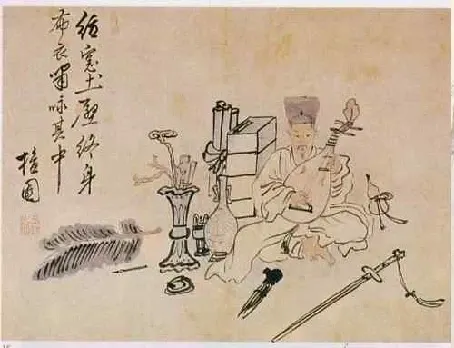
Kim Hong-do, Po-ui Pungnyu-do (A Commoner's Refinement) · Leeum Museum of Art · copyright expired (Gongu Madang) · Wikimedia Commons — at upper left he wrote, roughly, “Behind a silk window in an earthen-walled house, a man without office all his life, I will chant poems within,” and signed it Danwon
This article is written about the late Joseon painter Kim Hong-do and a bound set of paintings handed down under his name. Joseon was a dynasty that ruled the Korean peninsula from 1392 to 1910, and the setting of this article is the latter half of that dynasty, from the late 18th century to the 19th century.
First, let us define two terms. Genre paintings are artworks that take as their subject matter the ways people of that era worked, played, and lived. An album of paintings is a collection of multiple loose paintings bound together like a book. This album at the National Museum of Korea consists of 25 sheets and has been designated as a Treasure, a cultural heritage grade designated by the Korean government (KCI ART001763787) (KCI ART000949150). Among the 25 sheets, 14 depict commoners making a living, 3 depict romance between men and women, 5 depict play, and the rest show scenes of study, wedding ceremonies, and shamanic rituals (KCI ART000949150).
The names used to refer to this album are several, including “Danwon Pungsokdo-cheop”, “Danwon Pungsokhwa-cheop”, and simply “Pungsokhwa-cheop”. This article will refer to it as “Danwon Pungsokdo-cheop”. Art historians are divided on whether this album is in Kim Hong-do's own hand. A 2012 art history paper argued that it is difficult to view this album as Kim Hong-do's authentic work, and a paper the following year published a rebuttal against the "theory that it is not an authentic work." It is not stated in the abstract which paper that rebuttal targeted. This article follows that debate and examines what the question of authorship changes and what it leaves untouched when Kim Hong-do's genre paintings are used as historical sources for daily life in the late Joseon period.
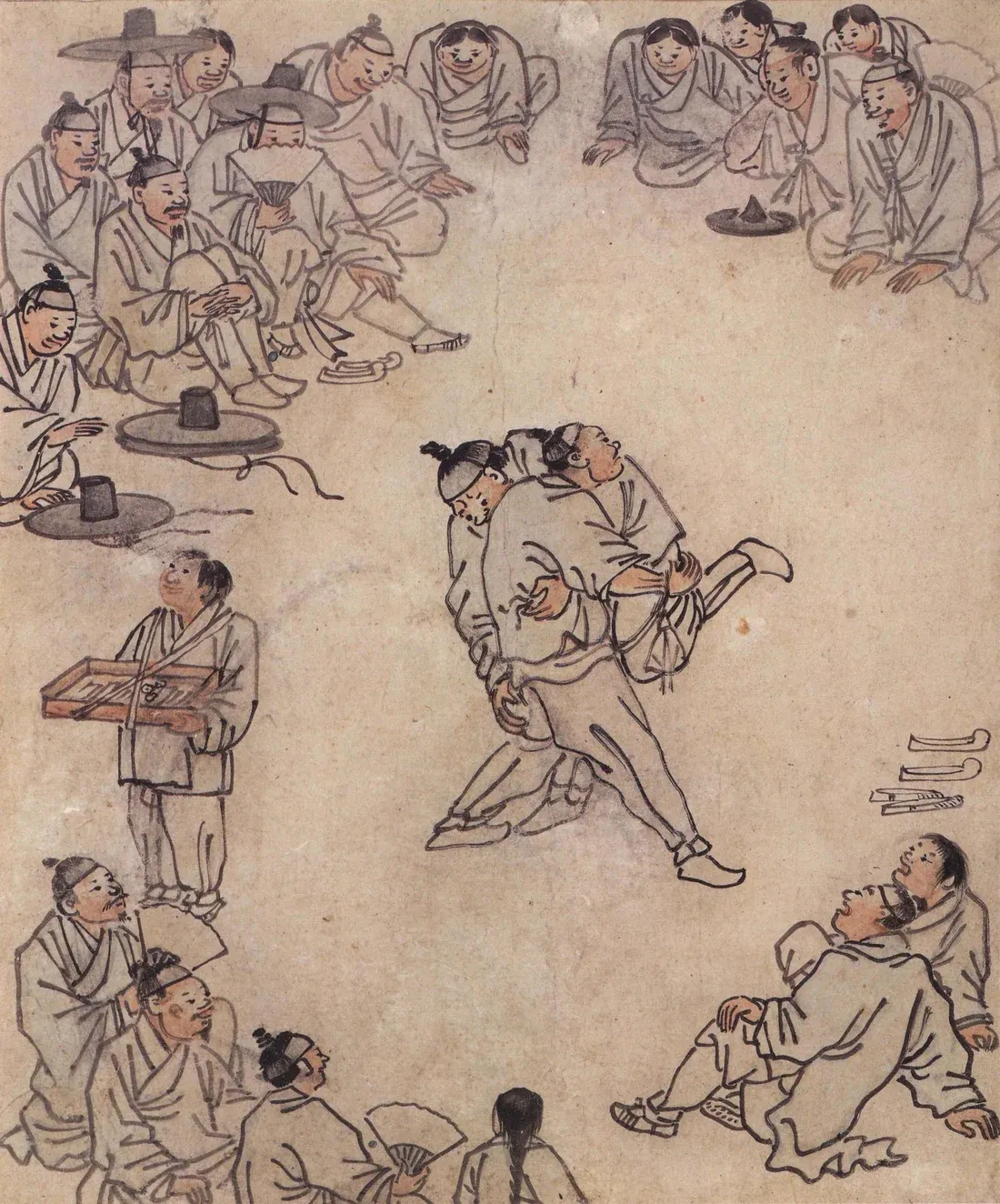
Wrestling, from the Danwon genre album · National Museum of Korea · copyright expired (Gongu Madang) · Wikimedia Commons — the 2012 paper pointed to left and right hands drawn swapped in this picture and in Dancing Boy
How "Kim Hong-do = Genre Painter" Became Established
A person who watched Kim Hong-do from a young age and evaluated him highly was his teacher. Kang Se-hwang (1713–1791), a scholar-literati who painted and also wrote critiques, noted that when Kim Hong-do frequented his household around age seven or eight, he praised his talent and taught him the principles of painting, that they later worked in the same government office, and that they ultimately became art-appreciating friends (DOI: 10.31065/ahak.275276.275276.201212.004). Kang Se-hwang wrote two pieces titled "Danwon-gi" recording Kim Hong-do's life. This is a rare occurrence for a painter from the jungin middle class, who stood between the nobility and commoners (DOI: 10.22835/ahvc.2015..15.002).
While Kang Se-hwang evaluated Kim Hong-do as an artist equally brilliant in all branches of painting, the area where he placed the highest meaning was genre painting. He called paintings depicting the daily lives of Joseon people of the same era—such as travelers and farmers, ferry crossings and shops, and examination sites—"paintings never seen before" (DOI: 10.22835/ahvc.2015..15.002). The same study considers that genre painting did not emerge or trend solely through the activities of these two men, and that behind it lay changes in Joseon society. A 2004 study views these genre paintings as works that appeared abruptly over a short period around 1800, and interprets them as the culture of commoners who gained money within a monetary economy (KCI ART000934449). That 18th-century people already recognized them as new paintings—this is the first layer of the evaluation of Kim Hong-do's genre paintings.
The second layer was built in the 20th century. According to a 2019 research history paper, Japanese researchers who wrote the first comprehensive histories of Joseon art during the Japanese colonial period had little interest in late Joseon painting, and the position Kim Hong-do occupied was not large (DOI: 10.17792/kcs.2019.37..133). This paper views that investigation and collection for public exhibitions in museums and art galleries were deeply intertwined with Japanese researchers' early studies of Joseon art, and that literary magazines such as Gaebyeok and Munjang served as stages that elevated the late Joseon period as a new heyday of national culture. Within that process, genre paintings were rediscovered as a "Joseon-style, realistic, and modern" branch and emerged as the category representing Kim Hong-do, while in the same process Kim Hong-do's Taoist-immortal paintings gradually faded amid the understanding that they were "Chinese-style and unrealistic," this paper records.
When this article overlaps the two studies, the "genre painter Kim Hong-do" we know today is an image that became established with 20th-century rediscovery layered on top of 18th-century evaluation. Because Album of Genre Paintings by Danwon sits at the very center of that image, the question of who painted it is not light.
How Do We Tell Who Painted It?
Kim Hong-do was a court painter. Court painters belonged to Dohwaseo, the official painting bureau of the Joseon royal court, and worked as professional painters making pictures needed by the state. Dohwaseo had other court painters besides Kim Hong-do who painted genre scenes, and among them, Geungjae Kim Deuk-sin (1754–1822) was especially praised consistently for his genre paintings. Discussions of his genre paintings have mostly centered on the influences exchanged with Kim Hong-do (KCI ART003396617). Since several court painters painted similar subjects, pictures without a clear name written on them require separate investigation to find out whose hand made them.
Author attribution is the work of examining and deciding who painted a picture when the name is not certain. The baseline for this is a genuine work. A genuine work is a piece acknowledged to have been painted by that artist directly. Papers also use terms like "authentic work" or "autograph" for the same meaning.
Another painting by Kim Hong-do clearly shows the materials used for author attribution. Regarding “Jinggak ajipdo”, which depicts a gathering held in the summer of 1784 at a government office pavilion in Daegu, a 2025 study checked seven steps: whether the gathering scene written in the letters of two literati of the time matches the painting, the brushwork, the painting style, and Kim Hong-do's unique drawing habits. It also found a collection of seal impressions containing the same seal as the one stamped on the painting (KCI ART003269042). These are documentary records, seals, and hand habits.
When documents or seals are lacking, the third material is what people lean on. Stylistic comparison is a method of placing features like the habit of drawing lines, the way figures are seated, and paper and mounting side by side with a definite genuine work to gauge whether it is the same hand. However, even what to place side by side becomes a subject of dispute. A 2013 rebuttal paper we will look at later cites a genre folding screen from 1778 and a genre folding screen from 1795, when Kim Hong-do was 51 years old, as genuine works of Kim Hong-do. However, this paper views simple horizontal comparison with these folding screens, without considering the special editing circumstances of the album, as a flaw in the skepticism argument. The point is that folding screens are paintings with a strong on-site nature, whereas albums are paintings edited indoors, so their production intentions differ. At the same time, this paper itself sets the production period of the album to be similar to the 1795 folding screen by comparing it with the folding screens (KCI ART001763787).
The Doubt of 2012 — A Village School with Attached Limbs and Swapped Hands
A paper published in the journal Art History Studies in 2012 compared in detail the genealogies of how late Joseon genre paintings were copied and passed down, and examined the paper and formats from various angles. The conclusion of this paper is that this album of paintings can by no means be seen as an authentic, direct brushstroke by Kim Hong-do (DOI: 10.15819/rah.2012..39.164).
The evidence specifically pointed out by this paper is the mistakes within the paintings. In “Village School”, the arm of the person sitting in front and the leg of the person sitting in the back are confused, drawn as if they merged into one in the middle. In “Wrestling” and “Dancer”, the left and right hands of the spectators and musicians are drawn backward, with the backs of the hands and fingers flipped. The paper considers such mistakes hard to find in Kim Hong-do's definite authentic works and a phenomenon that can appear only in copied paintings. No further explanation of why they appear only in copied paintings is given in the abstract.
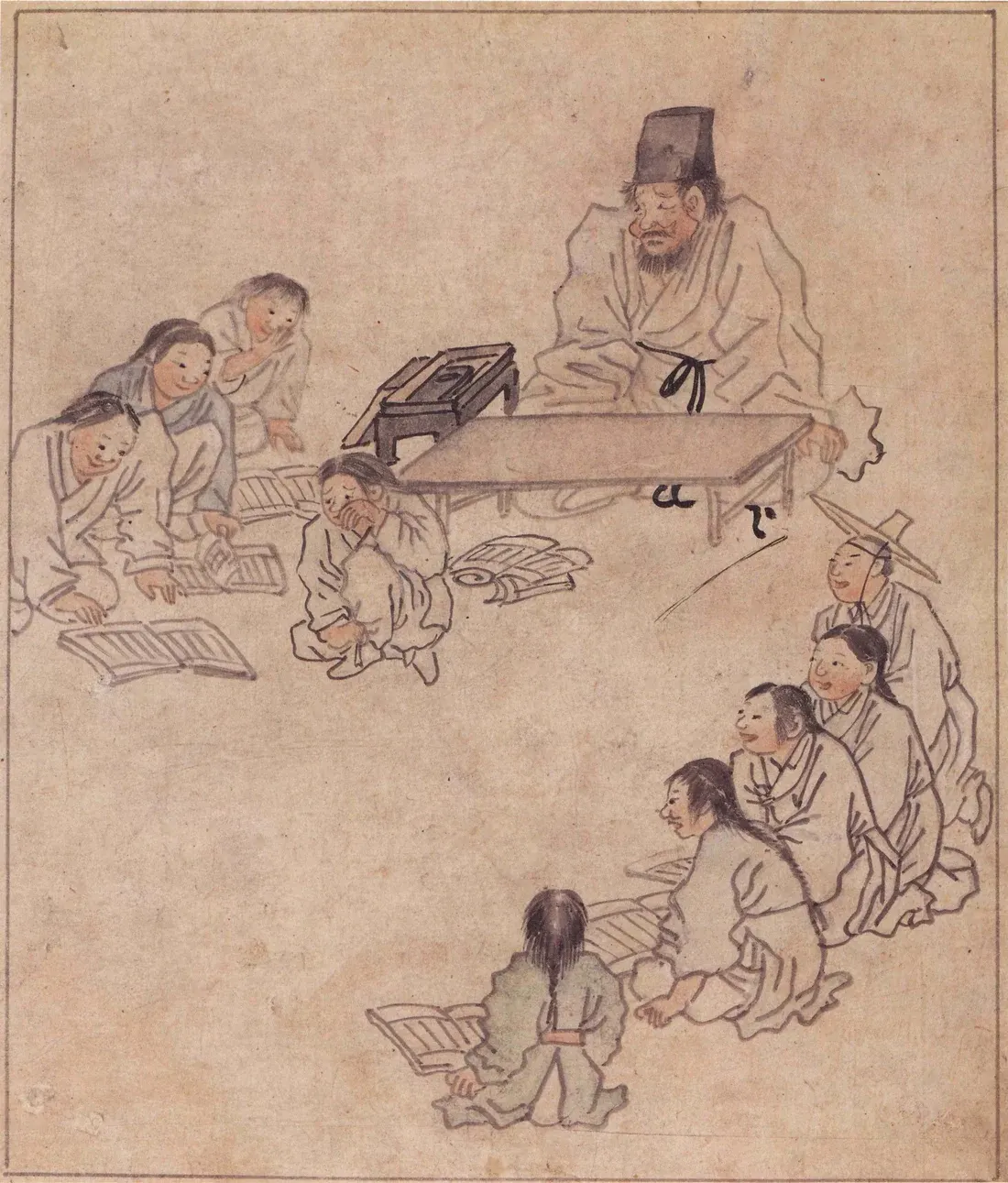
Village School, from the Danwon genre album · National Museum of Korea · copyright expired (Gongu Madang) · Wikimedia Commons — the 2012 paper pointed to a place in this picture where one figure's arm and another's leg merge into one (the abstract does not say where)
Aside from the mistakes, the paper raises four more points. First, the appearance of the figures and the brushwork in each painting vary across multiple branches—not only the styles of Kim Hong-do and Kim득신, but too many branches to group into just those two. Second, multiple types of paper with different qualities and sizes were used. Third, paintings with traces of major revisions made multiple times, such as “Ferryboat”, were left as they were and included in the album. Fourth, nearly all paintings have rectangular border lines drawn, and were drawn strictly within those boundaries even to the unreasonable extent that toes or arms were cut off (DOI: 10.15819/rah.2012..39.164).
Why are the border lines important? The paper views this as an indication bearing in mind a model book of pictures to be carved on wooden blocks and printed, and strongly suggests that this album was a draft drawing for that book. Here the third term appears. A hwago is a draft drawing sketched before making a finished product. Yet throughout the album, there are unprecedentedly many traces of ink running, strange ink lines drawn, paint smeared, and paper torn and shifted. Seeing this, the paper concludes that it did not go as far as being carved onto wooden blocks, and that this draft was used as a textbook for a long time just as it was.
The picture presented by the paper based on these gathered pieces of evidence is as follows. It is highly likely that court painters of the Bureau of Painting in the first half of the 19th century, the generation after Kim Hong-do and Kim Deuk-sin, were a hwago for teaching purposes that copied and collected genre paintings of earlier generations of masters that had already become models across multiple branches (DOI: 10.15819/rah.2012..39.164). The strength of the conclusions varies by layer. The judgment that "it is hard to see as an authentic direct brushstroke" with "by no means," and that it is "a collective copy model of later generations," is resolute as "almost certain." The more specific identity—namely, a hwago of a model book to be used as a textbook by painters in the first half of the 19th century—is an estimation that "it is most reasonable to view it as having high probability."
The album painted by this paper is a textbook that painters copied and collected to learn from. The claim that the name of Kim Hong-do was attached to deceive others is not in the abstract. The paper itself notes that even if it is not an authentic brushstroke, the art-historical and cultural-property value of this album is very high. This is because it is material showing that top-tier genre paintings by court painters during the reigns of the two Joseon kings, Jeongjo and Sunjo, were taken as models to create a textbook and used for a long time.
The Counterargument of 2013 — Edited Paintings, Two Brushes, Old Hands
A paper published the following year in the journal “Journal of Far Eastern Art” states itself to be a counterargument to the theory that the album of 25 paintings in the National Museum of Korea is not the genuine handwriting of Kim Hong-do (KCI ART001763787). The abstract does not mention the name of the opposing paper. The 2013 abstract speaks of the negative theory "raised in the meantime," while the 2014 abstract speaks of the problems "pointed out by prior researchers." Whether the research doubting his authentic handwriting was just a single 2012 paper cannot be known from the abstracts collected in this article.
This paper summarizes the grounds of the side denying authenticity into two premises. First is the premise that if it were Kim Hong-do's authentic handwriting, errors or mistakes in character depiction would be completely impermissible and the painting style must be above a certain level, and second is the premise that the nature of the lines must all be evenly identical. This is the shape of the negative theory organized by the 2013 paper. The expression in the 2012 paper's abstract was that such mistakes "are difficult to see in certain genuine works," which is not quite the same as saying "errors are completely impermissible." However, in the same sentence, it firmly adds that such mistakes are "a phenomenon that can appear only in copy models." As the 2013 paper sees it, the decisive flaw of the negative theory is that it left out the special editing circumstances and artistic nature unique to this album, and made a simple horizontal comparison with genuine works drawn directly on site.
The grounds put forward by the counterargument are three (KCI ART001763787). First, unlike paintings with a strong sense of being on-site such as the folding screens of 1778 and 1795, this paper views this album as a "secondary painting style" meticulously edited indoors according to the subject away from the site, and therefore considers that some descriptive errors could sufficiently occur. Second, according to this paper, when drawing figures, Kim Hong-do used hair brushes and bamboo pens with different line characteristics together, and thus it is easily misunderstood as having been painted by multiple artists. Third, this paper views this album as having been made by Kim Hong-do over at least 4 to 5 years in his later years to synthesize his expression of customs, from around the same period as the 1795 folding screen. Therefore, the explanation is that the cautious and drained-of-strength lines of old age increased noticeably instead of the lively lines of youth.
This counterargument does not argue that there are no errors. It views that some descriptive errors can sufficiently occur in paintings like this album. Since the abstract does not point out specific scenes from “The Village School” or “Ssireum”, placing the mistakes raised by the 2012 paper and the errors spoken of by the 2013 paper side by side is this article's comparison. Placed side by side like that, one side is read as the trace of a copyist's descriptive mistakes, while the other is read as errors that could occur while editing. The observation that the brushwork branches into multiple ways is also explained by one side as evidence of multiple hands, and by the other as the result of one hand using two tools.
There are also empty spots in the abstract. What was used to confirm that bamboo pens were used together, and what the basis is for saying the production took 4 to 5 years, do not appear in the abstract. Passages dealing with the type of paper, the square borders, the corrected traces of “The Ferryboat”, and severe stains brought up by the 2012 paper are also not in the abstract. Whether they were covered in the main text cannot be known from the abstract alone.
The counterargument ends with an evaluation. The passage stating that humor and a painting style "stroked with the heart" are the true appearance of this album is the appreciation and evaluation of this paper's author. The final sentence is an argument questioning the method itself, saying that if one tries to determine authenticity based solely on peripheral iconographic and linear errors, the conclusion will differ, and it does not answer the individual grounds raised by the negative theory one by one.
Copied Paintings That Crossed the Sea
The late 19th century, after Joseon opened its ports in 1876, is called the opening port period. At this time, Westerners traveling in and out of Joseon bought paintings copied from Kim Hong-do's "Travelers and Genre Scenes" (Haengnyeo pungsokdo) and from the "Danwon Album of Genre Paintings". A paper published in 2014 in "The Journal of Art History" approached this album centering on these copied paintings (DOI: 10.31065/ahak.283284.283284.201412.005).
In the private art market of that period, the two lines carried different names. Paintings copied from the "Danwon Album of Genre Paintings" were produced under the names of the copying painters themselves, and album books bearing names like Han Jin-woo and Mun Hye-san were sold to Westerners for whom Kim Hong-do's name was not particularly important. Paintings in the "Travelers and Genre Scenes" line, by contrast, were made bearing Kim Hong-do's name. The "Genre Scenes of the Four Seasons" (Sagye pungsokdo) at the Guimet Museum and the "Genre Scenes" (Pungsokdo) at the National Museum of Korea are examples, and the paper views these as intended for domestic customers who were well aware of Kim Hong-do's name. The Guimet "Genre Scenes of the Four Seasons" includes some scenes from "Travelers and Genre Scenes" but recomposes the folding screen around a theme of urban pleasure, "the leisure of scholars and gisaeng," to suit domestic customers' taste at the time. One genre painting album in the British Museum in London copied the "Danwon Album of Genre Paintings" as is, not only the folds of the figures' clothes but even the expression of the incorrectly drawn hands. The paper interprets that Westerners who were more interested in the subject matter of the daily life and customs of Joseon commoners than the level of the artwork preferred such paintings as ethnological collection items.
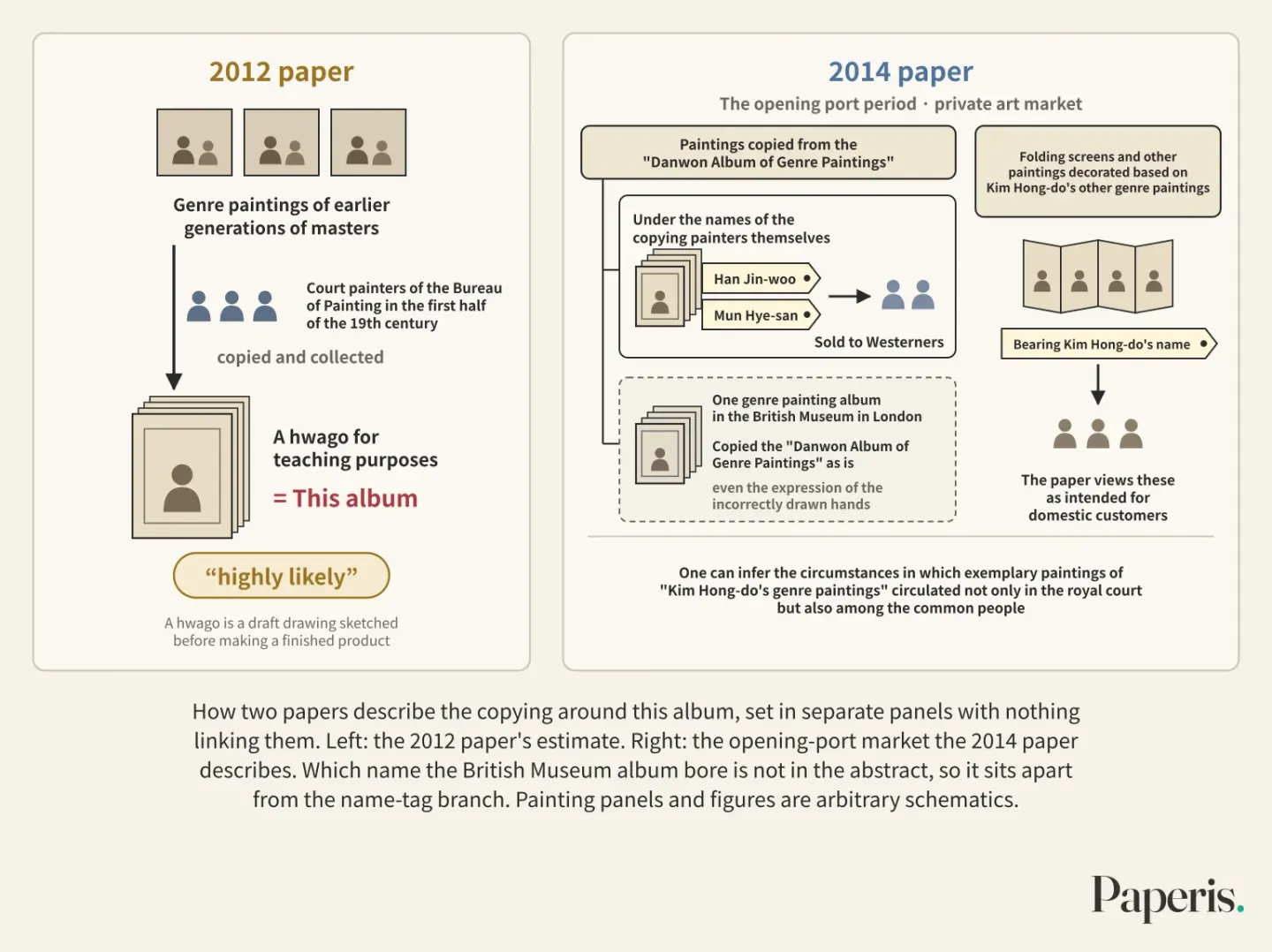
What this paper draws out is that one can infer the circumstances in which exemplary paintings of "Kim Hong-do's genre paintings" circulated not only in the royal court but also among the common people, with many copies being produced. And it notes that if one acknowledges the circumstances in which those exemplary models circulated, alongside the problems pointed out by previous researchers, there is room for reconsideration regarding this album, which shows the "method of drawing double outlines" used in paintings of the late 19th century (DOI: 10.31065/ahak.283284.283284.201412.005). What to rethink and how, such as when this album should be considered to have been painted, does not appear further in the abstract. The paper concludes that, regardless of authenticity, the importance of this album should be evaluated as an exemplary model used jointly by the royal court and commoners during the opening port period.
If the copyist transferred this album's hands as described in the 2014 paper, those hands would have already been drawn that way at that time. However, whether the copying route was the album itself or circulating exemplary model paintings is not in the abstract. Who first drew those hands that way is also not determined by this fact alone.
One Wrestling Match, Two Lifetimes
Taking a single sheet of “Ssireum”, we follow the life of this album of paintings as depicted by two papers in turn. The scene moves only within what each paper claims in its abstract.
In the version from the 2012 paper, the story begins in the late 18th century with genre paintings by master painters like Kim Hong-do and Kim Deuk-sin. In the early 19th century, when those paintings became established as models, painters of the Dohwaseo (Royal Bureau of Painting) copied them in various branches. With books to be carved on wooden blocks in mind, they fitted the drawings inside square borders, which resulted in toes or arms being cut off. The swapping of a spectator's left and right hands is also a mistake arising from copied drawings, according to this paper's judgment. The block carving is never accomplished, and the manuscript remains in use for a long time as a textbook. Smudged ink and paint stains, along with torn and creased paper, are seen by this paper as traces of that (DOI: 10.15819/rah.2012..39.164).
In the version from the 2013 paper, the same sheet comes from Kim Hong-do's own hand. According to this paper, around 1795, around the time of the folding screen and at about fifty years of age, Kim Hong-do reassembled scenes by theme indoors—unlike folding screens with a strong sense of being on-site—and compiled the album over at least 4 to 5 years. This paper considers that he used hair brushes and bamboo pens together, and that cautious lines from old age increased. Description errors can sufficiently occur in paintings edited in that way (KCI ART001763787).
The scene from the late 19th century comes from a 2014 paper. This paper notes that the British Museum album copied “Danwon Pungseokdocheop” as is, even down to the expression of incorrectly drawn hands, and considers that one can surmise the circumstances in which model paintings of "Kim Hong-do's Genre Paintings" circulated not only in the royal court but also among the private sector around that time. And at the end of the same abstract, it leaves room for reconsideration, stating that the double-layered outline method of late 19th-century paintings is visible in this album (DOI: 10.31065/ahak.283284.283284.201412.005). Therefore, the scene from the late 19th century remains less as a conclusion to either of the two versions and more as a question that both versions must answer.
How Far Each of the Three Papers Went
When you place what the three papers looked at and where they went side by side, it looks like this.
| Paper | What Was Examined | Conclusion | Strength of Conclusion |
|---|---|---|---|
| 2012 Art History Journal | Lineage comparison, errors in "Village School," "Wrestling," and "Boy Dancers," brushstroke variance, paper, borders, traces of revisions and smudges | “Hardly possible” to be an autograph original. A collective copy from a later period. Highly likely to be painting model books used for training by court painters in the first half of the 19th century | The first two are “never” and “almost certain”, the third is “highly likely” |
| 2013 Journal of Asian Art | The premises of the skeptical view (summarized by this paper), the production characteristics of the painting album | Handled as a work by Kim Hong-do, explaining it as an edited secondary painting style, the combined use of bristle brushes and bamboo pens, and late-period brushwork | Rebuts that the skeptical view has a “fatal flaw”. The method for verifying the evidence is not in the abstract |
| 2014 Journal of Art History Studies | Copies from the opening-port period, the circulation context of model paintings, double outlines | There is “room for reconsideration” of this painting album. Important as a model regardless of its authenticity | “Room for reconsideration”, circulation is “surmised” |
Looking at the three pieces one by one, the 2012 paper stated close to a certainty that it is “hardly possible” to be an autograph, the 2013 paper viewed it as a late-period work by Kim Hong-do and rebutted the skeptical view, and the 2014 paper spoke of “room for reconsideration” while concluding that we should evaluate this painting album regardless of its authenticity. Just from these three, we cannot know which direction the academic world has settled on, and how the museum currently labels the artist of this painting album is also not part of the evidence in this article. This article does not make a judgment. The three papers have each said only as much as written above, and these three alone do not settle whether this painting album is an autograph by Kim Hong-do or a copy from a later period.
The 2013 rebuttal clearly states that this painting album consists of pictures edited indoors away from the scene. The abstract of the 2012 paper does not explicitly mention whether they were drawn on-site, but even within its explanation that they were copied and collected from previous generations' paintings, this painting album cannot become a drawing made right next to a wrestling match. That the two explanations divided over the artist overlap on this point is what this article found by placing the two abstracts side by side. The question of whether the paintings were drawn while observing them on site is also a question from the primer covering the same late Joseon painter Jeong Seon.
What Artist Attribution Changes and What It Does Not
Kim Hong-do's genre paintings are used as material for daily life even outside of art history. There are two studies that name this specific album among them. A 2004 clothing study organized the attire of commoners by lifestyle type across the 25 chapters of Danwon Pungsokdo-cheop, and interpreted that a hat appearing in “The Blacksmith's Shop”, whose physical artifact has not yet been discovered, shows the changing customs of the late 18th-century Joseon Dynasty (KCI ART000949150). A 2015 study read this album through the aesthetics of photography. Even if the purpose of painting them was for the appreciation of commoners, the interpretation is that Kim Hong-do ultimately looked ahead to his era as an “eyewitness of the times”, captured the decisive moment that happened to arrive, and that its value as evidence grows higher with the passage of time, similar to a photograph (DOI: 10.20977/kkosea.2015.16.4.105).
What the artist attribution of this album makes us re-examine is, first of all, the date. When the 2004 study reads the hat as a clue to "18th-century" customs, that reading is premised on the paintings having been drawn in the 18th century. If, as the 2012 paper argues, this album is a work of court painters in the first half of the 19th century copying the paintings of the previous generation, when the hat in the painting actually looked like that must be questioned through an additional step. Studies that directly answer this question are not among the evidence collected by this article. Next is whose eye it is. A 2013 counterargument views this album as paintings edited indoors, and if we follow the explanation of the 2012 paper, they are copied paintings. This article's reading is that under neither explanation is this album portrayed as a painting that directly transferred a momentary scene from the field. The 2012 paper goes further, viewing the genre paintings contained in this album as having been created together in many aspects through a layered process of various people in China and Joseon—namely, kings, literati, court painters, and marketplace people—exchanging, modifying, and remaking them over a long period (DOI: 10.15819/rah.2012..39.164).
There are more studies that read paintings grouped as Kim Hong-do's genre paintings as material for daily life. However, the abstracts of these studies do not reveal which album the paintings belong to, so they do not directly connect to the controversy over the artist of this album. A 2020 study divided and collected the sounds depicted in Kim Hong-do's genre paintings into natural sounds like water, birds, and beasts, and social sounds like musical instruments, conversation, commands, peddling noises, and footsteps, and reported that conversation and labor sounds were frequently depicted among them (DOI: 10.21086/ksles.2020.04.27.2.193). A 2019 study published in a journal in the field of emotional and behavioral disorders selected 12 figures among Kim Hong-do's portraits and Daoist hermit and Buddhist figure paintings, read them through the framework of semiotics, and started from the reading that the disabled people in the paintings were portrayed with humor and equality, leading to the conclusion that the view of disabled people in the late Joseon Dynasty was positive and that disability policies were rational, advanced, and systematic (DOI: 10.33770/JEBD.35.4.19). A 2026 study examined images of women in late Joseon genre paintings, analyzing that in Kim Hong-do's works, women's labor and daily life actively transform into objects of gazing, and the structures of the male gaze and voyeurism are revealed on the screen. It then suggests understanding genre paintings not as simple records of reality, but as visual culture where what is chosen and how it is remembered are determined by the gaze of the male painter and viewer (KCI ART003373887). This article's view is that the distance between how the painting portrayed it and what society was actually like remains a question regardless of whose hand drew it. The suggestion of the 2026 study also points to this distance.
There are also things that the artist attribution of this album does not change. The list of work and play contained in the 25 chapters appears on the same screens even if the artist changes. And there is the material value of the album. The 2012 paper, which denied the autography, evaluates this album itself as the material through which we can catch the richest glimpse of the tradition of late Joseon genre paintings. The same paper goes even further here to write that this album “is unquestionably a national historical treasure”, which is that author's evaluation (DOI: 10.15819/rah.2012..39.164). As this article sees it, what the artist attribution makes us re-examine is daily life as seen “when, and through whose eyes” in the paintings, and it does not change what is depicted in the paintings.
So What Did We Learn?
What the 2012 paper proposed as the history of this album of paintings was a process in which later court painters copied genre paintings led by Kim Hong-do. The word forgery, meaning deceiving others, does not appear in that paper's abstract. This paper suggests that we might attach the label "Attributed to Kim Hong-do," meaning a painting traditionally handed down as Kim Hong-do's, based on the judgment that it is "almost certain" this album was founded on the genre paintings led most creatively by Kim Hong-do, and the labels "Kim Hong-do style" and "Kim Hong-do school," borrowing "je" and "ryu," which are used in traditional Korean music with meanings that mix creation, transmission, and re-creation, based on the judgment that the album being a collective model of later generations is "almost certain" (DOI: 10.15819/rah.2012..39.164).
The 2013 rebuttal explained the errors in depiction with a painting edited indoors and a painter's old age. A 2014 study on the open-port period noted that paintings copying this album were made in the private market in the late 19th century and sold to Westerners, and we can infer the circumstances in which model paintings also circulated among the general public. The swapped hand of a spectator at the ssireum match is the basis put forward by the 2012 paper. The 2014 paper also notes that the "incorrectly drawn hand" of this album was transferred as is to the copied paintings, but which painting's hand it is does not appear in the abstract. The locus of the dispute is who first drew those mistakes.
Looking at “Ssireum” again, the question splits into two. Whose hand did this painting come from, and what does this painting show? The first question has not yet been closed by the evidence gathered in this article. When answering the second question, we carry along the point that the painting is a visual frame selected, refined, and left behind by someone. If one study read this album like a photograph, another study suggests reading genre paintings as visual culture rather than simple records of reality.
Source Papers
- "A Stylistic Re-examination of Attribution and Meaning Interpretation in <Album of Genre Paintings by Danwon>" (2012) — DOI: 10.15819/rah.2012..39.164 — Limbs fused in The Village School, swapped hands in Wrestling/Dancing Boy, brushwork variations, multiple papers, borders, and correction marks mean it is “hardly ever likely” to be an authentic autograph, “almost certainly” a collective copybook by later generations, “highly likely” to be drawing models for court painters in the first half of the 19th century, yet valuable even if not autograph, and can also be called “attributed to Kim Hong-do” or “Kim Hong-do school/style”.
- "On the Authenticity Problem of <Album of Genre Paintings by Danwon>" (2013) — KCI ART001763787 — Counterarguments to the rejection of autograph theories. Explains errors and line quality differences through edited secondary painting styles, the concurrent use of brush and bamboo pen, and late-life brushwork.
- "Imitation and Diffusion of 'Kim Hong-do’s Genre Paintings' in the Open Port Period" (2014) — DOI: 10.31065/ahak.283284.283284.201412.005 — Open port period copies (the British Museum album even copied wrong hands) and distribution context of painting models; albums showing double outline styles warrant reconsideration and should be evaluated as drawing models regardless of authenticity.
- "Research History of 'Late Joseon Painting' - Rediscovery of Genre Painting and Danwon Kim Hong-do-" (2019) — DOI: 10.17792/kcs.2019.37..133 — The process by which the established theory “Kim Hong-do = genre painter” operated within modern and contemporary research history, exhibitions, and literary magazines.
- "Genre Painting, The Painting of Our Era: Kang Se-hwang’s Critical Activity and Kim Hong-do’s Travel Genre Paintings" (2015) — DOI: 10.22835/ahvc.2015..15.002 — Kang Se-hwang evaluated Kim Hong-do’s genre paintings as “paintings never seen before”, with social change in the background.
- "Teacher and Pupil, Biographies of Kim Hong-do Written by Kang Se-hwang : “Danwon-gi” and “Danwon-gi U-il-bon”" (2012) — DOI: 10.31065/ahak.275276.275276.201212.004 — The teacher-pupil, peer, and close friend relationship between Kang Se-hwang and Kim Hong-do, alongside “Danwon-gi”.
- "Folk Costume Culture by Living Type and Social Aspects in Late Joseon Genre Paintings - Focusing on Danwon Kim Hong-do’s Album of Genre Paintings -" (2004) — KCI ART000949150 — Classifies 25 leaves of the treasured album by living type and interprets the blacksmith’s hat as a clue to 18th-century custom changes.
- "The Emergence of Late Joseon Genre Paintings and Modernity" (2004) — KCI ART000934449 — Interprets genre paintings that suddenly appeared around 1800 as commoner culture within a monetary economy.
- "A Study on the Works of Danwon Kim Hong-do -<Jeongak Ajipdo>-" (2025) — KCI ART003269042 — Discovery of a seal catalog bearing the same seals as a 7-step analysis of letters, brush techniques, and painting habits.
- "A Re-examination of Geungjae Kim Deuk-sin’s Genre Paintings" (2026) — KCI ART003396617 — The development of Kim Deuk-sin’s (1754-1822) genre paintings, with existing discussions centered on his relationship and influence with Kim Hong-do.
- "Soundscapes Depicted in Late Joseon Genre Paintings of Danwon Kim Hong-do" (2020) — DOI: 10.21086/ksles.2020.04.27.2.193 — Classification of natural and social sounds in Kim Hong-do’s genre paintings, where conversations and labor sounds are frequent.
- "A Semiotic Analysis of Disability Images and Views on Persons with Disabilities in Danwon Kim Hong-do’s Genre Paintings" (2019) — DOI: 10.33770/JEBD.35.4.19 — Semiotic analysis of 12 figure and Taoist-Buddhist paintings, concluding that views on persons with disabilities were positive in the late Joseon period.
- "Reading <Album of Genre Paintings by Danwon> Through Photographic Aesthetics" (2015) — DOI: 10.20977/kkosea.2015.16.4.105 — Reinterpretation from the perspective of photographic aesthetics, viewing them as “witnesses of the era” with evidentiary value similar to photography.
- "The Formation of Memory about Women Revealed in Late Joseon Genre Paintings" (2026) — KCI ART003373887 — Women in genre paintings are memories selected and constructed through the gaze of male painters and viewers, not simple records of reality.
Sources (8)
- ≪단원풍속도첩≫의 작가 비정과 의미 해석의 양식사적 재검토DOI 10.15819/rah.2012..39.164
- 개항기 ‘김홍도 풍속화’의 모방과 확산DOI 10.31065/ahak.283284.283284.201412.005
- ‘조선후기 회화’의 연구사 -풍속화의 재발견과 단원 김홍도(檀園 金弘道)DOI 10.17792/kcs.2019.37..133
- 우리시대의 그림 풍속화: 강세황의 비평활동과 김홍도의 행려풍속도DOI 10.22835/ahvc.2015..15.002
- 스승과 제자, 강세황(姜世晃)이 쓴 김홍도(金弘道)전기 : 「檀園記」․「檀園記 又一本」DOI 10.31065/ahak.275276.275276.201212.004
- 조선후기 단원 김홍도의 풍속화에 묘사된 소리풍경DOI 10.21086/ksles.2020.04.27.2.193
- 단원 김홍도의 풍속화에 나타난 장애이미지와 장애인관에 대한 기호학적 분석DOI 10.33770/jebd.35.4.19
- 사진미학으로 읽는 단원풍속도첩DOI 10.20977/kkosea.2015.16.4.105