Paperis Articles
Dürer — The Perspective Devices in His Prints: Did Painters Really Use Them?
Across the 1525 and 1538 editions of his geometry book, the Underweysung der Messung, Albrecht Dürer published designs for four devices that took down perspective with string, grids and glass. This piece looks at the geometry those devices follow, one researcher's experiment rebuilding all four to draw a lute, and that researcher's account of which machines kept being reprinted and which devices artists kept using.
Your field's papers, as audio
Pick your fields and journals — Paperis summarizes the key papers and turns them into audio. Listen on your commute.
Start Paperis free →Dürer — The Perspective Devices in His Prints: Did Painters Really Use Them?
1525 Nuremberg, A Book of Rulers and Compasses
In 1525, in the southern German city of Nuremberg, the painter and printmaker Albrecht Dürer published a book on geometry. Referred to in this article for short as Instruction on Measurement, the long title of the book means "Instructions for Measuring with Compass and Ruler Lines, Surfaces, and Solids." The book contained contents such as finding the center of a circle, drawing spiral and egg-shaped lines, floor tile patterns, making sundials, and designing monuments (DOI: 10.1057/9781137010353_3). An article dealing with Renaissance genres and historical experience explains that Dürer wanted to place his country's art on the foundation of reason and teach applied geometry and perspective to young people (DOI: 10.1057/9781137010353_3). An art history paper reads Dürer's dedication to mathematics within the circle of Nuremberg scholars of that time (DOI: 10.1080/02666286.2016.1216821).
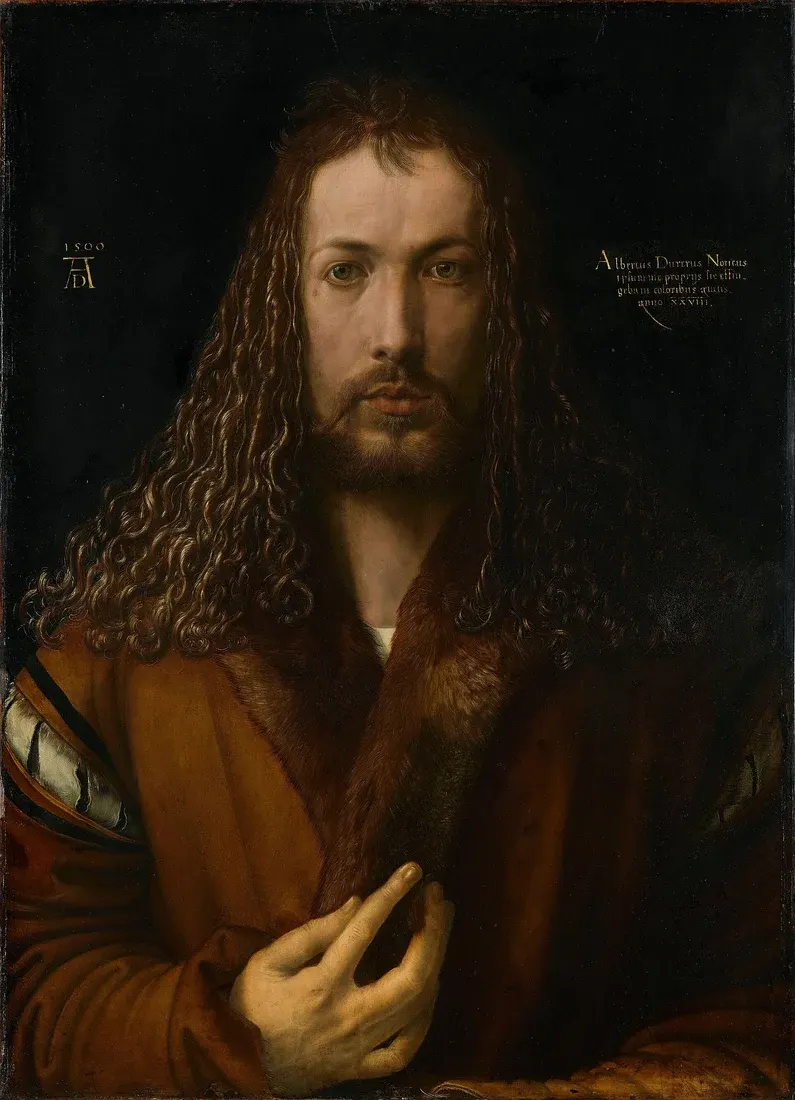
Albrecht Dürer, Self-Portrait (1500) · Alte Pinakothek, Munich · public domain · Wikimedia Commons
The book also featured illustrations of devices to help painters. Combined between the 1525 edition and the 1538 edition that came out after Dürer passed away in 1528, there are four devices (DOI: 10.1163/15733823-20241334). We need a name to group these devices together. A perspective device is a tool that fixes the position of the eye in one place, allowing one to find and transfer where the points of an object fall on a frame or glass set up between that eye and the object. Dürer's four devices are a framed grid, a glass plate, and two more complex machines than those (DOI: 10.1163/15733823-20241334).
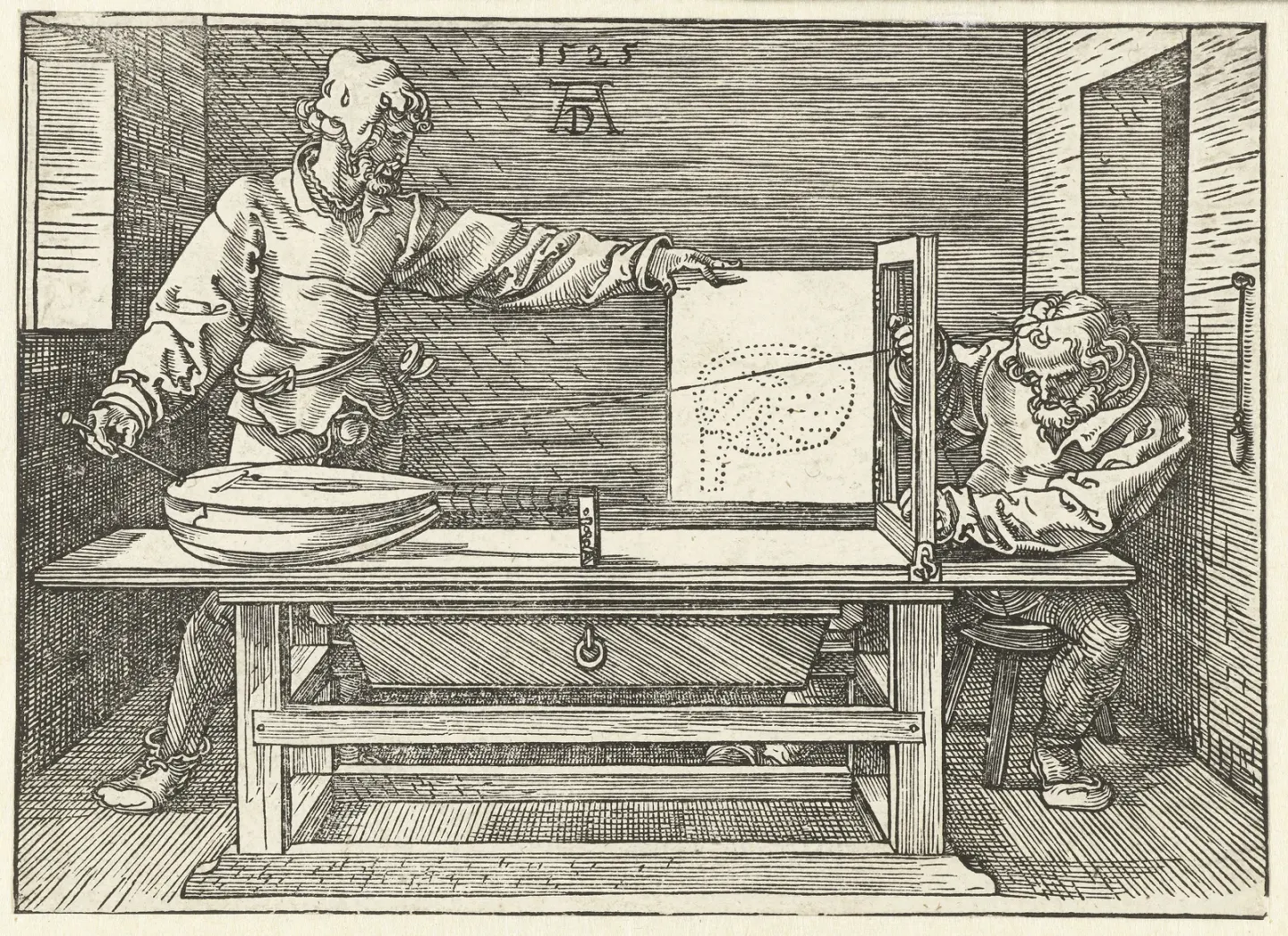
Albrecht Dürer, Draughtsman Drawing a Lute (1525, woodcut, Underweysung der Messung) · Rijksmuseum, Amsterdam · public domain (CC0) · Wikimedia Commons
When looking at the illustrations of the devices, a question follows. Did the painters of that era really paint with these? The first piece of the answer is what the print records. What the print shows is the appearance of the device and the way the device is meant to operate. Who, when, and what picture was painted with this device is not written on the print. The device in the print is a blueprint, and records of its use must be sought separately.
What a Single Thread Does
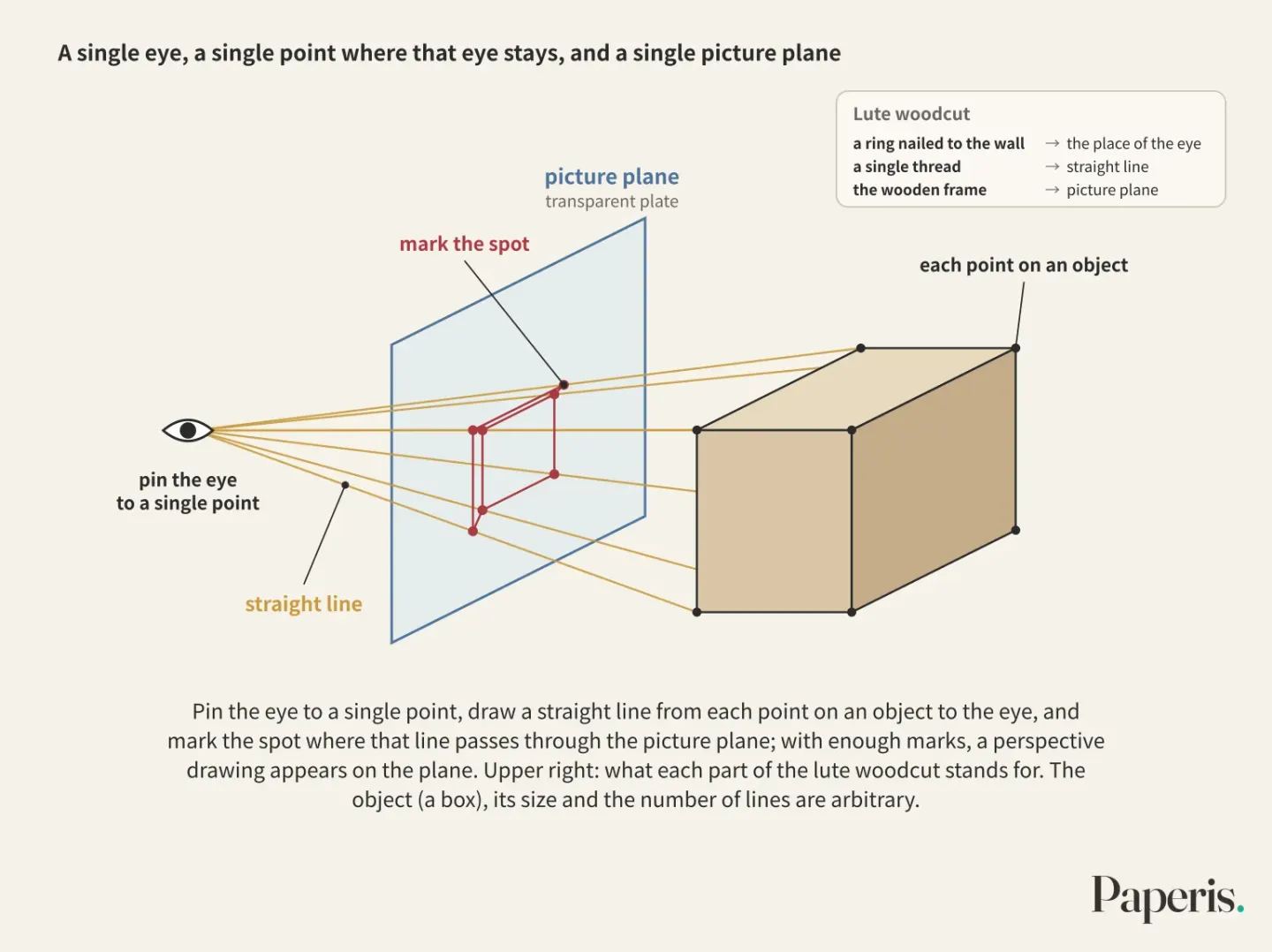
What Dürer's device follows is the geometry of perspective. As "Perspective and Space — The One Footprint a Picture Is Calculated For" covered, linear perspective is a method of drawing parallel lines receding into the distance so that they converge at a single point, creating depth on a flat surface through geometry, and a vanishing point is the point where parallel lines receding within a picture gather together. What the device follows by hand is the deeper premise underlying linear perspective. That premise is a single eye, a single point where that eye stays, and a single picture plane.
A picture plane is the surface of a picture considered as a transparent plate set up between the viewer's eye and the landscape. Pin the eye to a single point, and draw a straight line from each point on an object to the eye. If you mark the spot where that line passes through the picture plane, that mark is the position of that object within the picture. If you make enough marks, a perspective drawing emerges on the picture plane. A short 1969 article published in a mathematics education journal records that a single woodcut by Dürer clearly shows this exact idea—the idea that a perspective drawing is a rule-governed transformation that moves a three-dimensional space onto a single plane (DOI: 10.2307/3614537). In that 1969 note, the single print was used as material to explain perspective in school mathematics.
In the lute woodcut, a single thread plays the role of this straight line. A ring nailed to the wall assumes the place of the eye, and a thread coming out of the ring passes through a wooden frame to reach a point on the lute. After marking the spots where the thread passes through the frame with two horizontal and vertical threads hung on the frame, the thread is cleared away, a hinged board is closed over the frame, and a mark is made in that spot. This process is repeated once for each point on the lute. The structure is one where a single thread replaces the straight line coming from the eye, and the wooden frame replaces the picture plane.
A woodcut using a glass plate shortens this structure even further. The artist places their eye against the end of a small post to fix the position of the eye, sits looking at the sitting person through an upright glass plate, and traces the outlines visible on the glass as they are. Here, the glass plate is the picture plane itself, and the lines left on the glass are the perspective drawing. Without threads or hinges, it is a device left with only a single eye and a single picture plane.
The same principle is present in a woodcut depicting a reclining person. The artist places their eye against a small post with a pointed end to fix the position of the eye, and looks at the subject through a grid-lined frame. The same grid is drawn on the paper in front of the artist, so whatever is visible in each cell of the frame is transferred to the same cell on the paper. Drawn this way, the longer the body extends toward the artist, the shorter it becomes on the paper. Foreshortening is a method of drawing a body or object extending lengthily toward the viewer so that it is shortened as it appears to the eye, and the grid frame makes it possible to transcribe that shortening cell by cell.
There is also a path that goes by calculation instead of devices. Perspective construction is the work of calculating a perspective drawing by drawing lines with a ruler and compass without a device. Dürer's book also included one method of such calculation. The plan and elevation technique is a method where an object's top-down view and side view are drawn separately, and the position and height of each point are read from the two drawings to piece together a perspective drawing. Dürer pieced together a perspective drawing of a cube using this technique, and also used it to describe space curves that bend and turn. The Italian artist Piero della Francesca used the same technique broadly for perspective construction about half a century before Dürer's book (DOI: 10.1007/978-3-0348-8599-7_1).
The introduction to a comparative study published in 2026 interprets the Renaissance systematization of linear perspective as the transformation of subjective bodily vision into a rationalized, portable procedure (DOI: 10.4324/9781042013173-1). Borrowing this interpretation, Dürer's device can be read as an object that translates that procedure into wood, thread, and glass.
The one thing to take away from this section is this: Dürer's device and perspective construction are two paths leading to the same geometry, and the device replaces calculation with thread, frames, and an eye-rest.
An Experiment in Drawing a Lute Four Times
In 2024, a study published in a history of science journal had a researcher try out Dürer's devices firsthand. This is a way to find out, at least in part, whether the devices were actually useful. The researcher rebuilt all four devices that Dürer published across two plates, tried drawing a lute with each device, and recorded the problems encountered and the time taken. As a basis for comparison, they drew the same lute using perspective construction, and also drew several sheets freehand (DOI: 10.1163/15733823-20241334).
The results varied by device. The two more complex machines were inaccurate, time-consuming, and nearly unusable. The grid frame was faster and more accurate. In both speed and precision, the best method was tracing on a glass plate. In this experiment, tracing on glass took less than one-tenth of the time it took to prepare and draw the lute's tricky curved surfaces using perspective (DOI: 10.1163/15733823-20241334). The abstract does not name which print the two complex machines belong to. Judging by the shape of the prints, the string-based lute device is neither a grid frame nor a glass plate, so it appears to fall on the side of the complex machines, but this is merely this article's guess based on looking at the prints.
There are caveats attached to these results. The devices were rebuilt today by looking at the prints. The experiment was conducted by a single researcher, and the object drawn was a single lute with tricky curves. This experiment does not answer whether the same order would hold if a different person drew a different object. How the freehand drawings compared to the device drawings also does not appear in the abstract. Furthermore, the times and accuracies measured in the experiment cannot be transferred to the working hours or manual dexterity of painters in Dürer's time.
Within these caveats, what the experiment showed is this: The four devices varied greatly in their ease of use, with the less complex grid frame and glass being faster and more accurate. Calling the four prints "Dürer's perspective machines" as a single bundle erases this difference.
The Machines in Books, the Devices Left in Hands
Dürer's two complex machines were repeatedly reprinted in Renaissance perspective manuals afterward (DOI: 10.1163/15733823-20241334). The same researcher who conducted the reconstruction experiments traces the path the devices walked and suggests that the machines were probably not used much in actual work. This "probably" is the author's own qualifier. Conversely, drawing through grid frames and glass was recommended by multiple manuals and widely used by painters well into the 20th century, the author notes (DOI: 10.1163/15733823-20241334). Following this trace, the devices repeatedly printed in books and the devices long used in hands belonged to different lists.
This trace reveals once again the gap between prints and records of use. The fact that a device was reprinted in several books is evidence that its illustration spread widely. It does not become evidence that people drew a lot with that device. Among this article's foundations, the only link between the two is the aforementioned researcher's judgment, and even that judgment comes with a "probably."
Dürer himself revised his book after publishing it. One copy of Instruction on Measurement owned by Dürer retains handwritten corrections and added drawings. Bound together in that book are also several lesser-known drawings showing various modifications of perspective devices (DOI: 10.1080/02666286.2016.1216821). The researcher who introduced these drawings interprets them as shedding light on how Dürer's thoughts changed regarding the relationship between the painter and the subject being drawn, as well as the tools assisting that relationship (DOI: 10.1080/02666286.2016.1216821). These drawings are also illustrations of the devices. They read as a record of how Dürer's ideas about the devices shifted, but the abstract contains no basis to read them as a record that Dürer drew his own paintings with those devices.
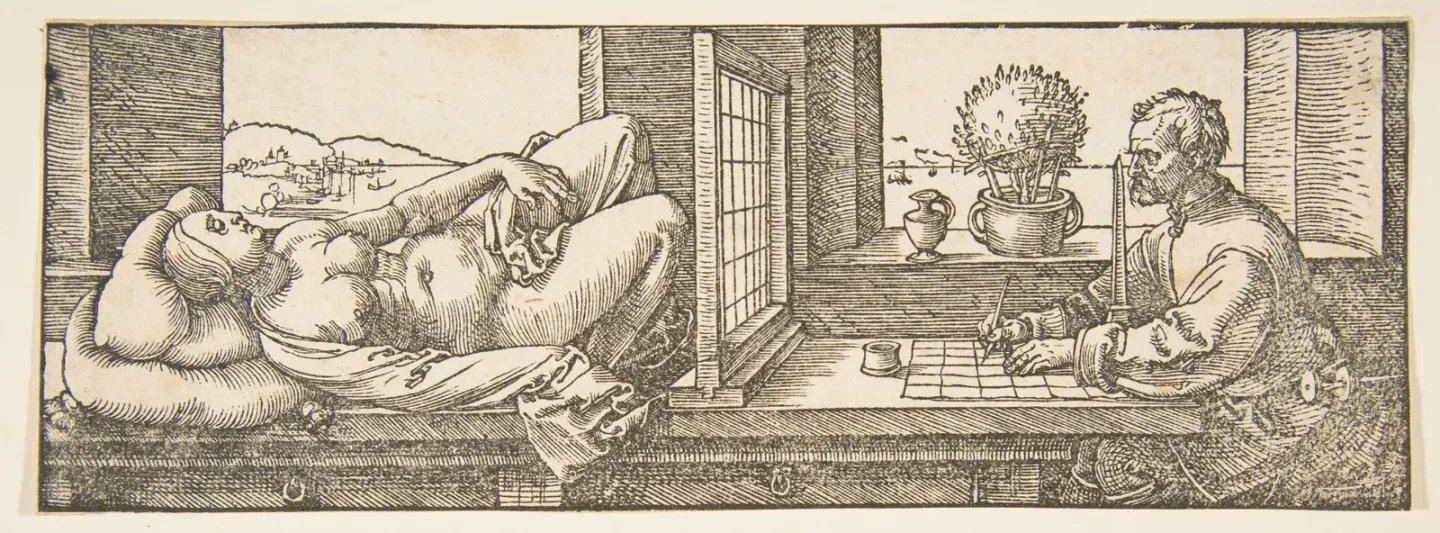
Albrecht Dürer, Draughtsman Making a Perspective Drawing of a Reclining Woman (woodcut, known as an illustration in the 1538 edition of Underweysung der Messung; this impression c. 1600) · The Metropolitan Museum of Art, New York · public domain (CC0) · Wikimedia Commons
How Closely Did Paintings Follow Their Geometry?
The other end of the device question is the painting. Seeing how accurately a painting follows the geometry of perspective gives us a clue to guess how it was made.
Filippo Brunelleschi in Florence had received training as a goldsmith. To the extent known, he did not join the painters' guild nor the painters' devotional fraternity (DOI: 10.1093/oso/9780198523949.003.0006). A history of mathematics writer who recorded this fact notes that while to today's eyes accurate perspective seems like an obvious device that makes a painting more natural, the invention of mathematical rules for perspective does not appear to lead directly to the increased realism in 15th-century painting. His main point is that neither was the person who first figured out how to draw objects accurately according to the laws of optics a painter (DOI: 10.1093/oso/9780198523949.003.0006). According to this interpretation, realistic painting and perspective rules are two separate things to be evaluated independently.
The geometry of a painting can be measured. A 2004 pattern recognition conference paper measured the chandelier in Jan van Eyck's "The Arnolfini Portrait". This study used the point that an image projected by an optical device follows the laws of perspective as a benchmark to test the claim that it was traced by projecting an image onto a surface. Although the painting looked very realistic to the eye, a large geometric error was revealed in the chandelier measured by projective geometry. The researchers considered that the error did not come from the craftsmanship of the actual chandelier but from the process by which the painting was made, and concluded that this casts serious doubt on the claim that optical tools were used for this painting (DOI: 10.1109/icpr.2004.1333855). What this study tested was the optical projection claim, and the subject was a single painting. Dürer's device was not among the test subjects. What to take away from this study is the method. Even paintings that look very realistic can deviate significantly when measured by geometry, and that deviation is measurable. The debate surrounding optical projection itself was covered in "Vermeer — The Question in a Bead of Light".
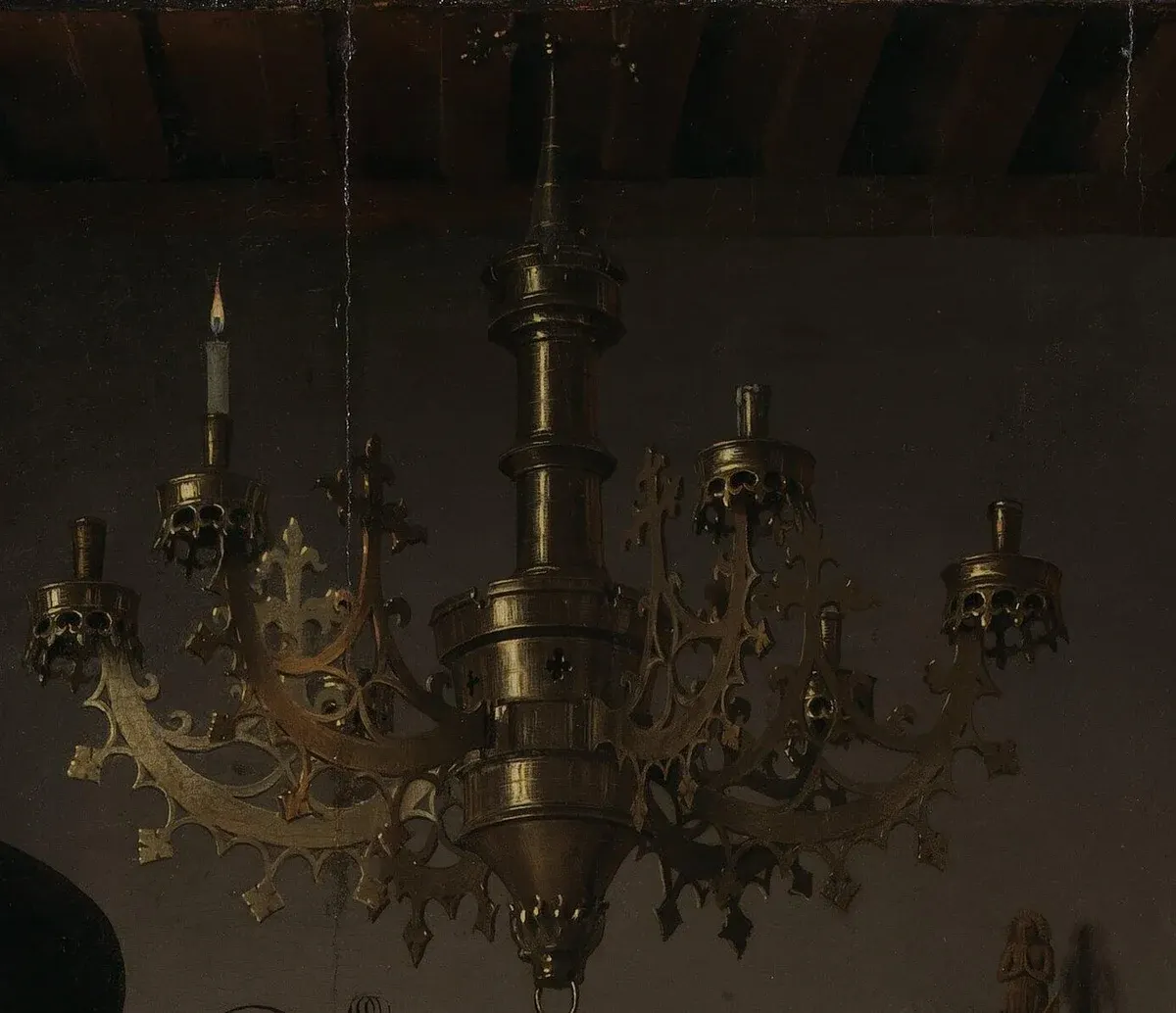
Jan van Eyck, The Arnolfini Portrait (1434), detail · The National Gallery, London · public domain · Wikimedia Commons
How a painting using perspective structured its surface is another issue. A philosophical essay published in an aesthetics journal argues that even while using linear perspective, a painting can be structured two-dimensionally centered on the arrangement of contours on the surface, and that most late 15th-century Italian paintings are like this (DOI: 10.1111/jaac.12160). This is a conceptual proposal by a philosopher and is not a result obtained by measuring paintings. Still, this proposal allows us to split the question one step further. Whether the space inside a painting fits geometry and whether the painter put that space first when structuring the surface are different questions.
Today's art education also teaches both paths. A chapter of a book dealing with art pedagogy divides perspective education into technical perspective, which follows geometry using drafting tools like rulers, compasses, and set squares, and freehand perspective, which gauges angles and depth by eye relying on perception and observation. It also notes that while Brunelleschi is counted as the discoverer of perspective theory, the person best known for exploring perspective theory through prints and drawings is Dürer (DOI: 10.1093/oso/9780195130799.003.0008).
Putting these pieces of evidence together narrows down the area where disputes remain. How much the device was actually used in work is based solely on the historical tracking of a researcher who conducted a reconstruction experiment, and that judgment comes with the author's own "maybe". The abstracts this article relied on contain neither records that Dürer painted his own oil paintings or prints using this device nor records that he did not. And whether the device was used or not is a different question from how great the painting is. None of the evidence in this article connects the two.
If You Stand Before a Grid Frame
Now we will trace it through once. Suppose you are seated before a grid frame recreated just like Dürer’s print. When you place one eye against a pointed post, the position of your eye is locked to a single point. This is the first promise of linear perspective: one eye and one point. The grid frame before your eyes acts as the picture plane, and whichever square of the frame each point of the subject beyond it falls into becomes the position of that point on the paper. If the subject extends longwise toward this side, it will appear shortened within the square, and if you transfer that shortened shape directly as it appears in the square, foreshortening naturally occurs on the paper.
In the reconstruction experiments, the grid frame was the side that was faster and more accurate, and in the experiment drawing the lute, tracing directly onto a glass plate was faster. In the reconstruction experiment, the two complex machines were inaccurate and time-consuming. As written earlier, that the lute apparatus using strings belongs to that side is a guess this article made by looking at the shape of the print. However, this is simply the sequence that emerged from an experiment drawing a single lute with a device recreated today, and this scene does not tell us whether any 16th-century painter actually sat before this frame.
There are three things to take away from this installment. First, what Dürer’s print left behind is the blueprint of a device, and records of its actual use must be sought separately. Second, in the experiment drawing a lute with the recreated devices, the four devices varied greatly in their ease of use, and based on that researcher’s tracking, complex machines were repeatedly published in books but probably rarely used, while grids and glass plates remained in painters' hands for a long time. Third, how closely a painting follows that geometry is a question that can be measured, but looking like reality and matching the geometry are different matters, and the evidence in this article did not measure the value of a painting by either standard.
Source Papers
- "Albrecht Dürer’s Drawing Devices: an Experimental Study" (2024) — DOI: 10.1163/15733823-20241334 — Reconstructed four devices from the 1525 and 1538 editions of "Instructions for Measurement" and tried drawing a lute. The two complex machines were inaccurate, slow, and nearly unusable, the grid frame was faster and more accurate, and drawing on glass was the best. The authors trace that complex machines were repeatedly printed in manuals but probably rarely used in practice, whereas grids and glass were widely used until the 20th century.
- "Albrecht Dürer’s personal Underweysung der Messung" (2016) — DOI: 10.1080/02666286.2016.1216821 — Handwritten corrections and added illustrations in Dürer's personal copy. An interpretation that the perspective-device variation drawings bound at the end reflect changes in Dürer's thinking about the painter-subject relationship and tools.
- "Murdering Peasants: Status, Genre, and the Representation of Rebellion" (2011) — DOI: 10.1057/9781137010353_3 — An explanation of the purpose (applied geometry and perspective education) and content (circle centers, spirals, tile patterns, sundials, monument design) of "Instructions for Measurement".
- "Perspective Drawing by Numbers" (1969) — DOI: 10.2307/3614537 — A mathematics education note showing that Dürer's woodcut demonstrates perspective drawing as a projective transformation from three dimensions to a plane.
- "Perspective and the Plan and Elevation Technique, in particular in the Work by Piero della Francesca" (1992) — DOI: 10.1007/978-3-0348-8599-7_1 — Dürer constructed a cube perspective using plan and elevation techniques, and Piero della Francesca used the same technique half a century earlier.
- "Introduction" (2026) — DOI: 10.4324/9781042013173-1 — The introduction to a comparative study viewing the embodiment of linear perspective's theorems as a rationalized, portable procedure (with a comparison to generative AI as the main body).
- "Building, drawing and ‘artificial perspective’" (1997) — DOI: 10.1093/oso/9780198523949.003.0006 — A history of mathematics description that the invention of perspective math rules does not directly connect to 14th-century painting realism, and Brunelleschi was originally a goldsmith, not a painter.
- "Did the great masters use optical projections while painting? Perspective comparison of paintings and photographs of Renaissance chandeliers" (2004) — DOI: 10.1109/icpr.2004.1333855 — Conference paper. Viewing the large geometric error in the chandelier of van Eyck's "Portrait of Giovanni Arnolfini and his Wife" as originating from the painting process, raising serious doubts about the claim that optical tools were used.
- "Two-Dimensional Versus Three-Dimensional Pictorial Organization" (2015) — DOI: 10.1111/jaac.12160 — Philosophical essay. The argument that a picture can be organized two-dimensionally even while using linear perspective, and that most late 15th-century Italian paintings are like this.
- "Spatial Thinking and Visualization: Teaching the Essential Principles of Perspective Drawing" (2000) — DOI: 10.1093/oso/9780195130799.003.0008 — Categorizing perspective education into technical (mechanical) perspective and freehand perspective. Dürer is best known as one who explored perspective theory through prints and drawings.
Sources (10)
- Albrecht Dürer’s Drawing Devices: an Experimental StudyDOI 10.1163/15733823-20241334
- Albrecht Dürer’s personal Underweysung der MessungDOI 10.1080/02666286.2016.1216821
- Murdering Peasants: Status, Genre, and the Representation of RebellionDOI 10.1057/9781137010353_3
- Perspective Drawing by NumbersDOI 10.2307/3614537
- Perspective and the Plan and Elevation Technique, in particular in the Work by Piero della FrancescaDOI 10.1007/978-3-0348-8599-7_1
- IntroductionDOI 10.4324/9781042013173-1
- Building, drawing and ‘artificial perspective’DOI 10.1093/oso/9780198523949.003.0006
- Did the great masters use optical projections while painting? Perspective comparison of paintings and photographs of Renaissance chandeliersDOI 10.1109/icpr.2004.1333855
- Two-Dimensional Versus Three-Dimensional Pictorial OrganizationDOI 10.1111/jaac.12160
- Spatial Thinking and Visualization: Teaching the Essential Principles of Perspective DrawingDOI 10.1093/oso/9780195130799.003.0008