Paperis Articles
Degas — As His Eyes Dimmed, Did His Lines Grow Coarse?
Degas wrote again and again in his letters that his eyes were failing, and his late pastels grew steadily coarser. Researchers writing from the side of vision and medicine built models that blurred his paintings and sculptures to an estimated acuity and read the loss of detail as an effect of his failing sight; the models show the two changing together, not how much of the coarseness the eyes account for. The records support that his eyes failed, but the names given to the disease differ in breadth from paper to paper, and the most specific candidate became less likely after genetic tests on descendants of his cousin and his younger brother.
Your field's papers, as audio
Pick your fields and journals — Paperis summarizes the key papers and turns them into audio. Listen on your commute.
Start Paperis free →Degas — As His Eyes Dimmed, Did His Lines Grow Coarse?
The Eyes the Painter of Ballet Pictures Wrote About in Letters
French painter Edgar Degas (1834–1917) was born in Paris and died in Paris. He enjoyed painting ballet dancers in practice rooms and on stage, horses and jockeys at the racetrack, and held exhibitions with the Impressionists. He painted many oil paintings, but as he grew older, paintings made with pastel increased. Pastel is a drawing material made by solidifying colour powder with a little binder into a stick shape, and you apply colour by rubbing it onto paper. Because the stick is placed directly onto the paper without a brush, the tracks where the hand passed become lines and surfaces as they are.
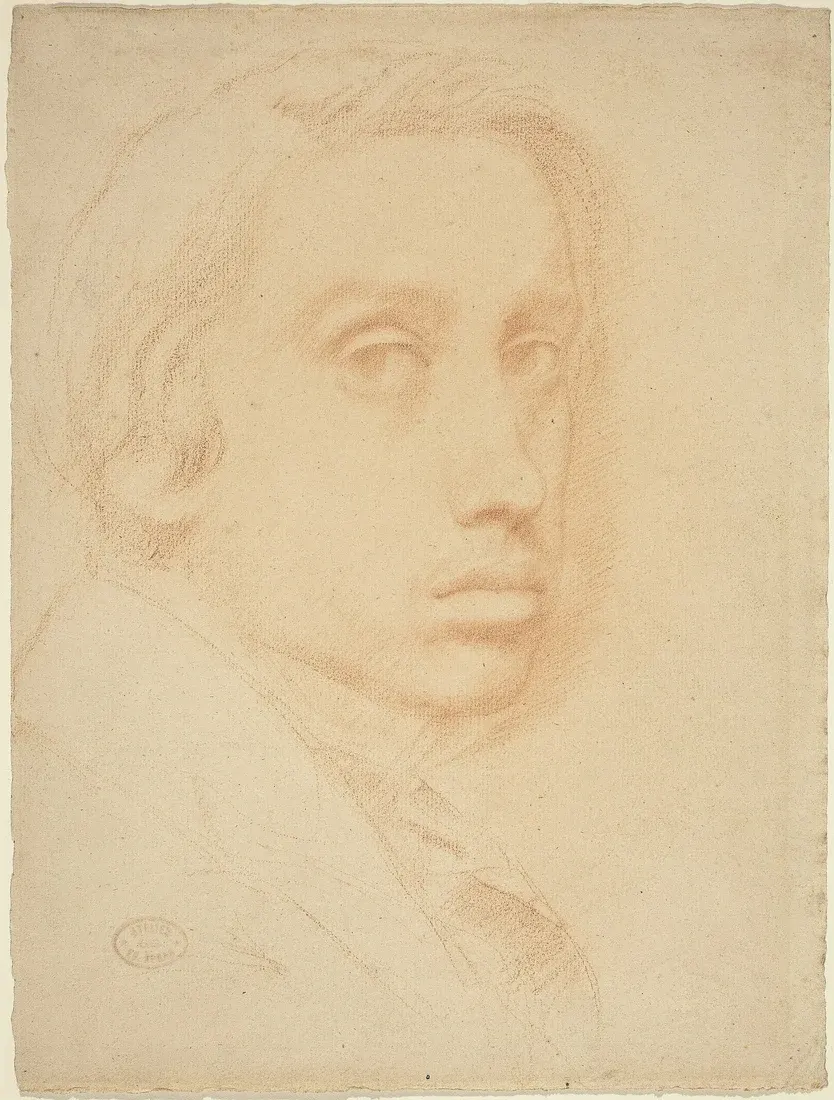
Edgar Degas, Self-Portrait (c. 1855, red chalk) · National Gallery of Art, Washington · public domain (CC0) · Wikimedia Commons
Degas wrote about his worsening eyesight several times in letters (PMID 7974192). Over the exact same decades, his pastels became increasingly rough (PMID 26563659). Placing these two facts side by side, researchers in eye and medical fields pose one question. Did his blurred vision change his painting? This article follows that question to the end, and the evidence is the writings those researchers wrote to answer that question.
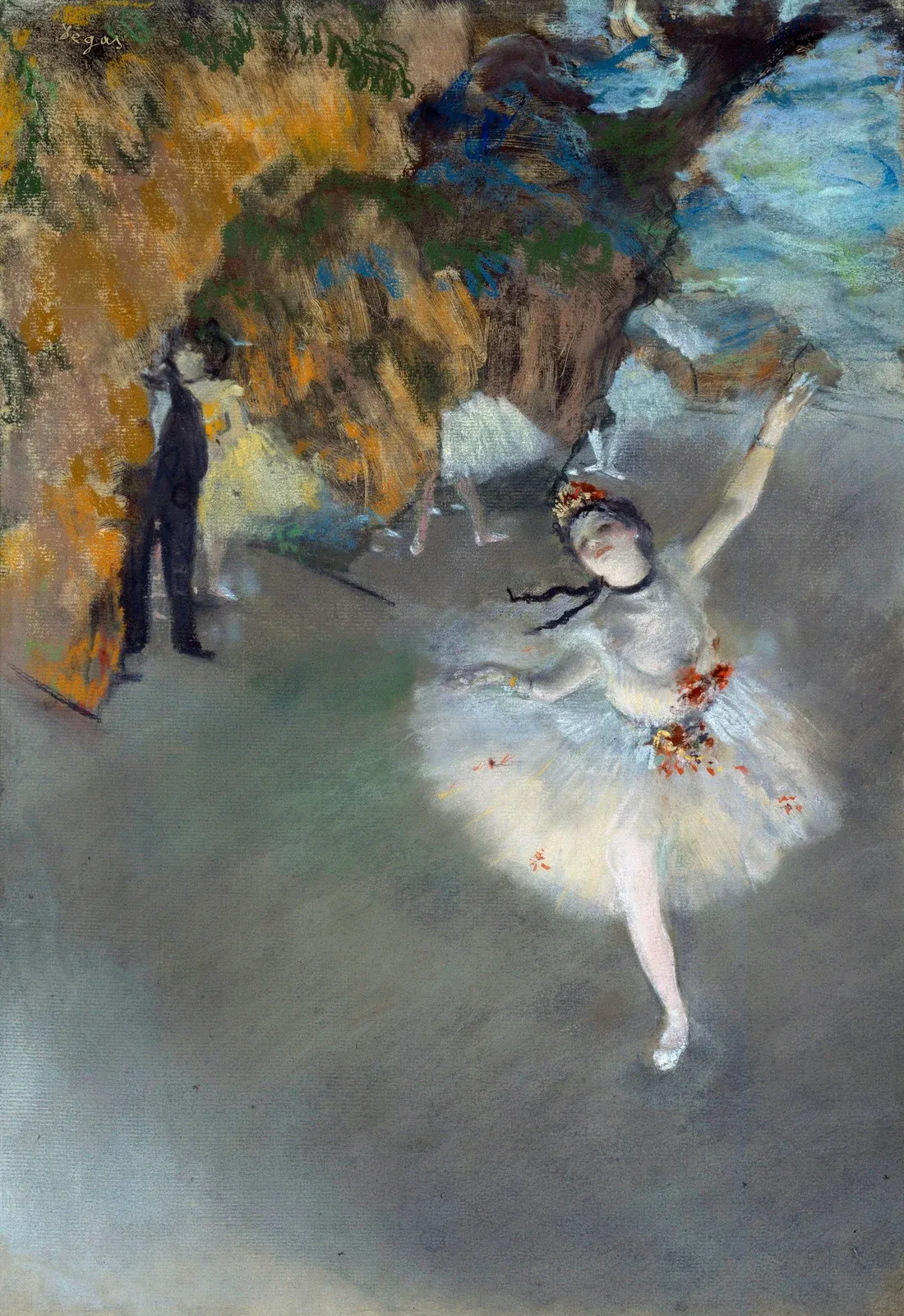
Edgar Degas, The Star (Dancer on the Stage) (c. 1876–1877, pastel) · Musée d'Orsay, Paris · public domain · Wikimedia Commons — an example chosen for comparison here, not a work the studies compared
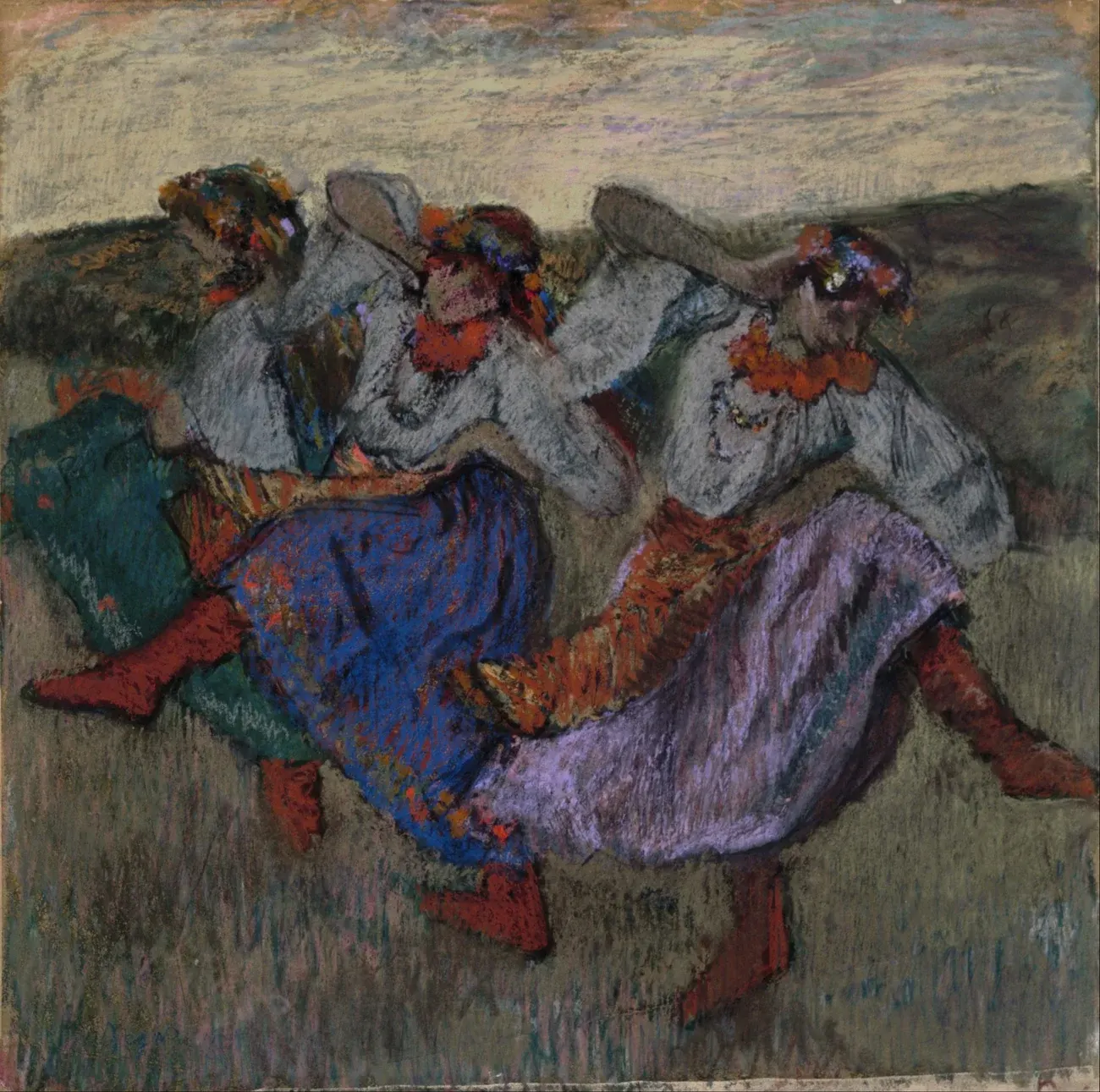
Edgar Degas, Russian Dancers (dated 1894–1904 by the museum, pastel) · Museum of Fine Arts, Houston · public domain · Wikimedia Commons — an example chosen for comparison here, not a work the studies compared
The Interpretation That Eyes Changed the Painting Style
Degas's eyesight declined over a span of 40 years, and during that time his pastels grew increasingly coarse (PMID 26563659). This is how an ophthalmology lecture held in 2015 under the name "The Killer Lecture" summarized Degas.
Writings dealing with Degas's eyes point commonly to the back of the eye. The retina is a thin membrane laid across the inner back wall of the eyeball, where incoming light is received and converted into nerve signals. The macula is a small part in the exact centre of the retina, responsible for looking closely at what is directly stared at, like letters or a face.
What the macula is responsible for can be called central vision in one word. Central vision is the power to clearly recognise the exact center where the gaze lands. When central vision drops, the very spot being looked at becomes the blurriest.
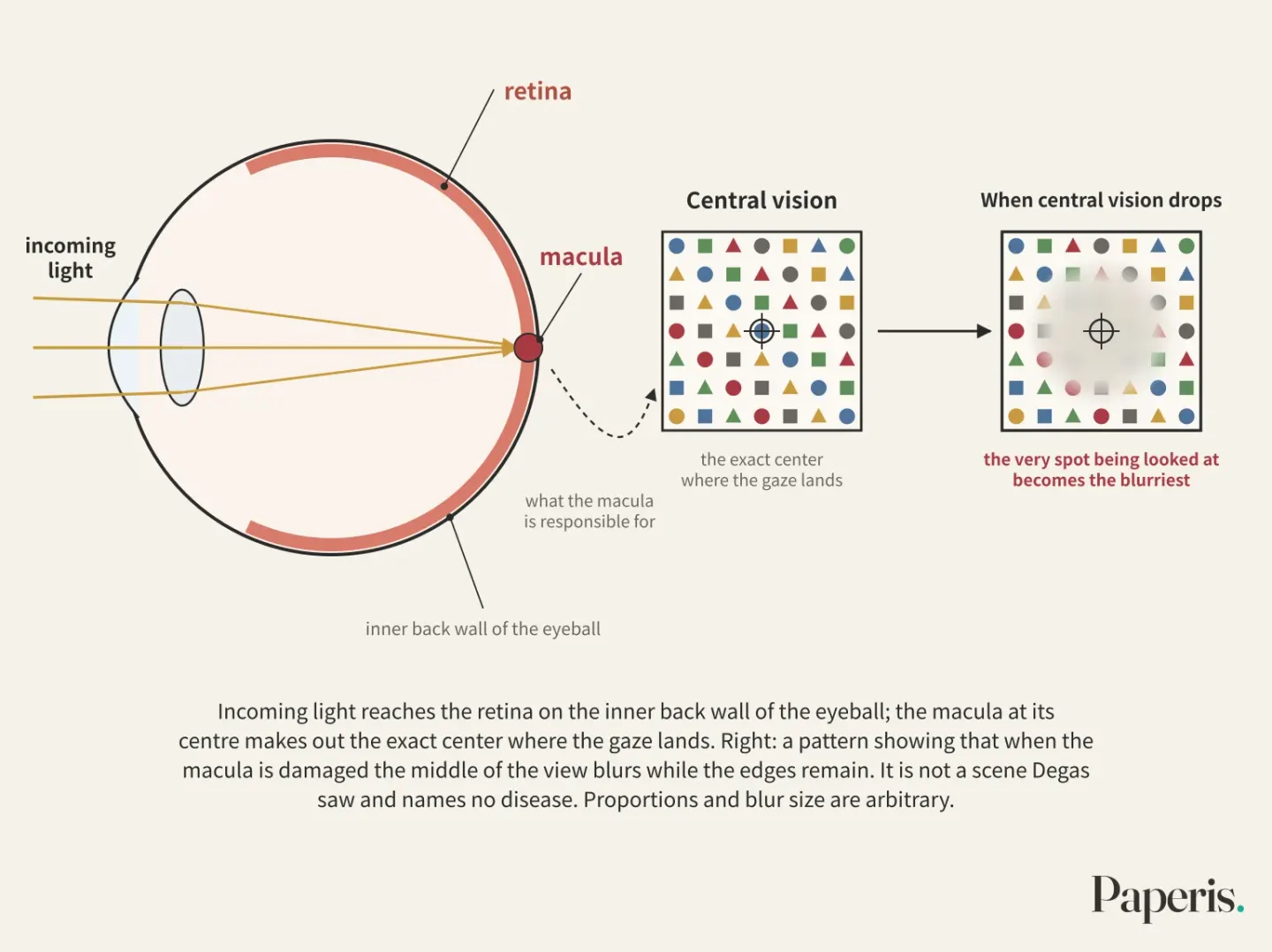
A 2013 paper describes this same flow more specifically. Degas gradually lost his eyesight over the last 40 years of his life due to a type of disease that occurred in the macula. The researchers consider the impact of this vision loss to be clear in the comparison between early pastels and late pastels. As the years went by, outline drawing, shading, and the precision of details decreased (PMID 24114134).
This kind of reading is not applied to Degas alone. A 2015 historical paper pairs the painting style changes of Munch, Cézanne, O'Keeffe, Constable, and Goya along with Degas to already known or suspected retinal diseases, ponders their possible impact, and concludes that retinal disease had a substantial influence on the works of these selected famous painters (PMID 26040100).
The claim is stacked in two layers. The lower layer is that Degas's eyes actually worsened, and the upper layer is that the paintings became coarser following the degree to which they worsened. The lower layer is supported by letters and the records of people around him, while the upper layer is supported by comparisons between works and model images created by researchers. However, even in judging that the disease existed, the researchers used works together with letters as evidence (PMID 17558845) (PMID 7974192). What stands in the lower layer even if works are removed and only records remain is Degas's own words that his vision was fading (PMID 7974192). The firmness of the two layers differs from each other.
Symptoms Left Behind in Letters and Relatives
Today's researchers cannot examine Degas in person. That is why studies of Degas's eyes are mostly retrospective diagnoses. A retrospective diagnosis is the process of estimating a medical condition in someone who has passed away, using only remaining records like letters, biographies, and artworks without a direct physical examination. A 2021 study added genetic testing of relative descendants to this, a story we will look at later.
In Degas's case, a fair amount of records remain. A 1994 paper notes that Degas described losing his eyesight multiple times in his letters, and that three ophthalmologists appear in his letters and notebooks (PMID 7974192). A 2007 study reviewed Degas's paintings, letters exchanged with friends and family, records left by acquaintances, and the Degas-Musson family papers at the Tulane University Library in the United States (PMID 17558845). The symptoms compiled by that study are as follows. The eye condition was first noticed in 1870 and worsened throughout his life. Central vision gradually declined in both eyes, and he became sensitive to light. Light sensitivity was most pronounced when Degas visited his maternal relatives in New Orleans, USA, where the sunlight was too strong for him to paint outside (PMID 17558845).
The 2007 study found a similar condition in a relative as well. Degas's maternal cousin Estelle Musson also slowly lost the vision in both eyes, was known to have been sensitive to light from an early age, and went completely blind in her early thirties. Degas and Estelle were otherwise healthy and both lived long lives (PMID 17558845). The researchers' conclusion contains the name of a disease. Inherited retinal dystrophy is a collective term for diseases where cells in the retina gradually break down over time due to a congenital genetic abnormality. The researchers concluded that the two likely suffered from an inherited retinal dystrophy that mainly damages central vision. The final sentence of the same conclusion notes that Degas's retinal disease surely influenced his life and art, but it did not prevent him from becoming one of the most highly regarded painters in history (PMID 17558845).
The fact that records remain serves as a stepping stone for Degas's retrospective diagnosis. The speaker at a 2015 lecture states that it is dangerous to diagnose an eye disease based solely on a painter's works. This is because painters have the freedom to paint as they wish. At the same time, the speaker adds that when an eye disease is documented in records, its effects can be analyzed (PMID 26563659). El Greco's astigmatism hypothesis was covered in "El Greco — Were His Elongated Saints the Fault of Astigmatism?". The foundation of the argument—namely, that his vision deteriorated over a long period—is supported by these records.
Three Periods Layered on One Canvas
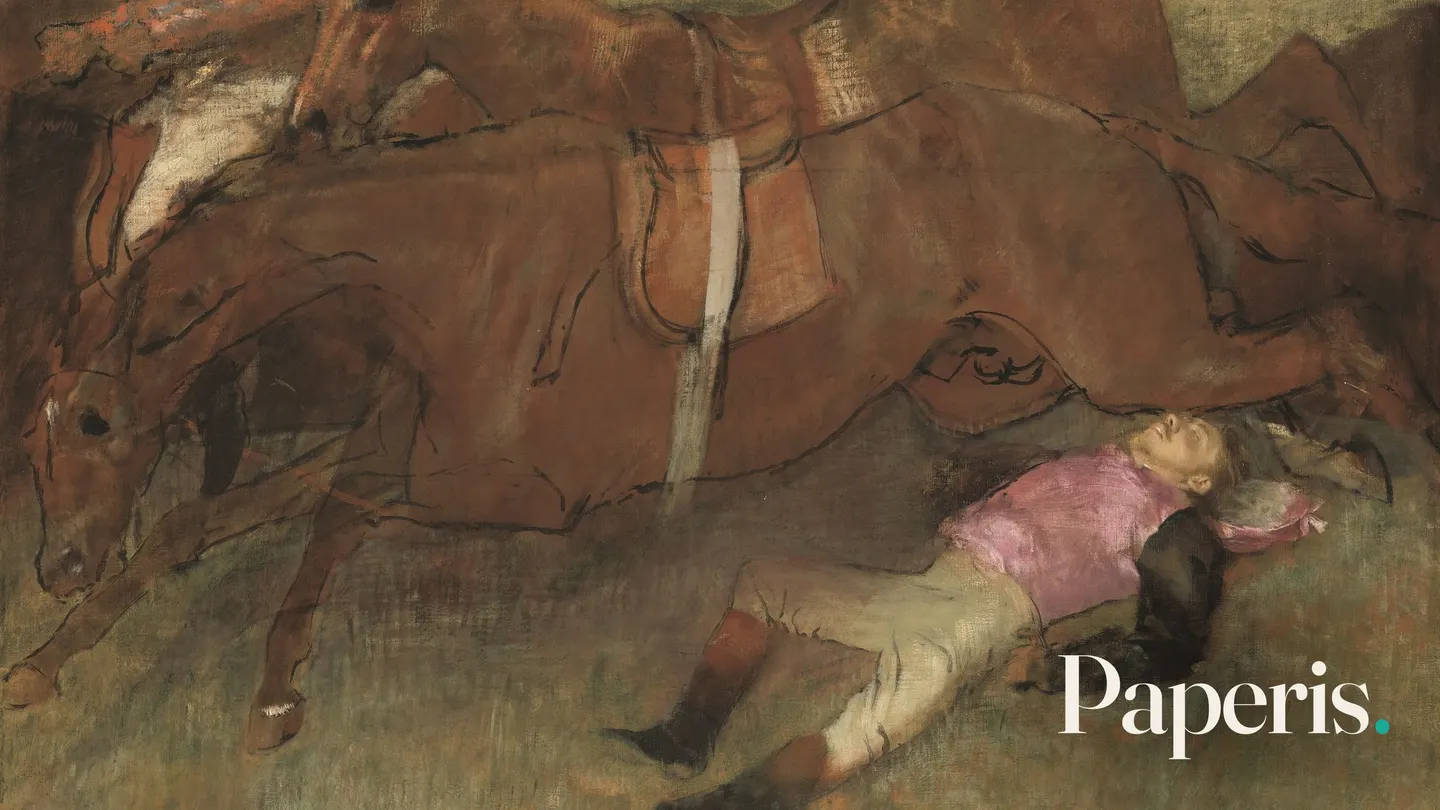
The most concrete evidence supporting the upper floor is an oil painting. "The Steeplechase: The Fallen Jockey" was begun in 1866 and reworked in 1880 and 1897 (PMID 24114134). The canvas depicts a jockey who has fallen to the ground alongside horses. The researchers suggest that this painting captures his struggle with vision like a historical record on a single canvas (PMID 24114134).
The researchers of the 2013 paper estimate that Degas's vision dropped from nearly normal to 20/200 in the meantime (PMID 24114134). A 20/200 visual acuity means that a person with normal vision must approach to within 20 feet (about 6 meters) to make out letters of a size they could normally read from 200 feet (about 60 meters) away, which corresponds to 0.1 on the decimal visual acuity scale. The abstract of the painting paper states this figure definitively. Another 2013 paper dealing with sculptures describes the starting point as "estimates of Degas's vision" (DOI: 10.3828/sj.2013.20b). Neither abstract details what was used or how to estimate the vision.
The researchers of the painting paper created a computer simulation incorporating that estimated vision. They placed side by side blurred images of this painting created using the vision levels of 1866, 1880, and 1897, and interpreted that the details became coarser and larger in accordance with the degree of vision loss. They also call this painting "an eye chart of Degas's painterly life" (PMID 24114134). The term eye chart is a metaphor used by the researchers. It is an interpretation that a single painting recorded his vision at those times like an eye examination chart, and that interpretation stands together with the simulation.
The simulation image is a model created by the researchers by plugging in estimated vision, not a record of the scene focused on Degas's eyes. The paper's abstract states that this image shows what Degas himself saw this painting as looking like at each period, but that appearance comes from the input of estimated vision. The abstract does not mention whether other symptoms Degas left in letters, such as light sensitivity, were included in the model. What this image shows, therefore, is the calculation that "if his vision was this much, this painting would have been this blurry," and the correspondence that changes in detail went hand in hand with changes in vision.
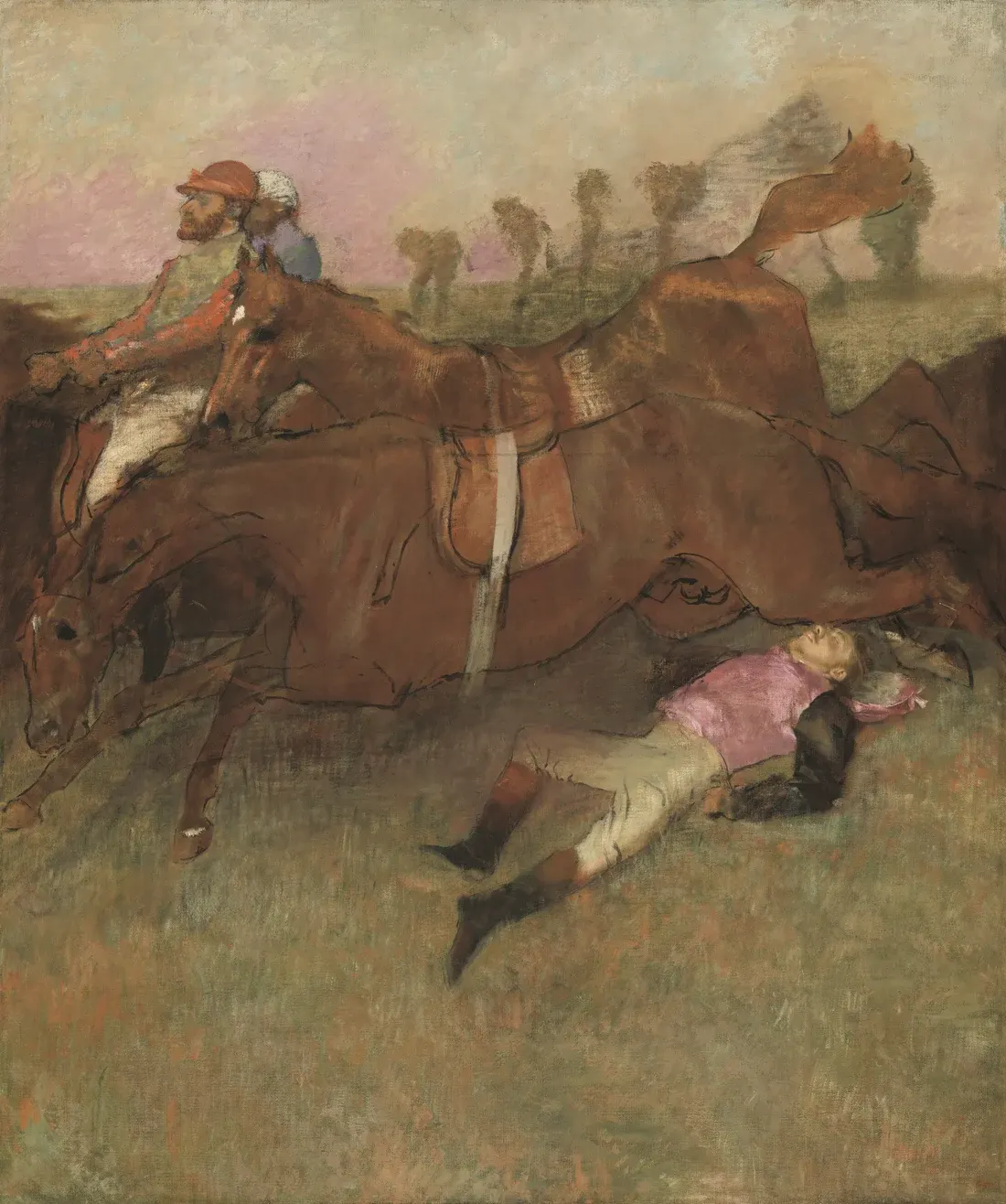
Edgar Degas, Scene from the Steeplechase: The Fallen Jockey (begun 1866, reworked 1880–1881 and c. 1897) · National Gallery of Art, Washington · public domain (CC0) · Wikimedia Commons
A Proposal to Re-read Even the Years of Sculptures
Degas did not only paint; he also sculpted many small pieces in wax. Another 2013 paper reports that Degas's worsening eyes over the years affected his late pastels, and starts from the premise that the impact of those eyes on his sculptures had not been deeply studied (DOI: 10.3828/sj.2013.20b).
The researcher created computer-simulated images of how the sculptures would have looked to Degas using his estimated visual acuity. And the researcher considers that those images visually show the constraints that worsening eyesight placed on Degas, helping to explain why the details in his sculptures increasingly vanished as he aged. The researcher views this technique as a new and relatively objective tool for dating works with delicate details, and suggests that some traditional dates listed in the catalogue of Degas's sculptures need to be re-examined (DOI: 10.3828/sj.2013.20b).
If this proposal is accepted, the dates in the sculpture catalogue could change. As this article reads it, the method of reading dates by the degree of detail relies on the same paper's interpretation that details diminished in accordance with eyesight. If that interpretation is shaken, the date estimates will be shaken along with it.
Scene — If You Look at Rough Work with Blurred Eyes
The concrete picture connecting visual acuity and roughened work in this bundle of evidence is a 2015 lecture's conjecture. The lecture first clarifies that ophthalmology cannot explain art, and states that vision is a painter's tool and its normal and abnormal properties can influence what a painter can do (PMID 26563659). And about Degas, it states that because blurred eyes made rough work appear smooth to him, he may have continued working (PMID 26563659).
We follow this conjecture as a scene. The arrangement of the scene was created by this article, and the lecture's words are a single sentence: "may have". Let us imagine Degas in his later years roughly rubbing a dancer's skirt with a pastel stick. His central visual acuity is reduced (PMID 17558845), so the very center of what he looks at is blurred. According to this conjecture, the roughly rubbed marks may have looked smooth to the blurred eyes of the person who drew them, and so he may have continued his work.
This link in the chain, namely the part that "blurred eyes made rough work appear covered and smooth", remains the speaker's conjecture. The lecture abstract wrote this with "may", and the results of testing it are not in this evidence bundle. Two 2013 papers discuss the impact of vision loss (PMID 24114134) and the constraints placed on Degas by his worsened vision (DOI: 10.3828/sj.2013.20b), but they do not state in their abstracts through what pathway worsened vision made the paintings rough. It is possible the paintings became rough because it was hard for the painter to check fine details with his own eyes, but studies measuring this are not in the evidence gathered by this article. Since 20/200 is visual acuity measured with distant letters, how much Degas saw at close range in front of the paper is also not in this evidence.
The Name of the Disease Is Not Yet Decided
The floor below, meaning the fact that his eyesight worsened, is solid. The writings generally point to the retina, and among it, the macula and central vision. However, the names attached to that disease vary in scope, and one specific disease name has been put to the test. The descriptions of the cause also differ slightly, with a 2004 essay describing it as something that happened with age, and a 2007 study writing that it was hereditary.
A two-page essay published in a journal in 2004, dealing with nearsighted painters, writes that Degas lost his eyesight to macular degeneration as he aged. Being an essay, the weight of the evidence is light. The same essay counts Degas among the Impressionist painters who were nearsighted, yet notes that because Degas frequently painted by looking at photographs, the share that nearsightedness played in his work was likely small (DOI: 10.1111/j.1600-0420.2004.00252.x).
An attempt to narrow the name down to one was made in 2021. Stargardt disease is a type of hereditary retinal degeneration, a disease where the macula is mainly damaged and central vision declines. Seeing that Degas and his maternal first cousin Estelle might have shared the same retinal disease by inheritance, the researchers tried to check whether living descendants of the family had mutations in the ABCA4 gene linked to Stargardt disease (PMID 33781147). Degas did not marry and had no children. Estelle had five children, four of whom were born by marrying Degas's younger brother, and several of those descendants were living in the New Orleans area. The researchers tested the genes of five of Estelle's great-grandchildren, who were the great-granddaughters of Degas's younger brother (PMID 33781147). Instead of Degas, who had no children, they examined descendants connected to both Estelle's and Degas's younger brother's families.
Mutations causing the disease in the ABCA4 gene did not turn up in any of the five people. The researchers therefore concluded that the possibility of Degas having suffered from Stargardt disease was low. And they noted the remaining possibilities together. Degas and Estelle might have shared a different genetic disorder, the two might have suffered from different retinal diseases, or it might have been another eye disease with a low probability, such as an inflammatory disease (PMID 33781147). This conclusion lowered the probability of one candidate and did not place a new name in its place.
Gathering the names that have appeared so far, it looks like this.
| Year | Type of Writing | Evidence | Name Put Forward |
|---|---|---|---|
| 1994 | Historical paper | Letters, notebooks, words of acquaintances, works | Retinal disease (PMID 7974192) |
| 2004 | Two-page essay | Author's overview | Nearsightedness, age-related macular degeneration (DOI: 10.1111/j.1600-0420.2004.00252.x) |
| 2007 | Historical study | Paintings, letters, records of acquaintances, family documents, medical history of maternal cousin | Hereditary retinal degeneration mainly harming central vision (PMID 17558845) |
| 2013 | Historical paper | Comparison of works, simulations | A type of disease occurring in the macula (PMID 24114134) |
| 2021 | Descendant genetic testing | Genes of five great-grandchildren of Estelle (great-granddaughters of Degas's younger brother) | High likelihood that it was not Stargardt disease (PMID 33781147) |
Records support that Degas's eyes worsened over a long time, but the name of that disease is not yet decided. There is no basis in this bundle of evidence to conclude that "Degas had ○○ disease."
What Paintings Alone Cannot Answer
An artist has the freedom to paint as they wish, and that is why a 2015 speaker warned against diagnosing eye diseases from paintings alone (PMID 26563659). We have records for Degas, but what the letters support is the fact that his vision worsened and the symptoms themselves. Which brushstrokes were due to his eyes and which were chosen by the artist is not answered by the letters. The interpretation comparing the three periods of "The Fallen Jockey" and the sculpture dating proposal bridge that gap with simulation (PMID 24114134) (DOI: 10.3828/sj.2013.20b). What the simulation showed is a correspondence where details and visual acuity changed together, and it did not separate how much of the coarseness was due to his eyes.
The opposing interpretation—the art-historical argument reading Degas's late rough lines as his style or choice of materials—is not within the evidence gathered here. All the texts gathered here are readings of paintings using eyes and eye disease as clues. Therefore, this evidence cannot say whether that interpretation is wrong or right. The scope that this bundle of evidence can speak to is limited to the fact that "researchers in vision and medicine read the coarseness of the paintings by pairing it with visual acuity."
Research reading late painting styles through the eyes of painters continues for other artists as well. A 2018 study analyzed the letters and late works of the Spanish painter Francisco Goya, concluding that the shift in his late style was likely due to progressing senile cataracts, and arguing that medicine can become a discipline that helps art history (PMID 29656484). The 2015 lecture placed side by side the fact that dense brown cataracts destroy color differentiation and the unfamiliar, intense colors appearing on Monet's late canvases before surgery, while pointing to Degas's increasingly coarse pastels (PMID 26563659). The evidence surrounding Monet's eyes and paintings was covered separately in "Monet's Japanese Footbridge — The Same Bridge, Different Colours".
So What Did We Learn
The evidence regarding Degas's eyes is divided into three parts, and their robustness varies.
First is the fact that his eyesight worsened. After his eye disease was first noticed in 1870, Degas spent his life losing central vision in both eyes and was sensitive to light, a fact supported by his letters, records from acquaintances, his works, and the story of a maternal cousin who suffered from a similar illness (PMID 17558845) (PMID 7974192).
Second is the connection between the disease and his paintings. Studies that matched three periods layered onto a single work, The Fallen Jockey, and the details of his sculptures against estimated visual acuity interpret that the details in his paintings became rougher and larger in accordance with his vision, while the details in his sculptures disappeared (PMID 24114134) (DOI: 10.3828/sj.2013.20b). This interpretation relies on models built by researchers, and the counter-argument that the rough lines were a choice has not been tested within this evidence.
Third is the name of the disease. As gathered in the table above, names ranging broadly from a retinal disease to narrowly defined ones such as inherited retinal dystrophy primarily damaging central vision and a type of disease occurring in the macula have been put forward (PMID 7974192) (PMID 17558845) (PMID 24114134), while Stargardt disease, which was the most specific, became unlikely following genetic testing of a relative's descendant (PMID 33781147).
If you stand before Degas's late pastels, three things can be read from those rough lines: records tell us that the lines were drawn by a painter with worsening eyesight, researchers' models produced the interpretation that those lines became rougher along with his failing vision, and no one has yet been able to name that eye disease.
Source Papers
- "Vision, eye disease, and art: 2015 Keeler Lecture." (2016) — PMID 26563659 — While diagnosing eye disease from paintings alone is dangerous, documented eye conditions can be analysed. A lecture suggesting that Degas' vision declined for 40 years, that his pastels grew progressively coarser, and that blurred vision may have masked this roughness and allowed him to keep working.
- "Did Edgar Degas have Stargardt disease?" (2021) — PMID 33781147 — Concludes that Degas was unlikely to have had Stargardt disease, as five great-grandchildren of his maternal cousin Estelle (great-grandchildren of Degas' younger brother) showed no ABCA4 pathogenic variants, leaving open the possibilities of other genetic disorders, different retinal pathologies, or inflammatory conditions.
- "Simulating Degas' vision: implications for dating his sculpture" (2013) — DOI: 10.3828/sj.2013.20b — A computer simulation based on estimated vision explains the loss of detail in his late sculptures and suggests a need to re-examine the dating of their creation.
- "An eye chart for Edgar Degas." (2013) — PMID 24114134 — Views macular disease in the last 40 years of his life as having an impact clearly evident in comparisons of early and late pastels, marked by reduced outlines, shading, and precision of detail. Reports that during "The Fallen Jockey" (begun 1866, retouched in 1880 and 1897), his vision dropped from near-normal to 20/200, and interprets via simulation how details became coarser and larger to match his sight.
- "Did Edgar Degas have an inherited retinal degeneration?" (2007) — PMID 17558845 — An analysis of paintings, letters, records from acquaintances, and documents from the Degas-Musson family. Concludes that progressive bilateral central vision loss and light sensitivity starting around 1870, alongside a similar medical history in his maternal cousin Estelle, point to a high likelihood of inherited retinal degeneration, which certainly influenced his life and art but did not prevent him from becoming one of history's most highly regarded painters.
- "Degas' loss of vision: evidence for a diagnosis of retinal disease." (1994) — PMID 7974192 — Describes multiple accounts of vision loss in Degas' letters, with three ophthalmologists appearing in his letters and notebooks, inferring retinal disease from his words and works.
- "The influence of retinal eye diseases on painting." (2015) — PMID 26040100 — A historical paper pairing shifts in the painting styles of Degas, Munch, Cézanne, O'Keeffe, Constable, and Goya with retinal diseases to deliberate on their possible impact, concluding that retinal disease significantly influenced the works of these selected famous painters.
- "Did poor eyesight influence Goya's late works? Medicine and art history in search for an interpretation of Goya's late paintings." (2018) — PMID 29656484 — Attributes the changes in Goya's late painting style to advanced age-related cataracts, arguing that medicine can be a discipline that aids art history.
- "Myopic artists" (2004) — DOI: 10.1111/j.1600-0420.2004.00252.x — A two-page essay on myopic artists, listing Degas as nearsighted while noting that he frequently painted from photographs, so the role of myopia would have been minor, and recording that he lost his sight to macular degeneration in old age.
Sources (9)
- Vision, eye disease, and art: 2015 Keeler LecturePMID 26563659
- Did Edgar Degas have Stargardt disease?PMID 33781147
- Simulating Degas' vision: implications for dating his sculptureDOI 10.3828/sj.2013.20b
- An eye chart for Edgar DegasPMID 24114134
- Did Edgar Degas have an inherited retinal degeneration?PMID 17558845
- Degas' loss of vision: evidence for a diagnosis of retinal diseasePMID 7974192
- The influence of retinal eye diseases on paintingPMID 26040100
- Did poor eyesight influence Goya's late works? Medicine and art history in search for an interpretation of Goya's late paintingsPMID 29656484
- Myopic artistsDOI 10.1111/j.1600-0420.2004.00252.x